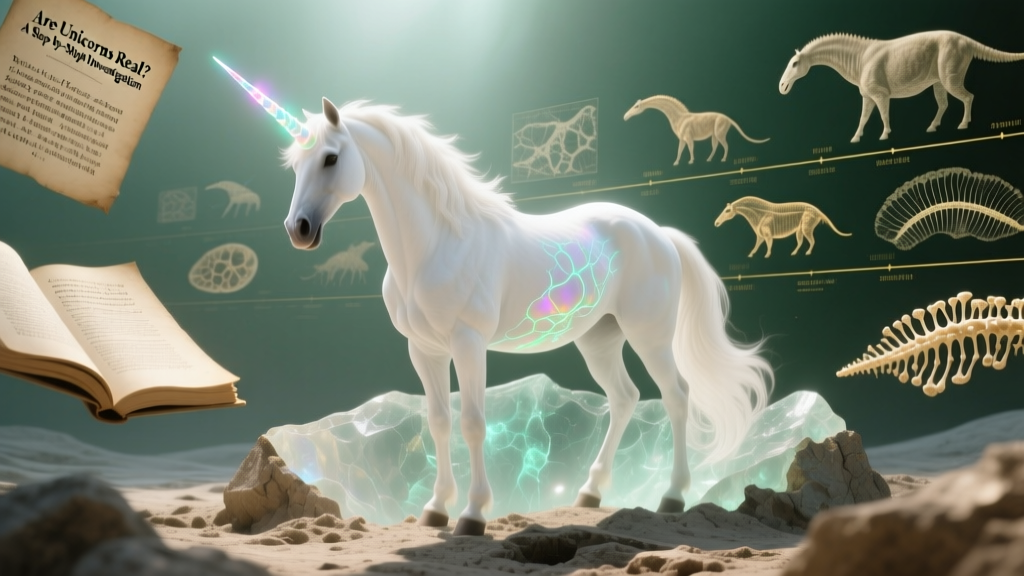
When enthusiasts and researchers ask, are unicorns real, the answer requires more than a simple yes or no. It demands a systematic investigation into paleontology, linguistics, and evolutionary biology. Rather than dismissing the creature as pure fantasy, we can apply a step-by-step analytical framework to trace the origins of the unicorn myth. By examining fossil records, ancient mistranslations, and biomechanical constraints, you can uncover the factual bedrock that inspired millennia of folklore. Here is your practical guide to investigating the historical and scientific reality behind the world's most famous mythical beast.
Step 1: Analyze Ancient Texts and Linguistic Mistranslations
The first step in any cryptozoological or mythological investigation is tracing the primary source material. The Western concept of the unicorn does not stem from a single sighting, but from a cascade of linguistic errors and exaggerated travelogues.
The Linguistic Debate: Are Unicorns Real in Ancient Texts?
In the 3rd century BCE, scholars translating the Hebrew Bible into Greek (the Septuagint) encountered the word re'em. Modern zoologists and biblical scholars identify the re'em as the aurochs (Bos primigenius), a massive, now-extinct wild ox with two distinct horns. However, the translators rendered re'em into the Greek word monokeros (meaning 'one-horned'). This translation was later carried into the Latin Vulgate as unicornis and eventually into the King James English Bible as 'unicorn.' This single linguistic pivot embedded the creature into Western religious and cultural consciousness.
Simultaneously, the Greek physician Ctesias of Cnidus wrote Indika around 400 BCE after traveling through Persia. He documented a 'wild ass' in India with a white body, red head, and a single multi-colored horn on its forehead. According to the Encyclopædia Britannica, Ctesias was likely describing the Indian rhinoceros, but his second-hand accounts from Persian locals morphed the animal into an equine-like creature in the minds of Greek readers.
Step 2: Examine the Fossil Record (The Elasmotherium Hypothesis)
To determine if a biological basis exists for the myth, investigators must look at the Pleistocene fossil record. The most compelling candidate for a 'real' unicorn is Elasmotherium sibiricum, commonly dubbed the Siberian unicorn.
This massive rhinocerotid roamed the Eurasian steppes and coexisted with early modern humans until approximately 39,000 years ago. According to research highlighted by the Smithsonian Magazine, Elasmotherium possessed a single, enormous horn protruding from its forehead. However, it did not resemble a white horse. It was a shaggy, heavily built herbivore weighing up to four tons. Oral traditions from early humans encountering these beasts, or discovering their massive fossilized skulls, likely contributed to the foundational myths of single-horned megafauna in Eastern Europe and Asia.
Comparative Analysis: Myth vs. Megafauna
| Trait | Mythological Unicorn | Elasmotherium sibiricum | Aurochs (Re'em) |
|---|---|---|---|
| Taxonomy | Equine (Horse-like) | Rhinocerotidae (Rhinoceros) | Bovidae (Wild Cattle) |
| Horn Composition | Spiraled bone/keratin | Solid keratin (no bone core) | Bone core with keratin sheath (x2) |
| Average Weight | 400 - 600 lbs (estimated) | 8,000 - 10,000 lbs | 1,500 - 3,300 lbs |
| Habitat | Enchanted forests (folklore) | Eurasian mammoth steppe | European and Asian woodlands/plains |
Step 3: Evaluate Biological and Biomechanical Constraints
If we attempt to map the mythological unicorn onto a modern equine frame, evolutionary biomechanics immediately present a barrier. Could a horse naturally evolve a single, central horn capable of combat?
Horns and ossicones in mammals serve specific evolutionary purposes, primarily intraspecific combat and defense. In bovids (like antelopes and cattle), horns consist of a bony core extending from the frontal bones, covered by a keratinous sheath. In rhinoceroses, the horn is entirely keratinized and rests on a heavily reinforced, thickened nasal bone structure.
An equine skull is fundamentally unsuited for a central combat horn. Horses possess elongated, fragile nasal bones designed to warm and humidify inhaled air during high-speed running. They lack the heavy sagittal and nuchal crests required to anchor the massive neck muscles necessary to counterbalance and wield a heavy, forward-facing weapon. If a horse were to ram an object with a central horn, the kinetic feedback would shatter its nasal bones and cervical vertebrae. Therefore, a biologically functional, combat-ready unicorn cannot exist within the anatomical constraints of the family Equidae.
Step 4: Trace the Physical Evidence (The Alicorn Trade)
Investigating physical artifacts is the next step in myth verification. During the Middle Ages and the Renaissance, European apothecaries and royalty possessed what they believed to be unicorn horns, known as 'alicorns.' These artifacts were tested for their purported ability to neutralize poisons, a highly sought-after trait among paranoid nobility.
The physical reality of the alicorn trade is rooted in marine biology, not terrestrial mythology. Viking and Norse traders hunted the narwhal (Monodon monoceros) in the Arctic. The male narwhal possesses a single, spiraled left canine tooth that can grow up to 10 feet long. Norse traders brought these tusks to European markets, selling them at astronomical markups. The Natural History Museum in London notes that Queen Elizabeth I received a carved narwhal tusk valued at £10,000—equivalent to the cost of an entire country estate. The physical presence of these spiraled 'horns' in European courts provided undeniable, albeit misidentified, proof to the public that unicorns were real.
Step 5: Synthesize the Cryptozoological Evidence
Completing this step-by-step investigation requires synthesizing the linguistic, paleontological, and historical data. When applying rigorous scientific frameworks to the lore, the mythological unicorn—a white, horse-like creature with a spiraled horn and magical healing properties—does not exist in the biological realm. The anatomical requirements for such an animal violate the biomechanical laws governing equine evolution.
However, the concept of the unicorn is deeply real, constructed from a mosaic of factual elements:
- Paleontological Memory: Human encounters with the single-horned Elasmotherium and fossil discoveries.
- Zoological Misidentification: Ctesias's accounts of the Indian rhinoceros and profile-view misinterpretations of the two-horned aurochs.
- Linguistic Errors: The Septuagint's mistranslation of the Hebrew re'em into the Greek monokeros.
- Economic Deception: The lucrative medieval trade of narwhal tusks disguised as alicorns.
By following this investigative methodology, researchers and enthusiasts can move beyond simple dismissal. Answering the question requires recognizing that myths are rarely pure inventions; they are distorted reflections of real biology, lost history, and human commerce.