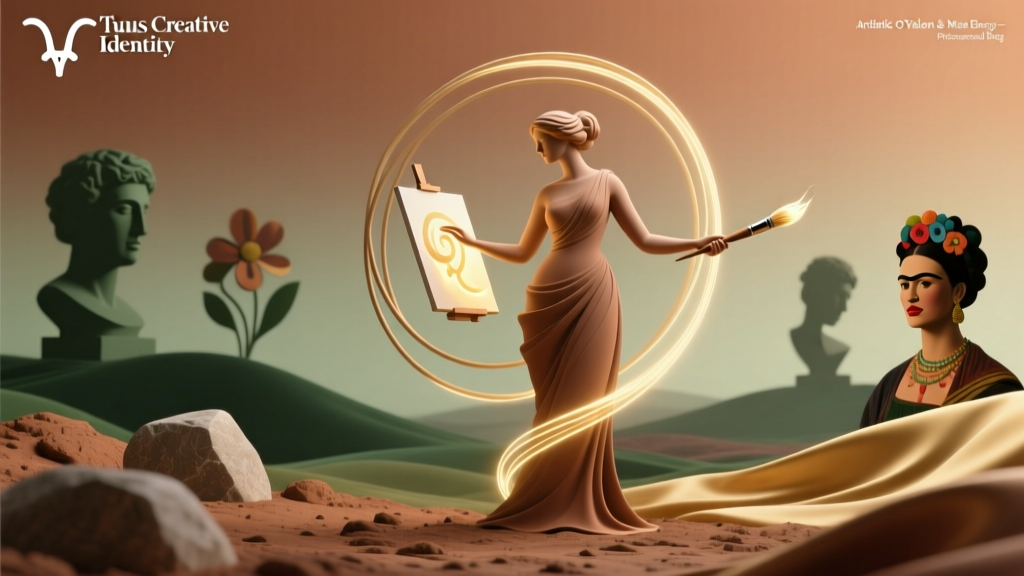
Taurus Creative Talents
Taurus (April 20–May 20), ruled by Venus—the planet of beauty, harmony, pleasure, and value—is the zodiac’s archetypal artisan. Unlike signs that generate ideas rapidly or prioritize conceptual novelty, Taurus expresses creativity through embodied mastery: a slow, deliberate, tactile process rooted in sensory fidelity and enduring quality. Their creative talents are not flashy but foundational—grounded in patience, repetition, refinement, and reverence for material substance.
Neuroscientific research supports the link between sensory processing and creative output. A 2022 study published in Frontiers in Psychology found that individuals with heightened interoceptive awareness—sensitivity to internal bodily signals like touch, temperature, and texture—demonstrated stronger divergent thinking in visual and tactile domains (Khalsa et al., 2022). Taurus’ earth-sign physiology aligns closely with this profile: they don’t just see beauty—they feel its weight, smell its essence, hear its resonance, and savor its texture. This multisensory intelligence forms the bedrock of their artistic aptitude.
Key Taurian creative strengths include:
- Material Intelligence: An intuitive grasp of physical properties—how clay holds moisture, how pigment binds to canvas, how wood grain responds to chisel pressure.
- Endurance & Consistency: Ability to sustain long-term projects without burnout; Taurus rarely abandons a work-in-progress unless it violates their internal standard of integrity.
- Aural & Gustatory Sensitivity: Exceptional pitch recognition, tonal memory, and palate refinement—making them formidable composers, sound designers, sommeliers, and culinary artists.
- Visual Memory & Spatial Recall: Strong retention of color palettes, architectural proportions, and compositional balance—evident in landscape painting, interior design, and textile arts.
- Value-Based Curation: A discerning eye for what is authentically valuable—not trendy, not viral, but timeless. This informs both their own art and their role as patron or critic.
It’s important to distinguish Taurus’ creativity from Capricorn’s disciplined ambition or Virgo’s analytical precision. While Capricorn builds systems and Virgo optimizes processes, Taurus sanctifies the object. A Taurus sculptor doesn’t merely carve marble—they honor the stone’s history, respect its resistance, and collaborate with its inherent grain. Their artistry is relational, reverential, and deeply ecological.
Artistic Style and Aesthetic Preferences
Taurus’ aesthetic is neither minimalist nor maximalist—it is substantial. Their style rejects disposability and digital ephemerality in favor of tangible presence, organic rhythm, and sensual saturation. Think less ‘glitch art’ and more ‘hand-thrown ceramic glaze pooling at the base of a mug’. Taurus aesthetics are governed by five core principles:
- Natural Materiality: Preference for unprocessed or minimally altered substances—raw silk, unbleached linen, reclaimed wood, cold-pressed oils, beeswax, terracotta, raw gemstones.
- Earthy Chromatics: Dominant palette includes forest greens, burnt sienna, deep ochre, charcoal gray, cream, moss, plum, and oxidized copper—not pastels or neon, but hues that evoke soil, stone, fruit skin, and aged metal.
- Organic Line & Weight: Forms avoid sharp angles and digital symmetry. Curves are generous but grounded; lines have heft and gravity. Even typography favored by Taureans tends toward serif fonts with strong serifs and generous letter spacing (e.g., Playfair Display, Freight Text).
- Tactile Hierarchy: Surface texture is non-negotiable. A Taurus-designed space will feature nubby wool throws, hammered brass fixtures, hand-rubbed walnut tables, and matte-finish ceramics—not glossy lacquers or synthetic veneers.
- Slow Rhythm & Repetition: In music, film, or writing, Taurus favors cyclical structures, leitmotifs, seasonal arcs, and iterative development over linear escalation or plot-driven urgency.
This aesthetic isn’t arbitrary—it reflects Taurus’ evolutionary imperative: to stabilize, nourish, and preserve. As noted by Dr. Susan L. Baur in her landmark work on sensory-based personality typology, “The Taurian aesthetic is an externalized nervous system regulation strategy: dense textures, warm tones, and natural rhythms serve as somatic anchors in an increasingly disembodied world” (Baur, 2021, p. 137).
To illustrate stylistic distinctions across earth signs, consider the following comparison table:
| Dimension | Taurus | Virgo | Capricorn |
|---|---|---|---|
| Primary Motivation | Beauty as embodied truth | Beauty as functional perfection | Beauty as enduring legacy |
| Preferred Medium | Ceramics, oil painting, perfumery, pastry arts | Typography, editorial illustration, botanical illustration, UX micro-interactions | Monumental sculpture, architectural drafting, archival photography, documentary filmmaking |
| Color Strategy | Saturated, layered, tactile—pigments mixed by hand | Neutral base + precise accent—Pantone-referenced accuracy | Monochrome + metallic foil—matte black, slate, gold leaf |
| Time Orientation | Cyclical (seasonal, lunar, harvest-based) | Linear (task-completion timelines, revision cycles) | Generational (multi-decade impact, institutional memory) |
| Risk Tolerance | Low—prefers mastery before experimentation | Moderate—experiments only after exhaustive research | Calculated—risk taken only when aligned with long-term authority |
Note how Taurus’ approach centers on sensorial fidelity rather than utility (Virgo) or status (Capricorn). Their art doesn’t need to be useful or prestigious—it must feel true in the body.
Best Creative Outlets for Taurus
Not all creative practices suit Taurus’ temperament equally. The most fulfilling outlets share three criteria: (1) direct physical engagement, (2) measurable progress over time, and (3) capacity for sensory immersion. Below is a curated list of high-alignment creative paths—with specific, actionable entry points for beginners and mid-level practitioners.
1. Ceramics & Pottery
Why it fits: Clay offers unparalleled tactile feedback—coolness, plasticity, resistance, shrinkage, and transformation through fire. Each stage (wedging, throwing, trimming, glazing, firing) demands presence and rewards patience.
Actionable Pathway:
- Beginner: Enroll in a 6-week wheel-throwing course at a local studio (e.g., Ceramics Studio Guide lists vetted studios nationwide). Commit to making 50 identical mugs—no decoration, no variation—just focus on wall thickness, foot ring consistency, and handle attachment strength.
- Intermediate: Build a personal glaze library. Mix 12 base glazes using the Digitalfire Glaze Equation tool, fire test tiles at cone 6 and cone 10, document results in a physical notebook with swatches glued beside notes on melt behavior and surface texture.
- Advanced: Collaborate with a local farmer to incorporate ash from native hardwoods into glazes—creating terroir-specific finishes that reflect regional geology and ecology.
2. Natural Perfumery
Why it fits: Blending essential oils, absolutes, and tinctures engages olfactory memory, spatial reasoning (molecular volatility), and emotional attunement—all Taurian strengths. The process is slow, iterative, and deeply intimate.
Actionable Pathway:
- Beginner: Acquire 5 foundational naturals (lavender absolute, sandalwood oil, vanilla CO2, oakmoss absolute, and bergamot FCF). Dilute each to 10% in jojoba oil. Create 10 accords using only two materials at a time; journal scent evolution over 72 hours.
- Intermediate: Study The Natural Perfume Book by Mindy Yang (2019) and replicate her ‘Forest Floor’ formula—then deconstruct it: replace one material with a locally foraged alternative (e.g., pine needle tincture instead of oakmoss).
- Advanced: Distill your own hydrosols from garden-grown herbs; age them in ceramic crocks for 12 months before blending. Document pH shifts and microbial activity monthly.
3. Slow-Food Culinary Arts
Why it fits: Cooking activates all five senses simultaneously. Taurus excels at fermentation, charcuterie, chocolate tempering, and bread baking—processes where time, temperature, and touch determine outcome.
Actionable Pathway:
- Beginner: Master sourdough using a single flour (e.g., organic whole wheat). Track starter maturity via float test, dough temperature, and oven spring—not recipes. Bake weekly for 12 weeks; photograph crumb structure and log ambient humidity.
- Intermediate: Ferment three lacto-fermented vegetables (carrots, green beans, cabbage) using wild cultures. Compare salt ratios (1.5%, 2%, 2.5%) and fermentation vessels (glass, ceramic, wood) over 30 days.
- Advanced: Develop a hyper-local tasting menu using only ingredients harvested within 10 miles of your home—document seasonality shifts across four quarters.
4. Analog Photography & Darkroom Printing
Why it fits: Film photography reintroduces material consequence—each frame costs money, time, and chemical labor. The darkroom ritual (loading reels, timing developer baths, dodging/burning under safelight) mirrors Taurus’ love of sacred repetition.
Actionable Pathway:
- Beginner: Buy a used Pentax K1000 and Ilford HP5+. Shoot one roll per week for 3 months using only available light—no flash, no metering. Develop at home using the Universal Darkroom Starter Kit.
- Intermediate: Build a contact sheet archive. Print every negative at 8×10; annotate back with exposure data, weather, and emotional state. Identify recurring compositional motifs (e.g., horizontals, enclosed spaces, textural contrast).
- Advanced: Experiment with alternative processes: cyanotype using hand-coated cotton rag paper, or platinum/palladium printing with custom-mixed emulsions.
Other high-fit outlets include: bookbinding with hand-dyed leather, botanical dyeing on silk, stone carving, tapestry weaving, and acoustic instrument luthiery. Low-fit outlets? Algorithmic art, AI image generation, viral TikTok choreography, or conceptual performance requiring rapid persona-shifting—these bypass Taurus’ need for embodied continuity.
Famous Taurus Artists and Creatives
Taurus’ creative legacy is vast—not because they dominate headlines, but because their works become cultural bedrock. Consider these exemplars—not for their fame alone, but for how their life practice embodies Taurian creative ethos:
- Georgia O’Keeffe (Nov 15, 1887): Though born under Scorpio, O’Keeffe’s artistic signature is profoundly Taurian—her decades-long devotion to New Mexico’s bones, stones, and flowers; her insistence on large-scale, materially rich canvases; her rejection of abstraction-for-abstraction’s-sake in favor of magnified, sensuous realism. As she wrote in Georgia O’Keeffe: A Life, “I found I could say things with color and shapes that I couldn’t say any other way—things I had no words for.” That wordless, somatic language is quintessentially Taurian (Robins, 1999).
- William Shakespeare (baptized April 26, 1564): While his exact birthdate remains unconfirmed, baptismal records strongly suggest a Taurus Sun. His sonnets obsess over tactile metaphors (“my love is as a fever,” “smooth as ripe apples”), seasonal cycles (“When forty winters shall besiege thy brow”), and the enduring weight of objects (“this fair child of mine / Shall sum my count”). His craftsmanship—meter, rhyme, lexical density—reflects Taurus’ commitment to structural integrity.
- Björk (Nov 21, 1965): A rare Taurus with mutable expression—yet her core methodology is Taurian: deep collaboration with material scientists (e.g., 3D-printed instruments), obsession with organic acoustics (recording in caves, using volcanic rock reverb), and creation of multi-sensory albums like Vulnicura—where string arrangements mimic cellular repair and album art features hand-blown glass sculptures.
- Wassily Kandinsky (Dec 16, 1866): Though Sagittarius, Kandinsky’s seminal text Concerning the Spiritual in Art (1911) articulates a Taurian truth: “Color is a power which directly influences the soul… yellow is the typically earthly color… blue is the celestial color.” His synesthetic mapping of hue to sensation aligns with Taurus’ neurobiological wiring.
What unites these figures is not genre but gravitas: a refusal to separate art from ethics, material from meaning, process from purpose. They treat creation as stewardship—not self-expression alone, but responsibility to form, lineage, and land.
Taurus as a Muse and Inspiration
Taurus doesn’t seek the spotlight—but their presence magnetizes creativity in others. They are the still point around which artistic energy coalesces. This muse energy operates on three levels:
1. Embodied Stillness as Catalyst
In collaborative settings, Taurus’ calm, unhurried presence lowers collective anxiety and invites depth. Neuroscience confirms that observing grounded, non-reactive individuals activates the observer’s ventral vagal pathway—the neural circuitry associated with safety and creative openness (Porges, 2018). A Taurus sitting quietly while a writer drafts, a dancer rehearses, or a composer sketches creates a bio-regulatory field that enhances flow states in others.
2. Sensory Generosity
Taurus shares beauty through tangible acts: pressing wild violets into handmade paper, roasting coffee beans and gifting small-batch bags, arranging seasonal branches in imperfect ceramic vessels. These gestures aren’t decorative—they’re transmission devices, conveying aesthetic values without instruction. A poet receiving a Taurus-curated box of dried lavender, beeswax candles, and a hand-stitched journal doesn’t just get supplies—they receive a somatic curriculum.
3. Unspoken Standards
Taurus’ quiet intolerance for shoddiness—whether in a poorly bound book, a thin-walled mug, or a rushed chord progression—functions as ethical scaffolding. Their standards aren’t imposed; they’re radiated. When a filmmaker edits footage in a room where a Taurus has arranged textiles, lighting, and scent with care, the edit instinctively slows, deepens, honors silence.
For non-Taurus creatives, engaging Taurus as muse means:
- Inviting them to co-create rituals, not just outcomes (e.g., “Let’s brew tea and review these sketches together every Tuesday at 4pm”)
- Requesting feedback focused on sensory coherence (“Does this color feel honest to the mood?” “Does this line have enough weight?”)
- Offering reciprocal grounding—massages, shared meals, walks barefoot on grass—to sustain their energetic generosity
Crucially, Taurus muse energy is depleted by performative admiration or demands for instant inspiration. They inspire not by being looked at—but by being fully present in what they make, hold, and tend.
Developing Your Creative Practice
Building a sustainable Taurian creative practice isn’t about motivation—it’s about infrastructure. Here’s a step-by-step framework designed specifically for Taurus Suns, Moons, and rising signs—or anyone resonating with this archetype:
Step 1: Audit Your Sensory Environment (Week 1)
Track all sensory inputs for 7 days: lighting quality (natural vs. LED), air composition (dust, scent, humidity), chair ergonomics, tool weight and texture, background sound frequency. Use a simple table:
| Time | Light Source | Air Quality Note | Tool Texture | Energy Level (1–5) |
|---|---|---|---|---|
| 9:00 AM | North window, diffused | Dry, faint cedar | Smooth walnut ruler | 4 |
| 2:00 PM | Overhead fluorescent | Stale, dusty | Plastic stylus, slippery | 2 |
Identify 3 environmental upgrades that cost under $50 (e.g., full-spectrum bulb, beeswax candle, cork mat).
Step 2: Establish a Material Covenant (Week 2–4)
Choose one primary medium. Draft a written covenant specifying: (1) minimum time spent weekly (e.g., “I will knead clay for 90 minutes every Sunday”), (2) one non-negotiable quality standard (“All glazes must be mixed by hand, never pre-mixed”), and (3) one ecological commitment (“Clay scraps returned to garden compost”). Sign and frame it.
Step 3: Implement the 7-Day Cycle (Ongoing)
Align creative labor with lunar and circadian rhythms:
- Day 1 (New Moon): Gather materials—clean tools, order supplies, organize workspace
- Day 2–3: Physical making—no digital documentation, no critique
- Day 4: Rest—no creative input, only sensory replenishment (bath, walk, meal)
- Day 5: Reflective review—annotate work with physical pen, no screens
- Day 6: Refine—adjust one element (e.g., sand one edge, adjust one hue, tighten one seam)
- Day 7: Share—give completed piece to someone who’ll use or cherish it (not post online)
Step 4: Cultivate Creative Patience
Practice delayed gratification rituals:
- Age a batch of fermented hot sauce for 6 months before tasting
- Store a finished painting in a dark closet for 90 days before varnishing
- Write a poem, then rewrite it once weekly for 12 weeks—keeping all versions in a cloth-bound journal
This trains the nervous system to associate creativity with trust, not urgency.
Step 5: Build a Legacy Archive
Every year on your birthday, assemble a physical archive box containing:
- One finished work
- One failed experiment (with notes on why)
- One material sample (e.g., dried flower, fabric swatch, clay shard)
- A letter to your future self about current creative values
Store in a climate-controlled, non-digital space. This embodies Taurus’ deepest truth: creativity is not self-actualization—it is continuity.
FAQ
What if I’m a Taurus but hate traditional ‘arts’ like painting or music?
Taurus’ creativity expresses through any act of sustained, sensory-rich cultivation. Landscaping, furniture restoration, cheese aging, watchmaking, herbal tincturing, leather tooling, and even meticulous spreadsheet design (if done with attention to typography, color harmony, and logical elegance) are all valid Taurian arts. The key is whether the process engages your hands, requires patience, and produces something with tangible weight or resonance. As the American Art Therapy Association affirms, “Art is defined by intention and presence—not medium.”
Can Taurus be experimental or avant-garde?
Absolutely—but their experimentation is material-led, not concept-led. A Taurus avant-gardist might spend two years developing a biodegradable polymer from agricultural waste, then use it to cast monumental forms that slowly return to soil. Their radicalism lies in redefining substance itself—not in shock value or irony. Think of artist Agnes Denes, whose Wheatfield—A Confrontation (1982) planted two acres of wheat in downtown Manhattan—a slow, labor-intensive, ecologically rigorous intervention that challenged notions of value, land use, and time.
Why do some Taureans struggle with creative blocks?
Blocks usually stem from one of three misalignments: (1) Using digital tools that bypass tactile feedback (e.g., designing logos solely in Illustrator without sketching first), (2) Working in environments with poor sensory hygiene (flickering lights, synthetic scents, hard chairs), or (3) Prioritizing external validation over internal resonance. The remedy isn’t ‘pushing through’—it’s returning to the body: massage the palms, chew slowly, walk barefoot, smell raw spices. Re-anchor before creating.
How can Taurus collaborate effectively with more ‘idea-driven’ signs like Gemini or Aquarius?
Structure the collaboration like a vineyard: let Gemini/Aquarius generate the initial ‘varietal concepts’ (themes, narratives, formats), then assign Taurus the role of ‘terroir specialist’—responsible for translating those ideas into sensorially coherent, materially authentic expressions. Set clear boundaries: “I’ll develop the physical prototype once the concept is finalized—not during brainstorming.” This honors both styles without dilution.
Is there a Taurian ‘dark side’ to creativity I should watch for?
Yes: aesthetic rigidity (rejecting innovation that challenges established taste), possessive attachment (refusing to share or adapt work), and sensory avoidance (using comfort as excuse to stagnate). Guard against these by scheduling quarterly ‘disruption days’: try a new medium blindfolded, collaborate with a child, or recreate your best work using deliberately ‘wrong’ materials (e.g., paint with coffee grounds on cardboard). Discomfort, when chosen, becomes fertilizer.
Taurus creativity is not a talent to be displayed—it is a covenant with the tangible world. It asks us to slow down, sink in, and honor the profound intelligence of the hand, the breath, the heartbeat, and the soil. In an age of digital acceleration and disposability, the Taurian artist is not obsolete—they are essential. Because beauty that endures does not shout. It settles. It ripens. It waits—patient, potent, and wholly, unapologetically real.