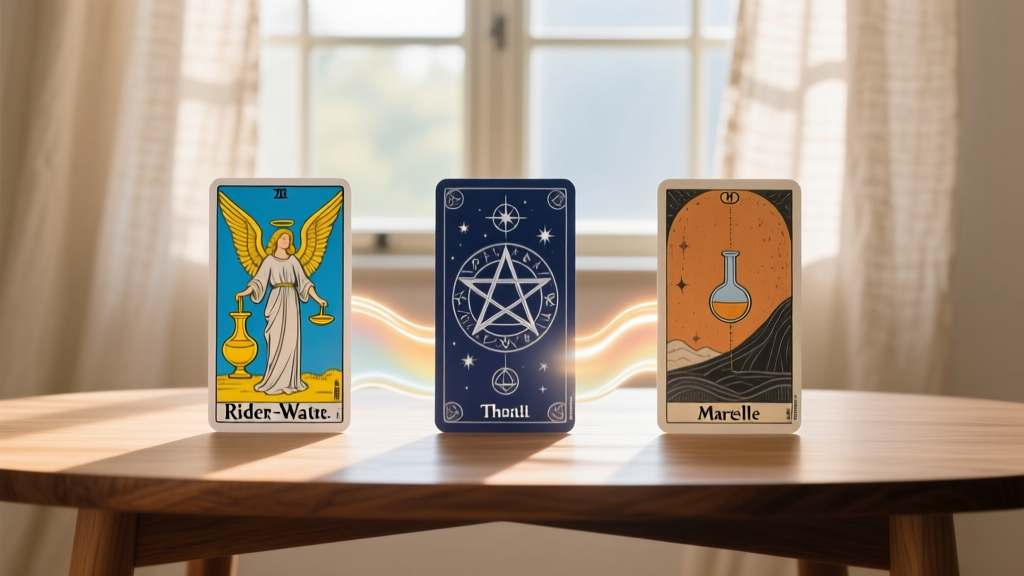
The temperance tarot card (Major Arcana XIV) represents the alchemical synthesis of opposing forces. Unlike cards that signify abrupt change or passive surrender, Temperance demands active, conscious blending. For advanced practitioners, understanding this card requires moving beyond basic keywords like moderation. By analyzing the temperance tarot against structurally similar Major Arcana alternatives and examining its visual evolution across the Rider-Waite, Thoth, and Marseille traditions, readers can unlock nuanced layers of meaning. This comparative framework provides exact interpretive metrics for navigating complex spreads where energetic equilibrium is the primary focus. Mastering these distinctions elevates your tarot practice from simple fortune-telling to precise psychological and spiritual diagnosis.
Analyzing the Temperance Tarot Against Major Arcana Alternatives
When constructing a spread, readers often confuse the energetic signature of Temperance with adjacent Major Arcana cards. While resources like Biddy Tarot note its general association with healing and patience, advanced reading requires distinguishing exactly how that healing occurs. Temperance is not merely about waiting; it is about the deliberate manipulation of elemental extremes.
Temperance vs. The Star: Active Synthesis vs. Passive Reception
The Star (XVII) provides passive, divine inspiration and spiritual renewal, typically following the destructive upheaval of The Tower. It is an open channel receiving cosmic grace. Temperance (XIV), conversely, requires active participation. It is the conscious mixing of fire and water. If a querent needs to simply trust the universe and heal, The Star is the operative archetype. If the querent must actively negotiate between two conflicting life areas (e.g., career ambition vs. family needs), Temperance is the required alternative.
Temperance vs. The Hanged Man: Dynamic Flow vs. Conscious Suspension
The Hanged Man (XII) achieves perspective through suspension, surrender, and the cessation of forward momentum. It is a necessary pause. Temperance achieves equilibrium through continuous, dynamic flow. The figure in Temperance is actively pouring water between cups, maintaining a kinetic loop. Use The Hanged Man when advising a client to stop forcing an outcome; use Temperance when advising them to find the middle path between two active extremes.
Temperance vs. Justice: Energetic Alchemy vs. Karmic Calibration
Justice (XI or VIII, depending on the tradition) balances karmic scales through objective, intellectual assessment and cause-and-effect. It is the sword of truth. Temperance balances energetic polarities through intuitive, alchemical blending. Justice asks, 'What is fair and legally right?' Temperance asks, 'What creates the most harmonious synthesis?' As noted in the esoteric archives of Labyrinthos, Temperance is governed by Sagittarius (mutable fire), giving it an expansive, philosophical adaptability that the rigid air energy of Justice lacks.
| Card | Core Mechanism | Elemental & Astrological Focus | Shadow Aspect |
|---|---|---|---|
| Temperance (XIV) | Active Synthesis & Blending | Fire & Water / Sagittarius | Dilution of purpose; compromise |
| The Star (XVII) | Passive Reception & Hope | Air & Water / Aquarius | Delusion; disconnected idealism |
| Hanged Man (XII) | Conscious Suspension | Water / Neptune | Stagnation; martyrdom |
| Justice (XI/VIII) | Karmic Calibration | Air / Libra | Rigidity; lack of empathy |
Visual and Interpretive Alternatives Across Deck Traditions
The meaning of the temperance tarot card shifts dramatically depending on the visual lexicon of the deck being used. Understanding these alternatives allows a reader to select the specific deck that best matches the querent's psychological framework.
Rider-Waite-Smith (RWS): The Angelic Path
In the RWS tradition, the card features the Archangel Michael (or sometimes Iris, goddess of the rainbow). The angel stands with one foot on land (representing the conscious, material realm) and one foot in water (representing the subconscious, emotional realm). The path in the background leads toward a golden crown, symbolizing spiritual mastery achieved through daily, grounded practice. This deck frames Temperance as a divine virtue, emphasizing protection, guidance, and the gradual ascent toward enlightenment.
Crowley’s Thoth Deck: The Alchemical Art
Aleister Crowley renamed this card 'Art' (XIV) to explicitly reflect the alchemical Great Work. The Thoth deck replaces the serene angel with a composite, androgynous figure—part lion, part eagle, part human—representing the alchemical marriage of opposing beasts and the unification of the elements. The figure stands before a cauldron emitting both fire and water, visually manifesting the Hermetic axiom Solve et Coagula (dissolve and coagulate). For clients dealing with deep psychological shadow-work or radical personal transformation, the Thoth 'Art' card provides a much more potent, visceral alternative to the gentle RWS angel.
Tarot de Marseille: The Earthly Virtue
In the historical Tarot de Marseille, the card is labeled Tempérance. Early woodcuts depict a winged figure (though wings are sometimes omitted in later prints) pouring liquid between two jugs. The Marseille tradition strips away much of the complex Hermetic occultism added by the Golden Dawn, focusing instead on the practical, earthly virtue of moderation, physical health, and the balancing of humors. It is an excellent alternative deck for querents seeking pragmatic, grounded advice regarding physical well-being, diet, or daily routine management, rather than high spiritual alchemy.
Upright and Reversed Mechanics: Diagnosing Imbalance
Reading the temperance tarot in reverse is frequently misunderstood as a simple warning against excess. A more precise, expert-level interpretation views the reversal as a diagnosis of where the alchemical process has failed.
- The Over-Pour (Excess): The reversed card can indicate that the querent is pouring too much energy into one cup. This manifests as over-compromise, people-pleasing, or diluting one's core boundaries in an attempt to keep the peace. The alchemical mixture has become toxic through over-hydration.
- The Blocked Flow (Stagnation): Alternatively, the reversal signifies a refusal to blend opposing forces. The querent may be holding rigidly to black-and-white thinking, refusing to integrate the shadow self, or experiencing a creative block where ideas cannot transition from the subconscious (water) to the conscious mind (fire).
- Corrective Action: When Temperance appears reversed, the actionable advice is to audit the querent's energy expenditures. Identify which 'cup' is draining their resources and physically restrict the flow until equilibrium is forcibly restored.
Practical Decision Framework for Readers
To integrate these comparisons into your practice, apply this decision matrix when the temperance tarot appears in a multi-card spread:
- Assess the Elemental Environment: If surrounded by heavy Cups (Water) or Wands (Fire), Temperance acts as the crucial regulator. It is the thermostat of the spread. Note exactly which element it is being asked to temper.
- Identify the Hebrew Resonance: Temperance is associated with the Hebrew letter Samekh, which translates to 'support' or 'prop.' Ask the querent: 'What underlying structure is currently supporting your ability to maintain balance? Is that foundation secure?'
- Select the Deck Intentionally: If the reading concerns legal disputes or strict ethical boundaries, pivot to Justice. If the reading concerns burnout and the need for rest, pivot to The Hanged Man. Reserve Temperance specifically for scenarios requiring the active, ongoing negotiation of two competing but equally valid priorities.
By treating the temperance tarot not as a static symbol of peace, but as a dynamic engine of alchemical synthesis, you equip your clients with the precise energetic mechanics required to navigate life's most complex contradictions.