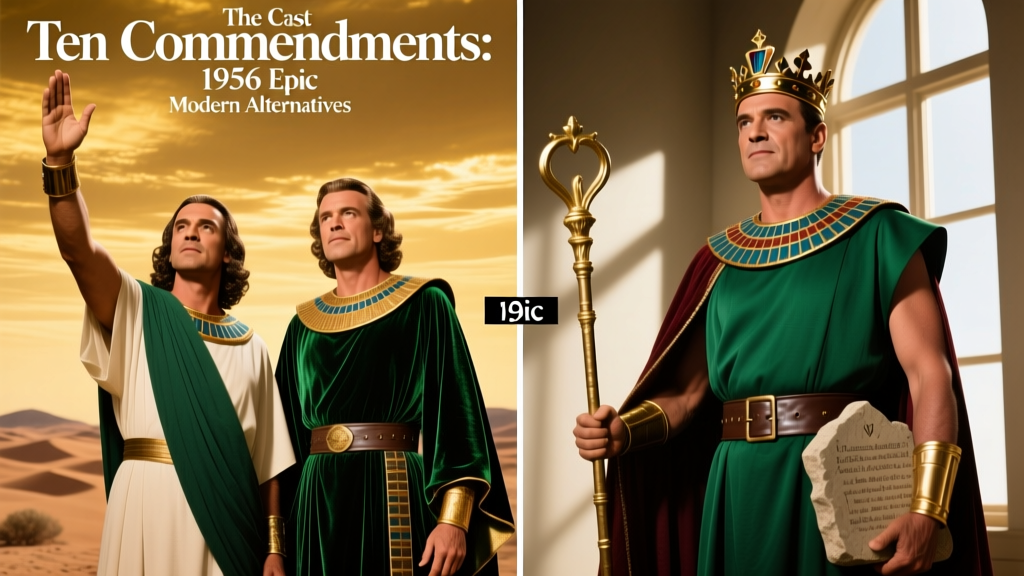
Cecil B. DeMille’s 1956 biblical epic remains a cornerstone of cinematic theology. When analyzing the ten commandments cast, we are not merely looking at a list of actors; we are examining how mid-century Hollywood codified the archetypal battle between divine submission and egoic tyranny. This analysis compares the foundational 1956 ensemble against modern cinematic alternatives, evaluating how different actors interpret the spiritual and psychological weight of Moses, Rameses, and the Israelites. By applying personality frameworks and mythological analysis, we can understand why certain casting choices resonate deeply with spiritual seekers while others fall flat.
The Archetypal Foundation: The Ten Commandments Cast of 1956
The 1956 production operated on a mythic scale, requiring actors who could embody Jungian archetypes rather than mere historical figures. Director Cecil B. DeMille, whose background in theater and early silent epics shaped his grandiose visual style, selected his ensemble based on physical stature, vocal timbre, and the ability to project absolute moral or tyrannical certainty. According to the American Film Institute Catalog, DeMille’s casting process was meticulous, prioritizing actors who could anchor the film's heavy theological themes without buckling under the spectacle.
Charlton Heston as Moses: The Enneagram 1 Reformer
Charlton Heston’s portrayal of Moses is the definitive Enneagram Type 1 (The Reformer) with a strong 9 wing. Heston plays Moses not as a man plagued by modern psychological doubts, but as a monolithic vessel for divine will. His physical rigidity and booming baritone voice communicate the heavy burden of moral absolutism. From a personality psychology perspective, Heston’s Moses represents the integration of the 'Senex' (wise old man) archetype. He does not seek liberation for personal glory; he is compelled by an external, objective moral imperative that overrides his ego.
Yul Brynner as Rameses: The Enneagram 8 Challenger
Yul Brynner’s Rameses II is a masterclass in portraying the unhealthy Enneagram Type 8 (The Challenger) intertwined with the ENTJ personality profile. Brynner relies on physical stillness and a piercing, unblinking gaze to project an ego incapable of yielding to a higher power. His Rameses is driven by a core fear of being controlled or harmed, leading him to consolidate power through sheer intimidation. Brynner’s performance is essential to the film's spiritual thesis: the divine cannot be negotiated with by the ego. Where Heston’s Moses looks upward toward revelation, Brynner’s Rameses stares rigidly forward, blinded by his own imperial legacy.
Anne Baxter as Nefretiri: The Shadow of Attachment
Anne Baxter’s Nefretiri introduces the archetype of the Enneagram Type 3 (The Achiever) descending into an unhealthy Type 4 (The Individualist) when her desire for Moses is thwarted. She represents the spiritual danger of attachment and the corrupting influence of courtly politics. Baxter’s performance bridges the gap between the divine narrative and human pettiness, illustrating how personal vendettas can alter the course of mythological history.
The Gritty Alternative: Exodus: Gods and Kings (2014)
Ridley Scott’s 2014 adaptation, Exodus: Gods and Kings, deliberately deconstructed the mythic scale of the 1956 film in favor of psychological realism and political grit. As noted by critics on Rotten Tomatoes, the film attempted to ground the biblical narrative in historical warfare, fundamentally altering the archetypal weight of the cast.
Christian Bale and Joel Edgerton: A Psychological Shift
Christian Bale reimagines Moses as an ISTP and Enneagram Type 8 guerrilla fighter. Bale’s Moses is driven by tactical pragmatism and trauma rather than divine submission. The burning bush sequence is framed ambiguously, suggesting psychological fracture or a localized hallucination rather than a clear theological mandate. This shifts the spiritual resonance from 'divine obedience' to 'human rebellion.' Conversely, Joel Edgerton’s Rameses is portrayed as an insecure ESTJ, driven by paternal inadequacy and the need to prove himself to his predecessors. By humanizing the villain, Scott dilutes the Jungian Shadow archetype, replacing mythic hubris with relatable, yet spiritually hollow, insecurity.
The Emotional Alternative: The Prince of Egypt (1998)
DreamWorks’ animated masterpiece offers a radically different interpretation of the Exodus mythos, prioritizing fraternal grief over theological warfare. Val Kilmer voices Moses as an INFP and Enneagram Type 9 (The Peacemaker) who is violently thrust into a Type 1 role. Kilmer’s vocal performance is soft, hesitant, and deeply empathetic, emphasizing Moses’s reluctance and the emotional toll of his divine assignment.
Ralph Fiennes voices Rameses as a tragic ENTJ burdened by the crushing weight of his father’s expectations. Fiennes captures the desperation of a man who loves his brother but is trapped by the institutional momentum of the Egyptian empire. This adaptation succeeds spiritually because it frames the central conflict not as good versus evil, but as the tragic divergence of two souls bound by love but separated by destiny.
Comparative Data: Archetypal Portrayals of the Exodus Mythos
To understand how these different casting choices impact the spiritual and psychological narrative, we must analyze the specific frameworks applied to the central characters.
| Adaptation | Moses Archetype | Rameses Archetype | Spiritual Focus | Psychological Framework |
|---|---|---|---|---|
| The Ten Commandments (1956) | Enneagram 1 / Senex (Heston) | Enneagram 8 / Shadow (Brynner) | Divine submission vs. Egoic tyranny | Jungian Mythic Absolutism |
| Exodus: Gods and Kings (2014) | Enneagram 8 / Warrior (Bale) | ESTJ / Insecure Heir (Edgerton) | Political rebellion and trauma | Modern Psychological Realism |
| The Prince of Egypt (1998) | INFP / Peacemaker (Kilmer) | ENTJ / Tragic Brother (Fiennes) | Fraternal love vs. Institutional duty | Emotional and Relational Grief |
| The Ten Commandments (2006 Miniseries) | Enneagram 9 / Reluctant Leader (Dougray Scott) | Enneagram 3 / Image-Conscious (Linus Roache) | Personal faith journey | Television Character Study |
Vocal and Physical Semiotics in Spiritual Casting
When evaluating biblical or mythological casts, spiritual seekers and personality analysts must look beyond the script to the semiotics of the actors' physical and vocal choices. DeMille’s 1956 cast relied on 'mythic resonance.' Heston’s deep, resonant chest voice was engineered to sound like the voice of God itself, a technique explored in depth by Britannica’s biographical analysis of DeMille, which highlights the director's obsession with auditory and visual grandeur.
In contrast, modern alternatives rely on 'micro-expressions' and vocal fragmentation. Bale’s gravelly whispers and Fiennes’s voice cracks communicate internal dissonance. For viewers seeking spiritual instruction, the 1956 cast provides a clear, unambiguous moral compass. For viewers seeking psychological validation, the modern casts offer a mirror to their own internal doubts and spiritual fatigue.
Actionable Framework for Analyzing Mythological Casting
To critically evaluate any spiritual or mythological film adaptation, apply this three-step analytical framework to the cast:
- Step 1: Identify the Enneagram Core Fear. Determine what the actor portrays as the character's primary driver. Is Rameses afraid of losing control (Type 8), or is he afraid of being worthless without his crown (Type 3)? The core fear dictates the spiritual lesson of the narrative.
- Step 2: Map the Shadow Integration. Observe how the actor portrays the character's confrontation with their Jungian Shadow. Does Moses integrate his shadow (his Egyptian upbringing and capacity for violence) to serve the divine, or does he repress it? True spiritual cinema requires the protagonist to acknowledge and integrate their shadow self.
- Step 3: Evaluate the Mythic vs. Human Scale. Ask whether the actor is playing a 'concept' or a 'person.' Neither is inherently superior, but they serve different spiritual needs. If you are seeking archetypal guidance for your own life's purpose, the mythic scale of the 1956 cast is superior. If you are processing grief or relational trauma, the humanized scale of the 1998 animated cast provides greater therapeutic value.
Why the 1956 Cast Remains the Spiritual Benchmark
Despite advances in cinematic technology and a modern preference for morally ambiguous protagonists, the original ensemble remains the benchmark for spiritual cinema. The actors were not tasked with making the audience 'like' them; they were tasked with making the audience feel the overwhelming weight of the divine. Heston, Brynner, and Baxter understood that they were participating in a modern ritual, translating ancient theological concepts into visual and auditory archetypes. For students of spirituality, mythology, and personality psychology, studying this specific cast offers a masterclass in how human vessels can embody the eternal struggle between the ego's demand for control and the soul's requirement for surrender.