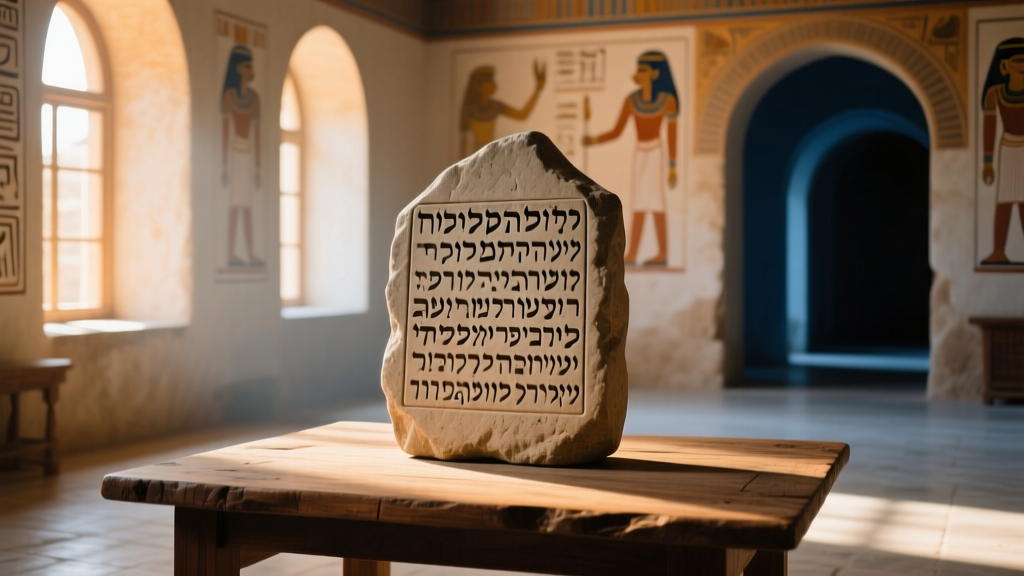
When studying the foundations of Western moral philosophy and ancient Near Eastern theology, researchers inevitably ask: what are the 10 commandments? Far from being a simple list of arbitrary rules, the Decalogue represents a sophisticated legal and spiritual covenant. Originating in the Late Bronze Age or Early Iron Age, these statutes formed the constitutional bedrock of ancient Israelite society. Understanding their origin story requires moving beyond modern religious instruction to examine the geopolitical, literary, and archaeological realities of the ancient Levant.
Etymology and the 'Ten Words'
The English phrase 'Ten Commandments' is a translation of the Latin Decem Mandata, but the original Hebrew text uses the term Aseret ha-Dibrot, which translates accurately to the 'Ten Words' or 'Ten Utterances.' This distinction is vital. In ancient Semitic legal traditions, a davar (word) carried performative power; it was not merely a suggestion but a binding cosmic decree. The Greek translation, the Septuagint, coined the term dekalogos (ten words), which eventually filtered into English via ecclesiastical Latin.
The Suzerainty Treaty Framework
To comprehend the origin story of the Decalogue, historians look to the Hittite Empire of the Late Bronze Age (circa 1400–1200 BCE). Scholars of ancient Near Eastern law, such as those cited by the Encyclopaedia Britannica, note striking structural parallels between the biblical covenant at Mount Sinai and Hittite suzerainty treaties.
A suzerainty treaty was a diplomatic pact between a dominant emperor (suzerain) and a lesser vassal king. These treaties followed a rigid, six-part formula that perfectly mirrors the structure of the Decalogue and the broader Sinai covenant:
- Preamble: Identifying the sovereign ('I am the Lord your God...').
- Historical Prologue: Recounting past benevolence ('...who brought you out of Egypt...').
- Stipulations: The core demands (The Ten Words).
- Deposition: Instructions for storing the treaty in a sacred temple (Placed in the Ark of the Covenant).
- Witnesses: Calling upon cosmic entities to enforce the pact (Heaven and Earth).
- Blessings and Curses: Consequences for loyalty or rebellion.
By adopting this specific diplomatic format, the origin story of the text frames the deity not merely as a local tribal god, but as an imperial sovereign entering into a formal, binding geopolitical treaty with a newly liberated vassal state.
Defining the Core: What Are the 10 Commandments in Context?
The actual stipulations are divided into two distinct tablets or domains: the vertical (duties to the divine) and the horizontal (duties to the community). The first four or five utterances establish theological exclusivity, prohibit idolatry, restrict the misuse of the divine name, and mandate Sabbath observance. The remaining utterances protect the foundational structures of ancient agrarian society: the family unit (honoring parents), the sanctity of life, marital fidelity, property rights, and the integrity of the judicial system (prohibiting false witness and covetousness).
Furthermore, the apodictic nature of these laws sets them apart from contemporary casuistic (case-based) law codes like the Code of Hammurabi. Casuistic laws follow an 'if-then' structure (e.g., 'If a man steals an ox, he shall pay thirtyfold'). The Decalogue, however, relies on apodictic law—absolute, unconditional prohibitions ('You shall not...'). This categorical imperative style implies a universal jurisdiction that transcends specific situational disputes, establishing a baseline of inherent human dignity and divine order that applies regardless of social status or economic condition.
Textual Variants: Exodus vs. Deuteronomy
The biblical canon preserves two distinct versions of the Decalogue: Exodus 20:2-17 and Deuteronomy 5:6-21. While largely identical, the variations provide critical data points for textual critics. According to the Jewish Virtual Library, the most significant divergence occurs in the rationale for the Sabbath commandment.
| Feature | Exodus 20 (Priestly/Creation Focus) | Deuteronomy 5 (Deuteronomic/Social Focus) |
|---|---|---|
| Sabbath Rationale | Rooted in the creation narrative (God rested on the seventh day). | Rooted in the Exodus narrative (liberation from Egyptian slavery). |
| Verb Used | 'Remember' (Zakhor) the Sabbath day. | 'Observe' or 'Keep' (Shamor) the Sabbath day. |
| Coveting Clause | Uses a single verb for coveting house and wife. | Separates the wife from the household property using distinct verbs. |
These differences suggest that the Decalogue was not a static monolith but a living document, adapted by different scribal schools to emphasize either cosmic order (Exodus) or social justice and liberation (Deuteronomy).
The Numbering Traditions Across Faiths
Because the text does not explicitly number the commandments, different religious traditions have developed distinct systems for dividing the verses into ten discrete units. This impacts how adherents interpret the boundary between theological and ethical mandates.
- Jewish Tradition: The first 'commandment' is the preamble and historical prologue combined ('I am the Lord... who brought you out of Egypt'). The prohibition against other gods and idols forms the second commandment.
- Catholic and Lutheran Tradition: Follows the Augustinian division. The first commandment combines the preamble, the prohibition of other gods, and the ban on idols. To maintain ten, the final commandment regarding covetousness is split into two: the ninth (coveting a neighbor's wife) and the tenth (coveting property).
- Reformed and Eastern Orthodox Tradition: Similar to the Jewish division regarding the preamble, but separates the prohibition of other gods (first) from the prohibition of idols (second). Coveting remains a single, tenth commandment.
The Documentary Hypothesis and Redaction History
Modern biblical scholarship utilizes the Documentary Hypothesis to trace the origin story of the text through distinct source traditions: the Yahwist (J), Elohist (E), Priestly (P), and Deuteronomist (D) sources. The Decalogue is primarily attributed to the Elohist and Deuteronomist traditions, with later Priestly redactors inserting the creation-based Sabbath rationale into the Exodus narrative. This layered composition explains the textual friction and duplicate phrasing found within the Pentateuch, demonstrating that the text evolved over centuries of exile, return, and temple rebuilding.
Archaeological Evidence: The Nash Papyrus and Qumran
The historical reception of the Decalogue is illuminated by material culture. The Nash Papyrus, dating to the second century BCE, contains a liturgical text combining the Decalogue with the Shema Yisrael. This artifact proves that the Ten Words were recited daily in the Second Temple period before being removed from the standard liturgy to counter sectarian claims that only these ten laws were given at Sinai. Furthermore, the Dead Sea Scrolls, specifically the tefillin (phylacteries) found at Qumran (4QDeut^j), reveal that early Jewish sects physically bound these words to their bodies as apotropaic devices, treating the text as a tangible spiritual technology rather than merely a moral abstraction.
Additionally, the discovery of ancient amulets and inscribed doorposts indicates that the Decalogue functioned within an apotropaic framework. In the ancient Levant, written words were believed to possess innate protective energy. By inscribing the Ten Words on doorframes or binding them in leather capsules on the forehead and arm, the ancient Israelites were not just memorizing a moral code; they were actively deploying a spiritual shield against chaotic forces, disease, and malevolent entities. This esoteric dimension of the text is frequently overlooked in modern secular analyses but remains central to understanding its original lived experience.
Synthesizing the Origin Story
The origin story of the Decalogue is a masterclass in ancient legal adaptation. By repurposing the diplomatic language of Hittite emperors, ancient Israelite scribes articulated a revolutionary theological paradigm: a covenant based on mutual obligation rather than capricious divine whim. Analyzing the textual variants, archaeological artifacts, and structural frameworks provides a rigorous methodology for understanding how these ancient words transitioned from Bronze Age treaty stipulations to the foundational ethical architecture of the modern world.