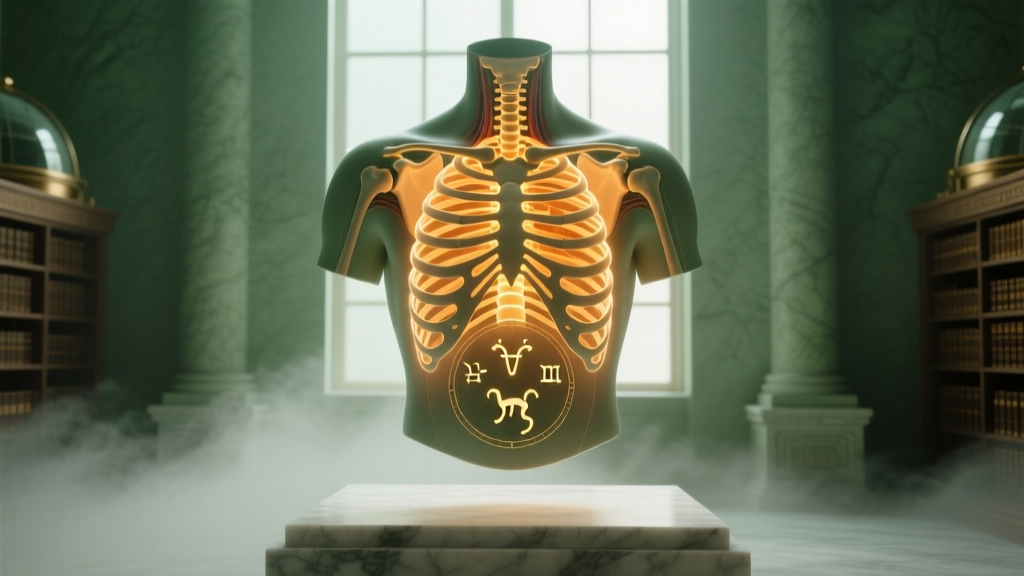
Modern clinical anatomy defines the thoracic cavity as the osteocartilaginous chamber housing the heart, lungs, and mediastinum. Yet, long before the advent of the stethoscope or the MRI, this specific anatomical region was universally recognized by ancient mystics, philosophers, and healers as the primary epicenter of human consciousness. The history of the thoracic cavity is not merely a timeline of medical discovery; it is a fascinating origin story of how humanity mapped the intersection of physical biology and spiritual awareness. By examining the esoteric traditions of Egypt, Greece, and the Vedic East, we can understand how the physical chest was originally conceptualized as a sacred vessel. This exploration reveals that the physical boundaries of the ribcage were historically viewed as the protective architecture for the soul's most volatile and divine elements.
Etymological Armor and the Egyptian Crucible of Maat
The term 'thorax' originates from the ancient Greek word thōrax, which translates directly to 'breastplate' or 'armor.' This etymological root provides a critical clue to the ancient mindset: the chest was not merely a biological container, but a fortified vault designed to protect the most vital essence of the human spirit. This concept of the chest as a sacred, protected space is most vividly illustrated in ancient Egyptian theology.
In the Egyptian Book of the Dead, the heart (ib) residing within the chest was considered the absolute seat of intelligence, emotion, and moral compass. The physical space of the chest was the crucible where the soul's weight was determined. During the Weighing of the Heart ceremony, the ib was measured against the feather of Maat (truth and cosmic order). As detailed in comprehensive analyses of Egyptian religion and mythology, the heart was not viewed as a mere muscular pump, but as the metaphysical ledger of a person's earthly actions. The surrounding thoracic structure was thus revered as the protective architecture of this divine ledger, ensuring the soul's integrity during its journey through the Duat (underworld). Mummification practices deliberately left the heart inside the thoracic cavity, unlike other organs, underscoring its indispensable role in the afterlife.
Hellenic Philosophy: Plato’s Thymos and the Thoracic Cavity
Moving from the Nile to the Aegean, classical Greek philosophy formalized the spiritual anatomy of the chest. Plato, in his seminal works Timaeus and Republic, articulated the theory of the tripartite soul. According to Platonic doctrine, the soul was divided into three distinct faculties: logistikon (reason, located in the head), epithymetikon (appetite, located in the abdomen), and thymos (spirit, passion, and courage).
As explored in the Stanford Encyclopedia of Philosophy's analysis of Plato's soul, the thymos was explicitly localized within the thoracic cavity. Plato described the chest as the dwelling place of righteous anger, bravery, and the drive for honor. The physical ribcage was theorized to act as a barrier, preventing the fiery, passionate energy of the thymos from overwhelming the cool, rational intellect of the brain, while simultaneously keeping it elevated above the base, animalistic desires of the lower abdomen. This philosophical framework deeply influenced early medical pioneers like Galen, who mapped the 'vital spirits' (pneuma zotikon) directly to the heart and the thoracic space, cementing the chest's reputation as the biological engine of courage and spiritual vitality for over a millennium.
Vedic Traditions: The Chest as an Energetic Resonator
In the ancient Vedic and Yogic traditions of India, the physical anatomy was viewed as a dense manifestation of a complex subtle energy system. The thoracic region corresponds precisely to the domain of the Anahata (heart) chakra, the fourth primary energy center. Unlike the Western esoteric focus on the heart organ itself, Eastern traditions focused on the entire thoracic space as a resonant chamber for Prana Vayu—the specific subdivision of life force energy responsible for inward movement and respiration.
The physical expansion and contraction of the chest during breathwork (Pranayama) were understood not just as mechanical gas exchange, but as the physical mechanism for drawing universal consciousness into the individual subtle body. The sternum and the ribcage were seen as the physical scaffolding that allowed the energetic heart to expand. When the thoracic space is constricted through trauma or poor posture, esoteric anatomy dictates that the flow of Prana Vayu is restricted, leading to spiritual stagnation and emotional armoring.
The Renaissance Paradigm Shift: Dissecting the Sacred Space
The spiritual conceptualization of the chest faced a radical disruption during the Renaissance. In 1543, Andreas Vesalius published De Humani Corporis Fabrica (On the Fabric of the Human Body), fundamentally shifting the paradigm from teleological mysticism to mechanistic anatomy. As documented by the National Library of Medicine's historical exhibitions, Vesalius's meticulous dissections stripped the physical body of its mystical properties, redefining it as a complex system of biological bellows and hydraulic pumps.
The heart was reduced to a muscular engine, and the lungs to mere air sacs. However, this mechanistic reductionism birthed a counter-movement within Western esotericism. Hermeticists, Rosicrucians, and later Theosophists maintained the ancient maps of the subtle body, arguing that while Vesalius had accurately mapped the physical hardware of the human form, he had entirely missed the energetic software that animated it. This schism created the dualistic framework we navigate today, where the chest is simultaneously treated as a mechanical cavity in the hospital and a sacred heart-space in the yoga studio.
Comparative Framework: Esoteric vs. Anatomical Models
To understand the divergence between ancient spiritual mapping and modern clinical science, we must examine how each paradigm interprets the specific functions of the chest space.
| Parameter | Ancient / Esoteric Model | Modern / Clinical Model |
|---|---|---|
| Primary Function | Seat of the soul, courage, and moral ledger | Protection of vital cardiopulmonary organs |
| View of the Heart | Metaphysical center of consciousness and Prana | Muscular pump for systemic blood circulation |
| Breathwork Role | Mechanism for drawing universal life force inward | Facilitation of oxygen and carbon dioxide exchange |
| Pathology / Trauma | Emotional armoring, spiritual stagnation, blocked Thymos | Pleurisy, pneumothorax, myocardial infarction |
| Skeletal Structure | Sacred armor protecting the spiritual epicenter | Osteocartilaginous cage for organ shielding |
Practical Application: Reclaiming the Resonator in Modern Practice
Understanding the historical origin story of this anatomical region provides a powerful foundation for modern spiritual and somatic practices. Rather than viewing the chest purely through a clinical lens, practitioners can integrate ancient wisdom with modern physiological science to optimize both physical health and energetic coherence.
One highly actionable method is Resonant Frequency Breathing. By breathing at a rate of approximately 5.5 breaths per minute, practitioners maximize Heart Rate Variability (HRV) and create a state of physiological coherence. Historically, this mirrors the ancient yogic goal of balancing the Ida and Pingala nadis within the chest space. The physical thoracic cavity acts as an acoustic and energetic resonator; slowing the breath to this specific cadence aligns the cardiovascular and respiratory systems, generating a measurable electromagnetic field around the heart that esoteric traditions have long described as the 'auric emanation' of the Anahata chakra.
Furthermore, somatic therapies utilize the concept of the 'armored chest'—a term coined by psychoanalyst Wilhelm Reich, who directly echoed Plato's concept of the thymos becoming trapped. Techniques such as thoracic extension mobilization and conscious sternum-lifting not only correct the kyphotic posture induced by modern lifestyles but also physically open the energetic gateway of the heart center. By consciously expanding the physical boundaries of the ribcage, practitioners signal to the autonomic nervous system that it is safe to drop emotional defenses. This synthesis of biomechanics and ancient spiritual mapping allows modern seekers to utilize the physical body as a precise instrument for consciousness expansion, honoring the original, sacred intent of the human design.