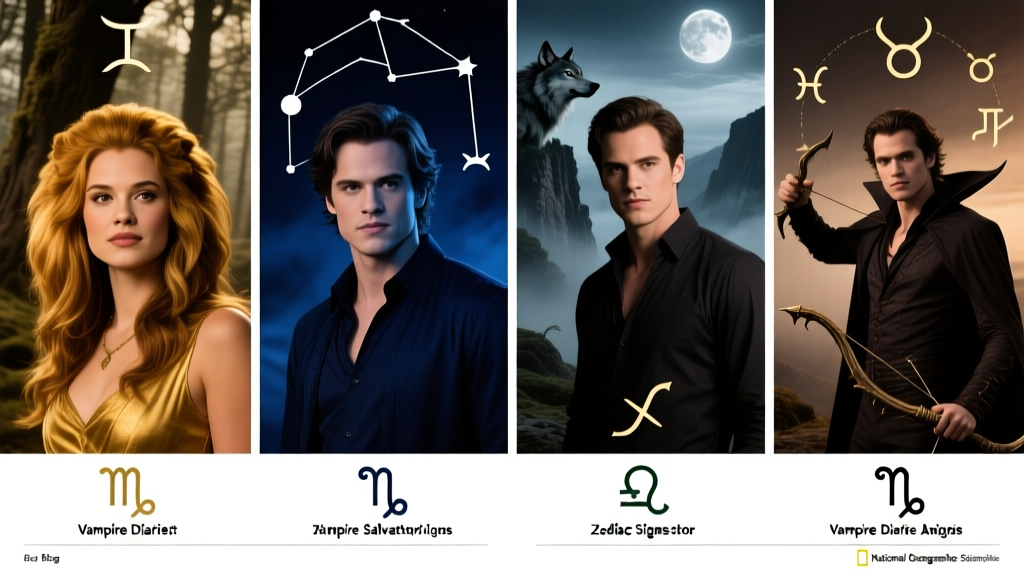
The cultural footprint of the vampire diaries cast extends far beyond supernatural teen drama. For students of personality psychology, astrology, and mythology, the ensemble represents a masterclass in archetypal casting. By analyzing the real-life astrological placements of the actors alongside the Myers-Briggs types and mythological roles of their characters, we uncover a deliberate psychological friction that fueled the show’s eight-season run. This expert analysis deconstructs the zodiac signs, cognitive functions, and shadow elements of the core ensemble, offering actionable frameworks for your own spiritual and psychological development.
The Astrological Blueprint of the Vampire Diaries Cast
To understand the enduring psychological resonance of the series, we must first map the elemental distribution of the core ensemble. The casting directors inadvertently (or perhaps intuitively) selected actors whose natal charts reflect the exact elemental tensions required to bring these Jungian archetypes to life. Below is a structural breakdown of the primary actors, their real-life zodiac modalities, and the psychological frameworks of their characters.
| Actor | Real Zodiac Sign | Character | Character MBTI | Core Archetype |
|---|---|---|---|---|
| Nina Dobrev | Capricorn (Cardinal Earth) | Elena Gilbert | ISFJ | The Orphan / Caregiver |
| Paul Wesley | Cancer (Cardinal Water) | Stefan Salvatore | INFJ | The Sage / Martyr |
| Ian Somerhalder | Sagittarius (Mutable Fire) | Damon Salvatore | ESTP | The Rebel / Trickster |
| Kat Graham | Virgo (Mutable Earth) | Bonnie Bennett | INFJ | The Magician |
| Candice King | Taurus (Fixed Earth) | Caroline Forbes | ESFJ | The Ruler |
Notice the heavy emphasis on Earth and Water placements among the actors, contrasting sharply with the chaotic Fire and Air energies introduced by the show’s antagonists and supernatural lore. This grounding in reality is what made the supernatural elements feel emotionally tangible to the audience.
Jungian Shadows: The Salvatore Brothers' Duality
The central conflict of the series relies on the Jungian concept of enantiodromia—the tendency of things to turn into their opposites. The Salvatore brothers are not just foils; they are fragmented halves of a single psyche, mirrored perfectly by the astrological modalities of the actors portraying them.
Paul Wesley (Cancer) vs. Stefan Salvatore (INFJ)
Paul Wesley’s Cancer Sun is inherently nurturing, protective, and deeply tied to the concept of home and lineage. In psychological astrology, Cancer represents the archetype of the mother and the protector. However, the shadow side of Cancer is emotional manipulation, martyrdom, and a paralyzing fear of abandonment. Wesley channels this into Stefan’s INFJ personality type. Stefan’s dominant cognitive function, Introverted Intuition (Ni), locks him into a singular, rigid moral vision, while his auxiliary Extroverted Feeling (Fe) forces him to absorb the emotional weight of Mystic Falls. When Stefan falls into his "Ripper" shadow, it is the ultimate manifestation of the Cancerian shadow: a protector who becomes a devourer when his emotional boundaries are breached.
Ian Somerhalder (Sagittarius) vs. Damon Salvatore (ESTP)
Ian Somerhalder’s Sagittarius Sun brings a restless, philosophical, and hedonistic energy to the screen. Sagittarius seeks truth through experience, often disregarding social conventions in the process. This aligns seamlessly with Damon Salvatore’s ESTP Myers-Briggs Type Indicator profile. Damon leads with Extroverted Sensing (Se), making him highly reactive, impulsive, and anchored in the immediate physical environment. His auxiliary Introverted Thinking (Ti) allows him to rationalize his selfish behavior through a cold, internal logic. Somerhalder’s natural Sagittarian charm softens Damon’s ESTP ruthlessness, creating the "lovable rogue" archetype. Damon’s character arc is a journey from Se-Ti impulsivity to developing his inferior Introverted Intuition (Ni), eventually learning to envision a future beyond his immediate desires.
The Divine Feminine and Earth Sign Anchors
While the Salvatore brothers represent the volatile interplay of Water and Fire, the heroines of the series are anchored by the stabilizing, pragmatic energy of the Earth signs. This elemental grounding is crucial for the narrative, as it provides a tether to humanity amidst escalating supernatural chaos.
Nina Dobrev and the Capricorn Burden
Nina Dobrev’s Capricorn Sun is defined by duty, stoicism, and an innate sense of responsibility. Capricorn is ruled by Saturn, the planet of restriction and karmic debt. This astrological placement perfectly informs her portrayal of Elena Gilbert, an ISFJ whose life is defined by the trauma of her parents' death and her subsequent role as a surrogate mother to her younger brother. Elena’s Introverted Sensing (Si) relies heavily on past precedent and a desire to maintain the status quo. Dobrev’s Capricorn resilience allows Elena to endure immense psychological trauma without shattering, though it also highlights the shadow of the Earth sign: a tendency toward self-neglect and the suppression of personal desires for the sake of duty.
Kat Graham and the Virgo Magician
Kat Graham, a Virgo Sun, embodies the analytical, service-oriented, and meticulous nature of the mutable Earth sign. Virgo is associated with the archetype of the healer and the craftsman. As Bonnie Bennett, Graham portrays a character whose magical prowess is not innate or chaotic, but learned through rigorous study and immense personal sacrifice. Bonnie’s magic requires precise incantations, deep focus, and a willingness to act as a conduit for natural forces. This mirrors the Virgoan drive for perfection and utility. The tragedy of Bonnie’s character arc is the classic Virgo shadow: becoming so essential to the functioning of the group that her own needs are entirely subsumed by her utility to others.
Pro Tips: Applying Mystic Falls Archetypes to Shadow Work
The psychological depth of the vampire diaries cast provides a unique framework for personal shadow work and personality integration. By identifying which character archetype you resonate with, you can target specific areas of your psyche for healing and development.
- The Salvatore Integration (Moral Rigidity vs. Impulsivity): If you identify with Stefan’s INFJ/Cancer energy, your shadow work must involve acknowledging your repressed desires and your capacity for anger. Practice "productive selfishness" by setting boundaries that prioritize your needs over the emotional comfort of others. If you align with Damon’s ESTP/Sagittarius energy, your work involves developing future-oriented thinking. Implement a 48-hour waiting period before making significant emotional or financial decisions to engage your intuitive functions.
- The Bennett Boundary (Combating Earth Sign Burnout): For those who channel Bonnie’s Virgo/INFJ energy, you likely suffer from "helper’s fatigue." Your shadow work requires decoupling your self-worth from your utility. Actionable step: Audit your weekly commitments and eliminate one recurring obligation that you perform solely out of guilt or a sense of obligation, not genuine desire.
- The Forbes Grounding (Somatic Regulation): Candice King’s portrayal of Caroline Forbes (ESFJ/Taurus) showcases a masterclass in somatic regulation. Caroline processes her trauma through physical organization, planning, and aesthetic control. If you feel overwhelmed by chaotic emotional waters, adopt Taurus grounding techniques: engage in heavy weightlifting, deep tissue massage, or meticulous environmental organization to pull your energy out of your head and back into your physical body.
Mythological Origins: Doppelgängers and Sirens
The lore that binds the vampire diaries cast together is deeply rooted in global mythology, specifically the concept of the doppelgänger and the sire line. In Germanic and Norse folklore, the fetch or vardøger is a spectral double that precedes or follows a person, often acting as a harbinger of death or a manifestation of a fractured psyche. The show’s use of the Petrova doppelgängers is a modern retelling of this myth, symbolizing Nature’s attempt to correct the imbalance caused by the first immortality spell.
Furthermore, the sire bond explored in the later seasons mirrors the mythological Sirens of Greek lore, but with a psychological twist. Rather than using auditory enchantment to lure sailors to their deaths, the show’s sire bond is based on trauma bonding and the psychological transference of dependency. This aligns with modern psychological understandings of trauma responses, where the victim forms an intense, irrational attachment to their abuser or savior as a survival mechanism. By weaving these ancient mythological structures into a modern psychological framework, the cast was able to elevate standard horror tropes into profound explorations of codependency, free will, and the inescapable nature of karmic debt.