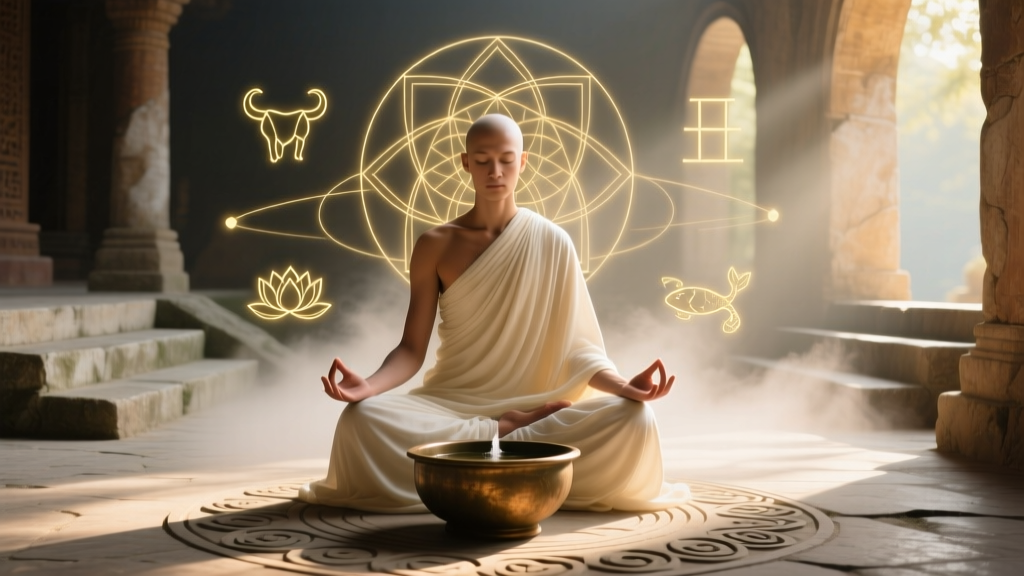
The word tantra originates from the Sanskrit root tan, meaning 'to weave' or 'to expand,' and tra, meaning 'instrument' or 'tool.' Far from the modern Western reduction of the practice to purely sexual intimacy, classical tantra is a comprehensive spiritual technology developed in India between the 5th and 9th centuries CE. It provides a framework for weaving together the material and spiritual dimensions of human existence, utilizing the physical body as a vessel for divine realization rather than an obstacle to overcome. For modern seekers, understanding this distinction is the critical first step toward applying these ancient methodologies to daily psychological and spiritual development.
The True Definition of Tantra (Beyond the Myths)
Historically, tantra emerged as a heterodox movement that challenged the rigid asceticism of early Vedic and Samkhya traditions. While earlier philosophies often viewed the material world as Maya (illusion) and the physical body as a source of suffering to be transcended, Tantric traditions embraced the physical realm as a direct manifestation of the divine. According to Britannica's historical overview of Tantra, these practices were codified in texts known as Agamas and Nigamas, which detailed complex rituals, mantra recitations, and the construction of mandalas designed to map the cosmos onto the human nervous system.
The core premise is that the universe is the play of consciousness (Shiva) and energy (Shakti). By systematically engaging the senses, the breath, and the mind, a practitioner can recognize the divine in everyday experiences, transforming mundane actions into profound spiritual rites.
Classical vs. Neo-Tantra: Understanding the Divide
The contemporary understanding of the practice is heavily influenced by 'Neo-Tantra,' a 20th-century Western synthesis that adapted certain esoteric concepts to focus primarily on somatic healing, psychological release, and sexual intimacy. While Neo-Tantra offers valid therapeutic benefits, it diverges significantly from the soteriological (liberation-focused) goals of the classical lineage.
| Feature | Classical Tantra | Neo-Tantra (Modern) |
|---|---|---|
| Origin | 5th-9th Century India | 20th Century Western Synthesis |
| Primary Goal | Moksha (Spiritual Liberation) | Intimacy, Healing, Somatic Pleasure |
| Role of the Body | Vessel for cosmic energy (Shakti) | Tool for psychological/sexual release |
| Transmission | Guru-to-student (Parampara) | Workshops, Books, Retreats |
| Core Practices | Mantra, Yantra, Mandala, Puja | Breathwork, Sensate Focus, Eye Gazing |
Core Philosophies of the Tantric Tradition
Radical Non-Duality (Advaita)
Unlike dualistic systems that separate the observer from the observed, classical tantra operates on a framework of radical non-duality. As noted in Yoga Journal's analysis of Tantric philosophy, the tradition asserts that there is no fundamental separation between the individual soul and the universal consciousness. The perceived separation is merely a result of avidya (ignorance). Practices are therefore designed not to 'attain' enlightenment as a future state, but to strip away the conditioning that obscures the ever-present reality of wholeness.
The Subtle Energy Anatomy
Tantric physiology maps the human body not just as flesh and bone, but as an intricate web of subtle energy. This anatomy includes the chakras (energy centers) and the nadis (energy channels). The Hatha Yoga Pradipika references 72,000 nadis, with three primary channels being the focus of Tantric meditation:
- Ida Nadi: The lunar, cooling channel associated with the left nostril and the parasympathetic nervous system.
- Pingala Nadi: The solar, heating channel associated with the right nostril and the sympathetic nervous system.
- Sushumna Nadi: The central channel running along the spinal cord, through which Kundalini (dormant spiritual energy) ascends. For a deeper anatomical breakdown, refer to Britannica's reference on Kundalini.
Practical Application: 3 Accessible Exercises for Beginners
You do not need to retreat to a Himalayan cave to begin integrating Tantric principles. The following three exercises are derived from classical methodologies and can be safely practiced in a modern environment to cultivate somatic awareness and energetic balance.
1. Nadi Shodhana (Channel Cleansing Breath)
This pranayama technique balances the Ida and Pingala nadis, harmonizing the left and right hemispheres of the brain and shifting the nervous system into a state of coherent equilibrium.
- Sit with a straight spine, resting your left hand on your knee in Chin Mudra (thumb and index finger touching).
- Bring your right hand to your face. Fold the index and middle fingers toward the palm, leaving the thumb, ring, and pinky fingers extended (Vishnu Mudra).
- Close your right nostril with your thumb and inhale slowly through the left nostril for a count of 4.
- Close both nostrils and hold the breath for a count of 4.
- Release the right nostril and exhale for a count of 4.
- Inhale through the right nostril for 4, hold for 4, and exhale through the left for 4.
- This completes one cycle. Perform 10 cycles daily, focusing entirely on the sensation of air crossing the nasal passages.
2. Trataka (Steady Gazing for Sensory Withdrawal)
Trataka is a purification practice that bridges the gap between physical sensory engagement and deep meditative absorption (Pratyahara). It builds intense concentration and stimulates the pineal gland.
- Place a candle on a stable surface exactly two feet away from you, with the flame at eye level.
- Sit in a darkened room with a straight spine.
- Gaze steadily at the brightest part of the flame without blinking. Maintain a soft, relaxed facial expression.
- When your eyes naturally begin to water or feel fatigued, close them gently.
- Visualize the exact image of the flame at the space between your eyebrows (the Ajna chakra) for as long as the afterimage persists.
- Repeat this process for 10 minutes.
3. Bija Mantra Resonance
Mantras in tantra are not merely prayers; they are sonic formulas that create specific vibratory frequencies in the subtle body. Bija (seed) mantras are single-syllable sounds tied to specific energy centers.
- Lam: Root Chakra (Muladhara) - Grounding and survival.
- Vam: Sacral Chakra (Svadhisthana) - Fluidity and creativity.
- Ram: Solar Plexus (Manipura) - Willpower and digestion.
- Yam: Heart Chakra (Anahata) - Compassion and integration.
- Ham: Throat Chakra (Vishuddha) - Expression and truth.
Practice: Select the seed mantra corresponding to the area of your life requiring balance. Using a mala (108 beads), chant the syllable aloud on the exhale, focusing on the physical vibration in the corresponding area of your torso or throat. The vibration should be felt in the tissue, not just heard in the room.
Foundational Texts for Authentic Study
For practitioners wishing to move beyond secondary interpretations and engage with primary source material, the following texts are essential. The Vijnana Bhairava Tantra is a premier manual of Kashmir Shaivism that outlines 112 distinct dharanas (centering techniques). These techniques range from observing the pause between breaths to utilizing intense sensory experiences (like the shock of cold water or the sound of a stringed instrument) as gateways to expanded consciousness. Another critical text is the Mahanirvana Tantra, which provides detailed frameworks for daily rituals, ethical living, and the integration of spiritual practice with household responsibilities, proving that classical tantra was always designed for the householder as much as the ascetic.