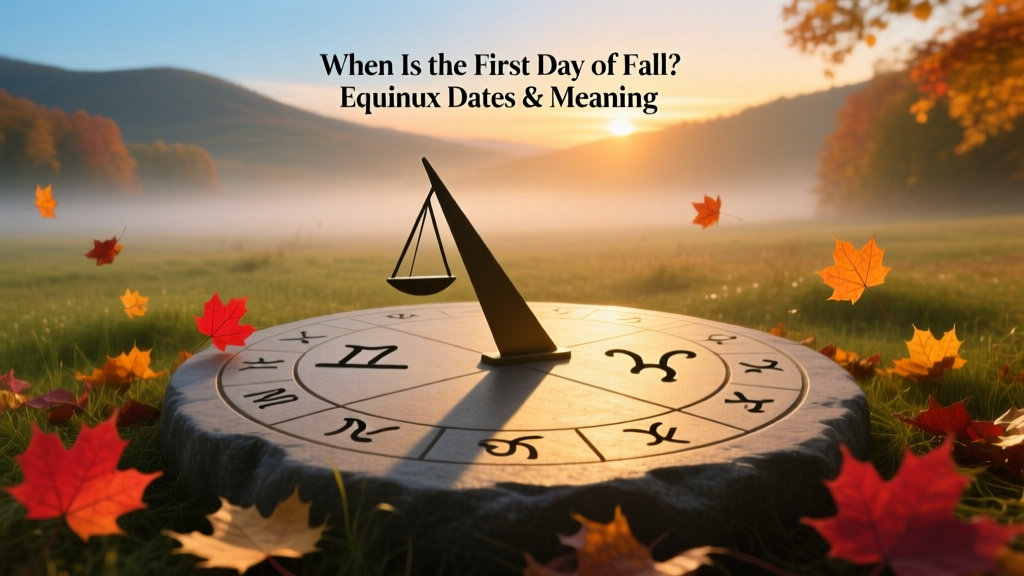
The transition from summer to autumn hinges on a precise celestial event. If you are asking when is the first day of fall, the answer depends on whether you consult an astronomer, a meteorologist, or an astrologer. For the Northern Hemisphere, the astronomical first day of autumn occurs on the autumnal equinox, which falls on September 22 or 23 each year. This moment marks the exact point when the sun crosses the celestial equator, resulting in nearly equal hours of daylight and darkness across the globe. Understanding this transition requires examining orbital mechanics, seasonal tracking systems, and the esoteric shifts that accompany the harvest season.
The Astronomical Answer: When Is the First Day of Fall?
Earth's axis is tilted at exactly 23.44 degrees relative to its orbital plane around the sun. Throughout the year, this tilt dictates which hemisphere receives more direct solar radiation. The autumnal equinox occurs at the precise moment the subsolar point—the spot on Earth's surface where the sun is directly overhead—crosses the equator moving southward. At this exact second, the sun's ecliptic longitude reaches 180 degrees.
Because a solar year is approximately 365.2422 days long rather than exactly 365 days, the Gregorian calendar slowly drifts relative to the solar cycle. Leap years correct this drift, which is why the equinox date fluctuates between September 22 and September 23 in the Northern Hemisphere. According to astronomical data tracked by Time and Date, the exact minute of the equinox shifts annually based on orbital mechanics.
| Year | Equinox Date | Exact Time (UTC) |
|---|---|---|
| 2024 | September 22 | 12:44 UTC |
| 2025 | September 22 | 18:19 UTC |
| 2026 | September 23 | 00:05 UTC |
| 2027 | September 23 | 06:01 UTC |
| 2028 | September 22 | 11:45 UTC |
Meteorological Fall and Thermal Inertia
While astronomers rely on planetary alignment, meteorologists use a fixed calendar system to track seasonal temperature changes. The meteorological first day of fall is always September 1, and the season ends on November 30. This discrepancy exists because meteorologists divide the year into four seasons of exactly three months each to simplify statistical analysis, agricultural planning, and climate modeling.
Astronomical seasons vary in length from 89 to 93 days due to the elliptical nature of Earth's orbit, governed by Kepler's Second Law, making long-term temperature averaging difficult. Furthermore, the meteorological calendar accounts for thermal inertia. The atmosphere and oceans retain massive amounts of heat from the summer solstice, meaning early September often feels like an extension of summer. By defining fall as the months of September, October, and November, climatologists can accurately track the gradual cooling trend and the lag of the seasons without the statistical noise of shifting start dates.
- Astronomical Fall: Based on the Earth's position relative to the sun. Starts on the equinox (Sept 22/23). Varies in length from 89 to 93 days.
- Meteorological Fall: Based on annual temperature cycles and the Gregorian calendar. Starts September 1. Always 91 or 92 days long.
Astrological Shifts: The Sun Enters Libra
In tropical astrology, the first day of fall is synonymous with the Sun's ingress into Libra. This cardinal air sign governs balance, diplomacy, aesthetics, and interpersonal relationships. The equinox represents the ultimate equilibrium point in the solar year—a literal and symbolic balancing of light and dark. As the sun crosses the celestial equator, the energetic focus shifts from the self-oriented vitality of Leo and the analytical service of Virgo into the relational dynamics of Libra.
The Cardinal Air Ingress
Cardinal signs initiate new seasons. Aries starts spring, Cancer starts summer, Libra starts fall, and Capricorn starts winter. When the sun enters Libra at the exact moment of the autumnal equinox, it triggers a collective energetic shift toward harmony and evaluation. Astrologers note that this period often brings relationship milestones, legal resolutions, and a desire to beautify one's environment before the inward turn of winter. The cardinal modality provides the spark of initiation, while the air element governs intellect and social connection, making this an optimal time for negotiating contracts and establishing boundaries.
Mythological Parallels: Persephone and Inanna
Ancient cultures mapped the psychological and agricultural realities of the equinox through mythology. The descent of the harvest goddess into the underworld is a pervasive archetype marking the beginning of the barren half of the year. In Greek mythology, Persephone eats the pomegranate seeds in the Underworld, binding her to Hades and triggering Demeter's grief, which strips the earth of its foliage and warmth.
Similarly, the ancient Sumerian myth of Inanna details her descent to visit her sister Ereshkigal, queen of the dead. Inanna must shed her garments and powers at each of the seven gates of the underworld, ultimately facing death and resurrection. These myths provide a framework for understanding the autumnal equinox not just as a drop in temperature, but as a psychological invitation to engage in shadow work, release superficial attachments, and prepare for the introspective darkness of winter. Britannica notes that these ancient harvest festivals were vital for societal cohesion and agricultural survival.
Hemispheric Differences and Orbital Mechanics
The concept of autumn is entirely dependent on your geographic location. When the Northern Hemisphere experiences the autumnal equinox, the Southern Hemisphere—including Australia, South America, and Southern Africa—experiences the vernal (spring) equinox. The subsolar point moving southward brings spring awakening to the south while signaling the harvest to the north.
Tracking the Equinox Across Time Zones
The equinox happens at one universal moment globally, but local clocks display different times. For example, if the equinox occurs at 12:44 UTC on September 22, it is 8:44 AM Eastern Daylight Time (EDT) in New York, but it is already 10:44 PM Australian Eastern Standard Time (AEST) in Sydney. Therefore, residents in the Southern Hemisphere will record the date as September 23, marking their first day of spring. The Old Farmer's Almanac provides localized calculators to determine the exact minute of the seasonal shift for your specific zip code, ensuring you can align your personal practices with the precise celestial moment.
Actionable Equinox Practices for Grounding and Balance
The intersection of astronomy and spirituality offers practical frameworks for personal development during the seasonal shift. The historical celebration of Mabon, the pagan harvest festival, aligns with the equinox's themes of gratitude and preparation. Implementing structured routines during this transition can help mitigate the physiological impacts of the changing photoperiod.
- Shadow Integration Journaling: As the Northern Hemisphere enters the dark half of the year, utilize the equal balance of light and dark to acknowledge repressed traits. Use specific prompts: What behaviors served me in the light of summer but will hinder me in the winter? What emotional harvest am I collecting from the past six months?
- Circadian Realignment: Adjust your sleep schedule to match the shifting photoperiod. With daylight hours now shorter than nighttime hours, increase morning sun exposure within 30 minutes of waking to regulate melatonin production and support seasonal affective stability.
- Environmental Audit: Reflecting Libra's domain, evaluate the balance in your physical space. Remove stagnant items, repair broken objects, and reorganize your living area to support the inward, reflective energy of the upcoming winter months. This physical decluttering reduces cognitive load during a season that naturally demands more internal processing.
Pinpointing the exact start of autumn requires understanding the mechanics of a tilted planet orbiting a star. Whether you are tracking the meteorological data for agricultural purposes, calculating the exact UTC minute for an astrological chart, or simply preparing your home for the harvest, the equinox serves as a definitive cosmic marker. By aligning your practical routines and spiritual practices with this celestial event, you leverage the natural rhythms of the Earth's orbit to foster personal equilibrium.