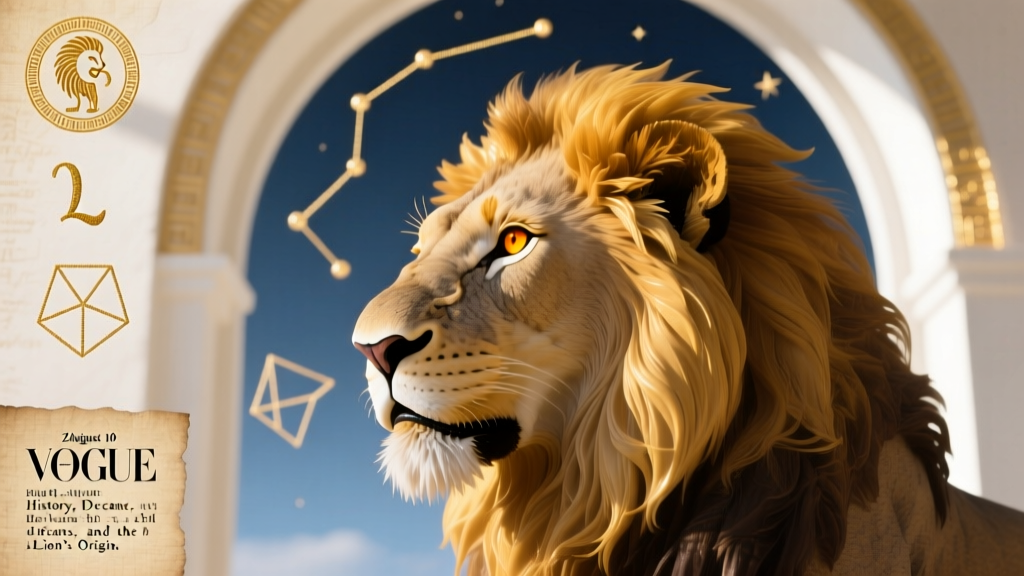
The Stratigraphy of the Mid-Summer Sun
To understand the zodiac 10 august placement, one must look past modern pop-astrology and examine the stratigraphy of ancient celestial observation. Falling squarely in the middle of the Leonine sector, this specific date carries a compounded historical weight that merges Babylonian statecraft, Egyptian solar theology, and Hellenistic decanic magic. Modern sun-sign columns flatten the Leo archetype into a monolith of ego and creativity, but historical astrology reveals a highly nuanced, mathematically divided sky. The Sun’s position in early August corresponds to the peak of the Northern Hemisphere’s agricultural summer, a period historically associated with absolute monarchical power, the scorching wrath of the divine, and the life-giving inundation of the Nile.
The Genesis of the Lion: From Babylonian UGA to Egyptian Sekhmet
The constellation we now call Leo was not originally a singular lion, but a complex celestial entity in ancient Mesopotamia. According to the Babylonian astronomical compendium MUL.APIN (compiled around 1000 BCE), this region of the sky was designated as UR.GU.LA, the "Great Lion." In Babylonian theology, the lion was the sacred beast of Ishtar and later became deeply associated with the supreme god Marduk and the divine right of kings. The stars forming the mane and chest of the lion (including Regulus, the "King Star") were used to mark the summer solstice in earlier epochs before axial precession shifted the solstitial points.
As astrological knowledge migrated westward into Egypt, the Leonine archetype bifurcated into solar and leonine deities. The scorching heat of early August was personified by Sekhmet, the lioness goddess of war, healing, and the brutal desert sun. However, August 10 also closely aligns with the historical heliacal rising of Sirius (Sopdet to the Egyptians). The reappearance of Sirius after a 70-day absence signaled the annual flooding of the Nile. Therefore, the mid-Leonine degrees historically carried a dual origin story: the destructive, parching heat of the lioness, and the imminent, life-saving promise of the river’s inundation.
Decanic Astrology: Tracing the Zodiac 10 August to Jupiter’s Domain
The most critical layer of historical origin for the zodiac 10 august placement lies in the decan system. Originating in Hellenistic Egypt and later codified in medieval grimoires, the zodiac was divided into 36 decans (10-degree segments). August 10 typically falls between 17° and 18° of Leo, placing it firmly in the second decan of the sign (which spans 10°00’ to 19°59’ Leo).
While the first decan of Leo is ruled by the Sun (and Mars in the Chaldean system), the second decan is traditionally ruled by Jupiter. This Jovian overlay fundamentally alters the expression of the Leonine energy. According to Heinrich Cornelius Agrippa’s translation of earlier Arabic and Greek texts in his Three Books of Occult Philosophy, the image of the second decan of Leo is described as a nobleman or a prince riding on horseback, accompanied by hounds, signifying nobility, leadership, legal authority, and expansive generosity. This explains why individuals born on this date often exhibit a more philosophical, magnanimous, and socially conscious leadership style compared to the raw, martial dominance of the first decan.
Comparative Anatomy of the Leonine Decans
| Decan | Degree Range | Traditional Ruler | Historical Imagery (Picatrix / Agrippa) | Core Archetypal Focus |
|---|---|---|---|---|
| 1st Decan | 0°00’ – 9°59’ Leo | Sun / Mars | A man wearing a crown, riding a lion | Raw power, ego, physical courage, sovereignty |
| 2nd Decan (Aug 10) | 10°00’ – 19°59’ Leo | Jupiter | A nobleman on horseback with hounds | Philanthropy, legal authority, mentorship, expansion |
| 3rd Decan | 20°00’ – 29°59’ Leo | Mars / Saturn | A fierce man holding a bow, commanding | Strategy, enforcement, discipline, structural legacy |
The Hellenistic Shift: Hercules and the Nemean Lion
When the Greeks adopted the Babylonian zodiac, they overlaid their own mythological framework onto the constellations. The Leo constellation became inextricably linked to the Nemean Lion, the invulnerable beast slain by Hercules as the first of his Twelve Labors. The historical significance of this myth for the August 10 degree is profound. The Nemean Lion’s skin was impervious to iron, bronze, and stone; Hercules could only defeat it by wrestling it with his bare hands and strangling it, later wearing its pelt as impenetrable armor.
In the context of the mid-Leonine degrees, this origin story shifts the archetype from mere "royalty" to the concept of invulnerability through direct confrontation. The 17th and 18th degrees of Leo carry the historical resonance of overcoming insurmountable obstacles not through external tools or delegated authority, but through sheer, unadulterated personal will and physical or spiritual endurance. The Jovian influence of the decan suggests that this victory is ultimately in service of a higher, civilizing good (Hercules clearing the land for humanity), rather than simple ego-gratification.
Astronomical Reality: Precession and the Constellation Boundaries
A rigorous historical analysis must address the astronomical divergence between the tropical zodiac used by Western astrologers and the actual, observable constellations. Due to the precession of the equinoxes—a 26,000-year wobble of the Earth’s axis identified by Hipparchus in the 2nd century BCE—the Sun is no longer in the constellation of Leo on August 10. Astronomically, the Sun transits through the constellation of Cancer during this time.
Claudius Ptolemy, in his foundational 2nd-century text Tetrabiblos, formalized the tropical zodiac, anchoring the signs to the seasons (the equinoxes and solstices) rather than the shifting stars. Ptolemy argued that the astrological power of Leo derives from the seasonal quality of mid-summer in the Northern Hemisphere: a time of intense, dry heat and maximum solar radiation. Therefore, the "truth" of the August 10 zodiac placement is rooted in the Earth’s seasonal relationship to the Sun, preserving the ancient, agrarian experience of the dog days of summer, regardless of where the background stars currently reside.
Actionable Synthesis: Working with the Mid-Leonine Historical Archetype
Understanding the deep history of the zodiac 10 august placement provides a highly specific framework for personal and strategic development. By synthesizing the Babylonian kingship, the Jovian decanic rulership, and the Herculean mythos, individuals or practitioners working with this energy can apply the following historical principles:
- Leverage Jovian Authority: Because this decan is ruled by Jupiter, raw displays of ego or aggression are historically misaligned with the degree’s power. Success comes through magnanimity, legal structuring, publishing, and acting as a patron or mentor to others.
- Embrace the Nemean Paradigm: When facing systemic resistance, abandon reliance on external tools or intermediaries. The 17th/18th degree of Leo demands direct, unmediated engagement with the core of the problem. Strip away the armor and rely on foundational strength.
- Align with the Sirian Cycle: Historically, early August was a time of preparation for the Nile’s flood. Use this period not for initiating new, chaotic ventures, but for reinforcing infrastructure, preparing resources, and anticipating a period of emotional or financial inundation and renewal.
The history of the mid-August sky is not merely a collection of myths; it is a sophisticated, ancient technology for understanding the mechanics of power, endurance, and seasonal timing. By honoring the Jovian-Lion archetype, one moves beyond superficial horoscopes and taps into a lineage of celestial observation that has guided leaders, builders, and mystics for over three millennia.