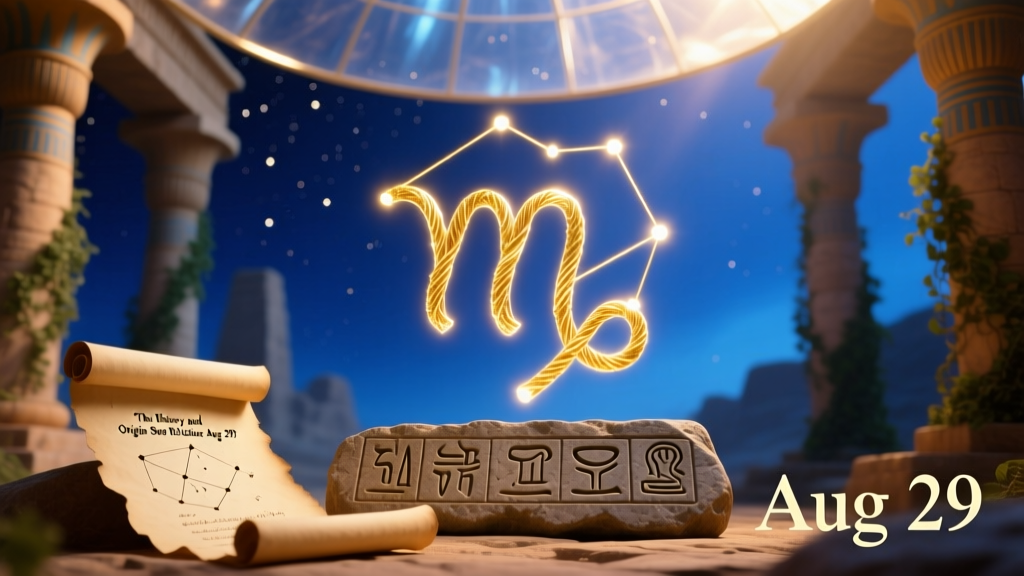
To understand the psychological and spiritual profile of the zodiac aug 29, one must look past modern syndicated horoscopes and examine the ancient agricultural and mythological frameworks that birthed the Virgo archetype. Born on the cusp of the late summer harvest, individuals born on this date inherit a complex lineage of celestial mythology. The evolution of this specific astrological placement spans thousands of years, transitioning from Mesopotamian star catalogs to Hellenistic decan systems, ultimately shaping the analytical and service-oriented traits associated with this birth date.
The Ancient Roots of the Zodiac Aug 29: Babylonian Origins
The origins of the late August zodiac placement do not begin with the Greco-Roman maiden, but rather in the cradle of civilization. According to the MUL.APIN astronomical tablets, compiled by Babylonian astronomers around 1000 BCE, the constellation we now call Virgo was originally known as MUL.AB.SIN, meaning "The Furrow." This constellation represented the goddess Shala, depicted holding an ear of barley or grain.
For the ancient Mesopotamians, late August marked a critical threshold in the agricultural calendar. The intense heat of summer was beginning to break, signaling the time to prepare the earth for autumn sowing or to finalize the late harvest. The zodiac aug 29 placement historically aligns with this transitional period of agricultural auditing. The meticulous, detail-oriented nature attributed to modern Virgos is a direct psychological descendant of the ancient Babylonian requirement to meticulously measure grain yields, calculate taxation, and prepare the furrows for the next cycle of survival.
Hellenistic Mythology: Astraea, Demeter, and the Harvest
As astrological knowledge migrated from Babylon to Greece, the "Furrow" was Hellenized into the constellation of Virgo, the Maiden. The Greeks layered their own mythological origin stories over the existing stellar framework, creating the multi-faceted archetype that influences the zodiac aug 29 personality today.
Astraea: The Star Maiden
The most prominent origin story links Virgo to Astraea, the goddess of innocence and justice. According to the poet Aratus in his 3rd-century BCE work Phaenomena, Astraea lived on Earth during the Golden and Silver Ages, dispensing justice and teaching humanity agriculture. However, as humanity descended into the Bronze and Iron Ages, becoming violent and corrupt, Astraea fled to the heavens, becoming the Virgo constellation. For those born on August 29, this mythological origin manifests as a deep-seated, sometimes rigid, internal moral compass and a profound disillusionment with societal injustice.
The Erigone Variation
A secondary, more tragic origin story ties the constellation to Erigone, the daughter of Icarius. After Dionysus taught Icarius winemaking, local shepherds mistakenly believed Icarius had poisoned them and killed him. Erigone, guided by her dog Maera, found her father's body and hung herself in grief. Zeus placed all three in the stars—Erigone as Virgo. This narrative injects a hidden layer of devotion, grief-processing, and fierce loyalty into the underlying psychological makeup of the late August Virgo.
Astronomical Precession: The Shifting Sky of August 29
A critical component of astrological history is the Precession of the Equinoxes, a slow wobble in the Earth's rotational axis identified by Hipparchus in 127 BCE. Because of this phenomenon, the physical constellation occupying the sky on August 29 has shifted dramatically over the millennia. While tropical astrology fixes the zodiac aug 29 sun sign in Virgo based on the seasons, sidereal and astronomical realities tell a different historical story.
| Era | Astrological System | August 29 Celestial Alignment | Core Archetypal Focus |
|---|---|---|---|
| 1000 BCE (Babylonian) | Sidereal / Observational | Constellation Leo (The Lion / King) | Authority, solar peak, grain taxation |
| 100 CE (Hellenistic) | Tropical (Ptolemaic) | Sign of Virgo (The Maiden) | Harvest, analysis, Mercurial service |
| Modern Era (21st Century) | Tropical (Western) | Sign of Virgo (First Decan) | Data synthesis, routine, purification |
| Modern Era (21st Century) | Sidereal (Vedic/Lahiri) | Sign of Leo (Simha) | Creativity, leadership, ego-integration |
Understanding this historical divergence is vital. A Western tropical astrologer interprets the zodiac aug 29 through the lens of the Virgo harvest maiden, while a Vedic astrologer interprets the same date through the Leonine fire of the sun. This duality explains why individuals born on this date often exhibit a paradox: the outward modesty and analytical restraint of Virgo, coupled with a hidden, fierce Leonine pride and creative drive.
Decoding the Zodiac Aug 29 Through the Chaldean Decans
To achieve true historical and astrological specificity, one must examine the Hellenistic system of Decans. The 360-degree zodiac wheel was divided by ancient Chaldean and Egyptian astrologers into 36 ten-degree segments, each ruled by a specific planet.
August 29 falls squarely within the First Decan of Virgo (0° to 10°). According to the Astrodienst historical decan archives, the first decan of Virgo is co-ruled by Mercury. Mercury, the planet of intellect, communication, and nervous system regulation, amplifies the earthy, practical nature of Virgo. Historically, this specific decan was associated with the drafting of laws, the invention of writing, and the meticulous categorization of the natural world. Consequently, the zodiac aug 29 profile is heavily Mercurial: highly verbal, deeply analytical, and prone to nervous energy if not intellectually stimulated.
Actionable Frameworks: Applying Ancient Virgo Wisdom
The historical and mythological origins of this birth date are not merely academic; they provide a blueprint for personal optimization. By aligning with the ancient rhythms of Shala's harvest and Astraea's justice, individuals born on August 29 can harness their innate archetypal strengths.
- The Mercurial Audit Protocol: Because August 29 is governed by the Mercury-ruled first decan, your cognitive peak occurs during systematic categorization. Implement a weekly "Mercurial Audit" every Sunday evening. Do not merely write a to-do list; categorize tasks by cognitive load (high-focus vs. administrative). This honors the ancient Babylonian scribes who meticulously categorized grain yields, preventing your nervous system from becoming overwhelmed by unstructured data.
- Astraea's Boundary Framework: The myth of Astraea fleeing a corrupt world highlights the Virgo vulnerability to environmental toxicity and moral fatigue. Establish a strict "Information Diet" and sensory boundary protocol. If you work in high-stress or emotionally demanding environments, schedule 20 minutes of complete sensory deprivation (no podcasts, no music, no screens) immediately post-work to reset your Mercurial nervous system before engaging with your household.
- The Shala Harvest Ritual: Connect to the original Babylonian "Furrow" archetype by engaging in cyclical completion rituals. Late August is historically a time of finalizing yields. Identify one long-term project or lingering obligation that has been draining your resources. Dedicate the final week of August exclusively to closing this loop, documenting the lessons learned, and physically clearing the workspace. This mimics the ancient agricultural preparation of the soil, ensuring psychological readiness for the new cycles of autumn.
By grounding modern personality traits in the rich historical soil of Babylonian astronomy and Hellenistic mythology, the zodiac aug 29 profile transforms from a generic horoscope into a profound, actionable framework for navigating the complexities of the modern world with ancient precision.