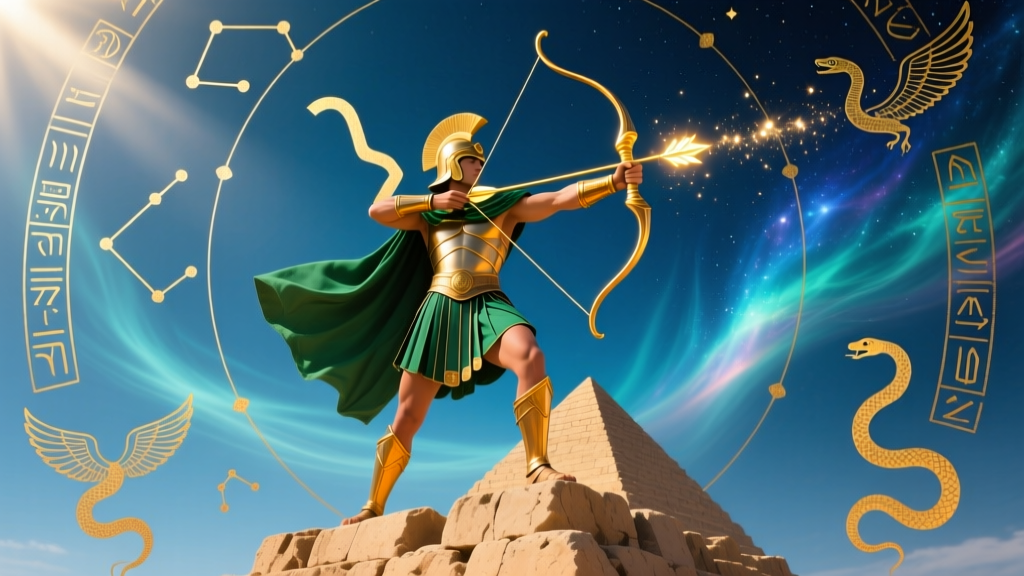
Individuals born on this date fall under the zodiac of November 27, placing them squarely in the second decan of Sagittarius. While modern pop astrology reduces this placement to mere horoscope tropes, the historical and mythological lineage of this specific astrological coordinate reveals a complex synthesis of Mesopotamian astronomy and Hellenistic mythology. Understanding the origin story of this archetype requires excavating over 4,000 years of celestial observation, moving from the Babylonian Pabilsag to the Greek centaur Chiron. This analysis traces the precise historical evolution of the late November archer, separating documented antiquity from modern astrological revisionism to provide a rigorous foundation for personality analysis.
The Ancient Roots: Babylonian Pabilsag and the Scorpion-Man
Long before the Greeks formalized the zodiac, the Sumerians and Babylonians mapped the ecliptic. The constellation we now associate with late November was originally designated as Pabilsag (PA.BIL.SAG). According to the MUL.APIN, the definitive Babylonian astronomical compendium compiled around 1100 BCE, Pabilsag was the patron deity of the city of Isin and a divine figure associated with the underworld and celestial judgment.
Visual representations on boundary stones (kudurru) and cylinder seals depict Pabilsag not as a simple horse-man, but as a complex chimera. He possessed the torso of a bearded man, the legs and tail of a scorpion, and sometimes the wings of an eagle. This iconography is deeply tied to the Girtablilu (Scorpion-men) who guarded the Mashu mountains in the Epic of Gilgamesh. The Metropolitan Museum of Art's archives on Mesopotamian art highlight how these composite creatures symbolized liminality—the threshold between the mortal realm and the divine underworld. For those studying the historical origins of this archetype, this reveals a foundational trait: the Pabilsag energy is inherently concerned with guarding thresholds, translating esoteric knowledge, and navigating the boundary between the known and the unknown.
Hellenistic Syncretism and the Zodiac of November 27
The transition from the Babylonian scorpion-man to the Greek centaur occurred during the Hellenistic period, following Alexander the Great's conquests. Greek astronomers, notably Eudoxus of Cnidus in the 4th century BCE and later Claudius Ptolemy in the 2nd century CE, adopted the Babylonian zodiac but overlaid it with their own mythological framework. As noted in Britannica's historical overview of Western astrology, the Greeks stripped away the scorpion tail and avian wings, replacing them with the equine lower half of the Centaur.
However, a critical historical distinction must be made regarding the specific degree of late November. The Greeks recognized two primary types of centaurs: the savage, wine-crazed followers of Dionysus (associated with the Lapith war) and the civilized, immortal scholars. The specific coordinate of the zodiac of November 27 aligns historically with Chiron or Pholus, the scholarly centaurs who dwelled in Mount Pelion, rather than the chaotic beasts of early myth.
The Chiron Distinction: Mentor and Wounded Healer
To understand the psychological architecture of this placement, one must examine Chiron’s specific mythological lineage. Unlike other centaurs born from the union of Ixion and a cloud, Chiron was the son of the Titan Cronus and the Oceanid nymph Philyra. Cronus, to hide his affair from his wife Rhea, transformed himself into a horse, resulting in Chiron’s unique physiology and immortal status.
Chiron became the preeminent mentor of Greek antiquity. The Perseus Digital Library at Tufts University catalogs his role as the tutor to Achilles, Asclepius (the god of medicine), Jason, and Heracles. Chiron’s domain was not the reckless expansion often attributed to modern Sagittarius, but rather the disciplined mastery of medicine, music, archery, and prophecy. The defining myth of Chiron is his incurable wound: accidentally struck by a poisoned arrow fired by Heracles, the immortal centaur suffered endlessly. Because he could not die, he eventually traded his immortality to free the titan Prometheus, and was subsequently placed in the stars by Zeus. This 'wounded healer' paradigm is the core historical DNA of the late November archetype.
Astrological Decans: The Esoteric History of the Second Decan
To pinpoint the exact historical flavor of this specific birth date, we must look to the decan system. Originating in ancient Egypt as a way to track the rising of specific star groups (decanoi) for timekeeping at night, the system was later integrated into Hellenistic astrology, dividing each 30-degree zodiacal sign into three 10-degree sectors.
The second decan of Sagittarius (spanning roughly November 22 through December 1, encompassing the 27th) was historically governed by Mars in the Chaldean order, and associated with the fire sign of Aries in the triplicity system. In the medieval astrological grimoire The Picatrix, and later in Heinrich Cornelius Agrippa’s Three Books of Occult Philosophy, the talismanic image of this specific decan is described as 'a man leading a horse, holding a bird in his hand.'
This imagery is highly specific. The horse represents physical vitality and martial energy (Mars), the man represents intellect and direction, and the bird represents the soul, prophecy, or higher perspective (Jupiterian oversight). Historically, astrologers used this decan to talismanically petition for success in veterinary medicine, the taming of wild impulses, and the safe navigation of long physical journeys.
Evolution of the Late November Archer Archetype
| Era / Culture | Designation | Visual Depiction | Core Archetypal Attribute |
|---|---|---|---|
| Sumerian / Babylonian (c. 2000 - 1100 BCE) | Pabilsag / Girtablilu | Man with scorpion tail, eagle wings, and bow | Guardian of thresholds; liminal protection |
| Ancient Egyptian (c. 1500 BCE Decans) | Kneph / Chont-Chontaeus | Ibis-headed or ram-headed deity holding a staff | Timekeeping; nocturnal navigation; cosmic order |
| Hellenistic Greek (c. 4th Century BCE) | Chiron / Sagittarius | Civilized centaur aiming a bow toward Scorpius | The wounded healer; scholarly mentorship |
| Vedic / Hindu Astrology | Dhanu (The Bow) | A golden bow and arrow; sometimes a horse head | Dharma; righteous action; spiritual aim |
Actionable Framework: Applying Historical Sagittarius Traits Today
Understanding the historical and mythological origins of this placement provides a highly specific framework for personal development and psychological integration. Rather than relying on vague horoscopes, individuals aligned with this coordinate can leverage the documented traits of Pabilsag and Chiron in practical ways.
- Operationalize the Wounded Healer Paradigm: Chiron’s myth dictates that true wisdom is forged through the management of an incurable vulnerability. In a practical sense, this means identifying your core psychological or physical limitations and using them as the foundation for your expertise. Do not attempt to 'cure' your fundamental quirks or past traumas; instead, build a career or vocation around guiding others through similar challenges. The historical archetype demands that your greatest weakness becomes the precise instrument of your mentorship.
- Cultivate Pabilsag Threshold Navigation: The Babylonian scorpion-man was a guardian of boundaries. To embody this, focus on roles that require mediation, translation, or the bridging of disparate fields. You are historically optimized to act as the conduit between technical experts and laypeople, or between strategic visionaries and operational teams. Seek environments where liminality—managing the space between two distinct states or departments—is highly valued.
- Leverage the Mars-Ruled Decan for Disciplined Execution: Because the second decan of Sagittarius is historically co-ruled by Mars, the Jupiterian desire for expansive philosophy must be grounded in martial discipline. Implement strict, physical routines to anchor your intellectual pursuits. The historical talisman of the 'man leading a horse' dictates that the intellect (the man) must maintain active, daily control over the physical drives (the horse). Schedule rigorous physical exertion immediately before engaging in deep cognitive or philosophical work to align with the decan's original astrological mechanics.
By anchoring your self-understanding in the verified historical lineage of the zodiac of November 27, you move beyond superficial personality tropes and engage with a profound, millennia-old framework of psychological and spiritual development.