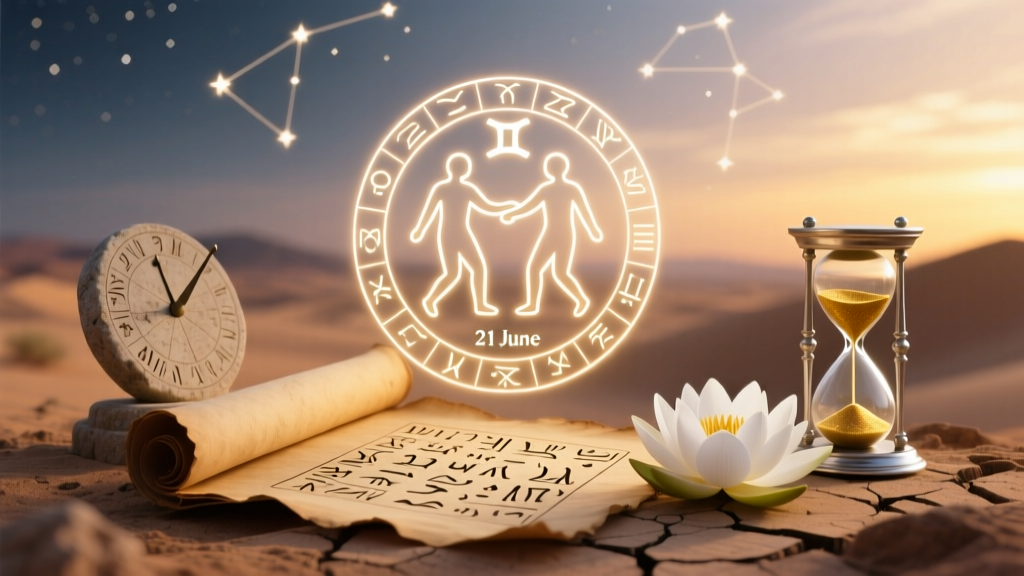
Determining the exact zodiac sign for 21 June requires a journey into ancient astronomical history. Because this date frequently falls on the astrological cusp between Gemini and Cancer, modern pop horoscopes often debate its placement. However, historical astrology relies on the summer solstice and the precise mathematical degree of the Sun. To understand the true zodiac sign for 21 June, we must examine Babylonian star catalogs, Ptolemy’s tropical zodiac framework, and the mythological origins that shaped how ancient civilizations interpreted this pivotal transitional period in the celestial calendar. The answer is rooted in millennia of observational astronomy, requiring us to separate seasonal mechanics from constellation boundaries.
The Babylonian Roots: MUL.APIN and the Ecliptic
Long before the Greeks formalized the zodiac, Babylonian astronomers meticulously tracked the Sun's path along the ecliptic. The earliest comprehensive star catalog, known as the MUL.APIN (compiled around 1000 BCE), did not use the 12 equal signs we recognize today. Instead, it mapped the sky into three paths belonging to the gods Anu, Enlil, and Ea. By the Achaemenid period (5th century BCE), Babylonian astrologers standardized the ecliptic into twelve equal 30-degree segments to simplify mathematical calculations for planetary positions. According to the World History Encyclopedia's archive on Babylonian Astronomy, this mathematical division birthed the tropical zodiac, anchoring the fourth sign, Cancer (known to them as Alluttu, the Crab), to the exact point of the summer solstice.
Ptolemy and the Tropical Zodiac Framework
The definitive historical framework for Western astrology was established by Claudius Ptolemy in the 2nd century CE. In his foundational text, the Tetrabiblos, Ptolemy explicitly divorced the zodiac signs from the physical constellations. He anchored the zodiac to the Earth's seasonal cycle rather than the fixed stars. As detailed in Britannica's biographical entry on Claudius Ptolemy, this tropical system dictates that 0 degrees Cancer is the precise mathematical point where the Sun reaches its maximum northern declination. Therefore, historically and astronomically within the Western tradition, the summer solstice marks the absolute beginning of Cancer.
Defining the Zodiac Sign for 21 June: The Solstice Anchor
When evaluating the zodiac sign for 21 June, modern confusion arises from the solar transition occurring precisely on this date. Depending on the leap year cycle and the exact time of the solstice, the Sun enters 0°00' Cancer on either June 20 or June 21. In historical astrology, there is no ambiguity: the moment the solstice occurs, the Sun ingresses into Cancer. If a birth occurs on June 21 prior to the exact minute of the solstice, the historical sign is Gemini. If it occurs after the solstice ingress, the sign is Cancer. This strict mathematical boundary was non-negotiable in ancient practice.
| Era / Civilization | Astronomical System | Designation for June 21 | Key Historical Text |
|---|---|---|---|
| Old Babylonian (c. 1800 BCE) | Irregular Constellations | Path of Anu / Enlil | Venus Tablet of Ammisaduqa |
| Neo-Babylonian (c. 500 BCE) | 12-Sign Equal Zodiac | 0° Cancer (Alluttu) | MUL.APIN Compendium |
| Hellenistic Egypt (c. 150 CE) | Tropical Zodiac | Summer Solstice Point | Ptolemy's Tetrabiblos |
Mythological Origins: The Crab and the Solstice Retreat
The association of the crab with the summer solstice predates Greek mythology, originating in Mesopotamian observations of the Sun's behavior. However, the Greeks codified this through the myth of Karkinos. During Hercules' battle with the Lernaean Hydra, Hera sent a giant crab to distract the hero. Though Hercules crushed the crab, Hera placed it in the heavens as a reward for its loyalty. Symbolically, the crab perfectly represents the solar mechanics of late June. Just as a crab walks sideways and possesses a hard protective shell, the Sun reaches its highest peak (the solstice) and begins its sideways, retreating descent back toward the celestial equator. The days begin to shorten, mimicking the backward scuttle of the crustacean.
The Hellenistic Rejection of the Cusp Concept
Modern astrology frequently describes June 21 as the Gemini-Cancer cusp, suggesting a blended personality profile. This concept is entirely absent from historical astrology. Hellenistic astrologers like Vettius Valens and Dorotheus of Sidon operated on strict degree boundaries. They utilized a system of bounds (horia) and terms, which divided each 30-degree sign into smaller, unequal segments ruled by different planets. A planet located at 29°59' Gemini was analyzed exclusively through the lens of Gemini and the specific bound ruler of that final degree. The energy did not bleed into Cancer until the exact mathematical ingress occurred. Valens explicitly documented the use of dodecatemoria (the twelfth-parts) to find hidden planetary influences, further proving that ancient astrologers relied on complex internal sign divisions rather than arbitrary cusp blending.
Astronomical Precession: Sign vs. Constellation
To fully grasp the history of this date, one must address the precession of the equinoxes, discovered by Hipparchus of Nicaea in 127 BCE. Due to the Earth's axial wobble, the background constellations shift backward by approximately one degree every 72 years. Today, on June 21, the Sun is physically located in the constellation of Taurus or early Gemini, not the constellation of Cancer. However, Western astrology utilizes Ptolemy's tropical zodiac, which is tied to the seasons, not the stars. The sidereal zodiac, utilized in Vedic astrology (Jyotish), accounts for this precession using an ayanamsa correction. Under the Lahiri ayanamsa, a June 21 tropical Cancer placement translates to a sidereal Gemini placement. Understanding this distinction is critical for researchers comparing Western historical texts with Eastern astronomical traditions.
Practical Framework for Historical Accuracy
To accurately determine the historical zodiac placement for a June 21 birth, astrologers must follow a rigorous analytical protocol:
- Obtain Exact Birth Time: The solstice ingress shifts by roughly six hours each year. A birth at 8:00 AM might fall in Gemini, while a birth at 8:00 PM falls in Cancer.
- Calculate True Solar Longitude: Use a Swiss Ephemeris to find the exact degree, minute, and second of the Sun's position at the moment of birth.
- Apply the Tropical Framework: Anchor the calculation to the vernal equinox (0° Aries) to maintain continuity with the Ptolemaic tradition.
- Analyze the Bounds (Horia): If the Sun is at 29° Gemini, identify the specific planetary ruler of that final degree to understand the nuanced historical expression of the placement.
By adhering to these historical methodologies, the interpretation of late June births transcends modern pop-astrology generalizations, grounding the analysis in the rigorous mathematical and mythological traditions of antiquity.