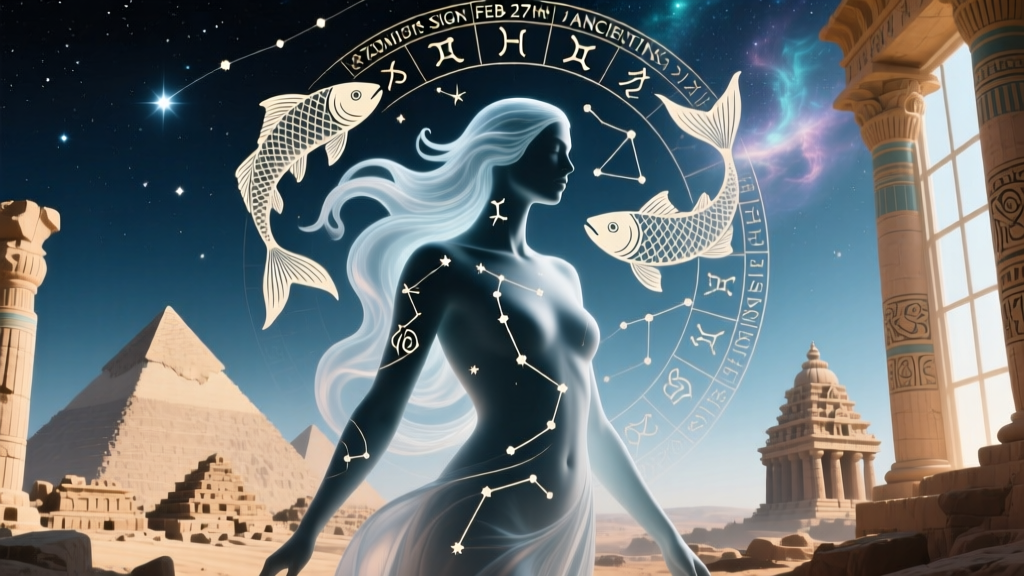
Individuals born on this date fall under the zodiac sign for Feb 27th: Pisces. While modern horoscopes often reduce this mutable water sign to vague tropes about empathy and daydreaming, the historical and mythological origins of Pisces reveal a profoundly complex archetype rooted in ancient Mesopotamian cosmology and Hellenistic syncretism. To truly understand the astrological blueprint of a late-February Pisces, we must examine the celestial cartography of the Babylonians, the mythic narratives of the Greeks, and the astronomical mechanics that separate the tropical zodiac from the visible night sky.
The Babylonian Roots: The Great One and the Swallow
The earliest documented origins of the Pisces constellation do not feature two fish, but rather a complex amalgamation of Mesopotamian deities. According to the MUL.APIN, an ancient Babylonian compendium of astronomical and astrological texts compiled around 1100 BCE, the region of the sky we now associate with Pisces was divided into two distinct asterisms. The first was SIM.MAH (The Swallow), associated with the goddess Anunitum, a deity of war and the evening star. The second was GU.LA (The Great One), representing Enki (later known as Ea), the Sumerian god of water, knowledge, and creation.
As Babylonian astrology evolved into the Hellenistic period, these two disparate figures were syncretized into the 'Twin Fishes.' The Open Richly Annotated Cuneiform Corpus (ORACC) notes that the Akkadian term rikis nūni (the cord of the fishes) was used to describe the starry pathway connecting them. This celestial cord represented the binding of the physical and spiritual realms, a foundational concept that would later define the psychological duality of the Pisces archetype. For a native born on February 27th, this ancient Babylonian lineage manifests as an innate tension between profound earthly responsibilities (Enki's domain) and the desire for transcendent spiritual liberation (Anunitum's celestial ascent).
Hellenistic Synthesis and the Myth of Aphrodite
When Alexander the Great conquered Persia, Babylonian celestial observations merged with Greek mythology, formalizing the zodiac sign for Feb 27th into the Hellenistic framework. The definitive text for this transition is Claudius Ptolemy’s Tetrabiblos (2nd century CE), which established the tropical zodiac used by Western astrologers today. According to Ptolemy's Tetrabiblos (LacusCurtius), Pisces is a feminine, nocturnal, and mutable water sign, traditionally co-ruled by Jupiter and Venus before the modern discovery of Neptune.
The Greek mythological origin of the twin fishes is tied to the monstrous Titan Typhon. According to Ovid’s Metamorphoses, when Typhon attacked Mount Olympus, Aphrodite and her son Eros (Cupid) fled to the Euphrates River. To escape the monster's wrath, they transformed into fish and tied themselves together with a woven cord so they would not be separated in the turbulent waters. This myth of the 'cord' (the asterism Linum Piscium) is crucial for understanding the Feb 27th personality profile. It signifies an archetype defined by deep, sometimes binding, relational attachments and the necessity of maintaining a tether to reality while navigating emotional depths.
Vedic Astrology: Meena Rashi and the Cosmic Ocean
To gain a complete historical perspective, we must contrast the Western tropical view with the Sidereal system of Vedic astrology (Jyotish). In the Hindu tradition, the equivalent to Pisces is Meena Rashi. Unlike the Greek myth of fleeing from danger, the Vedic symbolism of the two fish swimming in opposite directions represents the cyclical nature of karma and the dual currents of Pravritti (engagement with the material world) and Nivritti (withdrawal for spiritual liberation).
Meena is the final sign of the zodiac, representing the dissolution of the ego into the cosmic ocean before rebirth. Ruled by Guru (Jupiter), the historical texts like the Brihat Parashara Hora Shastra describe this sign as the repository of all past-life wisdom. For the February 27th native, analyzing their chart through a Sidereal lens often shifts the sun into Aquarius (Kumbha), but the underlying esoteric theme of the 'water-bearer' pouring into the 'ocean of Pisces' remains a vital evolutionary milestone in Vedic cosmology.
Astronomical Shift: The True Zodiac Sign for Feb 27th
A common point of confusion in modern astrology is the discrepancy between the astrological signs and the actual astronomical constellations. Due to the precession of the equinoxes—a slow wobble of the Earth's axis over a 25,772-year cycle—the tropical zodiac (which is anchored to the seasons) has drifted approximately 24 degrees away from the visible sidereal constellations. Therefore, while the tropical zodiac sign for Feb 27th is unequivocally Pisces, the Sun is astronomically positioned in the constellation of Aquarius on this date.
The International Astronomical Union (IAU) formalized the exact boundaries of the 88 modern constellations in 1930, highlighting this astronomical divergence. The table below illustrates the precise positional data for a February 27th birth date:
| System / Framework | Designation for Feb 27th | Ruling Planet (Historical/Modern) | Element & Modality |
|---|---|---|---|
| Western Tropical Zodiac | Pisces (330° - 360°) | Jupiter (Traditional) / Neptune (Modern) | Mutable Water |
| Vedic Sidereal (Lahiri Ayanamsa) | Aquarius (Kumbha) | Saturn (Shani) | Fixed Air |
| IAU Astronomical Constellation | Aquarius | N/A (Astronomical mapping only) | N/A |
Esoteric Evolution and Jungian Psychology
In the late 19th and early 20th centuries, the historical archetype of Pisces underwent a radical psychological re-evaluation. Theosophists and early depth psychologists, most notably Carl Jung, reinterpreted the ancient 'twin fishes' not as literal deities, but as representations of the unconscious mind and the integration of the shadow. Jung viewed the Piscean era as a historical epoch defined by the tension of opposites, requiring the individual to achieve 'individuation' by reconciling conflicting inner drives.
For the late-February native, this esoteric history provides a powerful framework. The 'cord' that binds the Babylonian and Greek fishes is reimagined as the psychological tether that prevents the mutable water sign from entirely dissolving into the collective unconscious. The historical evolution of Pisces from an agrarian water deity to a complex psychological archetype demands that modern practitioners approach this sign with rigorous introspection rather than superficial emotional categorization.
Actionable Framework: Applying Historical Archetypes Today
Understanding the deep history of your zodiac sign allows for highly specific, actionable spiritual and psychological practices. Individuals born on February 27th can utilize the following historically grounded frameworks for personal development:
- The Enki Protocol (Boundary Setting): Drawing on the Babylonian god of boundaries and deep waters, practice structured emotional containment. Dedicate 15 minutes daily to 'cord-cutting' visualization, consciously severing energetic ties to external stressors to prevent empathetic burnout.
- Hellenistic Relational Audits: Reflecting on the myth of Aphrodite’s binding cord, evaluate your closest relationships. Identify which connections act as a grounding tether versus those that drag you into turbulent emotional undertows. Restructure your social environment based on mutual stabilization.
- Vedic Dissolution Practices: Embrace the Meena archetype of ego-dissolution through non-dual meditation (such as Yoga Nidra). Focus on the transition state between waking and sleeping to access the subconscious wisdom attributed to the final sign of the zodiac.
- Shadow Integration (Jungian): Map the 'two fish swimming in opposite directions.' Journal your conscious desires (the upward-swimming fish) and your repressed, shadow impulses (the downward-swimming fish). Actively find one practical way to integrate a repressed trait into your waking life each month.
By anchoring the zodiac sign for Feb 27th in its rich, multi-millennial history, the native transcends generic horoscopic advice, gaining access to a profound lineage of cosmic cartography and psychological depth.