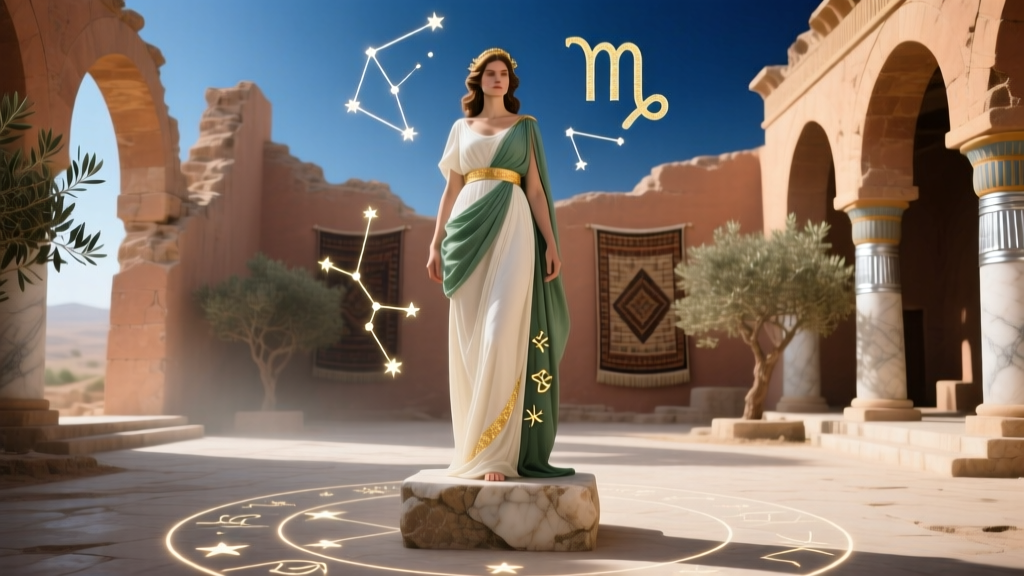
Individuals researching the zodiac sign for Sep 16 are looking at the 23rd and 24th degrees of the ecliptic longitude known as Virgo. While modern pop astrology reduces this earth sign to mere perfectionism or anxiety, the historical and mythological origins of this specific celestial coordinate reveal a far more complex, powerful archetype. Born at the threshold of the autumnal equinox, the September 16 birthday carries the accumulated weight of ancient Babylonian agriculture, Hellenistic planetary rulerships, and syncretic goddess worship. To understand the true psychological blueprint of this birthdate, we must excavate the origin story of the Maiden and the Furrow, tracing how ancient astronomers mapped the harvest.
The Astronomical Roots: Babylonian Shala and the Furrow
Long before the Greeks envisioned a maiden in white robes, the Mesopotamians mapped this region of the sky as AB.SIN, meaning 'The Furrow.' According to the State Archives of Assyria Online and translations of the MUL.APIN (a comprehensive Babylonian star catalog compiled around 1000 BCE), this constellation represented the goddess Shala. Shala was a deity of grain and agriculture, often depicted holding a massive ear of barley.
This origin story is critical for understanding the foundational psychology of the Virgo archetype. The Furrow was not merely a symbol of passive nature; it was a testament to human engineering, irrigation, and the meticulous accounting of crop yields. The Babylonians viewed this sector of the zodiac as the ultimate ledger of survival. For those born on September 16, this ancient association manifests as an innate drive to categorize, optimize, and ensure the 'harvest' of their daily efforts. The analytical nature of Virgo is not a modern neurosis; it is an ancient survival mechanism rooted in the agricultural accounting of the Bronze Age.
Hellenistic Syncretism and the Maiden of Eleusis
As astrological knowledge transferred from Babylon to Alexandria, the constellation underwent a process of Hellenistic syncretism. The ear of grain held by Shala was reinterpreted by Greek astronomers as the star Spica, and the figure transformed into Parthenos (The Maiden). This Maiden was frequently conflated with Demeter (the goddess of the harvest) and her daughter Persephone, tying the constellation directly to the Eleusinian Mysteries—the most sacred initiation rites of ancient Greece.
In his foundational text Ptolemy's Tetrabiblos, the 2nd-century astronomer Claudius Ptolemy classified the stars in this region as 'Mercurial and somewhat Saturnine,' denoting a blend of intellectual agility and structural discipline. However, Ptolemy noted that the bright star Spica possessed a 'Venusian and Martial' nature. This duality—intellectual earthiness mixed with Venusian aesthetics—forms the bedrock of the historical Virgo personality, demanding both utility and beauty in equal measure.
Why the Zodiac Sign for Sep 16 Defies Generic Virgo Stereotypes
On September 16, the Sun is positioned at approximately 23° to 24° of Virgo. To understand the specific origin story of this birthday, we must look to the Hellenistic system of Decans and Bounds (Terms), which divides each sign into smaller, highly specific micro-zones.
- The Chaldean Decan: The 23rd degree falls into the Third Decan of Virgo. In the Chaldean system, this decan is ruled by Venus. This injects a profound appreciation for aesthetics, diplomacy, and material refinement into the typically austere Virgo archetype.
- The Ptolemaic Bounds: According to the Egyptian terms codified by Ptolemy, the degrees from 21° to 28° of Virgo are governed by Mars.
This creates a rare astrological synthesis: a Venus-ruled decan operating within a Mars-ruled bound, all grounded in the mutable earth of Virgo. Historically, this specific coordinate was associated with the 'sculpting of the harvest.' It represents the aggressive defense of one's resources (Mars) combined with the refinement of one's environment (Venus).
Historical Interpretations of Virgo Across Eras
| Era / Culture | Constellation Name | Core Archetype & Symbolism | Planetary Association |
|---|---|---|---|
| Babylonian (c. 1000 BCE) | AB.SIN (The Furrow) | Agricultural ledger, survival, Shala's barley | Mercury (via later syncretism) |
| Egyptian (Hellenistic Era) | Isis-Horia | Isis holding the infant Horus; protective mother | Mercury / Venus |
| Greek (Classical) | Parthenos (The Maiden) | Demeter/Persephone; the harvest and the underworld | Mercury |
| Hellenistic Decan (Sep 16) | Third Decan of Virgo | The aesthetic refinement and defense of the yield | Venus (Decan) / Mars (Bound) |
How Ancient Origins Shape the Modern September 16 Personality
When we synthesize the Babylonian Furrow, the Eleusinian Maiden, and the Venus-Mars micro-rulerships, a highly specific psychological profile emerges for the September 16 individual. This is not the stereotypical 'nervous' Virgo. According to Encyclopaedia Britannica's historical analysis of the constellation, the evolution of Virgo from a furrow to a goddess represents the civilization of raw nature into structured society.
Individuals born on this date possess an innate understanding of systemic aesthetics. Because their specific degree is touched by Venus, they cannot tolerate ugly systems. A spreadsheet or a daily routine must not only be efficient; it must be visually and logically elegant. Furthermore, the Martian bound gives them the executive function to ruthlessly prune away habits, relationships, or projects that fail to meet their rigorous standards. They are the architects of the harvest, possessing both the vision to design the garden and the blade to cut the weeds.
Actionable Guidance Based on Historical Archetypes
To leverage the deep historical current of the zodiac sign for Sep 16, individuals born on this day should align their daily practices with their ancient astrological blueprint. Vague advice like 'relax more' ignores the martial and venusian drives of this specific degree. Instead, implement the following historically grounded frameworks:
- Strategic Environmental Curation: Honor the Venusian decan by auditing your physical workspace for aesthetic friction. Aggressively eliminate tools that do not serve a precise, functional purpose, and invest in high-quality, beautiful implements for your daily tasks. The Babylonian scribe used the finest stylus; you should demand the same of your environment.
- Somatic Harvesting: The Martian bound of the 23rd degree requires physical expenditure to process mental stress. Engage in 'somatic harvesting'—activities that yield a tangible, physical result from your effort, such as landscaping, woodworking, or weightlifting. This satisfies the ancient urge to shape the earth.
- Diplomatic Accounting: Channel the goddess Shala’s ledger by keeping a meticulous record of your energy expenditures, not just your finances. Use a weekly audit to track which relationships and projects yield a high 'caloric return' on your emotional investment, and use your Martian bounds to sever ties with energy-deficit ventures.
By understanding the origin story of the Maiden and the Furrow, the September 16 individual transforms their perceived earthly burdens into a historical mandate: to cultivate, refine, and fiercely protect the harvest of their life's work.