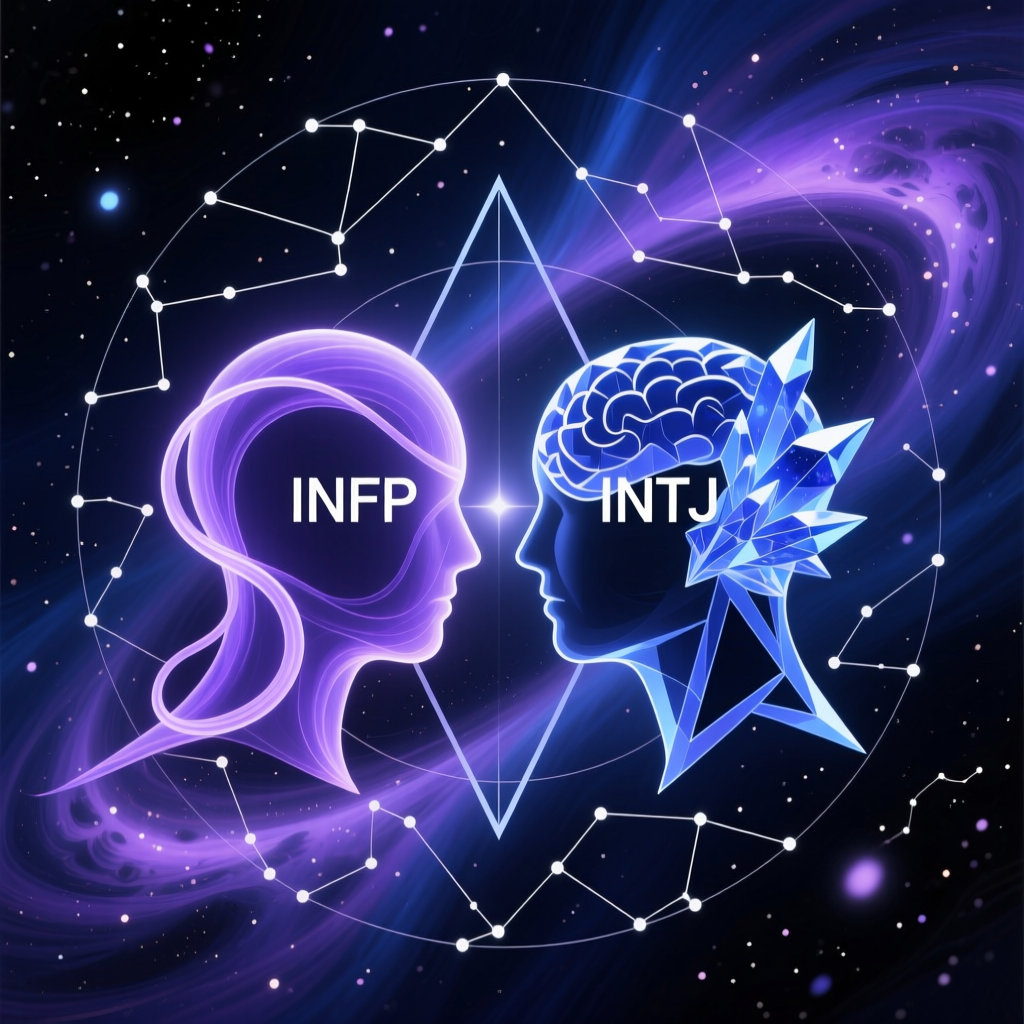
When an INFP and an INTJ come together, the result is one of the most intellectually stimulating and emotionally layered pairings in the Myers-Briggs Type Indicator. On the surface, these two types may seem like an unlikely match — the INFP leads with feeling while the INTJ leads with logic. Yet beneath the surface, they share a powerful common language: intuition. Both types live in the world of ideas, possibilities, and meaning, which creates a magnetic pull that few other pairings can replicate.
This article explores every dimension of INFP and INTJ romantic compatibility — from the spark that draws them together to the friction points that test their bond. Whether you are an INFP curious about your INTJ partner, an INTJ trying to decode your INFP significant other, or simply fascinated by personality-based relationship dynamics, this deep dive will give you the insight you need to understand, nurture, and celebrate this extraordinary connection.
Romantic Dynamics: Where Idealism Meets Strategy
The romantic relationship between an INFP and an INTJ is often described as a meeting of the philosopher and the architect. The INFP brings warmth, emotional depth, and a relentless search for authenticity, while the INTJ contributes vision, structure, and a commitment to long-term growth. Together, they create a partnership that is both emotionally rich and strategically sound.
The Initial Attraction
What draws an INFP and an INTJ together is rarely superficial. The INFP is captivated by the INTJ’s quiet confidence, intellectual rigor, and unwavering sense of purpose. There is something deeply attractive to an INFP about a person who knows exactly who they are and where they are going. Meanwhile, the INTJ is drawn to the INFP’s authenticity, creativity, and emotional intelligence. In a world that often feels shallow and transactional, the INFP represents something rare and genuine — a person who cares deeply about meaning and human connection.
Both types are introverted, which means their courtship tends to be slow-burning and deliberate. Neither is likely to rush into a relationship. The INFP wants to feel certain that the connection is meaningful, and the INTJ wants to be confident that the partnership is compatible in the long run. This mutual caution, paradoxically, often strengthens the foundation of the relationship because by the time they commit, both partners have thoroughly considered the decision.
Shared Values & Long-Term Vision
One of the greatest strengths of the INFP-INTJ pairing is their shared desire for a purposeful life. Neither type is content with mediocrity or conformity. The INFP dreams of a life aligned with personal values and creative expression, while the INTJ envisions a life built on competence, mastery, and strategic achievement. While their methods differ, their underlying drive — to live a life that matters — is remarkably aligned.
This shared idealism translates into powerful long-term compatibility. When an INFP and an INTJ build a life together, they often create a shared vision that is both emotionally fulfilling and practically achievable. The INFP ensures the vision remains human-centered and values-driven, while the INTJ ensures it is realistic and well-executed. Explore more about how intuitive types connect in our guide to intuitive type relationships.
Emotional Intimacy & Vulnerability
Emotional intimacy is where this pairing faces its most interesting challenge and its greatest opportunity for growth. The INFP craves deep emotional connection and is generally willing to be vulnerable, sharing their inner world with someone they trust. The INTJ, on the other hand, tends to guard their emotions carefully and may take much longer to open up.
When the INTJ does choose to be vulnerable with their INFP partner, it is a profound act of trust — and the INFP recognizes this. The INFP’s natural empathy and non-judgmental acceptance create a safe space for the INTJ to express feelings they might never share with anyone else. In return, the INTJ’s loyalty and consistency give the INFP the security they need to continue being open. This mutual exchange of trust is the emotional bedrock of the relationship.
Friendship Patterns: The Quiet Understanding
Before they are lovers, many INFP-INTJ couples are friends — and their friendship patterns reveal a great deal about why this pairing works so well. Both types value depth over breadth in their social lives. They would rather have one or two truly meaningful connections than a wide circle of superficial acquaintances.
As friends, the INFP and INTJ often bond over shared intellectual interests — philosophy, psychology, literature, science, art, or any topic that allows them to explore ideas in depth. Their conversations can last for hours, moving seamlessly between abstract theories and personal reflections. The INFP brings emotional nuance and imaginative perspectives, while the INTJ contributes analytical frameworks and strategic thinking.
One of the most beautiful aspects of their friendship is the comfortable silence they share. Both types understand the need for solitude and do not interpret quiet moments as disconnection. They can sit together in the same room, each absorbed in their own activity, and feel completely at ease. This mutual respect for personal space is a gift that carries over into their romantic relationship and prevents the kind of suffocation that can occur when two introverts do not understand each other’s need for alone time.
The INFP often helps the INTJ develop greater emotional awareness and interpersonal sensitivity, while the INTJ helps the INFP build confidence in their decision-making and long-term planning. This reciprocal growth is what transforms their friendship from a pleasant connection into a transformative bond. Learn more about INFP personality traits that make them such empathetic friends.
Workplace Synergy: Complementary Strengths in Action
When an INFP and an INTJ collaborate in a professional setting, their complementary strengths can produce outstanding results. The INFP excels in roles that require empathy, creativity, and values-driven communication — think counseling, writing, design, or advocacy. The INTJ thrives in positions that demand strategic planning, systems thinking, and independent problem-solving — such as engineering, research, management, or entrepreneurship.
In a team environment, the INFP serves as the emotional compass, ensuring that projects remain aligned with human values and that team members feel heard and respected. The INTJ serves as the strategic engine, ensuring that goals are clearly defined, resources are efficiently allocated, and obstacles are systematically addressed. Together, they cover each other’s blind spots beautifully.
Potential workplace friction arises when the INFP perceives the INTJ as too blunt or dismissive of people’s feelings, or when the INTJ perceives the INFP as too idealistic or inefficient. However, when both types recognize and respect their differences, they can build a professional partnership that balances heart and head in a way that neither could achieve alone. For more on how these types function professionally, see our INTJ career guide and INFP career paths articles.
Communication Styles: Bridging Feeling & Thinking
Communication is both the greatest challenge and the greatest growth opportunity in an INFP-INTJ relationship. The INFP communicates primarily through the lens of Introverted Feeling (Fi), which means they process the world through personal values, emotions, and a deep sense of what feels right or wrong. The INTJ communicates through the lens of Introverted Intuition (Ni) and Extraverted Thinking (Te), which means they prioritize patterns, efficiency, and logical coherence.
How the INFP Communicates
The INFP tends to be indirect and nuanced in their communication. They often hint at their feelings rather than stating them outright, hoping their partner will intuitively pick up on emotional cues. They value harmony and may avoid confrontation, sometimes suppressing their needs to keep the peace. When they do express themselves, their language is often rich with metaphor, imagery, and emotional subtext.
How the INTJ Communicates
The INTJ is direct, precise, and efficiency-oriented. They say what they mean and expect others to do the same. They have little patience for ambiguity or passive-aggressive communication and may become frustrated when they feel their partner is not being straightforward. However, their directness is rarely intended to be hurtful — it is simply their natural mode of expression.
Bridging the Gap
The key to effective communication between these two types lies in mutual adaptation. The INFP can benefit from practicing more direct expression of their needs and feelings, rather than expecting the INTJ to read between the lines. The INTJ can benefit from softening their delivery and recognizing that emotional expression is not inefficiency — it is a valid and important form of communication.
When both partners make these adjustments, they develop a communication style that is both honest and compassionate — a rare and powerful combination. Discover more about communication between feeling and thinking types in our detailed guide.
Conflict Resolution: Navigating Emotional & Logical Friction
Every relationship experiences conflict, and the INFP-INTJ pairing is no exception. However, the way these two types handle disagreement reveals both their vulnerabilities and their strengths.
Typical Conflict Patterns
When conflict arises, the INFP’s instinct is often to withdraw. They need time and space to process their emotions before they can engage in a productive conversation. If pushed to respond immediately, they may become overwhelmed, tearful, or shut down entirely. The INTJ, conversely, prefers to address issues head-on. They want to identify the problem, analyze it logically, and implement a solution as quickly as possible.
This mismatch in conflict styles can create a painful cycle: the INTJ pushes for resolution, the INFP withdraws, the INTJ becomes frustrated by the withdrawal and pushes harder, and the INFP retreats further. Breaking this cycle requires conscious effort from both partners.
Strategies for Healthier Conflict Resolution
For the INFP, the most important step is to communicate the need for processing time rather than simply withdrawing in silence. A simple “I need a few hours to think about this, and then I want to talk” can prevent the INTJ from interpreting the withdrawal as avoidance or indifference.
For the INTJ, the most important step is to validate the INFP’s emotional experience before jumping to solutions. Statements like “I can see this is really important to you” or “I want to understand how you’re feeling” go a long way in helping the INFP feel safe enough to engage.
When both partners commit to these adjustments, conflict becomes an opportunity for deeper understanding rather than a source of resentment. The INFP learns to articulate their needs more clearly, and the INTJ learns to lead with empathy before logic. For additional insights, read our article on MBTI conflict resolution strategies.
Cognitive Function Interplay: The Engine Beneath the Surface
To truly understand INFP-INTJ compatibility, we need to look beneath the four-letter type codes and examine the cognitive functions that drive each personality. This is where the deepest insights — and the most meaningful growth opportunities — are found.
INFP Cognitive Function Stack
- Dominant: Introverted Feeling (Fi) — A deeply personal value system that guides decisions based on authenticity and moral alignment.
- Auxiliary: Extraverted Intuition (Ne) — A capacity for seeing possibilities, generating ideas, and exploring “what if” scenarios.
- Tertiary: Introverted Sensing (Si) — A connection to past experiences, routines, and personal memories.
- Inferior: Extraverted Thinking (Te) — A developing capacity for organization, efficiency, and objective logic.
INTJ Cognitive Function Stack
- Dominant: Introverted Intuition (Ni) — A pattern-recognition system that synthesizes information into a singular vision or insight.
- Auxiliary: Extraverted Thinking (Te) — A drive for efficiency, structure, and external organization.
- Tertiary: Introverted Feeling (Fi) — A developing sense of personal values and emotional authenticity.
- Inferior: Extraverted Sensing (Se) — A less-developed awareness of the present physical environment.
The Function Dance
What makes the INFP-INTJ pairing so fascinating is the way their cognitive functions mirror and complement each other. Both types share Fi and Te in their function stacks, but in different positions. The INFP leads with Fi while the INTJ has Fi in the tertiary position. The INTJ leads with Te in the auxiliary position while the INFP has Te as their inferior function.
This creates a dynamic where each partner can help the other develop their weaker functions. The INFP can help the INTJ connect with and articulate their deeper values and feelings (Fi development), while the INTJ can help the INFP build practical skills in organization, planning, and objective decision-making (Te development). This mutual function development is one of the most powerful aspects of the relationship and is a key reason why many INFP-INTJ couples report significant personal growth as a result of their partnership.
Their shared use of intuition — Ne for the INFP and Ni for the INTJ — means they both live in the world of ideas and possibilities, even though they approach that world differently. The INFP’s Ne generates a wide array of possibilities and connections, while the INTJ’s Ni narrows those possibilities down to the most likely and strategically sound outcome. Together, they can brainstorm expansively and then focus effectively — a combination that serves them well in every area of life. Read more about cognitive functions explained in our comprehensive guide.
Practical Tips for a Thriving INFP-INTJ Relationship
Understanding the theory behind your compatibility is valuable, but applying that understanding in daily life is what truly makes a relationship flourish. Here are practical, actionable tips for both partners:
For the INFP
- Practice direct communication. Your INTJ partner genuinely wants to understand you, but they need you to say what you mean. Instead of hoping they will pick up on subtle cues, express your needs and feelings clearly and specifically.
- Appreciate their love language. The INTJ shows love through actions — solving problems, planning for the future, and creating systems that make your life easier. Recognize these gestures as expressions of deep care, even if they are not accompanied by effusive emotional declarations.
- Give them intellectual space. The INTJ needs time to think, analyze, and pursue their interests independently. This is not a rejection of you — it is how they recharge and maintain their sense of competence.
- Don’t take bluntness personally. When your INTJ partner gives direct feedback, it is almost always intended to be helpful, not hurtful. Try to hear the intention behind the words.
- Share your creative world. Your imagination, artistic sensibility, and emotional depth are gifts. Invite your INTJ partner into your inner world — they will be fascinated and moved by what they find.
For the INTJ
- Lead with empathy. Before offering a solution, acknowledge your INFP partner’s feelings. A few words of validation can transform a difficult conversation into a moment of connection.
- Express your feelings verbally. Your INFP partner needs to hear that you love them, appreciate them, and value the relationship. Do not assume they already know — say it out loud, even when it feels uncomfortable.
- Be patient with processing time. When conflict arises, give your INFP partner the space they need to process their emotions. Pushing for immediate resolution will only deepen the rift.
- Embrace spontaneity occasionally. While you thrive on plans and structure, your INFP partner often finds joy in unplanned moments of creativity and exploration. Let yourself be surprised.
- Validate their idealism. The INFP’s dreams and values are not impractical fantasies — they are the compass that gives their life meaning. Honor their vision, even if you would approach things differently.
For Both Partners
- Create shared rituals. Whether it is a weekly walk, a monthly book discussion, or a nightly check-in, shared rituals create a sense of stability and connection that benefits both types.
- Respect the need for solitude. Both of you are introverts who need alone time. Normalize this need and communicate about it openly so that neither partner feels neglected or smothered.
- Keep learning together. Your shared love of ideas is one of your strongest bonds. Take a class, explore a new subject, or start a project together to keep your intellectual connection alive and growing.
- Celebrate your differences. Rather than trying to change each other, recognize that your differences are what make the relationship so rich and transformative. The INFP softens the INTJ; the INTJ strengthens the INFP.
Frequently Asked Questions
Are INFP and INTJ considered a good match?
Yes, the INFP and INTJ are widely considered one of the most compatible pairings in the MBTI framework. Their shared intuitive orientation creates a natural intellectual connection, while their complementary feeling and thinking preferences allow each partner to help the other grow. Both types value depth, authenticity, and long-term commitment, which provides a strong foundation for a lasting relationship. Of course, individual maturity, life experiences, and willingness to communicate all play critical roles in any relationship’s success.
What are the biggest challenges in an INFP-INTJ relationship?
The most common challenges revolve around communication styles and emotional expression. The INFP may feel that the INTJ is too blunt, emotionally distant, or overly focused on efficiency at the expense of feelings. The INTJ may feel that the INFP is too sensitive, indirect, or prone to overthinking emotional situations. Conflict resolution styles also differ significantly — the INFP tends to withdraw while the INTJ tends to confront. Overcoming these challenges requires conscious effort, patience, and a genuine willingness to understand each other’s perspective. For more on personality-based relationship challenges, see our MBTI relationship challenges guide.
How do INFP and INTJ handle emotional intimacy?
Emotional intimacy develops slowly but deeply in an INFP-INTJ relationship. The INFP is generally more comfortable with emotional vulnerability and may open up earlier in the relationship. The INTJ takes longer to trust and reveal their inner emotional world, but when they do, the depth of their commitment and feeling is profound. The INFP’s empathy and acceptance create a safe container for the INTJ’s emotional expression, while the INTJ’s loyalty and consistency give the INFP the security they need to remain open. Over time, this creates an intimate bond that is both emotionally rich and intellectually stimulating.
Can an INFP-INTJ relationship work long-term?
Absolutely. In fact, the INFP-INTJ pairing has several characteristics that support long-term success. Both types are introverted and value deep, committed relationships over casual connections. Both are future-oriented and motivated by personal growth. Both share a disdain for superficiality and a commitment to living authentically. When both partners are willing to invest in understanding each other’s communication styles, respect each other’s need for independence, and actively nurture their emotional and intellectual connection, this pairing can produce one of the most fulfilling and enduring partnerships in the MBTI spectrum. Explore more about long-term MBTI relationship success in our detailed resource.