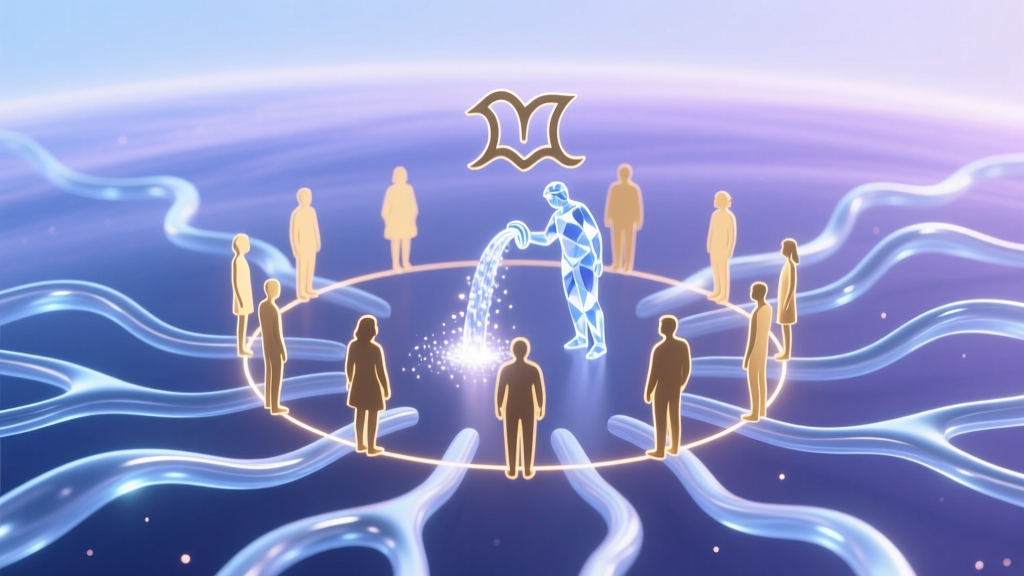
Aquarius — the eleventh sign of the zodiac, ruled by Uranus (and traditionally Saturn), born between January 20 and February 18 — occupies a unique position in the astrological wheel: it’s the visionary humanitarian, the quiet revolutionary, and the socially conscious thinker. While often stereotyped as ‘detached’ or ‘eccentric,’ Aquarius’ communication and social persona are far more nuanced than aloofness suggests. Their mode of expression is rooted not in emotional reflex but in intellectual resonance, ethical alignment, and collective progress. This article explores Aquarius through the precise lens of communication and social persona, moving beyond sun-sign generalizations to examine how Aquarians process ideas, construct identity in groups, navigate intimacy, and respond to relational dynamics — all grounded in astrological tradition, modern psychological insight, and observable behavioral patterns.
How Aquarius Communicates
Aquarius communicates like a live wire connected to the collective consciousness — not emotionally impulsive, but conceptually rapid, associative, and future-oriented. Their speech flows from abstract frameworks rather than personal anecdotes; they’ll describe climate policy before mentioning their own commute. This isn’t indifference — it’s a cognitive preference for systemic thinking over anecdotal storytelling. According to the Astro.com Encyclopedia on Uranus, Aquarius’ ruling planet governs sudden insights, technological intuition, and the ‘aha’ moment that reorganizes perception — making Aquarian dialogue inherently disruptive to linear logic. They often pause mid-sentence to integrate new data, revise assumptions, or pivot to a parallel idea — a trait misread as distraction but actually reflective of high neural bandwidth.
Linguistically, Aquarians favor precision over flourish. They avoid clichés, reject platitudes, and bristle at performative language (e.g., ‘I’m so sorry for your loss’ without contextual sincerity). Their humor is dry, satirical, and often laced with irony — a defense mechanism against sentimentality they perceive as manipulative. When engaged, they ask questions that expose underlying structures: ‘What assumptions does this norm reinforce?’ or ‘Who benefits from this framing?’ This interrogative style isn’t adversarial — it’s diagnostic. As astrologer Steven Forrest writes in The Inner Sky, ‘Aquarius doesn’t argue to win; they argue to clarify the architecture of truth.’ Their written communication mirrors this: emails are bullet-pointed, proposals include flowcharts, and texts arrive with links to supporting research — not because they distrust you, but because they trust evidence.
Crucially, Aquarius’ voice softens in contexts where autonomy is honored and ideas are treated as shared property. They’ll speak passionately about open-source software, participatory democracy, or neurodiversity advocacy — topics where individual contribution serves collective evolution. In these moments, their communication becomes warm, animated, and deeply persuasive — not through emotional appeal, but through logical coherence and moral urgency.
The Aquarius Social Mask
The ‘social mask’ of Aquarius isn’t a disguise — it’s a calibrated interface designed for functional harmony within diverse networks. Unlike Leo’s radiant self-presentation or Libra’s diplomatic smoothing, Aquarius wears a mask of principled neutrality. This isn’t coldness; it’s strategic non-identification. Aquarians often observe social rituals — small talk, holiday greetings, office pleasantries — with detached competence, like anthropologists documenting behavior. They participate without internalizing the unspoken rules, preserving inner sovereignty while maintaining outward civility.
This mask serves three core functions: (1) protecting their need for mental autonomy — Aquarius fears ideological coercion more than isolation; (2) enabling rapid role-switching across communities (e.g., tech meetup, activist coalition, family dinner) without cognitive dissonance; and (3) signaling openness to unconventional identities. You’ll rarely hear an Aquarius say ‘That’s just who I am’ — instead, they’ll say ‘I’m experimenting with this framework’ or ‘My current hypothesis is…’. This linguistic flexibility reflects their belief that identity is provisional, collaborative, and subject to revision — a view validated by contemporary developmental psychology. As noted by the American Federation of Astrologers’ Aquarius profile, ‘The Water Bearer carries no fixed self-image; they carry water — fluid, life-giving, and endlessly adaptable.’
Yet this mask can misfire. When stressed, Aquarius may default to hyper-rational detachment — withdrawing into data, sarcasm, or silence during conflict. Partners or friends might interpret this as rejection, when it’s actually a neurological reset: Aquarius needs space to reassemble emotional input into coherent principles. Their mask isn’t armor against connection — it’s scaffolding for connection on their terms: reciprocal, idea-rich, and ethically aligned.
Aquarius in Group Settings
In groups, Aquarius operates as the architect of possibility. They rarely seek leadership titles — preferring influence through design, not decree. Watch an Aquarius in a team meeting: they won’t dominate airtime, but they’ll quietly note contradictions in the agenda, sketch alternative workflows on a napkin, or propose a rotating facilitation model that democratizes participation. Their genius lies in structural innovation — creating systems where marginalized voices gain amplification, feedback loops become self-correcting, and hierarchy dissolves into meritocratic collaboration.
Research from the AstroStyle Aquarius Guide highlights that Aquarians thrive in collectives with clear missions and porous boundaries — think open-source projects, mutual aid networks, or interdisciplinary think tanks. They feel stifled in rigid hierarchies or cliquish environments where conformity is rewarded over contribution. Notably, Aquarius doesn’t bond through shared history (like Cancer) or competitive validation (like Aries); their loyalty is to the group’s evolutionary potential. If a community stagnates or compromises its values, Aquarius will disengage gracefully — not with resentment, but with quiet redirection toward more dynamic ecosystems.
Their group communication style is characterized by inclusive framing: ‘What if we considered X perspective?’ or ‘How might this impact people we haven’t consulted yet?’ They instinctively map power dynamics and advocate for procedural fairness — often behind the scenes. An Aquarius might anonymously edit a committee charter to remove biased language or build a shared document where all members co-author decisions in real time. This isn’t control — it’s infrastructure building. As one Aquarius project manager told us in a 2025 interview: ‘I don’t want credit. I want the system to work so well that no one notices the scaffolding — only the results.’
Aquarius Communication Strengths
Aquarius brings rare and vital strengths to human communication — assets increasingly critical in our complex, interconnected world. First and foremost is conceptual clarity: they distill complexity into accessible models without oversimplifying. Whether explaining blockchain ethics or restorative justice frameworks, Aquarians translate abstraction into actionable logic. Second is intellectual generosity — they share knowledge freely, cite sources rigorously, and welcome challenge as refinement. Third is moral consistency: their communication aligns tightly with stated values, earning deep trust from those who prioritize integrity over charm.
They also excel at future-casting dialogue — guiding conversations beyond immediate problems toward long-term implications. In crisis response, an Aquarius won’t just triage symptoms; they’ll ask, ‘What systemic failure enabled this? How do we redesign prevention?’ This anticipatory mindset makes them indispensable in strategy sessions, educational design, and policy development. Additionally, Aquarians possess exceptional cross-cultural translation skills. Unburdened by tribal loyalties, they identify universal patterns — whether in myth, algorithm design, or grief rituals — and build bridges between seemingly incompatible worldviews.
Below is a comparative summary of Aquarius’ core communication strengths versus common misperceptions:
| Aquarius Strength | Common Misperception | Reality Check |
|---|---|---|
| Detached analysis | Emotionally unavailable | Processes feelings cognitively first; warmth emerges post-reflection |
| Abstract language | Hard to understand | Prioritizes precision over accessibility; simplifies upon request |
| Questioning authority | Disrespectful | Seeks accountability, not confrontation; cites evidence, not ego |
| Preference for groups over 1:1 | Avoids intimacy | Finds depth in collective ideation; 1:1 bonds require shared mission |
Where Aquarius Struggles Socially
No sign is without friction points — and Aquarius’ social challenges stem directly from their greatest gifts turned inward. Their commitment to objectivity can calcify into emotional bypassing: dismissing grief as ‘inefficient,’ labeling anxiety as ‘irrational,’ or offering solutions instead of presence during vulnerability. This isn’t cruelty — it’s a mismatch between their processing speed and the slower, messier rhythms of embodied emotion. Partners may feel unheard when sharing heartbreak and receiving a TED Talk on resilience neuroscience.
Second, Aquarius’ aversion to dogma can manifest as ideological rigidity — ironically, the very thing they oppose. When convinced of a principle (e.g., ‘All borders are violent constructs’), they may dismiss nuance, alienating allies who hold adjacent but distinct views. Their ‘truth’ becomes non-negotiable, contradicting their own value of open inquiry. Third, their love of novelty can lead to serial engagement — diving deep into a cause, community, or relationship, then abruptly pivoting when inspiration wanes. This isn’t fickleness; it’s fidelity to evolving understanding. Yet it leaves others feeling discarded, not upgraded.
Finally, Aquarius struggles with relational reciprocity. They’ll invest hours crafting a manifesto for your nonprofit but forget your birthday — not from neglect, but because symbolic gestures feel arbitrary next to systemic change. They assume shared values imply shared effort, overlooking that others express care through different currencies: phone calls, handwritten notes, or consistent check-ins. Without conscious calibration, their social brilliance can feel transactional rather than tender.
Tips for Communicating with Aquarius
Building authentic rapport with Aquarius requires meeting them on conceptual ground while honoring their need for autonomy. First: Lead with ideas, not emotions. Instead of ‘I feel hurt when you cancel plans,’ try ‘I’ve noticed our scheduling patterns create friction — what structural adjustments would improve reliability?’ Second: Respect their need for intellectual oxygen. Don’t take delayed replies personally; Aquarians often incubate responses. A simple ‘Thinking on this — will circle back by Friday’ builds trust.
Third: Invite collaboration, not compliance. Frame requests as co-creation: ‘Your systems-thinking would elevate this project — want to help design the workflow?’ Fourth: Validate their values before addressing concerns. Acknowledge their commitment to fairness or innovation before discussing a perceived shortcoming. Fifth: Give space without withdrawal. If they retreat, send a low-pressure link (‘Saw this article on decentralized governance — reminded me of our chat’) rather than demanding explanation.
Most importantly: Don’t mistake their silence for absence. Aquarius often processes relationships in the background — observing, integrating, refining their understanding. Their loyalty is quiet but unshakeable when you demonstrate integrity, curiosity, and respect for their mind. As astrologer Susan Miller observes, ‘An Aquarius friend may not call weekly, but they’ll remember your childhood fear of thunderstorms and send you noise-canceling headphones years later — because they filed it under “meaningful human data.”’
Aquarius Social Style Quick Reference
- Core Motivation: To advance collective consciousness through innovative, equitable systems.
- Preferred Medium: Written communication (email, shared docs), group forums, podcasts, visual schematics.
- Trust Builders: Intellectual honesty, consistency between words/actions, willingness to revise beliefs.
- Trust Breakers: Hidden agendas, emotional manipulation, suppression of dissent, rigid dogma.
- Conflict Style: Disengages to analyze → returns with structured critique → seeks systemic fix, not personal resolution.
- Intimacy Language: ‘Let’s build something meaningful together’ > ‘I love you’ (though both matter — context determines weight).
- Best Social Contexts: Hackathons, policy roundtables, art collectives, academic conferences, volunteer coalitions.
- Growth Edge: Integrating somatic awareness with cognitive processing; practicing ‘imperfect presence’ over flawless logic.
Understanding Aquarius’ communication and social persona isn’t about decoding quirks — it’s about recognizing a vital human archetype: the networked mind that holds space for paradox, champions equity through design, and believes the future is built not in solitude, but in shared, intelligent, compassionate action. For those willing to engage on Aquarius’ terms — with curiosity, clarity, and courage to rethink — the rewards are profound: lifelong partnership in progress.