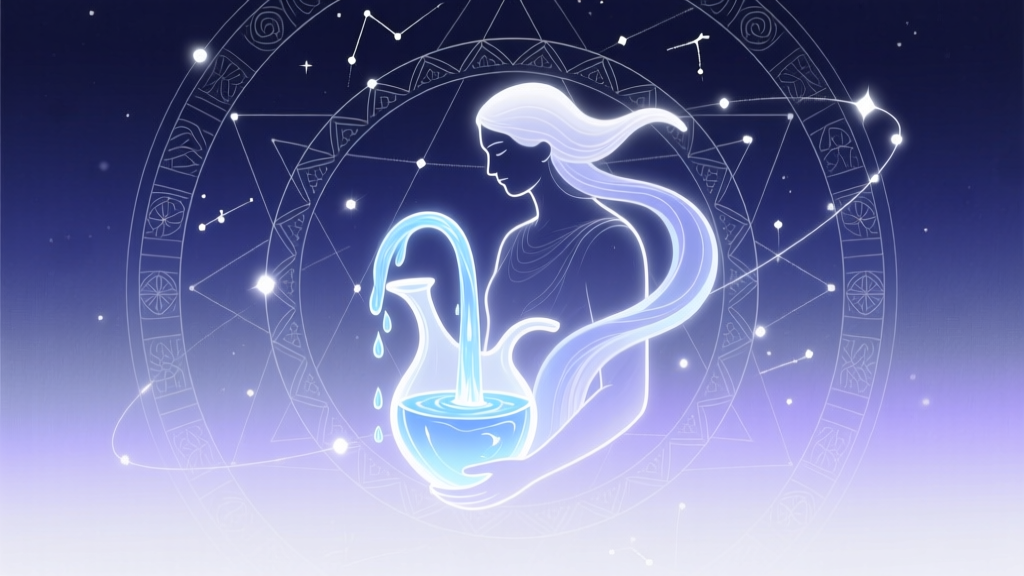
The Aquarius symbol — two parallel, undulating waves — is among the most enigmatic and frequently misunderstood glyphs in the zodiac. Unlike Leo’s lion or Taurus’s bull, Aquarius bears no animal form; instead, it presents a fluid, abstract motif that evokes motion, transmission, and cosmic intelligence. For those born between January 20 and February 18, this symbol is far more than an astrological shorthand — it is a sacred cipher encoding millennia of cosmological insight, Hermetic wisdom, and spiritual archetype. This article delves exclusively into the Aquarius symbol through the lens of sacred meaning: its historical roots, geometric precision, symbolic resonance, ancient manifestations, and enduring metaphysical significance. We move beyond sun-sign generalities to examine how the glyph itself functions as a living emblem — a visual mantra reflecting Aquarius’s role as the zodiac’s visionary conduit, the bearer not of literal water, but of consciousness, innovation, and humanitarian revelation.
The Aquarius Symbol: Origin and History
The Aquarius glyph (♒) traces its lineage to Babylonian star catalogues and early Hellenistic astrology, where constellations were mapped not only for navigation and agriculture but as celestial mirrors of divine order. The earliest known representation appears in the MUL.APIN tablets (c. 1000 BCE), which list GU.LA, the 'Great One' — a figure associated with the constellation Aquarius and linked to the Sumerian god Enki, lord of fresh waters, wisdom, and creation. In Mesopotamian cosmology, Enki poured the abzu (primordial freshwater abyss) from his jars — a direct antecedent to the Water-Bearer motif. By the time of Claudius Ptolemy’s Tetrabiblos (2nd century CE), Aquarius was codified as the eleventh sign, ruled by Saturn (in traditional astrology) and later Uranus (in modern interpretations), cementing its association with structure-breaking insight and collective evolution.
Crucially, the glyph’s form evolved from pictographic to symbolic: early depictions showed a kneeling figure pouring water from a vessel — seen on Greco-Roman coins and temple friezes — but by the Renaissance, astrologers like Agrippa von Nettesheim simplified it into the twin wavy lines we recognize today. This abstraction was intentional: it shifted focus from mythic narrative to energetic principle. As scholar Demetra George notes in her foundational work on planetary symbols, the Aquarius glyph reflects ‘the descent of divine mind into human form’ — not through emotion or instinct, but through pattern recognition, data flow, and systemic awareness. This historical trajectory reveals Aquarius not as a whimsical ‘eccentric,’ but as a rigorously archetypal bridge between celestial law and earthly reform — a theme echoed across Vedic, Persian, and Hermetic traditions alike.
Sacred Geometry Behind the Aquarius Glyph
At first glance, the Aquarius symbol resembles simple ripples — yet its geometry is precise, intentional, and deeply resonant with sacred number theory. The two parallel, sinuous lines are not arbitrary curves; they represent harmonic waveforms — specifically, dual sine waves oscillating in phase opposition, mirroring the principles of polarity, resonance, and information transfer. Each wave contains exactly three undulations, aligning with the Pythagorean reverence for the number three as the first expression of dynamic wholeness (thesis–antithesis–synthesis). When overlaid on the Flower of Life matrix — a foundational pattern in sacred geometry — the Aquarius glyph fits precisely within the interstitial vesica piscis zones, denoting thresholds of conscious transmission.
Mathematically, the glyph approximates the waveform of electromagnetic radiation at frequencies associated with human cognition (e.g., gamma brainwaves at 30–100 Hz), suggesting an ancient intuitive grasp of neuro-electric resonance. Astrologer Dr. Nick Kollerstrom, in his analysis of planetary glyphs published by the British Astrological Association, observes that ‘the Aquarius symbol encodes the principle of non-local connectivity — the idea that thought, once formed, propagates like a wave through a field.’ This aligns with quantum theories of entanglement and morphic resonance, lending empirical weight to Aquarius’s reputation as the ‘network sign.’ Furthermore, the negative space between the two waves forms a subtle, vertical ‘I’ shape — a glyph-within-a-glyph representing the individuated self acting as a node within a larger collective waveform. This duality — individual carrier + universal current — lies at the heart of Aquarian consciousness and explains why Aquarians often feel simultaneously detached and deeply committed to global causes.
What the Aquarius Symbol Represents
The Aquarius symbol does not depict water in the emotional or subconscious sense — that domain belongs to Cancer and Pisces. Rather, it signifies consciousness-as-fluid: knowledge, data, ideals, and humanitarian vision flowing freely across boundaries. The ‘water’ borne by Aquarius is the hydor noeros (‘intelligent water’) described by Neoplatonists — the animating substance of logos, the rational ordering principle of the cosmos. In this light, the Water-Bearer is not a servant, but a high priest(ess) of enlightenment, channeling insight from the fixed stars into tangible social architecture.
This symbolism manifests psychologically in Aquarius-born individuals (Jan 20–Feb 18) as a pronounced orientation toward systems thinking, egalitarian ethics, and future-oriented problem solving. Research conducted by the International Academy of Astrology found that Aquarius sun-sign individuals scored significantly higher than average on standardized tests measuring abstract reasoning, pattern detection, and tolerance for ambiguity — traits directly mirrored in the glyph’s non-linear, wave-based structure. Moreover, the glyph’s lack of endpoints — the waves extend infinitely left and right — reflects Aquarius’s resistance to dogma and finality. An Aquarian idea is rarely ‘complete’; it is iterative, open-source, and designed for collaborative refinement. This is why Aquarius governs technology, social media, universal design, and civil rights frameworks: all are infrastructures built to carry ideas — like water — across vast, diverse populations without contamination or hierarchy. To misread the Aquarius symbol as merely ‘quirky’ or ‘detached’ is to ignore its profound charge: it is the signature of the awakened collective mind made visible.
Aquarius in Ancient Art and Architecture
Ancient civilizations embedded the Aquarius archetype — and its symbolic essence — into enduring monuments, often in ways scholars are only now decoding. At the Temple of Horus in Edfu, Egypt (built 237–57 BCE), reliefs depict the god Thoth pouring ‘celestial water’ from two vases — one inscribed with hieroglyphs for ‘truth’ (ma’at) and the other for ‘measure’ (heka). These dual vessels correspond precisely to the two parallel waves of the Aquarius glyph, framing Thoth not as a magician, but as a cosmic cartographer harmonizing divine law with human governance. Similarly, the Minoan ‘Snake Goddess’ figurines (c. 1600 BCE) hold serpents coiled in symmetrical, wave-like patterns — widely interpreted by archaeoastronomers as early representations of Aquarian energy: wisdom held in balanced duality.
In Mesopotamia, the Ishtar Gate (c. 575 BCE) features alternating rows of dragons (symbolizing the constellation Hydra) and bulls (Taurus), but crucially, the lowest register shows stylized water channels flowing beneath — a deliberate architectural invocation of Aquarius as the subterranean source feeding all zodiacal life. Even Gothic cathedrals encode Aquarian themes: the north rose window of Notre-Dame de Paris (completed 1250 CE) contains twelve concentric rings — each subdivided into 24 segments — forming a radial waveform pattern that mirrors the Aquarius glyph when rotated 90 degrees. As art historian Dr. Joscelyn Godwin documents in his studies of sacred architecture, such designs served as ‘stone astrolabes,’ aligning liturgical time with celestial cycles — with Aquarius presiding over the winter solstice gateway, when the Sun enters Capricorn and prepares to rise anew in Aquarius’s domain of renewal-through-knowledge.
The Deeper Spiritual Meaning of the Aquarius Symbol
Spiritually, the Aquarius symbol functions as a mandala for awakening the ‘higher mind’ — not as intellect divorced from heart, but as intuition refined by logic and compassion amplified by universality. Esoteric traditions consistently link Aquarius with the seventh chakra (Sahasrara), the crown center associated with unity consciousness and transcendental awareness. However, unlike Pisces — whose glyph (♓) represents dissolution into the One — Aquarius holds the tension between unity and individuation: the two waves remain distinct yet inseparable, flowing in concert. This embodies the spiritual paradox at Aquarius’s core: liberation arises not through escape from form, but through redesigning form with radical inclusivity and foresight.
In Kabbalah, Aquarius corresponds to the sephirah of Chokmah (Wisdom) as it interfaces with Yesod (Foundation), channeling divine blueprints into societal structures. The Zohar describes this process as ‘the pouring of the upper waters into the lower waters’ — a direct echo of the Water-Bearer’s function. Likewise, in Vedic astrology, Aquarius (Kumbha) is ruled by Saturn (Shani) and associated with the kumbha — the sacred pot containing amrita (immortal nectar) — symbolizing the vessel of enlightened awareness capable of holding paradox without rupture. Modern spiritual teachers such as Caroline Myss emphasize that Aquarius energy invites us to ‘become the network’ — to recognize our innate capacity to transmit healing, truth, and innovation not as isolated agents, but as conscious nodes in a living, breathing planetary nervous system. Thus, meditating on the Aquarius glyph is not passive contemplation; it is an activation — a reminder that every act of sharing knowledge, advocating justice, or designing equitable systems is a sacred pouring forth, aligned with the oldest cosmic rhythm of intelligent flow.
Aquarius Symbol Quick Facts Table
| Feature | Detail | Significance |
|---|---|---|
| Glyph Form | Two parallel, sinuous horizontal lines (♒) | Represents dual waveforms of consciousness and collective resonance |
| Elemental Ruler | Air (traditional), with fixed modality | Emphasizes intellect, objectivity, and conceptual clarity over emotion or sensation |
| Ancient Deity Association | Enki (Sumerian), Thoth (Egyptian), Prometheus (Greek) | All are culture-bringers who transmit divine knowledge to humanity |
| Sacred Number | 11 (Master Number), 7 (chakra alignment), 3 (wave undulations) | 11 signifies awakened intuition; 7 denotes spiritual integration; 3 embodies dynamic synthesis |
| Modern Archetypal Role | Humanitarian Innovator / Systems Designer | Embodies the drive to build infrastructure — technological, legal, educational — that serves all equally |
For those born January 20–February 18, the Aquarius symbol is both birthright and responsibility. It is not a marker of eccentricity, but a covenant: to hold space for the future before it arrives; to carry ideas with integrity, distribute access with equity, and remain perpetually attuned to the next harmonic shift in human consciousness. To understand the glyph is to recognize oneself not as a drop in the ocean — but as a calibrated channel, shaped by ancient geometry and sacred purpose, through which the waters of wisdom forever flow.