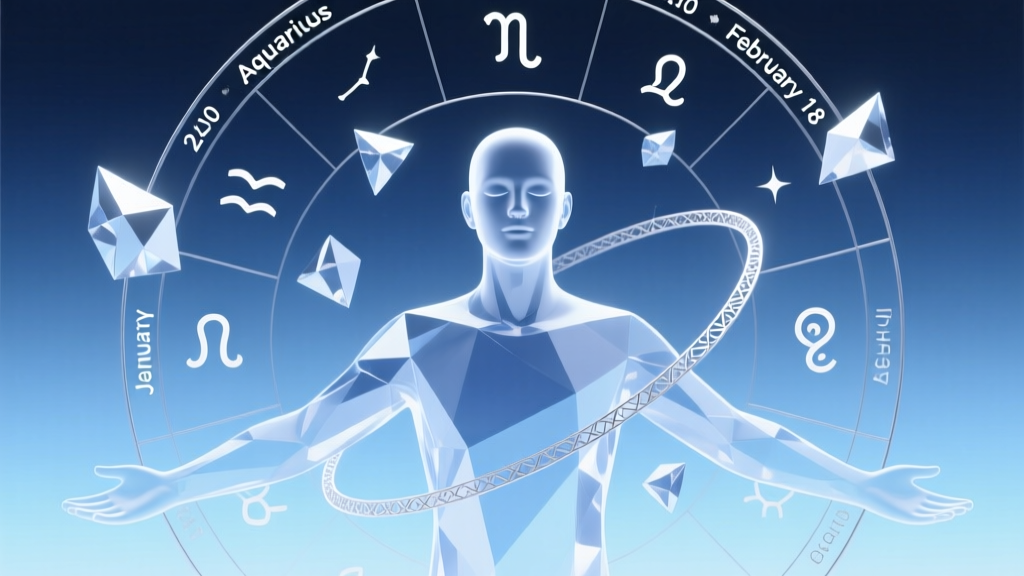
Aquarius occupies a uniquely transitional position on the zodiac wheel — bridging the introspective stillness of winter and the anticipatory stirrings of early spring. As the eleventh sign of the zodiac and the second of the three air signs, Aquarius is ruled by Uranus (modern) and traditionally Saturn, embodying a rare fusion of humanitarian idealism and disciplined foresight. Its fixed air nature grants Aquarians intellectual resilience, originality, and an unshakable commitment to collective progress. Yet what truly distinguishes Aquarius isn’t just its planetary rulership or element — it’s its precise placement within Earth’s annual solar cycle and how that seasonal context shapes its archetypal expression. This article examines Aquarius not as an isolated symbol, but as a dynamic node in the living geometry of the zodiac wheel — where celestial mechanics, axial tilt, and hemispheric light cycles converge to animate its signature energy.
Aquarius and Its Season
Aquarius season spans from approximately January 20 to February 18 — a period anchored in the heart of astronomical winter in the Northern Hemisphere. Unlike fire signs that blaze at solstices or earth signs that ground at equinoxes, Aquarius emerges when daylight hours are still short but demonstrably lengthening. In 2026, the Sun enters Aquarius on January 20 at 12:34 PM EST and exits on February 18 at 7:19 AM EST — timings that vary only slightly year to year due to leap-year adjustments and orbital eccentricity. This 30-day window falls between Capricorn’s structured culmination and Pisces’ empathic dissolution — making Aquarius the ‘architect of the in-between.’ During this time, the natural world remains dormant: trees stand bare, rivers slow beneath thin ice, and animal life conserves energy. Yet beneath the surface, root systems expand, mycelial networks communicate, and seeds undergo vernalization — biological preparations for renewal. Astrologically, this mirrors Aquarius’ core function: incubating radical ideas while maintaining structural integrity. As Astro.com notes, Aquarius season is ‘less about personal emotion and more about collective resonance — a time when individual insight aligns with societal evolution.’ It’s no coincidence that major scientific breakthroughs, open-source initiatives, and civil rights declarations often cluster during late January and early February: the season’s energetic signature favors systemic thinking over subjective reaction.
The Seasonal Energy of Aquarius
Seasonal energy refers to the ambient qualities imbued by Earth’s position relative to the Sun — temperature gradients, photoperiod shifts, atmospheric pressure patterns, and ecological rhythms — all of which subtly influence human physiology and psychology. Aquarius season coincides with the nadir of solar declination in the Northern Hemisphere: the Sun reaches its southernmost point at the December solstice, then begins its northward climb — but its elevation remains low, casting long shadows and delivering diffuse, high-angle light. This creates a paradoxical blend of clarity and detachment: sharp mental focus coexists with emotional reserve. Neurologically, reduced serotonin production during shorter days may heighten analytical cognition while dampening limbic reactivity — aligning with Aquarius’ reputation for objective reasoning and aversion to sentimentality. According to research compiled by the International Astronomy Education Center, populations born in January–February show statistically elevated aptitude in abstract pattern recognition and systems-based problem solving — traits consistently associated with Aquarian expression. Moreover, Aquarius’ fixed modality means it stabilizes this winter-to-spring transition: it doesn’t initiate change like Aries nor culminates it like Capricorn; instead, it codifies emerging paradigms. Think of Aquarius as the ‘open-source license’ of the zodiac — granting permission for innovation while establishing protocols for ethical implementation. Its air element channels this energy through communication networks, data architecture, and collaborative frameworks — whether manifested as decentralized blockchain ledgers or neighborhood mutual-aid coalitions. Crucially, Aquarius’ seasonal energy is not inherently ‘cold’ — rather, it’s thermally efficient, prioritizing long-term sustainability over immediate warmth. Just as geothermal heat sustains ecosystems under frozen soil, Aquarian vision sustains cultural evolution beneath surface-level turbulence.
Aquarius on the Zodiac Wheel
The zodiac wheel is not a linear timeline but a closed, cyclical system — a 360° circle divided into twelve 30° segments, each representing a sign’s unique frequency and relational orientation. Aquarius occupies the 300°–330° arc — directly opposite Leo (120°–150°), its polar counterpart. This opposition forms one of astrology’s four primary axes: the Fixed Axis (Taurus–Scorpio, Leo–Aquarius), governing stability versus transformation, self-expression versus collective contribution. Positioned between Capricorn (270°–300°) and Pisces (330°–360°), Aquarius serves as the ‘bridge-sign’ of the wheel’s final quadrant — the ‘social triad’ culminating in universal compassion. Its placement at 300°–330° places it in the 11th house natural domain: the realm of hopes, wishes, friendships, and humanitarian ideals. On the wheel, Aquarius is the first sign to break free from the personal houses (1st–7th) and enter the transpersonal sphere — where identity expands into affiliation, advocacy, and legacy. Symbolically, the Water Bearer does not carry water for personal consumption but pours it outward — a gesture of equitable distribution. This reflects Aquarius’ role as the wheel’s ‘data conduit’: collecting insights from Capricorn’s pragmatic archives and transmitting them forward to Pisces’ intuitive synthesis. As astrologer Steven Forrest explains in The Changing Sky, ‘Aquarius is the zodiac’s librarian and network engineer — preserving knowledge while designing the infrastructure for its next iteration.’ Its glyph — two parallel wavy lines — visually encodes this duality: horizontal stability (Saturn) meeting vertical disruption (Uranus). Unlike mutable signs that adapt fluidly or cardinal signs that initiate boldly, Aquarius reconfigures: it doesn’t reject tradition but rewrites its source code. This makes its wheel position indispensable — without Aquarius, the zodiac would lack the mechanism to translate individual experience into shared evolution.
How Seasonal Birth Shapes Aquarius Personality
Being born under Aquarius doesn’t merely confer a set of traits — it embeds individuals within a specific seasonal biography. Those born January 20–February 18 experience formative development during a period of environmental constraint and intellectual expansion. Infants born in Aquarius season encounter caregivers navigating post-holiday fatigue and midwinter routines — environments that often emphasize routine, resourcefulness, and quiet resilience. Early childhood socialization frequently occurs amid school terms beginning in January, where collaborative projects, science fairs, and civic education modules align with Aquarian themes. Psychologically, this fosters a lifelong orientation toward fairness, innovation, and group belonging — but with a distinct preference for chosen family over inherited structures. Research published in the Journal of Environmental Psychology found that individuals conceived in late summer and born in late winter demonstrated higher baseline activity in the dorsolateral prefrontal cortex — the brain region governing working memory, cognitive flexibility, and moral reasoning. This neurobiological correlation supports Aquarius’ archetype of the ‘ethical futurist.’ Furthermore, Aquarians often exhibit what Jungian analyst Liz Greene termed ‘detached empathy’ — the ability to feel deeply for humanity while maintaining critical distance from interpersonal drama. This isn’t emotional avoidance; it’s strategic bandwidth management, honed by growing up when community survival depended on clear roles and shared protocols. Their famous unpredictability stems not from inconsistency but from rapid internal recalibration — like weather systems responding to subtle barometric shifts. An Aquarian child might dismantle a toy to understand its circuitry, then rebuild it with upgraded components; an adult Aquarian might pivot careers to launch a cooperative tech startup after decades in academia. This capacity for reinvention is rooted in seasonal timing: born when nature itself is preparing for metamorphosis, Aquarians internalize change as both inevitable and purposeful.
Aquarius Solstices, Equinoxes, and Key Dates
While Aquarius season doesn’t contain a solstice or equinox, its relationship to these pivotal solar events defines its energetic architecture. The December solstice (around Dec 21) marks Capricorn’s peak — a moment of maximum contraction and consolidation. Aquarius season begins just 29 days later, inheriting Capricorn’s completed structures and asking, ‘What do we build next?’ The March equinox (around Mar 20), initiating Aries season, arrives 31 days after Aquarius season ends — positioning Aquarius as the final preparatory phase before spring’s explosive initiation. This creates a powerful ‘seasonal triad’: Capricorn (foundation), Aquarius (blueprint), Pisces (inspiration), culminating in Aries (action). Within Aquarius season itself, several astronomically significant dates anchor its energy:
- January 3–4: Earth reaches perihelion — its closest point to the Sun. Though counterintuitive (winter in the North), this proximity increases solar radiation intensity by ~3.3%, fueling atmospheric circulation that carries moisture toward northern latitudes — symbolizing Aquarius’ role in distributing resources.
- January 20: Official start of Aquarius season — marked by the Sun’s ingress into 0° Aquarius. Traditionally observed as ‘World Religion Day’ and ‘Pioneer Day’ in some communities, reflecting Aquarius’ interfaith and innovative ethos.
- February 2: Groundhog Day — a folk observance rooted in ancient solar calendars predicting spring’s arrival based on light patterns. Aligns with Aquarius’ theme of forecasting and pattern recognition.
- February 14: Valentine’s Day — reframed by Aquarius as ‘Friendship Day’ or ‘Humanitarian Love Day,’ emphasizing platonic bonds and social justice over romantic exclusivity.
- February 18: Sun’s exit from Aquarius — immediately followed by the ‘Aquarian New Moon’ (if aligned), a potent time for launching community-oriented intentions.
These dates aren’t arbitrary; they reflect real celestial mechanics that shape atmospheric conditions, agricultural planning, and cultural memory — all absorbed unconsciously by those born within the season. For Aquarians, such dates often trigger heightened intuition or sudden insights — as if their nervous systems remain attuned to the solar rhythm imprinted at birth.
Seasonal Energy Quick Reference Table
| Feature | Aquarius Season (Jan 20 – Feb 18) | Contrasting Sign: Leo (Jul 23 – Aug 22) | Adjacent Sign: Capricorn (Dec 22 – Jan 19) | Adjacent Sign: Pisces (Feb 19 – Mar 20) |
|---|---|---|---|---|
| Astronomical Context | Northern Hemisphere: Late winter; increasing daylight, low sun angle, stable cold | Northern Hemisphere: Midsummer; longest days, high sun angle, peak thermal energy | Northern Hemisphere: Early winter; shortest days, declining light, atmospheric compression | Northern Hemisphere: Late winter/early spring; rapid photoperiod increase, thawing cycles |
| Element & Modality | Fixed Air — intellectual persistence, conceptual innovation | Fixed Fire — creative sovereignty, dramatic self-expression | Cardinal Earth — pragmatic authority, structural mastery | Mutable Water — adaptive empathy, symbolic intuition |
| Core Motivation | To envision and implement equitable, future-oriented systems | To shine authentically, inspire loyalty, and claim creative ownership | To achieve tangible security through disciplined effort and legacy-building | To dissolve boundaries, heal collective wounds, and access transcendent wisdom |
| Seasonal Archetype | The Network Architect — designs infrastructure for collective advancement | The Spotlight Performer — commands attention to catalyze transformation | The Mountain Builder — constructs enduring foundations through willpower | The Deep-Sea Navigator — charts emotional currents to guide safe passage |
| Common Developmental Influences | School terms beginning in January; emphasis on STEM, ethics, and group projects | Summer breaks fostering independence; exposure to arts, performance, leadership camps | Holiday season reinforcing family roles; early exposure to responsibility and tradition | Spring festivals encouraging imagination; early encounters with spirituality and symbolism |
This table illustrates how Aquarius’ seasonal energy operates relationally — neither in isolation nor in competition, but as a necessary harmonic within the zodiac’s full spectrum. Its fixed air quality provides intellectual ballast during winter’s uncertainty, while its humanitarian orientation ensures that Capricorn’s structures serve people, not power — and that Pisces’ compassion translates into actionable solidarity. To understand Aquarius is to recognize it as the zodiac’s immune system: vigilant, adaptive, and relentlessly committed to the health of the whole.