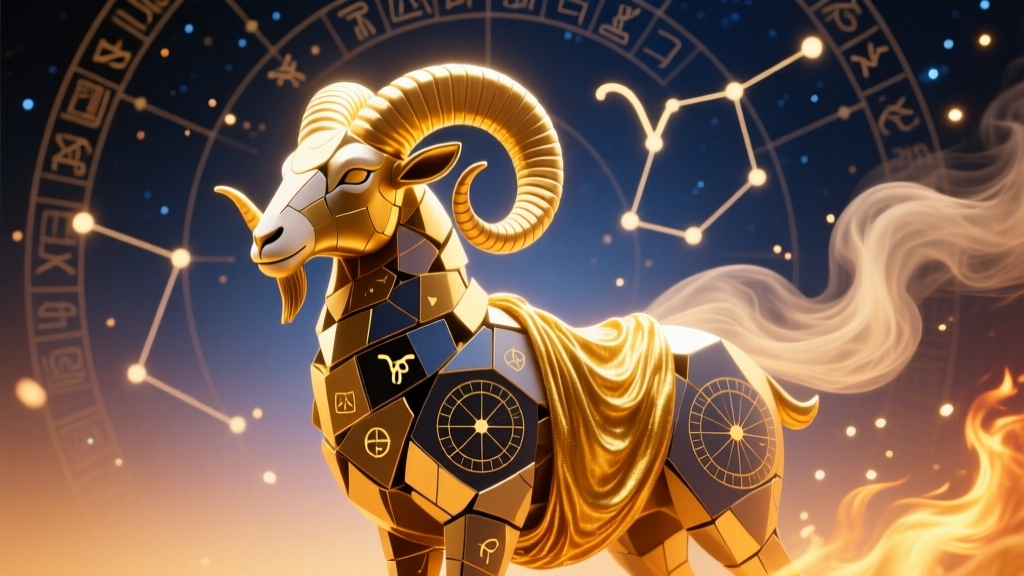
Aries—the first sign of the zodiac, spanning March 21 to April 19—carries more than just astrological symbolism. Its identity is deeply rooted in millennia of myth, ritual, and celestial observation. Unlike signs whose stories evolved gradually, Aries emerges with startling clarity from foundational myths across civilizations: as a divine ram, a sacrificial offering, a cosmic herald of spring, and a symbol of raw, untempered courage. To understand Aries is not merely to list its traits—boldness, initiative, impatience—but to descend into the sacred narratives that birthed those qualities. This article traces Aries from its earliest attested origins in Mesopotamian astronomy through its transformation in Greek and Roman myth, its role in ancient religious calendars, and its enduring resonance in modern psychological astrology. We examine not only what Aries represents—but why, through the lens of mythic precedent, cultural reverence, and astronomical alignment.
The Myth Behind Aries
The myth behind Aries is not a single tale but a layered palimpsest—each civilization inscribing its values onto the same celestial figure. At its core lies the image of the ram: an animal simultaneously gentle and fierce, fertile yet stubborn, instinctively protective and fiercely independent. In ancient cosmologies, rams were associated with sovereignty, virility, and divine intervention—qualities that would crystallize into the Aries archetype. The earliest known reference to Aries as a distinct constellation appears in the MUL.APIN tablets—a Babylonian compendium of astronomical knowledge dating to c. 1000 BCE—where it is named LÚ.HUN.GÁ, meaning "The Hired Man" or "The Agrarian Worker," later reinterpreted as "The Ram." This shift reflects a broader evolution: from an agrarian symbol tied to seasonal labor and renewal, to a celestial sovereign marking the vernal equinox—the moment the Sun crosses the celestial equator and day conquers night. For over two millennia, Aries held this pivotal position, anchoring the zodiac’s starting point. As scholar Dr. Francesca Rochberg notes in *The Heavenly Writing*, "The identification of the Ram with the equinoctial point was not arbitrary; it encoded a theological assertion about cosmic order, divine agency, and the cyclical triumph of life over dormancy." That assertion—of courageous emergence, self-initiated action, and sacrificial leadership—remains the bedrock of Aries’ mythic identity.
Aries in Greek Mythology
In Greek mythology, Aries is inextricably linked to the legend of the Golden Fleece—a story that fuses divine justice, familial betrayal, and heroic destiny. The ram was no ordinary beast: born of the union between the sea god Poseidon and the mortal Theophane, it possessed a fleece of pure gold and wings that carried it across oceans. Its most famous act came when Nephele, a cloud-nymph and mother of Phrixus and Helle, summoned the ram to rescue her children from imminent sacrifice at the hands of their stepmother, Ino. As recounted in Apollonius Rhodius’ Argonautica, the ram swept down, bearing Phrixus and Helle on its back. Tragically, Helle fell into the strait now named the Hellespont (Dardanelles), but Phrixus reached Colchis safely. There, he sacrificed the ram to Zeus and hung its golden fleece in a sacred grove guarded by a sleepless dragon—an act that would later ignite Jason’s quest. Crucially, Zeus honored the ram’s valor by placing it among the stars as the constellation Aries. This myth encodes multiple Arian themes: the sign’s association with rescue and protection (Nephele’s intervention), swift decisive action (the ram’s flight), willingness to bear burdens (carrying two children), and the tension between sacrifice and reward (Phrixus’ offering leading to divine immortality for the ram). As the Astro.com Encyclopedia of Astrology observes, "Aries embodies the spirit of the ram who acts first—not out of recklessness, but because waiting risks annihilation. Its myth is one of urgent salvation, not passive endurance." Modern psychological astrologers like Liz Greene further emphasize how this narrative mirrors the Aries developmental imperative: to claim autonomy, separate from inherited trauma (Ino’s manipulation), and initiate one’s own heroic journey—even at great personal cost.
Aries in Roman Mythology
Roman mythology absorbed and adapted Greek stories, but with distinct theological emphases. While the Greeks centered Aries around the Golden Fleece and divine rescue, the Romans fused the ram with Mars—their god of war, agriculture, and virile vitality. Mars was not merely destructive; he was the guardian of Rome’s borders, the patron of spring planting, and the father of Romulus and Remus. His sacred animal was the ram—symbolizing both martial aggression and generative power. Roman priests known as the Salii performed ritual dances in March (named after Mars) carrying shields called ancilia, believed to have fallen from heaven—a motif echoing the ram’s celestial descent. The ram’s horns were also linked to the cornu, a military trumpet used to signal charges, reinforcing Aries’ association with initiation and command. Unlike the Greek emphasis on individual heroism (Jason, Phrixus), Roman Aries mythology stressed civic duty, disciplined courage, and the collective will to defend and renew. The Encyclopaedia Britannica entry on Mars notes that "Mars’ dual role as agricultural protector and battlefield commander made him uniquely suited to preside over the year’s beginning—when land must be tilled and armies must muster." Thus, Aries in Roman thought became less about personal liberation and more about structured assertion: the courage to found, govern, and protect. This nuance explains why Aries individuals often display both pioneering independence and a deep sense of responsibility toward their chosen tribe—be it family, team, or nation.
Ancient Cultural Interpretations of Aries
Beyond Greece and Rome, Aries resonated across ancient cultures—not always as a ram, but consistently as a harbinger of renewal and sovereign power. In Babylonian astronomy, Aries was part of the Path of the Moon, governing the first month of the year, Nisan. Its rising marked the New Year festival Akitu, featuring rituals of cosmic re-creation and the king’s symbolic submission—and reaffirmation—of authority before the god Marduk. In Egypt, the ram was sacred to Amun, the hidden creator god who merged with Ra to become Amun-Ra, lord of the sun and kingship. Temples at Karnak featured ram-headed sphinxes guarding processional avenues—direct visual links between Aries’ celestial presence and pharaonic legitimacy. Even in Vedic astrology, though Aries (Mesha) entered later via Hellenistic influence, its Sanskrit name means "ram," and its presiding deity is Mangala (Mars), associated with energy, courage, and righteous warfare. These cross-cultural parallels are neither coincidental nor superficial. They reflect a shared human response to the vernal equinox: the observable return of light, warmth, and growth after winter’s contraction. Anthropologist Mircea Eliade described such moments as illud tempus—sacred time when myth and reality converge. Aries, as the equinoctial sign, became the celestial anchor for this convergence. As historian David Pingree writes in From Astral Omens to Astrology, "The Ram’s placement at the equinox made it the ‘doorway’ through which the Sun entered the realm of life—thus, its mythic attributes were inevitably those of gatekeepers, founders, and initiators." This universal framing explains why Aries traits—leadership, spontaneity, assertiveness—are so consistently observed across cultures, independent of Western astrological doctrine.
The Constellation Story of Aries
The constellation Aries occupies a modest patch of sky between Pisces and Taurus, containing no first-magnitude stars—yet its mythic prominence far outweighs its visual brilliance. Its brightest star, Hamal (Alpha Arietis), is an orange giant located approximately 66 light-years away, with a luminosity 90 times that of the Sun. Hamal’s name derives from the Arabic hamal, meaning "lamb" or "ram," preserving the sign’s ancient identity. Just south lies Sheratan (Beta Arietis), whose name comes from the Arabic al-sharatayn, meaning "the two signs," referencing its historical role in marking the vernal equinox alongside another star (now lost to precession). Indeed, due to axial precession, Aries ceased to house the equinox around 100 BCE—shifting it into Pisces—but retained its title as the first sign, a testament to its foundational mythic status. The constellation’s asterism forms a crooked triangle, evoking a ram’s head and horns. Notably, Aries contains the spiral galaxy NGC 772 and its satellite NGC 770—objects whose gravitational interaction mirrors the mythic tension between autonomy and loyalty central to Aries psychology. Astronomers at the International Astronomical Union confirm that Aries remains one of the 48 constellations cataloged by Ptolemy in the Almagest (c. 150 CE), cementing its classical legitimacy. What makes Aries’ celestial story unique is its quiet dignity: unlike Orion or Scorpius, it does not dominate the night sky with drama or violence. Instead, it asserts presence through precision—its stars form navigational markers, its boundaries are clearly defined, and its seasonal return signals an irrevocable turning point. This subtlety reflects the Aries archetype itself: not always the loudest voice, but invariably the one that sets the agenda, opens the door, and defines the terms of engagement.
How Mythology Shapes the Aries Archetype
Mythology does not merely decorate astrology—it generates its psychological architecture. The Aries archetype—described in modern typology as spontaneous, competitive, direct, and self-assertive—is not a statistical abstraction but a living inheritance from ancient narrative structures. Jungian analyst James Hillman argued that archetypes are "gods in exile"—primordial patterns that shape perception, motivation, and behavior when embodied in human experience. For Aries, the key mythic motifs coalesce into three core dynamics: (1) The Initiate, embodying the ram’s leap into action without guaranteed outcome; (2) The Protector, reflecting Nephele’s intervention and Mars’ guardianship; and (3) The Sovereign, expressing the equinoctial authority to define beginnings. These are not personality traits to be adopted or discarded—they are existential roles activated under pressure. When an Aries person rushes into a conflict, they are not merely impulsive; they are enacting the ram’s flight from danger—prioritizing motion over analysis because stillness equals vulnerability. When they champion a cause or defend a friend, they channel the sacrificial logic of Phrixus’ offering: action as devotion. And when they launch a business, declare independence, or set firm boundaries, they perform the sacred function of the equinoctial ram—establishing a new cycle where none existed before. Research in archetypal psychology, as synthesized by authors like Keiron Le Grice in The Archetypal Cosmos, confirms that "planetary archetypes gain coherence and depth precisely through their mythic associations—not despite them." Thus, understanding Aries requires moving beyond Sun sign horoscopes to engage with the weight of its stories: the golden fleece is not treasure to be seized, but a symbol of hard-won authenticity; the ram’s horns are not weapons, but instruments of boundary-drawing and self-definition.
Aries Mythology Quick Reference
For easy integration into study, teaching, or personal reflection, here is a structured overview of Aries’ mythological foundations:
| Cultural Tradition | Key Myth/Event | Symbolic Meaning | Modern Archetypal Expression |
|---|---|---|---|
| Babylonian | Equinoctial marker in MUL.APIN; associated with Nisan and Akitu festival | Cosmic renewal, divine kingship, cyclical rebirth | Starting new chapters, launching initiatives, asserting authority |
| Greek | Ram rescues Phrixus & Helle; Golden Fleece hung in Colchis; ram placed in stars by Zeus | Divine rescue, sacrificial courage, heroic ascent | Protecting loved ones, acting decisively in crisis, claiming autonomy |
| Roman | Ram as sacred animal of Mars; linked to March festivals, military signaling, and civic founding | Disciplined action, civic duty, generative strength | Leading teams, defending principles, building systems from scratch |
| Egyptian | Ram-headed Amun-Ra; temple iconography at Karnak and Luxor | Hidden creative power, royal legitimacy, life-giving force | Trusting inner knowing, embodying confidence, initiating from stillness |
This table illustrates how Aries’ mythic DNA transcends culture while retaining thematic consistency: initiation, protection, sovereignty, and renewal. Whether invoked by Babylonian priests, Greek poets, or Roman generals, the ram represented the irrepressible impulse to begin—to move, to lead, to embody the first breath of a new world. That impulse remains the heart of Aries—not as a personality quirk, but as a sacred inheritance written in starlight and story.