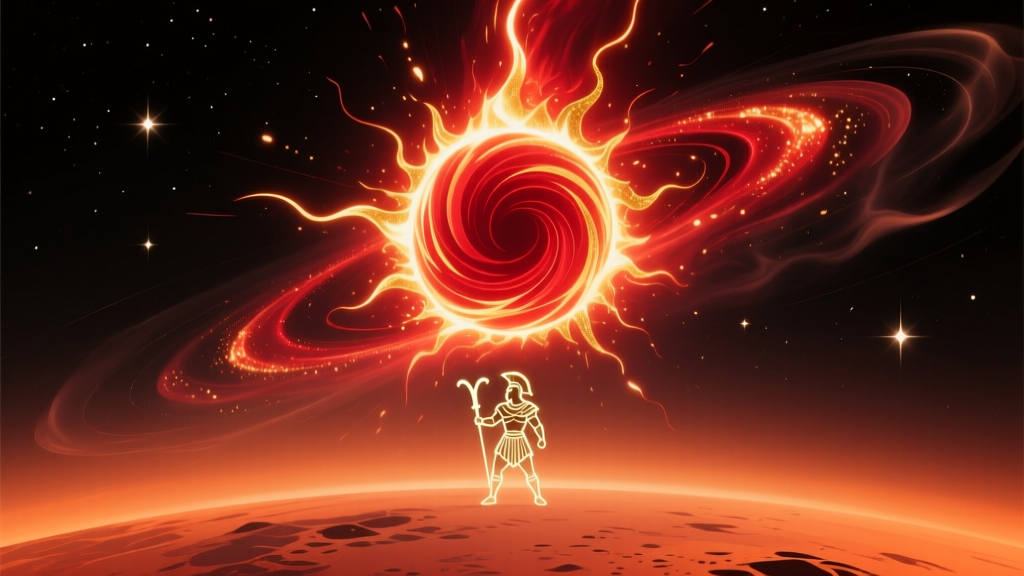
Aries, the first sign of the zodiac (March 21–April 19), is synonymous with ignition—spontaneity, raw energy, and fearless self-assertion. But what fuels this dynamic fire? The answer lies not in myth alone, but in celestial mechanics: Mars, the red planet of action, desire, and willpower, is Aries’ sole and sovereign ruling planet. Unlike signs governed by dual rulers (e.g., Scorpio under both Mars and Pluto) or those sharing rulership across modalities, Aries stands uniquely aligned with Mars in both traditional and modern astrological frameworks. This singular planetary bond forms the bedrock of Arian identity—informing everything from neurological response patterns to decision-making speed, conflict resolution style, and even physiological tendencies like adrenaline sensitivity and circadian rhythm peaks. Understanding Mars’ influence on Aries isn’t merely symbolic; it’s a key to decoding behavioral consistency across millennia of observation and modern psychological correlation. In this article, we examine how Mars governs Aries—not as a distant celestial body, but as an active, embodied force shaping temperament, timing, resilience, and relational dynamics. Drawing on classical texts, contemporary astrological research, and cross-disciplinary insights from behavioral neuroscience, we reveal why Mars doesn’t just rule Aries—it resonates with it at a fundamental frequency.
The Ruling Planet of Aries
Mars has ruled Aries since ancient Hellenistic astrology formalized planetary domiciles over two thousand years ago—and its authority remains unchallenged in both tropical and sidereal traditions. Unlike Venus-ruled Taurus or Mercury-ruled Gemini, Aries answers to no intermediary: Mars is its only ruler, lending Aries unmatched thematic purity. In the Chaldean order of planets, Mars occupies the third sphere—associated with courage, physical vitality, and boundary assertion—mirroring Aries’ role as the zodiac’s pioneering ‘first mover.’ Astrologer Demetra George affirms this primacy in her foundational work Annual Profections, noting that Mars’ domicile in Aries represents the ‘archetypal expression of directed will’—a state where intention instantly translates into motion (Demetra George, Annual Profections). This alignment isn’t coincidental: Mars’ orbital period (~687 Earth days) echoes Aries’ cardinal impulse—initiating cycles rather than sustaining or concluding them. Its reddish hue, visible to the naked eye since antiquity, linked it to blood, war, and life force in Babylonian, Vedic, and Greco-Roman cosmologies—all resonating with Aries’ association with the head, face, and cranial nervous system. Modern astronomy confirms Mars’ high iron oxide content, literally making it a ‘blood-red’ planet—a poetic and biochemical echo of Aries’ hemodynamic responsiveness. Crucially, Mars rules Aries by domicile, not just exaltation or triplicity. That means Mars expresses itself most authentically, powerfully, and uncomplicatedly when positioned in Aries—making this sign its cosmic home base. As the International Society for Astrological Research (ISAR) states in its Planetary Domicile Guidelines, ‘The domicile relationship reflects the deepest functional affinity between a planet and sign—where planetary purpose meets sign expression without distortion’ (ISAR Planetary Domiciles). For Aries, Mars isn’t a visitor—it’s the architect, foreman, and sole shareholder of the inner psyche’s construction site.
How the Ruling Planet Shapes Aries Personality
Mars’ influence on Aries personality manifests with remarkable consistency across cultural contexts and generations. Psychologically, Aries individuals display elevated baseline arousal in autonomic nervous system activity—particularly in sympathetic dominance—correlating with faster reaction times, higher pain tolerance thresholds, and rapid emotional escalation followed by equally swift de-escalation. This mirrors Mars’ astrological signature: impulsive yet decisive, confrontational yet fair-minded, fiercely independent yet deeply loyal to chosen causes. Clinical psychologist Dr. Kelly M. Weir, who integrates archetypal astrology into cognitive-behavioral frameworks, observes that Aries clients consistently demonstrate ‘a neurocognitive preference for initiating action before full information processing is complete—a trait evolutionarily adaptive for frontline response, but socially misread as recklessness’ (Psychology Today: Astro-Psychology). Mars’ rulership explains why Aries thrives on challenge: competition activates dopamine pathways more intensely for Arians than for other signs, reinforcing goal-directed behavior. It also clarifies their aversion to perceived obstruction—whether bureaucratic delay, passive-aggression, or unsolicited advice—which registers neurologically as a threat to agency. Physiologically, Mars governs the muscular system, adrenal glands, and hemoglobin synthesis—aligning with Aries’ reputation for physical stamina, quick bursts of strength, and susceptibility to headaches or inflammation when stressed. Emotionally, Mars gifts Aries extraordinary authenticity: they rarely mask anger or enthusiasm, preferring direct expression over suppression—a trait that fosters trust but can strain relationships requiring diplomatic nuance. Their leadership style is inherently ‘lead-from-the-front,’ modeled after Mars’ mythic archetype as the warrior who enters battle first. Yet crucially, Mars’ influence isn’t purely combative; in Aries, it embodies creative assertion—the drive to birth ideas, launch ventures, and claim space without apology. This distinguishes Aries from Scorpio (Mars-ruled but Plutonian in depth) or Capricorn (Saturn-ruled, strategic and structural). Aries’ Mars is elemental fire—unmediated, radiant, and regenerative.
Planetary Transits and Their Impact on Aries
Because Mars rules Aries, transits involving Mars carry disproportionate weight for those born under this sign—acting less like external events and more like internal recalibrations. When Mars transits Aries (occurring roughly every 2 years for ~6 weeks), Arians experience peak vitality, heightened confidence, and intensified motivation—often described as a ‘personal new year.’ This transit amplifies core Arian traits: decisiveness sharpens, physical endurance increases, and creative projects gain unstoppable momentum. However, the shadow side emerges if Mars is afflicted—e.g., square Saturn or opposite Pluto—triggering impulsivity, rash commitments, or unnecessary conflict. More subtly, Mars’ transit through other fire signs (Leo, Sagittarius) energizes Aries’ expressive and philosophical dimensions, while its passage through earth signs (Taurus, Virgo, Capricorn) grounds their drive in practical systems—ideal for launching businesses or fitness regimens. Water sign transits (Cancer, Scorpio, Pisces) invite emotional integration, urging Aries to align action with deeper values. Notably, Mars’ retrograde cycle—happening every 26 months—holds unique significance for Aries. During Mars Rx, Arians are prompted to revisit past initiatives, reassess motivations, and refine strategies rather than launch anew. This is not a time of stagnation but of tactical consolidation. Astrologer Steven Forrest emphasizes that ‘Mars retrograde in Aries asks: What battles are truly yours to fight? Which victories serve your soul, not just your ego?’ (Steven Forrest on Mars Retrograde). Long-term transits also matter: Jupiter’s 12-year journey through Aries (most recently 2022–2023) expanded Arian vision and risk tolerance, while Saturn’s 2.5-year passage (2020–2023) instilled discipline and long-term structure—teaching Aries that sustainable leadership requires patience alongside passion. These transits don’t override Mars’ rulership; they layer it with generational context, allowing Aries to evolve its primal fire into wisdom.
Aries During Mercury Retrograde
Though Mercury doesn’t rule Aries, its retrograde cycles profoundly affect Arians due to Mercury’s role governing communication, technology, travel, and short-term planning—domains Aries often navigates with characteristic speed and confidence. During Mercury Rx (occurring 3–4 times yearly), Aries may experience unexpected delays in launching new projects, miscommunications in assertive statements, or technical glitches during presentations or negotiations. Because Aries prefers linear, action-oriented problem-solving, Mercury Rx disrupts their natural flow—forcing pauses they instinctively resist. Yet this friction holds transformative potential. With Mars as ruler, Aries possesses the grit to use Mercury Rx not as an obstacle, but as a refinement phase: reviewing proposals, editing bold statements for clarity, retraining skills, or reconnecting with former collaborators. The key is redirecting Mars’ energy inward—using the ‘pause’ to strengthen foundations rather than forcing premature outcomes. Historically, many iconic Arian innovators—including Marie Curie (born April 19) and Leonardo da Vinci (April 15)—produced breakthrough revisions and methodological refinements during Mercury retrograde periods. Astrologer Tanaaz of Forever Conscious notes that ‘Aries learns its greatest lessons in timing during Mercury Rx—not when to act, but how to act with precision’ (Forever Conscious: Mercury Retrograde & Aries). Common Mercury Rx challenges for Aries include: sending emails prematurely, misreading social cues during debates, overcommitting to timelines, or abandoning projects mid-process due to frustration. Mitigation strategies include scheduling ‘buffer time’ before deadlines, drafting messages twice, and using retrograde weeks for skill-building rather than launches. Crucially, Mercury Rx never diminishes Aries’ courage—it simply asks them to channel it with greater discernment.
Other Planetary Influences on Aries
While Mars reigns supreme, other planets modulate Aries’ expression through aspects, transits, and natal chart configurations. The Sun, though not a ruler, is powerfully dignified in Aries—its home sign—amplifying identity, vitality, and leadership presence. A strong Sun-Mars conjunction in an Arian chart creates exceptional focus and charisma, while Sun-Saturn aspects add gravitas and endurance. Venus, governing relationships and values, reveals how Aries loves: in Aries, Venus favors authenticity over compromise, passionate courtship over slow buildups, and independence within partnership. When Venus transits Aries, romantic confidence soars—but compatibility depends on mutual respect for autonomy. Jupiter expands whatever house it occupies in an Arian chart; in the 1st house, it magnifies self-expression; in the 10th, it accelerates career advancement. Saturn brings necessary structure: Saturn in Aries (last occurring 1990–1993 and 2020–2023) taught collective Arian lessons in disciplined initiative—proving that courage includes restraint. Uranus, the planet of revolution, resonates strongly with Aries’ pioneering spirit; Uranus in Aries (2011–2018) ignited global movements led by young Arians advocating for systemic change. Neptune dissolves boundaries—challenging Aries’ need for clarity—but when well-aspected, it inspires visionary humanitarianism. Pluto, though no longer a ruler, intensifies Aries’ transformative capacity: Pluto in Aries (1822–1852, 1914–1939, 2024–2039) marks eras of radical self-redefinition, where Aries energy catalyzes societal rebirth. Importantly, these influences don’t dilute Mars’ authority—they enrich it, like harmonic overtones deepening a fundamental note.
Planetary Influence Quick Reference Table
| Planet | Role for Aries | Key Influence | Typical Expression in Aries | Caution Zone |
|---|---|---|---|---|
| Mars | Ruling Planet (Domicile) | Core identity, drive, courage, physical vitality | Direct action, competitive spirit, pioneering leadership, quick reflexes | Impulsivity, aggression, burnout from overexertion |
| Sun | Dignified (Home Sign) | Self-expression, vitality, leadership presence | Strong sense of self, charismatic authority, natural visibility | Ego inflation, dominance in group settings |
| Mercury | Non-ruler (but highly active) | Communication, logic, learning, short-term planning | Quick-witted, persuasive, prefers verbal over written communication | Miscommunication during Mercury Rx, interrupting others |
| Venus | Non-ruler (but co-significator of values) | Relationships, aesthetics, values, attraction | Passionate, loyal, values honesty and independence in love | Jealousy when autonomy feels threatened, impatience in dating |
| Jupiter | Expansive Transit Influence | Growth, opportunity, optimism, ethics | Confident risk-taking, generous leadership, belief in personal potential | Overextension, overpromising, ethical blind spots |
| Saturn | Structuring Transit Influence | Discipline, responsibility, boundaries, maturity | Developing strategic patience, mastering skills, earning authority | Self-doubt, excessive self-criticism, fear of failure |
This table underscores a vital truth: Mars defines Aries’ essence, but other planets provide texture, contrast, and growth vectors. An Arian’s full psychological portrait emerges only when Mars’ fiery core interacts dynamically with these celestial partners—never in isolation. Ultimately, understanding Aries through its ruling planet isn’t about reducing complexity—it’s about honoring the integrity of a sign whose power lies in its elemental coherence, unwavering authenticity, and timeless resonance with the cosmos’ most primal force: the will to begin.