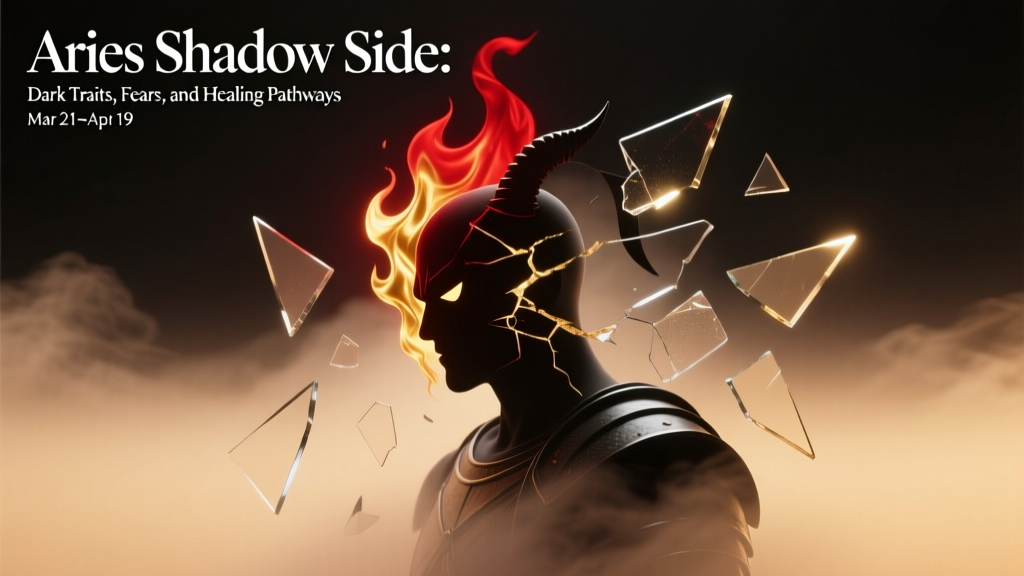
Aries — the first sign of the zodiac, ruled by Mars and born under the fiery cardinal energy of spring — is often celebrated for courage, initiative, and bold leadership. Yet like all archetypes, Aries carries a shadow: a constellation of unconscious tendencies that emerge when unexamined, unregulated, or triggered by fear. Understanding the shadow side of Aries isn’t about pathologizing its fire — it’s about honoring its full complexity. In Jungian psychology, the shadow represents repressed, disowned, or socially unacceptable aspects of the self. For Aries, this includes impulsivity disguised as bravery, dominance mistaken for confidence, and impatience weaponized as efficiency. This article moves beyond sun-sign stereotypes to examine Aries’ psychological undercurrents with nuance, grounded in astrological tradition and modern depth psychology. We’ll explore how Aries’ core drive for autonomy and self-assertion can curdle into aggression, how its pioneering spirit can devolve into ruthless competition, and — most importantly — how conscious integration transforms these energies into wisdom, compassion, and grounded leadership.
The Shadow Side of Aries
The Aries shadow is not inherently evil — it’s unintegrated. As the first sign, Aries embodies raw, undifferentiated life force: the spark before form, the cry before language, the fist before diplomacy. When this primal energy flows consciously, it inspires innovation, protects boundaries, and initiates healing change. But when fragmented or suppressed — often due to early environments that punished assertiveness or equated independence with selfishness — Aries’ shadow emerges as reactive, self-centered, and combative. According to astrologer Steven Forrest, author of The Inner Sky, "Aries’ greatest challenge is learning that true strength lies not in conquering others, but in mastering the battlefield within."https://www.stevenforrest.com/books/the-inner-sky/ This mastery begins with acknowledging what Aries habitually denies: vulnerability, dependence, and the necessity of collaboration. The shadow Aries may dismiss others’ input as weakness, misinterpret patience as passivity, and mistake speed for efficacy — leading to burnout, fractured relationships, and ethical blind spots. Unlike water signs whose shadows drown in emotion or earth signs whose shadows hoard control, Aries’ shadow burns hot and fast — often leaving scorched earth in its wake. Its cardinal fire demands direction; without conscious channeling, it becomes wildfire. Importantly, the Aries shadow rarely manifests as passive aggression — it’s too direct for that. Instead, it appears as blunt dismissal, preemptive strikes in arguments, or unilateral decisions made “for everyone’s good” without consultation. Recognizing these patterns isn’t about shame — it’s about reclaiming agency over one’s own fire.
Aries Fears and Insecurities
Beneath Aries’ confident exterior lies a quiet, persistent tremor: the fear of being powerless, irrelevant, or — worse — forgotten. As the sign of the self, Aries’ deepest insecurity revolves around existential invisibility: the terror that without action, assertion, or victory, they cease to matter. This isn’t vanity — it’s an archetypal echo of the newborn’s first breath, the infant’s cry for survival. When unacknowledged, this core fear metastasizes into several interlocking anxieties: fear of being controlled or overridden (triggering defensiveness), fear of failure that undermines self-worth (leading to avoidance of vulnerable endeavors), and fear of emotional entanglement that dilutes autonomy (causing premature detachment). Clinical astrologer Erin Sullivan notes in Dynamic Astrology that Aries’ “fear of dependency is so profound it can sabotage intimacy before it begins — mistaking closeness for captivity.”https://www.erinsullivan.com/books/dynamic-astrology/ These fears are rarely verbalized; instead, they surface behaviorally — through chronic busyness (to prove indispensability), competitive one-upmanship (to secure status), or abrupt exits from relationships (to avoid perceived engulfment). Aries may also develop a hidden fear of stillness — silence feels dangerous because it invites confrontation with unmet needs or unresolved anger. Interestingly, research in personality psychology shows that high-dominance individuals (a trait strongly correlated with Aries placements) often exhibit elevated cortisol responses to perceived challenges to their authority — confirming the physiological reality of these deep-seated insecurities.https://www.apa.org/pubs/journals/features/psp-pspi0000376.pdf Healing begins not by erasing these fears, but by befriending them — recognizing that the desire to be seen is human, and that true visibility arises from authenticity, not conquest.
Defense Mechanisms of Aries
Aries employs several hardwired defense mechanisms — evolutionary adaptations refined over millennia to protect its fiercely independent identity. Chief among them is denial, particularly of emotional impact: “I’m fine” uttered seconds after slamming a door; “It doesn’t bother me” while jaw clenches. This isn’t deception — it’s neurobiological self-preservation. Mars-ruled physiology floods the system with adrenaline during threat, prioritizing action over reflection. Another hallmark is projection: attributing one’s own unacknowledged aggression or impatience onto others (“You’re overreacting!” when, in fact, Aries initiated the escalation). Rationalization follows closely — justifying harsh words as “honesty,” cutting off dialogue as “efficiency,” or abandoning commitments as “following my truth.” Perhaps most insidious is splitting: viewing people, situations, or even parts of themselves in binary terms — hero/villain, winner/loser, strong/weak — which prevents nuanced understanding and fosters polarization. A structured comparison of common Aries defenses versus healthier alternatives reveals the path forward:
| Defense Mechanism | Shadow Manifestation | Integrated Alternative | Embodied Practice |
|---|---|---|---|
| Denial of Impact | “It’s not a big deal” after causing harm | Accountability + Repair | Saying: “I see how that affected you. What do you need?” |
| Projection | Accusing others of jealousy when feeling insecure | Self-Inquiry | Journal prompt: “What am I afraid would happen if I owned this feeling?” |
| Rationalization | Calling betrayal “liberation” | Moral Clarity | Asking: “Does this align with my deepest values — or just my immediate impulse?” |
| Splitting | Labeling ex-partners as “toxic” without reflection | Complexity Holding | Writing two columns: “What I learned from them” / “What I contributed to the dynamic” |
These defenses served Aries well in ancestral contexts — quick decisions saved lives; emotional suppression enabled battle readiness. Today, however, they hinder relational intelligence and self-awareness. The shift from defense to discernment requires pausing — not to suppress fire, but to aim it with precision.
When Aries Is Under Stress
Stress doesn’t extinguish Aries’ fire — it distorts it. Under pressure, Aries regresses toward its most primitive expression: the “infantile warrior.” This isn’t childishness — it’s a neurological downshift into survival mode where the prefrontal cortex (responsible for empathy and consequence evaluation) yields to the amygdala (governing fight-or-flight). Key stress indicators include: escalating impatience (snapping at minor delays), hyper-competitiveness (turning collaborative projects into zero-sum contests), blaming others for systemic issues (“If they’d just listen, we’d be done”), and physical restlessness (pacing, fidgeting, insomnia). Notably, stressed Aries rarely withdraws — they double down, often taking on unsustainable workloads or initiating unnecessary conflicts to regain a sense of control. The International Society for Astrological Research (ISAR) emphasizes that planetary transits affecting Mars (e.g., Saturn square Mars) often correlate with heightened Aries stress responses — manifesting as frustration, accidents, or confrontations.https://www.isarastrology.com/ Crucially, Aries stress is rarely about the stated issue — it’s about the underlying threat to autonomy or competence. A missed deadline isn’t just logistical; it’s evidence of failing as a leader. A disagreement isn’t just perspective divergence; it’s an assault on self-sovereignty. Recognizing this allows loved ones to respond with grounding, not argument — offering choices (“Would you like space or support right now?”) rather than solutions. For Aries themselves, stress signals are invitations to reconnect with embodiment: breathwork to regulate the nervous system, martial arts to channel energy constructively, or creative destruction (e.g., tearing up old journals) to release pent-up force safely.
Toxic Aries Patterns and How to Heal
“Toxic” Aries isn’t a fixed identity — it’s a behavioral loop activated when shadow traits dominate consciousness. Three recurring patterns stand out: 1) The Tyrant of Time — enforcing rigid schedules, punishing lateness as moral failure, and treating others’ time as subordinate to their agenda; 2) The Lone Wolf Savior — refusing help while simultaneously rescuing others, creating dependency they then resent; and 3) The Erasure of Process — dismissing preparation, reflection, or feedback as “slowing things down,” thereby replicating mistakes and alienating collaborators. Healing these patterns demands more than willpower — it requires rewiring neural pathways through consistent somatic and relational practice. For The Tyrant of Time, healing involves co-creating timelines with others and practicing “time generosity”: arriving 15 minutes early to appointments not to control, but to offer presence. For The Lone Wolf Savior, therapy modalities like Internal Family Systems (IFS) help separate the protective “hero” part from the vulnerable “child” part that fears inadequacy. For The Erasure of Process, implementing mandatory “pause points” — e.g., a 10-minute silent review before sending any email, or requiring three diverse perspectives before finalizing a plan — builds structural humility. Astrologer Demetra George, in Asteroid Goddesses, reminds us that Mars-ruled energy finds its highest expression not in domination, but in disciplined courage — the willingness to face one’s own limitations with the same ferocity once reserved for external foes.https://www.demetrageorge.com/asteroid-goddesses/ True healing occurs when Aries redirects its legendary tenacity inward — not to conquer the self, but to companion it.
Embracing the Full Spectrum of Aries
To embrace Aries’ full spectrum is to hold paradox: the warrior and the witness, the pioneer and the student, the spark and the hearth. It means honoring the sign’s divine mandate — to initiate, to lead, to embody fearless presence — while integrating its complementary truths: that initiation requires listening, leadership demands humility, and fearlessness includes trembling. The mature Aries doesn’t abandon fire; they learn to tend it like a sacred hearth — feeding it with intention, containing it with respect, and sharing its warmth without consuming others. This integration transforms Aries from a solitary flame into a communal beacon: the coach who empowers teammates to shine, the entrepreneur who builds equitable systems, the activist whose rage fuels sustainable justice, not vengeance. Mythologically, Aries is linked to the Golden Ram — a symbol of sacrifice, transcendence, and divine guidance. Its shadow is the ram that charges blindly; its light is the ram that leaps *with* purpose, carrying others across thresholds. When Aries integrates its shadow, it becomes what Jung called the “Self-actualized Hero”: not one who defeats monsters, but one who recognizes the monster as a disowned part of itself — and transforms it through conscious love. This is the Aries that doesn’t just start revolutions, but sustains them. That doesn’t just claim territory, but cultivates gardens. That doesn’t just win battles, but negotiates peace — fiercely, fairly, and with unwavering heart.
Shadow Work Prompts for Aries
Shadow work for Aries is not about diminishing fire — it’s about refining its quality. These prompts invite embodied reflection, not intellectual analysis. Journal deeply, speak them aloud, or sit with them in silence before action:
- When did I last blame someone else for a problem I contributed to? What felt unsafe about owning my part?
- What situation makes me feel most powerless? Where in my body do I feel that? What does that sensation need — not fix, but witness?
- Describe a time I rushed a decision to avoid discomfort. What was I avoiding feeling? What would have happened if I’d waited 24 hours?
- Who in my life consistently mirrors my impatience or anger? What might they be reflecting back that I refuse to see?
- If my inner child could speak, what would they beg me to stop doing ‘for my own good’?
- What does ‘true safety’ feel like in my body — not as achievement, but as stillness?
Commit to one prompt weekly. Track patterns. Notice when defensiveness arises — that’s not failure; it’s data. As Carl Jung wrote, “One does not become enlightened by imagining figures of light, but by making the darkness conscious.” For Aries, the path to luminous leadership begins not in the blaze, but in the courageous, tender act of lighting a candle in the shadow — and recognizing, at last, that the light and the dark are both theirs to hold.