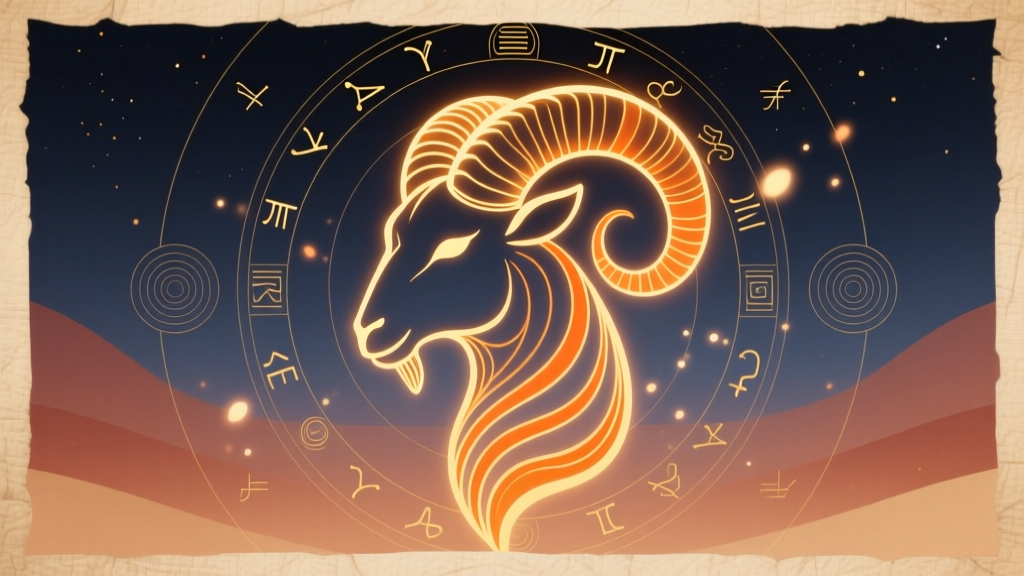
The Aries symbol — two sweeping, upward-curving horns forming a dynamic, forward-thrusting glyph — is one of the most instantly recognizable icons in astrology. Yet few understand its profound layers: its Mesopotamian ancestry, its resonance with sacred geometry, its embodiment of primordial life force, and its enduring presence in temple art, mythic iconography, and initiatory traditions. Unlike modern typographic representations, the Aries glyph (♈) is not merely a decorative shorthand; it is a condensed cosmogram — a visual mantra encoding sovereignty, courage, rebirth, and divine will. This article delves exclusively into the symbolic anatomy of Aries, grounded in historical linguistics, comparative mythology, and esoteric tradition. We examine how this sign’s emblem bridges astronomy and archetypal psychology, revealing why the Ram remains a universal symbol of first cause, sacrificial initiation, and conscious emergence.
The Aries Symbol: Origin and History
The Aries glyph traces its lineage to the earliest known zodiacal systems — specifically, the Babylonian MUL.APIN tablets (c. 1000 BCE), where constellations were codified for calendrical and ritual purposes. In these texts, the constellation now associated with Aries was originally linked to the LU.HUN.GA, or 'The Hired Man', a figure representing agricultural renewal and divine labor. By the 7th century BCE, however, Babylonian astronomers began aligning the vernal equinox — the celestial marker of spring and new beginnings — with the constellation AGA.US ('The Agrarian Leader'), later identified with the Ram. This shift coincided with the rise of Marduk-centered theology, wherein the Ram became an epithet of the supreme god, symbolizing creative authority and cosmic order (British Museum, MUL.APIN Tablets).
When Greek astrologers like Berossus (3rd c. BCE) and later Claudius Ptolemy adopted and systematized Babylonian star lore, they translated AGA.US into Krios — Greek for 'Ram' — and embedded it as the first sign of the tropical zodiac. Ptolemy’s Tetrabiblos explicitly anchors Aries at the spring equinox point, affirming its role as the 'beginning of the circle' — not just chronologically, but metaphysically. The Ram thus became inseparable from the concept of archē: the originating principle in Stoic and Neoplatonic thought. As scholar Francesca Rochberg notes in The Heavenly Writing, 'The Ram’s placement at the equinox was never arbitrary; it reflected a theological conviction that creation begins with assertive, self-initiated motion' (Princeton University Press, Rochberg 2004). This historical framing distinguishes Aries from all other signs: its symbol does not represent a passive trait or emotional state, but an ontological act — the first breath of conscious intention.
Sacred Geometry Behind the Aries Glyph
At first glance, the Aries glyph (♈) appears deceptively simple: two mirrored, crescent-like curves converging at a central point, often drawn with a subtle downward stroke connecting their bases. Yet this form encodes precise geometric relationships rooted in Pythagorean and Hermetic traditions. Each horn is drawn as a segment of a circle whose radius equals the distance from the convergence point to the tip — approximating the golden ratio spiral’s initial arc. When overlaid on a unit circle, the glyph’s apex aligns with 30° — the exact ecliptic longitude of the first degree of Aries — while the base stroke mirrors the horizontal axis of the horizon, anchoring the symbol in both celestial and terrestrial orientation.
Esoteric cartographer and symbolist Robert Lawlor observed that the Aries glyph embodies the 'vesica piscis' principle — the almond-shaped intersection of two circles — which in medieval Christian iconography represented Christ as the 'divine mediator', and in Tantric diagrams signified the union of Shiva (consciousness) and Shakti (energy). In the Aries glyph, the overlapping arcs suggest dual potentialities (initiation and resistance, action and consequence) converging into singular focus. The central point — sometimes subtly emphasized as a dot or node — functions as the bindu in Vedic cosmology: the unmanifest seed from which all movement arises. This geometry echoes the Egyptian ankh, where the loop (spirit) emerges from the cross (matter), reinforcing Aries’ role as the spark before manifestation. Modern astrologer Michael Erlewine affirms this in The Only Astrology Book You’ll Ever Need, stating, 'The Aries glyph is less a picture of an animal than a diagram of will-in-motion — the geometry of self-assertion made visible' (Red Wheel/Weiser, Erlewine 2019). Its symmetry is not static balance, but kinetic tension — ready to release.
What the Aries Symbol Represents
The Aries symbol represents far more than 'leadership' or 'boldness' — traits often oversimplified in pop astrology. At its core, the Ram glyph signifies ontological priority: the irreducible fact of 'I am' before 'I think' or 'I relate'. In Jungian terms, it correlates with the Self archetype in its most primal, undifferentiated expression — not the integrated Self of individuation, but the raw, pre-egoic impulse toward existence. This is why Aries energy feels urgent, uncomplicated, and occasionally reckless: it operates prior to social conditioning, moral calculus, or strategic foresight. It is the body’s flinch before the mind registers danger; the infant’s cry before language forms; the seed’s rupture of the husk before sunlight is perceived.
Mythologically, the Ram appears across cultures as a bearer of divine revelation and salvific power. In Greek myth, the Golden Fleece — retrieved by Jason — hung in a sacred grove guarded by a Ram sent by Hermes to save Phrixus and Helle from sacrifice. In Hindu tradition, Agni — the fire god and divine messenger — rides a Ram, symbolizing the transmission of sacred knowledge through purified will. Even in the Hebrew Bible, the Ram caught in the thicket (Genesis 22:13) substitutes for Isaac, transforming sacrifice into covenant — a pivotal moment where divine command meets human agency. These narratives converge on a single motif: the Ram as the vehicle of intervention — not passive acceptance, but active, embodied response to existential crisis. Thus, the Aries glyph does not symbolize aggression, but agency-as-sacrament: the sacred right — and responsibility — to initiate, to choose, to say 'yes' or 'no' before any external authority confirms it. For those born March 21–April 19, this glyph maps their soul’s native grammar: identity formed not through reflection, but through action; truth discovered not in dialogue, but in daring.
Aries in Ancient Art and Architecture
The Ram motif appears with striking consistency in sacred architecture and ritual art across civilizations — always positioned at liminal thresholds. In the Temple of Karnak (Luxor, Egypt, c. 15th c. BCE), processional avenues are lined with ram-headed sphinxes — not lion-bodied, but distinctly ovine — representing Amun-Ra in his creative aspect. Their horns curve upward in near-perfect alignment with the Aries glyph, and their paws rest upon carved ankh symbols, visually fusing life-force with sovereign will. Similarly, at the 4th-century BCE Temple of Zeus at Nemea, the metopes depict the myth of the Golden Fleece, with the Ram rendered in high relief, its horns stylized as twin volutes echoing the zodiacal sign — a deliberate astrological reference confirming the Ram’s association with divine kingship and cosmic renewal.
In Mesopotamian cylinder seals (c. 2000 BCE), the Ram appears alongside the 'Winged Disk' — a solar symbol representing divine authority — often grasped in the hands of a king or deity. Assyrian royal inscriptions refer to rulers as 'the Ram of Ashur', linking political legitimacy to Aries’ archetypal function: the capacity to break inertia and establish new order. Even in early Christian basilicas, such as Santa Sabina in Rome (5th c. CE), the bronze doors feature lamb-and-ram iconography interwoven with Alpha-Omega motifs — a theological synthesis where the Lamb (Christ as sacrifice) and the Ram (Christ as victor) coexist. As art historian David Talbott documents in The Saturn Myth, 'The Ram’s recurrence at architectural thresholds — gateways, sanctuaries, tombs — signals its role as guardian of the 'first step': the transition from potential to actual, from darkness to light, from death to rebirth' (Mikamar Publishing, Talbott 1980). For Aries natives, this architectural resonance underscores a lifelong theme: their personal 'thresholds' — career shifts, relationship beginnings, creative launches — are rarely gradual; they arrive as decisive, structural breaks demanding presence and courage.
The Deeper Spiritual Meaning of the Aries Symbol
Spiritually, the Aries symbol invites a radical reorientation: away from seeking validation, safety, or consensus — and toward cultivating what Sufi mystics call haqq al-yaqin: 'truth of certainty' born of direct experience. The Ram does not consult before charging; it senses the opening and moves. This is not impulsivity, but instinctual fidelity — alignment with one’s inner compass before the mind generates doubt. In Kabbalah, Aries corresponds to the sephirah Keter (Crown), the highest emanation on the Tree of Life, representing pure will unmediated by intellect or emotion. Here, the glyph becomes a meditation tool: tracing its curves inward can quiet mental chatter and awaken somatic awareness — the 'fire in the belly' that yogis name manipura chakra and Taoists call dan tian.
Contemporary spiritual teacher Caroline Myss describes Aries energy as 'the soul’s declaration of independence from inherited narratives' — a perspective echoed in depth psychology, where the Aries impulse initiates the hero’s journey by crossing the 'first threshold' (Campbell’s The Hero with a Thousand Faces). For individuals born March 21–April 19, the sacred task encoded in their symbol is not to dominate others, but to master self-abdication: to refuse outsourcing their authority to gurus, institutions, or even well-meaning loved ones. The Ram’s horns do not point outward to conquer, but upward — toward aspiration, clarity, and vertical alignment with purpose. When lived consciously, Aries energy becomes devotional: each act of courageous choice is a prayer; every boundary set, a ritual of self-honoring; every new beginning, an offering to the unknown. As astrologer Steven Forrest writes in The Inner Sky, 'Aries is the universe whispering, "You are allowed to exist — fully, fiercely, unapologetically. Now go build something true"' (Red Wheel/Weiser, Forrest 2017). That permission — encoded in two curved lines — remains humanity’s oldest, most sacred birthright.
Aries Symbol Quick Facts Table
| Aspect | Detail | Significance |
|---|---|---|
| Unicode | U+2648 | Standard digital representation used in astrology apps and ephemerides |
| Element | Fire | Represents spontaneous ignition, not sustained burn — the spark before the flame |
| Mode | Cardinal | Embodies initiating energy — begins cycles, sets direction, creates momentum |
| Planetary Ruler | Mars | Links the glyph to assertion, drive, and protective vitality — not aggression |
| Mythic Animal | Ram (not sheep) | Rams butt heads to establish hierarchy; sheep follow — highlighting Aries’ sovereign autonomy |
| Sacred Number | 1 | Symbolizes unity, origin, and indivisible consciousness — the monad in Pythagorean thought |