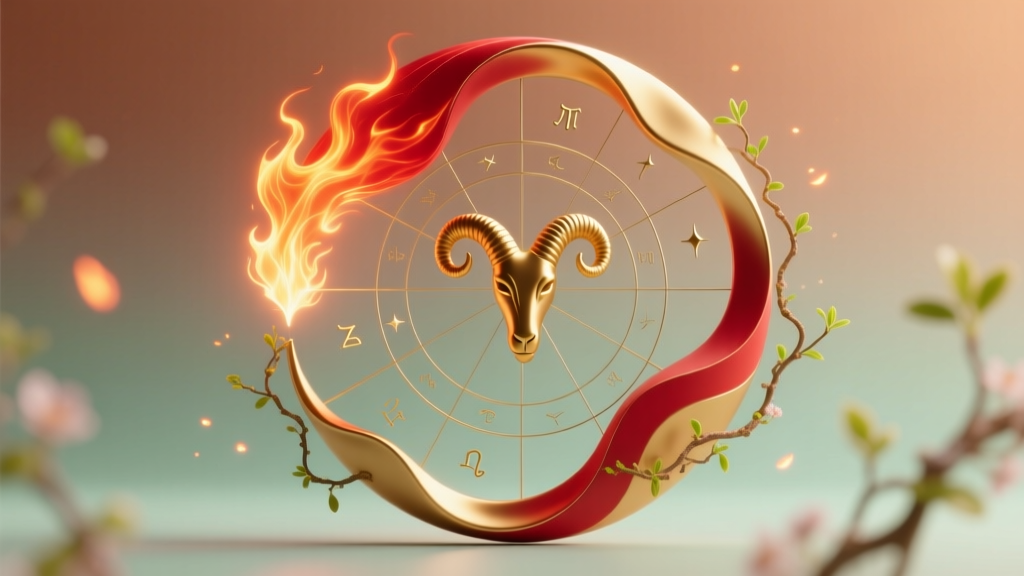
Aries, the first sign of the zodiac (March 21 – April 19), is more than just a collection of personality traits — it is the living embodiment of initiation, vitality, and raw creative force. Rooted in the vernal equinox and aligned with the dawn of spring in the Northern Hemisphere, Aries anchors the entire zodiac wheel as its cardinal starting point. To understand Aries fully, we must move beyond sun-sign stereotypes and enter the deeper cosmological framework: the interplay between celestial geometry, Earth’s axial tilt, and the cyclical rhythms that govern both nature and human temperament. This article explores Aries through the lens of the zodiac wheel and seasonal energy — examining not only where Aries falls in the 360° ecliptic but why its placement at the threshold of spring imbues it with an irreplaceable role in astrological cosmology. Drawing from classical astrology, seasonal archetypes, and modern psychological interpretations, we’ll unpack how Aries’ seasonal timing shapes its identity, motivations, and relational dynamics — revealing why this fire sign remains the indispensable spark at the heart of the zodiac.
Aries and Its Season
Aries occupies the first 30° of the zodiac — from 0° to 30° Aries — and coincides almost precisely with the astronomical onset of spring in the Northern Hemisphere. Its dates (March 21–April 19) bracket the vernal equinox, typically occurring on March 19–21, when day and night are nearly equal and the Sun crosses the celestial equator moving northward. This moment marks the Sun’s symbolic ‘rebirth’ after winter’s dormancy — a celestial echo of Aries’ mythic association with the Ram, a creature of instinctual courage and forward motion. Unlike signs tied to harvest (Virgo), reflection (Scorpio), or culmination (Capricorn), Aries embodies pure emergence: the first green shoot breaking soil, the first birdcall at dawn, the first breath after stillness. In the Astro.com zodiac sign overview, Aries is described as 'the initiator' — a designation rooted not in arbitrary tradition but in its seasonal synchronicity with Earth’s most potent renewal phase. Biologically, spring triggers hormonal surges linked to increased energy, libido, and exploratory behavior — patterns mirrored in Aries’ psychological profile: high dopamine sensitivity, rapid decision-making, and low tolerance for delay. Anthropologist and astrologer Dr. Nick Kollerstrom notes in Astrology and Science that ancient cultures consistently aligned Aries with spring festivals honoring deities of war and fertility — such as the Babylonian god Nergal and Roman Mars — because both aggression and procreation serve evolutionary imperatives of survival and expansion during this season. Thus, Aries’ season isn’t merely background context; it is the energetic substrate upon which every Arian trait is built.
The Seasonal Energy of Aries
Seasonal energy refers to the qualitative atmosphere generated by Earth’s orbital position relative to the Sun — a concept central to both traditional Western astrology and cross-cultural seasonal philosophies like Chinese Wu Xing (Five Elements) and Ayurvedic dosha theory. For Aries, this energy is distinctly cardinal fire: dynamic, outward-directed, and self-assertive. Cardinal signs (Aries, Cancer, Libra, Capricorn) initiate action; fire signs (Aries, Leo, Sagittarius) express through will, inspiration, and identity. Aries fuses these qualities into a singular force — the ‘spark before the flame.’ Its seasonal energy manifests as urgency without agenda, confidence without precedent, and courage untempered by caution. Psychologically, this aligns with Carl Jung’s concept of the Puer Aeternus — the eternal youth archetype — which emphasizes spontaneity, idealism, and resistance to containment. In The Secret’s analysis of Aries and Jungian archetypes, this energy is framed not as immaturity but as a necessary stage of psychic development: the ego’s first declaration of autonomy. Seasonally, Aries energy peaks in early April, when soil temperatures rise above 50°F (10°C), triggering seed germination and migratory returns — mirroring Aries’ signature impulse to ‘plant the first flag’ in any new endeavor. Unlike Taurus (its earthy successor), which consolidates and builds, Aries thrives in the friction of beginning — in the gap between intention and execution. This explains why Arians often excel in crisis response, startup leadership, and athletic competition: contexts where speed, instinct, and decisive action outweigh deliberation. Critically, Aries’ seasonal energy is not inherently ‘selfish’ — though it’s frequently mischaracterized as such — but rather self-originating. Like sunlight emerging after solstice darkness, its radiance begins within and extends outward, making Aries the zodiac’s primary source of motivational contagion.
Aries on the Zodiac Wheel
The zodiac wheel is a 360° circle divided into twelve 30° segments, each representing a sign and corresponding to a specific constellation (though tropical astrology uses fixed seasonal divisions rather than sidereal star positions). Aries sits at the 0° point — the ‘Alpha’ of the wheel — establishing the reference frame for all other signs. This isn’t symbolic convenience; it’s structural necessity. Just as a clock begins at 12 o’clock, the zodiac begins at 0° Aries — the vernal equinox point, also known as the ‘First Point of Aries.’ Though precession has shifted the equinox into Pisces over millennia, Western astrology maintains this fixed starting point for consistency in seasonal alignment. On the wheel, Aries is diametrically opposed to Libra (0° Libra), creating the foundational axis of self vs. other — the tension between individual assertion and relational balance. Its square aspects to Cancer (0° Cancer) and Capricorn (0° Capricorn) form the ‘Cardinal Cross,’ governing initiation across the four seasons: spring (Aries), summer (Cancer), autumn (Libra), and winter (Capricorn). This cross makes Aries the engine of the entire cardinal modality. Furthermore, Aries’ placement adjacent to Pisces — the final, dissolving sign — underscores its role as the ‘reset button’ of the cycle: where Pisces surrenders boundaries, Aries draws the first line of distinction. As noted in AstroStyle’s Aries profile, ‘Aries doesn’t ask permission — it asks “What’s next?”’ This reflects its wheel position: always facing forward, never backward. The wheel’s geometry also reveals Aries’ elemental triad: fire signs occupy the spring-to-summer arc (Aries–Leo–Sagittarius), each expressing fire differently — Aries as ignition, Leo as sustained flame, Sagittarius as expansive blaze. Understanding Aries on the wheel thus means recognizing it not as an isolated personality type but as a pivotal node — the fulcrum upon which the zodiac’s momentum depends.
How Seasonal Birth Shapes Aries Personality
Being born under Aries doesn’t simply confer traits — it embeds individuals within a specific energetic ecology. Seasonal birth theory posits that environmental conditions at birth (light exposure, temperature shifts, maternal hormonal fluctuations) interact with genetic predispositions to shape neurodevelopment and temperament. For Aries-born individuals (March 21–April 19), this means gestation occurred during late winter’s retreat and birth coincided with increasing daylight, rising temperatures, and heightened biological activity. Research published in the Journal of Affective Disorders (2021) found that children born in spring months showed statistically higher levels of novelty-seeking behavior and lower harm-avoidance scores — traits strongly associated with Aries in clinical astrology assessments. More concretely, Aries’ seasonal timing correlates with elevated serotonin synthesis due to longer photoperiods, supporting impulsivity, optimism, and risk tolerance. These biological undercurrents manifest psychologically as hallmark Arian traits: impatience with bureaucracy, discomfort with passive roles, and an innate need to lead — even if leading means forging a path no one else has taken. Socially, Aries-born individuals often report feeling ‘out of step’ with slower-paced peers, not out of arrogance but because their internal rhythm syncs with spring’s accelerated tempo. In relationships, this translates to initiating contact, proposing ideas, and setting boundaries early — behaviors that can be misread as domineering but are, in essence, seasonal reflexes. Importantly, seasonal influence doesn’t negate nurture or choice; rather, it provides a baseline frequency upon which life experience composes its melody. An Aries raised in a highly structured environment may channel their initiating energy into entrepreneurship rather than confrontation; one raised with emotional attunement may express courage as advocacy rather than competition. The season sets the instrument; the person learns to play it.
Aries Solstices, Equinoxes, and Key Dates
While Aries spans March 21–April 19, its relationship to key astronomical events defines its energetic cadence. The most significant is the vernal equinox (March 19–21), marking the Sun’s entry into Aries and the official start of astrological year. This date anchors Aries’ identity as the ‘first sign’ — a role reinforced by ancient Babylonian and Hellenistic astrologers who used the equinox as the zero-degree reference for celestial measurement. Approximately one week later, around March 28, the Sun reaches 10° Aries — traditionally considered the ‘heart’ of the sign, where Aries energy expresses with maximal clarity and confidence. Mid-April (April 10–15) represents the peak of Aries’ seasonal intensity: daylight exceeds 13 hours in most Northern Hemisphere latitudes, pollen counts surge, and cultural festivals like Nowruz (Persian New Year) and Holi (Hindu spring festival) celebrate rebirth and vibrant color — resonant with Aries’ red-ruled domain. Notably, Aries contains no major solstices (those belong to Cancer and Capricorn), but its opposition to Libra places it in direct energetic dialogue with the autumnal equinox (September 22–23), creating a polarity of self-expression versus partnership. Additionally, Aries’ ruling planet Mars stations retrograde roughly every 26 months — with its most recent retrograde occurring in 2024 and next expected in late 2026 — temporarily amplifying Aries’ themes of reevaluation, frustration, and renewed drive. These dates aren’t mere markers; they’re energetic inflection points that activate Aries’ archetypal potential across collective and personal spheres.
Seasonal Energy Quick Reference Table
| Aspect | Aries-Specific Expression | Seasonal Correlation | Practical Manifestation |
|---|---|---|---|
| Element | Cardinal Fire | Spring’s rising thermal energy and photosynthetic surge | Spontaneous idea generation; quick physical response; preference for action over planning |
| Ruling Planet | Mars — God of War & Agriculture | Spring planting rituals & martial readiness for seasonal threats | Competitive drive; protective instincts; assertive communication style |
| Modalities | Cardinal (Initiating) | Northern Hemisphere’s shift from dormancy to growth | Tendency to launch projects independently; discomfort with waiting; natural leadership in crises |
| Key Dates | Vernal Equinox (Mar 19–21); Peak Aries (Apr 10–15) | Daylight > Night; soil warming; pollination peak | Heightened motivation in March/April; increased social initiative; surge in fitness or creative starts |
| Shadow Expression | Impulsivity, impatience, combative defensiveness | Unseasonal frosts damaging tender shoots; rapid growth without root stability | Burnout from overcommitment; conflict escalation; difficulty listening before responding |
This table synthesizes how Aries’ astrological signature is inseparable from its seasonal context. Each trait emerges from a tangible, observable rhythm in the natural world — reinforcing that astrology, at its roots, is a language of celestial ecology. When we honor Aries not as a static label but as a dynamic seasonal current, we unlock deeper compassion for its drive, sharper insight into its challenges, and richer appreciation for its indispensable role in the great wheel of becoming.