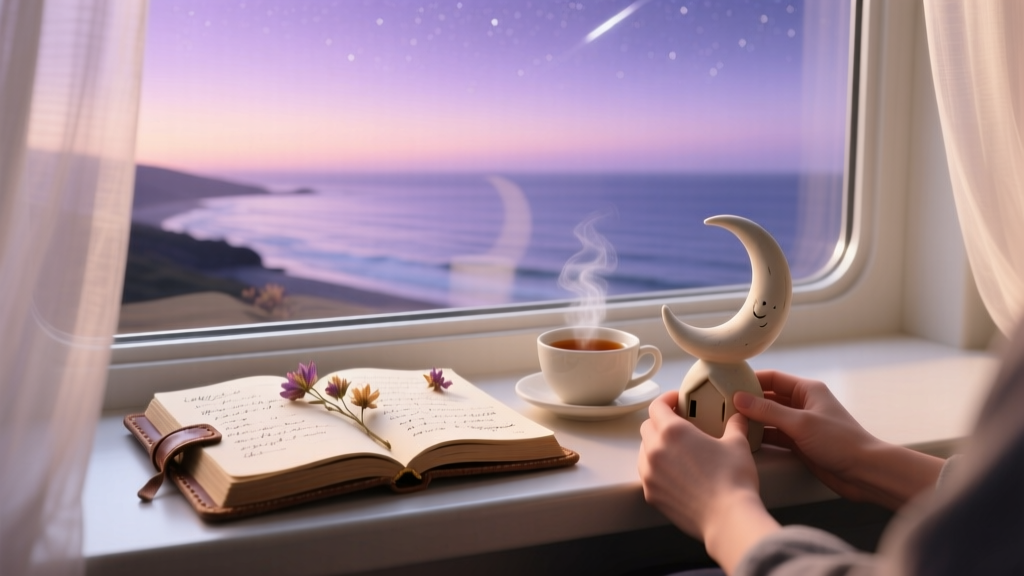
Cancer — the fourth sign of the zodiac, ruled by the Moon and anchored in the water element — doesn’t just go on vacation. They embark on emotional pilgrimages. Born between June 21 and July 22, Cancers carry the quiet strength of tides: deeply sensitive, fiercely protective, and instinctively drawn to places that feel like sanctuary. Their travel style is rarely about ticking off landmarks or chasing adrenaline for its own sake. Instead, every journey is filtered through an inner compass calibrated to comfort, connection, and meaning. For Cancer, travel is less about geography and more about resonance — the warmth of a sunlit kitchen in a coastal village, the scent of rain on ancient stone, the laughter echoing across a shared dinner table. This isn’t escapism; it’s soul maintenance.
The Cancer Travel Style
Cancer’s travel identity is rooted in their cardinal water nature — initiating action through feeling rather than logic. Unlike fire signs who seek conquest or air signs who prioritize novelty, Cancer travelers move with a quiet intentionality. Their ideal trip feels like a soft exhale: unhurried, emotionally safe, and rich with sensory familiarity. They’re drawn to destinations where they can ‘set up camp’ — not literally, but psychologically. A week-long stay in a family-run guesthouse with a garden, a seaside cottage with a well-stocked pantry, or a mountain cabin with a fireplace and handwritten recipe cards — these aren’t luxuries to Cancer; they’re prerequisites for presence.
This emotional architecture shapes everything: from how they choose accommodations (prioritizing homelike ambiance over Instagrammable aesthetics) to how they interact with locals (preferring deep, one-on-one conversations over group tours). Cancers often travel with sentimental objects — a seashell from childhood, a worn journal, a photo tucked into a passport sleeve — because physical anchors help them process new environments without losing themselves. According to the Astro.com Zodiac Sign Profiles, Cancer’s lunar rulership makes them acutely attuned to environmental energy; they’ll intuitively avoid places that feel energetically ‘thin’ or emotionally barren, even if those locations are objectively beautiful.
What sets Cancer apart is their profound capacity for nostalgic immersion. They don’t just visit a place — they absorb its rhythm, its culinary cadence, its generational stories. A Cancer in Kyoto won’t rush to Fushimi Inari; they’ll spend hours watching tea masters whisk matcha in a centuries-old machiya, then return the next day to sit quietly in the same corner, noticing how light shifts across the tatami. Their travel style is archival: collecting recipes, recording local lullabies, preserving pressed flowers in guidebooks. As astrologer Susan Miller notes in her Susan Miller Astrology Calendar, “Cancer’s greatest adventure is the inward one — and the outer world becomes its most vivid mirror.” That mirror reflects best in settings that honor continuity, care, and quiet reverence.
Best Travel Destinations for Cancer
Cancer thrives where land meets water, memory meets tradition, and hospitality feels ancestral. Their top destinations aren’t ranked by popularity, but by emotional resonance — places where the local culture mirrors Cancer’s values of nurture, protection, and intergenerational belonging. Coastal Portugal stands out: towns like Sintra and Évora offer fairy-tale architecture wrapped in misty hills, family vineyards that welcome guests like long-lost cousins, and seafood stews simmered for generations. The pace is slow, the light is golden, and the sense of rootedness is palpable — all deeply soothing to Cancer’s lunar sensitivity.
Japan’s rural Tohoku region offers another powerful alignment. Far from Tokyo’s neon pulse, villages like Ouchi-juku preserve Edo-era post towns with thatched roofs, steaming onsen fed by volcanic springs, and elders who share folktales over miso soup. Cancer feels viscerally understood here — where respect for ancestors, seasonal rituals (like cherry blossom picnics or autumn moon-viewing), and meticulous care in craft (pottery, weaving, sake brewing) reflect their own inner world. Similarly, Ireland’s Wild Atlantic Way delivers emotional nourishment: dramatic cliffs softened by rolling green pastures, pubs where strangers become confidants over live fiddle music, and ancient stone circles whispering stories older than language.
For Cancers seeking warmth and sensory richness, Oaxaca, Mexico, is unparalleled. Its layered indigenous and colonial heritage expresses itself in vibrant textiles, mole sauces passed down through matriarchal lines, and Day of the Dead altars built with love and remembrance. The city’s markets hum with life, yet its courtyard cafés invite stillness — a perfect duality for Cancer’s need to both engage and retreat. As the AstroStyle Cancer Profile observes, “Cancer doesn’t want to be a tourist — they want to be *tended to*, and to tend in return.” These destinations don’t just host Cancers; they hold them.
How Cancer Plans and Experiences Trips
Cancer’s trip planning is less spreadsheet-driven and more story-driven. They begin not with flight times, but with feelings: a dream of waking to seabird calls, a memory of grandmother’s lavender soap inspiring a Provence itinerary, or the longing to walk where a beloved poet once wandered. Their research phase is immersive and intuitive — watching YouTube videos of local festivals, reading memoirs set in the destination, listening to regional music playlists, and saving Pinterest boards titled “Kitchen Light in Lisbon” or “Rain Sounds in Kyoto.” They’ll spend weeks studying a single neighborhood map, visualizing morning walks past bakeries, afternoon naps in shaded plazas, and evening meals lit by string lights.
Once traveling, Cancer experiences time differently. They resist rigid schedules, preferring ‘soft structure’: a morning market visit, an open afternoon for wandering or resting, and an evening reserved for meaningful connection — whether with a local artisan or a travel companion. They’re masters of the ‘slow detour’: stopping to help a fisherman mend nets, joining a spontaneous cooking class in someone’s home kitchen, or sitting silently beside a river at dusk, absorbing the transition from day to night. Their journals overflow with sensory details — the texture of hand-thrown pottery, the taste of sea salt on lips, the exact shade of twilight over a harbor — because for Cancer, memory is emotion made tangible.
Technology serves them pragmatically, not obsessively. They’ll use translation apps to ask about family recipes, but rarely check real-time transit updates — preferring to trust serendipity and local guidance. And when things go awry (a missed train, a sudden downpour), Cancer doesn’t panic; they adapt with quiet resourcefulness, often discovering hidden gems in the detour. Their resilience comes not from control, but from deep self-trust — knowing that wherever they are, they can create safety, warmth, and meaning. As astrologer Steven Forrest writes in The Inner Sky, “Cancer’s power lies in transforming any space — even a rainy bus stop — into a hearth.”
Adventure Activities for Cancer
Don’t mistake Cancer’s gentleness for passivity. Their adventures are rarely extreme sports — but they are profoundly courageous in ways that align with their soul’s priorities. For Cancer, true adventure means stepping into vulnerability with purpose: learning to bake sourdough from a Tuscan nonna, tracing ancestral roots in County Clare, or volunteering at a coastal conservation project that protects nesting sea turtles. These activities satisfy Cancer’s need for emotional significance, skill-building rooted in tradition, and contribution to something enduring.
Water-based exploration resonates deeply: guided kayaking through bioluminescent bays in Puerto Rico, snorkeling coral nurseries in Belize with marine biologists, or sailing traditional dhows along Oman’s Dhofar coast — where navigation relies on stars and oral history, not GPS. Each activity engages Cancer’s intuition, reverence for natural cycles, and desire to protect fragile ecosystems. Similarly, forest bathing (shinrin-yoku) in Japan’s Yakushima Island — walking mindfully among 7,000-year-old cedar groves — activates Cancer’s innate grounding and restorative instincts.
Even ‘adventure’ involving risk feels intimate and intentional for Cancer: staying overnight in a Mongolian ger to learn nomadic herding rhythms, participating in a silent meditation retreat in the Himalayas, or navigating the labyrinthine souks of Fez with only a hand-drawn map from a local shopkeeper. These aren’t thrill-seeking acts — they’re pilgrimages of presence. What unites them is the invitation to deepen relationship: with self, with others, with history, with the Earth. Cancer doesn’t climb mountains to conquer them; they ascend to witness the sunrise with tears in their eyes, feeling the ancient pulse of the planet beneath their feet.
Solo vs. Group Travel for Cancer
Cancer’s relationship with companionship while traveling is nuanced and deeply personal. Solo travel offers vital space for emotional recalibration — time to journal by the sea, revisit childhood memories triggered by a certain scent or melody, or simply rest without performing sociability. Many Cancers report their most transformative trips happening alone: a month in a Greek island village where they learned olive harvesting from a widow who shared stories of her late husband over shared figs. Solitude, for Cancer, isn’t loneliness; it’s communion with their inner Moon — reflective, cyclical, and deeply restorative.
Yet Cancer also craves profound connection — and group travel, when carefully chosen, can fulfill this beautifully. They flourish in small, values-aligned groups: a women’s writing retreat in Big Sur, a culinary pilgrimage through Emilia-Romagna with fellow food historians, or a volunteer-build trip helping rebuild homes after floods in Appalachia. In these settings, Cancer naturally assumes the role of emotional steward — remembering everyone’s tea preference, noticing when someone seems withdrawn, organizing shared meals that feel like family gatherings. They’re less comfortable in large, impersonal tours where interaction remains superficial; what they seek is intimacy, not crowd size.
The key for Cancer is autonomy within connection. They need ‘recharge zones’ — a private room, a morning walk alone, an hour with a book in a quiet café — even within group settings. When traveling with partners or family, Cancer prioritizes co-creation: choosing destinations together, cooking meals side-by-side, building shared rituals (like lighting a candle each evening to name one thing they’re grateful for). Ultimately, whether solo or accompanied, Cancer’s travel success hinges on one condition: the freedom to feel, fully and without judgment. As the International Society for Astrological Research (ISAR) affirms in its Zodiac Sign Resource Guide, “Cancer’s journey is measured not in miles, but in moments of authentic emotional resonance.”
Cancer Travel Bucket List Table
| Destination | Experience | Why It Resonates With Cancer | Emotional Anchor |
|---|---|---|---|
| Sintra, Portugal | Stay in a 19th-century palace-hotel, attend a fado performance in a candlelit cellar, learn pasteis de nata baking from a convent nun | Blends fairy-tale romance, deep history, and living tradition — all hallmarks of Cancer’s love for layered, emotionally rich narratives | A handwritten recipe card signed by the nun |
| Kyoto, Japan | Participate in a tea ceremony led by a 12th-generation master, sleep in a ryokan with a private garden bath, join a moon-viewing (tsukimi) picnic in Arashiyama | Honors ritual, ancestry, seasonal awareness, and quiet contemplation — mirroring Cancer’s lunar reverence and need for sacred pause | A pressed maple leaf from the garden bath |
| Cliffs of Moher, Ireland | Walk the coastal path at dawn, visit a cliffside cottage museum honoring local fishing families, listen to sean-nós singing in a Galway pub | Connects Cancer to elemental power (sea/cliff), intergenerational resilience, and oral storytelling — core to their emotional lineage | A smooth, grey stone gathered at the cliff’s edge |
| Oaxaca City, Mexico | Learn alebrije carving from Zapotec artisans, join a mezcal tasting in a palenque surrounded by agave fields, build an ofrenda for Día de Muertos | Centers indigenous wisdom, ancestral veneration, tactile creativity, and communal celebration — all deeply aligned with Cancer’s nurturing sovereignty | A miniature alebrije painted in family birthstone colors |
| Amalfi Coast, Italy | Stay in a lemon-grove villa in Ravello, take a boat to Capri’s Blue Grotto at sunset, cook pasta with a local nonna using tomatoes grown on her terrace | Offers sensory abundance (citrus, sea, pasta), intergenerational knowledge transfer, and breathtaking beauty grounded in domestic warmth | A jar of homemade limoncello with a note in Italian |
This bucket list isn’t about checking boxes — it’s about cultivating a lifetime of emotional landmarks. Each entry invites Cancer to return, not just physically, but psychically: to retrace feelings, deepen relationships, and honor the quiet, tidal truth that home isn’t always a place — sometimes, it’s the way you hold yourself, and others, in the world.