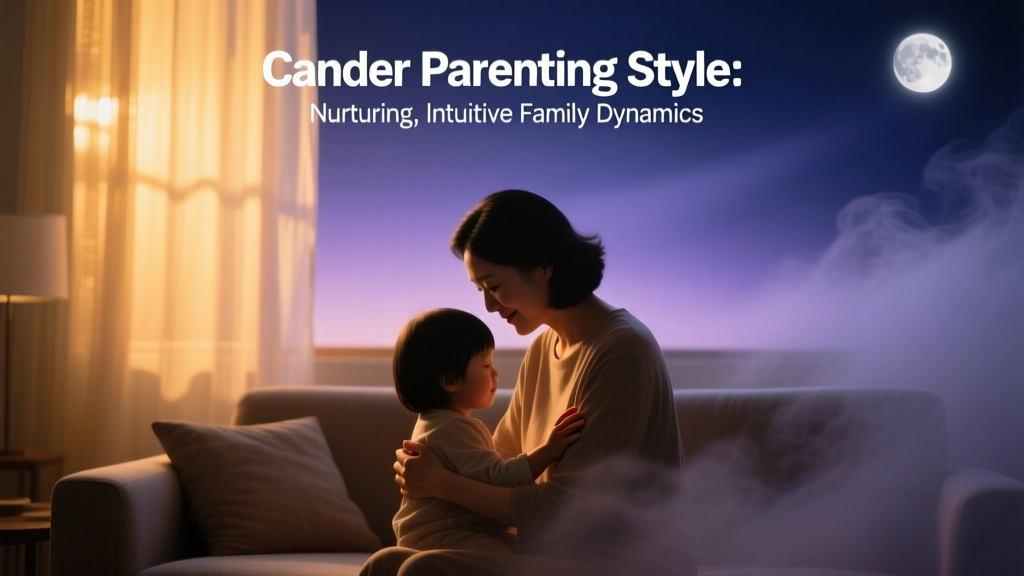
Cancer—the fourth sign of the zodiac, ruled by the Moon and anchored in the water element—embodies the archetype of the caregiver. Born between June 21 and July 22, Cancers bring an unparalleled depth of empathy, memory, and emotional attunement to family life. In parenting and family dynamics, they don’t just raise children; they cultivate emotional ecosystems. Their approach is rarely loud or directive—it’s woven into bedtime rituals, handwritten notes tucked into lunchboxes, and the quiet vigilance of a parent who senses distress before it’s voiced. Unlike fire signs who lead with inspiration or air signs who prioritize intellectual exchange, Cancer parents lead with felt safety: the unspoken assurance that home is where feelings are held, not fixed. This article explores Cancer’s distinctive imprint on family life—not as a horoscope trope, but as a lived psychological and relational reality grounded in astrological tradition, behavioral observation, and modern attachment theory.
Cancer as a Parent
Cancer parents are often described as ‘the heart of the home’—but this phrase barely captures the complexity of their parental identity. Governed by the Moon—the celestial body associated with instinct, memory, nourishment, and emotional rhythms—Cancer parents operate from a deeply somatic, cyclical awareness. They don’t just respond to a child’s needs; they anticipate them. A Cancer mother may notice her toddler’s subtle shift in appetite or sleep pattern days before illness manifests. A Cancer father might reorganize weekend plans without explanation because his internal barometer registers his teen’s unspoken anxiety. This isn’t psychic ability—it’s neurobiological attunement amplified by lunar sensitivity. Research in developmental psychology supports the link between caregiver sensitivity and secure attachment outcomes, noting that responsive, emotionally available caregivers foster resilience across the lifespan (American Psychological Association, Attachment Theory). For Cancer parents, responsiveness isn’t a technique—it’s second nature. Their parenting is rooted in remembering: not only their own childhood experiences (often revisited with poignant clarity), but also the emotional imprints of their children’s milestones—first steps, first heartbreaks, first moments of autonomy. This memory-rich orientation means Cancer parents often serve as family archivists: photo albums, voice memos, saved artwork, holiday traditions preserved across generations. Yet this strength carries nuance: when overwhelmed, Cancer parents may retreat inward or over-identify with their child’s emotions, blurring boundaries. Their greatest growth lies in distinguishing protection from possession—and nurturing independence without abandoning emotional closeness.
Parenting Style and Family Values
The Cancer parenting style defies rigid categorization—it’s less about rules and more about resonance. Psychologist Diana Baumrind’s foundational parenting typologies (authoritative, authoritarian, permissive, neglectful) don’t fully map onto Cancer’s approach, which blends high responsiveness with variable demandingness. A Cancer parent may enforce strict bedtime routines (to ensure restorative sleep and emotional regulation) while remaining flexible about homework deadlines during periods of family stress. Their authority emerges not from hierarchy, but from reliability: showing up consistently, remembering promises, honoring feelings even when disagreeing with behavior. Core family values for Cancer households include sanctuary, continuity, and emotional literacy. Sanctuary means home is non-negotiably safe—a place where vulnerability is honored, not corrected. Continuity expresses itself in rituals: Sunday dinners, seasonal decorations, annual visits to grandparents’ homes, or even the same lullaby sung for three generations. These aren’t habits; they’re emotional anchors. Emotional literacy is taught implicitly: Cancer parents model naming feelings (“I feel tender today”), validate discomfort (“It makes sense you’re sad—we miss Grandma”), and normalize tears as information, not weakness. Importantly, Cancer’s water-element nature means their values flow rather than command. They rarely lecture; instead, they create conditions where values organically take root—like planting seeds in rich soil and tending gently. According to the International Society for Astrological Research (ISAR), Cancer’s lunar rulership correlates strongly with ‘nurturance as identity’ across cultural studies of parenting styles (ISAR Research Archive). This isn’t passive care—it’s active, embodied stewardship of emotional ecology. Challenges arise when Cancer’s desire for harmony suppresses necessary conflict, or when nostalgia idealizes the past at the expense of present-moment adaptation. The most balanced Cancer families integrate tradition with evolution—keeping the recipe for Grandma’s apple pie while inviting teens to reinterpret its meaning.
Cancer Children: Traits and Needs
A Cancer child (born June 21–July 22) enters the world with an unusually developed emotional antenna. From infancy, they display heightened sensitivity to tone, atmosphere, and physical touch—cooing when held by calm caregivers, withdrawing under harsh lighting or raised voices. Pediatric research on sensory processing highlights that many Cancer-born children align with what’s termed ‘slow-to-warm-up’ or ‘deeply reflective’ temperaments (HealthyChildren.org, AAP). Their early development often emphasizes emotional cognition over motor or verbal milestones—they may point to express longing before speaking full sentences, or cry inconsolably when separated from primary caregivers long before typical separation anxiety peaks. Cancer children need environments rich in predictable rhythm: consistent sleep schedules, familiar foods, gentle transitions between activities. Unstructured chaos—even well-intentioned ‘free play’ without scaffolding—can trigger anxiety. Yet within security, they bloom creatively: drawing elaborate family portraits, narrating intricate imaginary worlds centered on home and belonging, or memorizing song lyrics with uncanny fidelity. Their loyalty is fierce but selective; trust is earned slowly and guarded fiercely. Discipline works best when framed relationally (“When you hit your brother, I feel worried because I love you both”) rather than transactionally (“You’re losing screen time”). Punishment without emotional repair feels like abandonment. Crucially, Cancer children carry ancestral echoes—they may express worries about family finances, repeat phrases their grandparents used, or develop phobias mirroring parental anxieties. This isn’t mimicry; it’s energetic inheritance. Supporting them means validating their perceptiveness (“Yes, something *did* feel tense at dinner”) while helping them differentiate their feelings from others’. When thriving, Cancer children become extraordinary empathic leaders—attuned therapists, compassionate educators, intuitive healers—whose strength lies not in detachment, but in deep, discerning connection.
Family Role of Cancer
Within the family system, Cancer rarely seeks the spotlight—but without them, the emotional infrastructure collapses. Think of Cancer as the family’s central nervous system: not the CEO (that’s often Leo or Capricorn), not the project manager (Virgo or Aquarius), but the limbic regulator—the one who notices when Dad hasn’t laughed in three days, who brings soup when Aunt Maria is grieving, who rearranges seating at Thanksgiving so estranged cousins aren’t forced into proximity. Their role is container and conduit. As container, they absorb ambient stress, metabolize collective emotion, and hold space for contradictions—joy and grief coexisting, anger and love intertwined. As conduit, they translate unspoken needs into actionable care: “Mom seems tired—let’s make breakfast,” or “Sam hasn’t mentioned the audition—maybe he needs to talk.” Astrologer Steven Forrest observes that Cancer’s evolutionary purpose is to “create sanctuary in a chaotic world”—a function that manifests most potently within kinship networks (Steven Forrest, The Changing Sky). This role extends beyond blood ties: Cancer often becomes the de facto aunt/uncle to friends’ children, the neighbor who stocks emergency snacks, the colleague who remembers birthdays and checks in after losses. However, chronic role overload risks depletion. When Cancer over-functions as family emotional laborer, resentment builds silently—manifesting as passive resistance, health flare-ups (Cancer rules the chest, stomach, and breasts), or sudden withdrawal. Healthy expression of this role requires conscious delegation (“Can you handle bedtime tonight? I need quiet”) and permission to receive care without guilt. In multigenerational households, Cancer often serves as the bridge between elders and youth—translating wisdom without dogma, honoring tradition while making space for new expressions of belonging. Their legacy isn’t written in achievements, but in the quality of relational memory they preserve: the way a grandchild knows exactly how Great-Grandma stirred her tea, or why certain songs instantly evoke safety.
Cancer Parent-Child Compatibility
Cancer’s compatibility with children depends less on sun sign alignment and more on mutual capacity for emotional reciprocity. That said, certain placements harmonize with Cancer’s core frequencies. Pisces and Scorpio children (both water signs) intuitively understand Cancer’s unspoken language—shared sensitivity becomes a source of profound bonding, though boundaries require extra attention to prevent enmeshment. Taurus and Virgo children (earth signs) ground Cancer’s fluidity; their practicality complements Cancer’s nurturing, creating stable, sensory-rich homes (think herb gardens, cozy reading nooks, homemade remedies). With Aries or Sagittarius children (fire signs), dynamic tension arises: Cancer’s caution meets their impulsivity, potentially sparking power struggles around independence. Success hinges on Cancer learning to scaffold risk (“Let’s walk to the corner together first”) rather than restrict—and fire-sign children learning to honor Cancer’s need for emotional downtime. Air signs (Gemini, Libra, Aquarius) challenge Cancer intellectually but may frustrate their need for emotional continuity; consistency in communication (e.g., weekly check-ins, shared journals) bridges the gap. Notably, Cancer parents often report strongest resonance with children who have prominent Moon, Cancer, or 4th house placements in their charts—regardless of sun sign—confirming astrology’s emphasis on lunar nodes over solar identity in familial bonds. Regardless of sign, the golden rule remains: Cancer thrives when their child’s autonomy is honored *within* relational safety. They don’t need to fix every hurt—but they must witness it fully. As astrologer Donna Cunningham writes, “The Cancerian gift is not solving pain, but holding its weight until the other feels light enough to carry it again” (Donna Cunningham, The Moon in Your Life).
Family Dynamics Quick Reference Table
| Aspect | Cancer Parent Strengths | Potential Challenges | Support Strategies |
|---|---|---|---|
| Emotional Attunement | Uncanny ability to sense unspoken needs; creates profound safety | Risk of absorbing child’s emotions as their own; boundary erosion | Practice “feeling with, not for”; use journaling to distinguish emotions |
| Ritual & Tradition | Builds intergenerational continuity; anchors children in identity | Rigidity may stifle individual expression; nostalgia can overshadow present | Invite co-creation: “What new tradition should we start this year?” |
| Conflict Resolution | Seeks harmony; prioritizes relational repair over being right | Avoidance of necessary confrontation; passive-aggression under stress | Use “I feel” statements; schedule calm-time conversations post-tension |
| Nurturing Expression | Embodied care—cooking, tucking in, physical comfort, memory-keeping | May equate love with service; overlook verbal/emotional affirmation | Pair actions with words: “I’m making your favorite meal because I love you” |
| Response to Stress | Retreats to restore; protects family from external overwhelm | Withdrawal may be misread as rejection; delays problem-solving | Communicate needs clearly: “I need two hours alone, then I’ll listen deeply” |
In essence, Cancer’s contribution to family life is irreplaceable—not because they’re perfect, but because they embody the ancient, vital truth that human beings grow roots before they reach branches. Their parenting doesn’t chase milestones; it cultivates the soil where milestones naturally emerge. To parent alongside or raise a Cancer is to learn that love is not always loud, but it is always present—like the tide, like memory, like the quiet, unwavering light of the Moon.