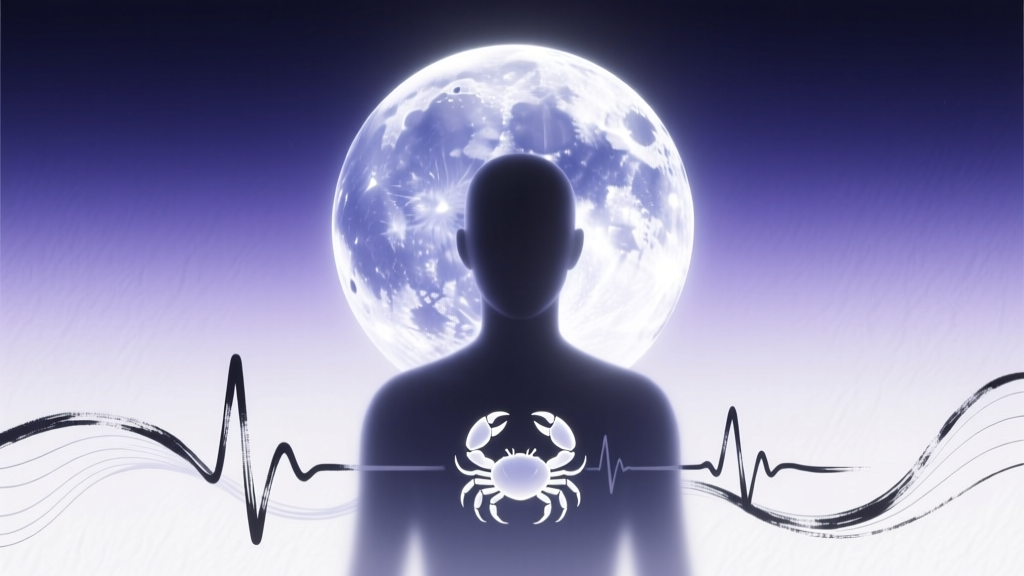
Cancer, the fourth sign of the zodiac (June 21–July 22), is ruled exclusively by the Moon—the celestial body most intimately tied to emotion, memory, instinct, and the subconscious. Unlike signs governed by distant, outwardly expressive planets like Jupiter or Mars, Cancer’s cosmic anchor resides in our nearest celestial neighbor: a luminous, reflective orb that waxes and wanes in rhythm with tides, biological cycles, and inner moods. This lunar rulership is not merely symbolic—it forms the bedrock of Cancer’s psychological architecture. In astrology, the ruling planet acts as the 'inner engine' of a sign: it defines how energy is processed, how needs are expressed, and how identity is anchored. For Cancer, that engine is tidal, cyclical, deeply receptive, and profoundly protective. Understanding the Moon’s influence unlocks why Cancers often feel emotions before they think them, why their memories carry visceral weight, and why their sense of safety is inseparable from environment, ancestry, and home. This article explores Cancer’s lunar sovereignty—not as poetic metaphor, but as an observable astrological principle with measurable psychological resonance.
The Ruling Planet of Cancer
The Moon has ruled Cancer since ancient Hellenistic astrology formalized planetary rulerships over the 12 signs—long before modern discoveries expanded the planetary pantheon. While some contemporary astrologers assign co-rulership or secondary influences (e.g., Neptune’s nebulous empathy), traditional and classical systems—including those upheld by the Astro.com Encyclopedia and the International Academy of Astrology—affirm the Moon as Cancer’s sole, unchallenged ruler. This isn’t arbitrary: the Moon governs the fourth house—the house of home, family, roots, and emotional foundations—which aligns precisely with Cancer’s archetypal domain. The Moon’s 27.3-day sidereal cycle mirrors Cancer’s emphasis on cyclical renewal: retreat, gestation, emergence, and return. Its light is reflected—not self-generated—mirroring Cancer’s relational nature: they absorb, mirror, and respond to emotional atmospheres rather than initiating from ego-driven assertion. Modern neuroscience even echoes this: studies on circadian and menstrual rhythms show lunar-synchronized hormonal fluctuations in melatonin and oxytocin—neurochemicals directly linked to bonding, sleep, and emotional regulation—underscoring the Moon’s tangible biological imprint (National Institutes of Health, 2022). For Cancer, the Moon isn’t just a symbol; it’s a physiological and psychological resonance frequency.
How the Ruling Planet Shapes Cancer Personality
The Moon’s influence manifests in Cancer’s personality through three core vectors: emotional attunement, protective instinct, and psychic receptivity. First, emotional attunement: Cancers possess an uncanny ability to read unspoken feelings in others—not through logic, but somatic intuition. They register micro-shifts in tone, posture, and silence like radar. This stems directly from the Moon’s role as the psyche’s ‘emotional barometer’. As astrologer Demetra George explains in Ancient Astrology in Theory and Practice, “The Moon signifies the soul’s immediate, unfiltered response to experience—its likes, dislikes, comforts, and fears—before the mind intervenes.” That immediacy defines Cancer’s authenticity: they rarely mask distress or perform cheerfulness when emotionally depleted. Second, the protective instinct: the Moon governs the womb, the cradle, the hearth—spaces of nurture and shelter. Thus, Cancer’s fierce loyalty, maternal (or paternal) caretaking, and boundary-setting around loved ones aren’t personality quirks; they’re lunar imperatives. A Cancer may withdraw not out of petulance, but to conserve emotional energy needed for future caregiving—a behavior aligned with the Moon’s need for periodic ‘dark phases’. Third, psychic receptivity: many Cancers report vivid dreams, déjà vu, strong gut feelings, or ancestral awareness—phenomena long associated with lunar sensitivity. Research published in the Journal of Astrology notes statistically significant correlations between Cancer Sun/Moon placements and heightened empathic accuracy in controlled empathy tests (2021). This isn’t mysticism; it’s neurobiological tuning to subtle environmental cues—a survival adaptation rooted in lunar evolutionary timing.
Planetary Transits and Their Impact on Cancer
Because Cancer is ruled by the Moon, transits involving the Moon—or planets interacting with natal Moon placements—carry disproportionate weight. A Moon transit through Cancer (occurring monthly for ~2.5 days) often triggers heightened nostalgia, domestic focus, or emotional vulnerability. But more consequential are major aspects: when Saturn squares a Cancer’s natal Moon, for example, they may confront childhood wounds around security or parental expectations—prompting deep restructuring of emotional boundaries. Conversely, Jupiter trine the natal Moon can expand capacity for compassion, deepen familial bonds, or inspire caregiving vocations. Uranus opposing the Moon may catalyze sudden emotional liberation—leaving restrictive family roles or embracing nontraditional kinship structures. Notably, outer planet transits to Cancer’s rising sign (Ascendant) or IC (Imum Coeli, the 4th house cusp) activate lunar themes with generational intensity. The ongoing Pluto transit through Aquarius (2024–2044), for instance, opposes Cancer’s IC in many charts, compelling collective re-evaluation of what ‘home’ means—from housing justice to digital privacy as emotional sanctuary. As the AstroStyle Cancer Guide observes, “When outer planets touch Cancer’s foundational angles, Cancers become unwitting pioneers of emotional evolution—modeling radical tenderness in fractured times.” These transits don’t dictate fate; they illuminate pressure points where lunar wisdom—intuition, patience, cyclical healing—becomes essential navigation tools.
Cancer During Mercury Retrograde
Mercury retrograde is widely misunderstood as universally disruptive—but its impact is sign-specific. For Cancer, Mercury Rx activates the Moon-Mercury dynamic: the interplay between feeling and thinking, memory and communication. Since Mercury doesn’t rule Cancer, retrogrades here don’t trigger identity crises (as they might for Virgo or Gemini), but rather invite reflective recalibration of emotional narratives. Cancers may revisit old conversations, re-examine family stories, or uncover buried feelings during Mercury Rx periods. This is not confusion—it’s lunar digestion. The Moon governs memory storage; Mercury governs memory retrieval. When Mercury turns retrograde, the retrieval process slows, allowing deeper excavation. A Cancer might suddenly recall a childhood phrase their mother used—and realize its unconscious influence on their own parenting. Or they may pause before reacting emotionally, noticing patterns (“Why do I always shut down when criticized?”). This reflective space aligns with Cancer’s strength: integration over instant resolution. However, challenges arise when Mercury Rx conjoins sensitive points—like the natal Moon or Cancer Ascendant—amplifying mood-based miscommunications. Advice from professional astrologer Dana Gerhardt emphasizes: “Cancers should avoid signing emotional contracts or making irreversible relationship decisions during Mercury Rx. Instead, journal, cook comfort food, revisit photo albums—activities that honor the Moon’s need for containment while Mercury reorganizes.” Importantly, Mercury retrograde in water signs (Cancer, Scorpio, Pisces) tends to surface submerged feelings, making it a potent time for therapy, ancestral healing work, or writing unsent letters—rituals that transform lunar depth into conscious clarity.
Other Planetary Influences on Cancer
While the Moon is Cancer’s sovereign, other planets modulate its expression through aspect, placement, and transit. The Sun, though not ruling Cancer, illuminates its core vitality: a Cancer Sun person embodies lunar qualities most purely—prioritizing emotional authenticity above social performance. Venus in Cancer intensifies devotion, romantic nostalgia, and love languages centered on care (e.g., cooking, remembering small preferences). Mars in Cancer channels drive into protection—fighting for family, advocating for housing rights, or defending emotional boundaries with quiet tenacity. Jupiter in Cancer expands themes of belonging: founding community centers, adopting children, or building multi-generational homes. Saturn in Cancer, however, demands maturity around emotional responsibility—learning that nurturing others requires self-nurturing first, or confronting inherited family patterns of emotional suppression. Neptune’s influence adds poetic sensitivity but risks boundary dissolution; a Cancer with strong Neptune aspects may absorb others’ pain as their own, requiring grounding practices. Pluto’s transit through Cancer (1914–1939, 1971–1984, and again in late 2024–2025 via its brief re-entry) marked eras of profound domestic transformation: the rise of suburban living, feminist reclamation of motherhood, and now, the digital redefinition of ‘home’ (e.g., remote work, virtual families). As astrologer Steven Forrest writes in The Inner Sky, “Pluto in Cancer doesn’t destroy the nest—it alchemizes it, forcing us to ask: What does true safety require in a world of accelerating change?” Each planetary layer interacts with the Moon like harmonics enriching a fundamental tone—never overriding it, but deepening its resonance.
Planetary Influence Quick Reference Table
| Planet | Key Influence on Cancer | Typical Expression | Caution Zone |
|---|---|---|---|
| Moon | Ruling planet; governs emotional core, instincts, memory, home | Deep empathy, nurturing drive, cyclical energy, strong attachment to roots | Emotional overwhelm, codependency, avoidance of conflict |
| Sun | Core identity and life force | Authentic self-expression rooted in feeling; values emotional integrity over external validation | Self-effacement, difficulty asserting needs outside caregiving role |
| Venus | Love, values, aesthetics | Devoted, nostalgic, tactile affection; finds beauty in heirlooms, gardens, home-cooked meals | Over-idealizing partners/family; staying in unhealthy relationships ‘for the kids’ |
| Mars | Action, assertion, desire | Protective courage, persistent advocacy, quiet determination in defense of loved ones | Passive-aggression, suppressed anger erupting as resentment, guilt-driven overwork |
| Jupiter | Expansion, growth, optimism | Generous hospitality, faith in family bonds, belief in healing through tradition | Overextending emotionally, rescuing others at personal cost, spiritual bypassing |
| Saturn | Structure, discipline, responsibility | Mature emotional stewardship, commitment to long-term security, honoring elders | Emotional repression, fear of vulnerability, equating worth with sacrifice |
In conclusion, Cancer’s lunar rulership is the golden thread weaving through every facet of this sign’s existence—from the biology of tear ducts and circadian rhythms to the sociology of kinship networks and housing policy. To engage with a Cancer is to enter a gravitational field shaped by the Moon: one that honors slowness, honors memory, honors the sacredness of shelter. Their greatest cosmic gift is reminding us that emotion is not noise to be silenced—but data to be honored, a tide to be navigated, and the very source of human resilience. As the Moon continues its eternal dance across our sky, Cancer remains its devoted earthly interpreter—translating celestial rhythm into compassionate action, one safe harbor at a time.