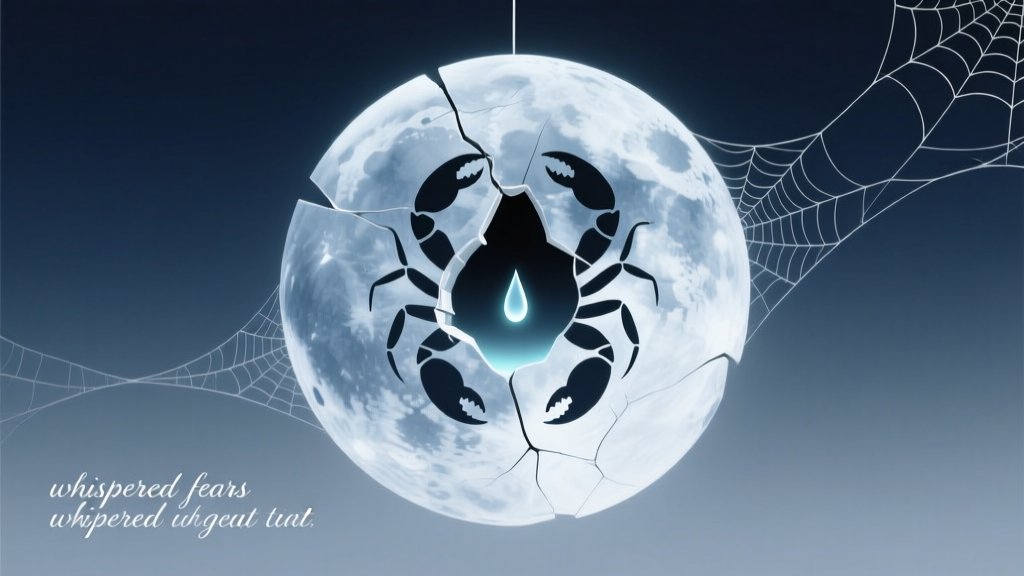
The Shadow Side of Cancer
Cancer—the fourth sign of the zodiac, ruled by the Moon and anchored in the water element—embodies nurturing, intuition, memory, and deep emotional attunement. Yet like all signs, Cancer carries a shadow side: the repressed, unacknowledged, or distorted expressions of its core gifts. The shadow is not 'evil'—it’s the unconscious counterpart to conscious strengths. For Cancer, this shadow emerges when sensitivity hardens into manipulation, protectiveness curdles into control, and empathy collapses into emotional parasitism. Unlike fire or air signs whose shadows often manifest as aggression or detachment, Cancer’s shadow operates quietly—through passive resistance, guilt-laden silence, or veiled martyrdom. Because Cancer governs the home, family, and early conditioning, its shadow is deeply entangled with childhood wounds, ancestral patterns, and unprocessed grief. According to Jungian astrologer Liz Greene, the Moon-ruled Cancer archetype carries an innate vulnerability that, when unexamined, becomes fertile ground for projection and emotional enmeshment. When Cancer denies its need for safety—or overidentifies with it—it risks becoming emotionally coercive, using vulnerability as leverage rather than invitation. This isn’t malice; it’s survival logic gone awry. The Cancer shadow doesn’t shout—it sighs, withdraws, remembers every slight, and waits. Its power lies in its invisibility: a silent resentment that calcifies over years, a ‘motherly’ expectation that masquerades as love but functions as obligation. Recognizing this shadow requires courage—not because it’s monstrous, but because it wears the face of care. To confront Cancer’s darkness is to ask: Where have I confused protection with possession? Where has my empathy become a tool for influence rather than connection? And how much of my ‘sacrifice’ serves others—and how much serves my unmet need for recognition?
Cancer Fears and Insecurities
At the heart of Cancer’s shadow lie three interlocking fears: abandonment, irrelevance, and emotional exposure without reciprocity. These are not abstract anxieties—they’re visceral, somatic, and rooted in the Moon’s archetypal role as the guardian of the inner world and early attachments. Cancer’s deepest insecurity isn’t about being disliked; it’s about being *unnecessary*. Because Cancer’s sense of identity is relational—‘I am because I am needed’—its self-worth hinges on perceived utility within intimate circles. This creates a paradox: the more Cancer gives, the more it fears being taken for granted. Astrologer Steven Forrest observes in The Inner Sky that Cancer’s lunar nature makes it exquisitely attuned to emotional atmospheres—but also hypersensitive to shifts in attention, tone, or presence. A delayed text, a distracted glance, or even a neutral comment can register as existential threat. This fear of abandonment isn’t always about physical separation; it’s often the terror of emotional invisibility—of pouring love into a vessel that never fills, or offering care that evaporates upon receipt. Compounding this is Cancer’s fear of being seen *without context*: raw emotion stripped of narrative, history, or justification. A Cancer may weep openly—but only after constructing a story that explains *why* they’re hurting, thereby preserving dignity while still seeking comfort. Unhealed, these insecurities fuel chronic hypervigilance: scanning for signs of withdrawal, rehearsing apologies before conflicts arise, or preemptively withdrawing affection to avoid rejection. Over time, this erodes authenticity. The Cancer individual may begin to equate emotional safety with predictability—even at the cost of mutuality—and mistake dependency for intimacy. As the Swiss Astrology Center notes, Cancer’s lunar rulership means its fears are cyclical, waxing and waning with internal tides—making them harder to ‘solve’ and easier to soothe through ritual, repetition, and symbolic reassurance (e.g., keeping mementos, maintaining routines, revisiting familiar places).
Defense Mechanisms of Cancer
Cancer’s defense mechanisms are rarely confrontational—they’re atmospheric, indirect, and emotionally resonant. Rather than meeting conflict head-on, Cancer reshapes the emotional weather around it. The most common defenses include emotional mirroring, selective memory, guilt induction, and strategic withdrawal. Emotional mirroring—unconsciously reflecting another’s mood back at them—is both empathic and protective: it disarms potential threat by signaling alignment, but can also blur boundaries and obscure authentic feeling. Selective memory manifests as ‘forgetting’ slights that trigger shame (e.g., a harsh word spoken in anger) while vividly recalling moments of neglect—even decades later. This isn’t pathology; it’s the Moon’s archival function prioritizing emotionally charged data. Guilt induction operates subtly: a sigh, a quiet ‘I guess I’ll handle it,’ or an overextended sacrifice that silently demands repayment. These aren’t calculated manipulations—they’re learned survival strategies from environments where direct assertion led to punishment or dismissal. Strategic withdrawal—often mistaken for aloofness—is Cancer’s primary fortress. When threatened, Cancer doesn’t flee outward; it retreats inward, pulling emotional curtains shut. This isn’t indifference; it’s self-preservation through containment. What appears as coldness may be profound overwhelm—a nervous system saturated with unprocessed affect. Importantly, these defenses serve real purposes: they’ve kept Cancer safe, maintained relationships, and preserved emotional continuity. The problem arises when they become default settings—when mirroring replaces authenticity, when withdrawal replaces repair, when guilt replaces honest negotiation. As clinical astrologer Erin Sullivan writes in Dynamics of Aspect Analysis, ‘The Moon’s defenses are not flaws—they are ancient protocols. Healing begins not by dismantling them, but by upgrading their firmware.’ That means cultivating new tools—like naming needs directly, tolerating discomfort without retreating, or practicing ‘non-transactional’ giving—while honoring the wisdom embedded in old patterns.
When Cancer Is Under Stress
Stress activates Cancer’s shadow with surgical precision. Under pressure, its lunar rhythm destabilizes: emotions flood without regulation, memories resurface with traumatic clarity, and attachment instincts override discernment. Unlike Capricorn (its opposite sign), which responds to stress with stoic control, Cancer under duress becomes emotionally porous—absorbing ambient anxiety, replaying past hurts, and conflating present triggers with childhood wounds. A minor disagreement may evoke the sting of a parent’s dismissal; a logistical delay may echo the terror of instability in early life. Physiologically, Cancer governs the chest, stomach, and breasts—areas where stress manifests as digestive upset, shallow breathing, or tightness behind the ribs. Psychologically, stress reveals three escalating patterns: first, hyper-vigilance (scanning for danger in tone, timing, or silence); second, emotional contagion (‘catching’ others’ moods and mistaking them for one’s own); third, identity collapse (‘If I’m not needed, who am I?’). This final stage is the most perilous: when Cancer’s relational self-definition fractures, it may latch onto any available role—victim, savior, martyr—to restore coherence. In extreme cases, this fuels codependency: staying in harmful relationships to avoid the void of self-reliance. Notably, Cancer’s stress response is rarely explosive—it’s cumulative. Small dismissals accumulate like sediment, until a seemingly trivial event triggers disproportionate reaction: tears, silence, or sudden estrangement. This is not ‘overreaction’—it’s the overflow of unprocessed emotional backlog. Research from the National Institute of Mental Health confirms that individuals with high emotional sensitivity (a Cancer hallmark) show heightened amygdala activation during interpersonal stress, making regulation more metabolically costly. Thus, stress management for Cancer isn’t about ‘toughening up’—it’s about building emotional infrastructure: somatic grounding, narrative reframing, and intentional boundary rituals.
Toxic Cancer Patterns and How to Heal
Unaddressed, Cancer’s shadow crystallizes into toxic patterns that harm both self and others. These include emotional blackmail, covert control, nostalgia-based idealization, and compassion fatigue masquerading as virtue. Emotional blackmail occurs when Cancer weaponizes vulnerability—‘If you leave, I’ll fall apart’—not as truth-telling, but as coercion. Covert control manifests as ‘helpful’ interference: rearranging a partner’s schedule ‘for their own good,’ monitoring children’s friendships ‘to keep them safe,’ or editing family narratives to preserve harmony. Nostalgia-based idealization distorts memory, painting the past as uniformly warm and secure—erasing complexity and stifling growth. Compassion fatigue disguised as virtue looks like chronic exhaustion paired with resentment toward those ‘not appreciating enough.’ Healing begins with differentiation: separating genuine care from enmeshed obligation. Key steps include: (1) Naming needs explicitly—not ‘I’m fine’ but ‘I need reassurance right now’; (2) Practicing ‘detached nurturing’: offering support without attaching outcomes (e.g., ‘I’ll listen, but I won’t fix it’); (3) Reclaiming autonomy through small, non-relational acts of self-authorship (e.g., taking a solo trip, changing a routine, saying ‘no’ without explanation). Therapy modalities proven effective for Cancer’s profile include Internal Family Systems (IFS), which honors protective parts without letting them dominate, and Somatic Experiencing, which addresses the body’s stored stress. Crucially, healing isn’t about becoming ‘less Cancer’—it’s about integrating the Crab’s hard shell *with* its soft interior, so protection serves growth, not imprisonment.
Embracing the Full Spectrum of Cancer
True wholeness for Cancer lies not in rejecting its shadow, but in recognizing it as the dark soil from which its luminous qualities grow. The same depth that enables profound empathy also holds unprocessed sorrow; the same loyalty that sustains families can constrict freedom; the same intuition that reads rooms can spiral into paranoid rumination. Embracing the full spectrum means holding paradox: being fiercely protective *and* radically permissive of others’ autonomy; honoring tradition *while* questioning inherited roles; receiving care *without* performing unworthiness to earn it. It means understanding that Cancer’s ‘moodiness’ isn’t instability—it’s the Moon’s natural cycle, a sacred rhythm of release and renewal. When integrated, Cancer’s shadow transforms: manipulation becomes discernment; clinginess becomes devoted presence; sentimentality becomes ancestral reverence. This integration shows up in mature Cancer expressions—like the therapist who holds space without absorbing pain, the artist who transmutes grief into haunting beauty, or the elder who shares stories not to bind, but to liberate. As astrologer Demetra George writes in Ancient Astrology in Theory and Practice, ‘The Moon’s light is reflected, not self-generated—yet its illumination is indispensable. So too is Cancer’s reflected sensitivity: it doesn’t diminish the Sun’s authority; it makes it visible to the human heart.’ Embracing the full spectrum is an act of radical self-honesty: acknowledging that your capacity to nurture is matched only by your capacity to wound—and that both arise from the same wellspring of love.
Shadow Work Prompts for Cancer
Shadow work for Cancer is deeply somatic and narrative-based. Below are seven targeted prompts designed to gently excavate unconscious patterns while honoring Cancer’s need for safety and meaning:
| Prompt | Purpose | Journaling Tip |
|---|---|---|
| What did ‘safety’ feel like in my earliest memories—and what had to be sacrificed to maintain it? | Uncovers foundational contracts with care | Write in present tense, using sensory details (smells, textures, sounds) |
| When do I use silence as a shield? What am I protecting—and what am I avoiding? | Reveals strategic withdrawal patterns | Track three instances this week; note physical sensations before/during/after |
| What emotion do I most fear expressing directly—and what story do I tell myself about why it’s dangerous? | Identifies suppressed affect | Answer in one sentence, then write the ‘opposite story’ (e.g., ‘Anger is destructive’ → ‘Anger is my boundary made audible’) |
| Where have I confused ‘being needed’ with ‘being loved’? | Challenges relational self-worth | List three relationships; beside each, write: ‘I am valued for ______’ (fill in intrinsic quality, not function) |
| What childhood memory feels ‘charged’—and what part of me is still living inside it? | Accesses lunar imprint | Dialogue with that younger self: What does she need to hear? What does she need to release? |
Consistency matters more than volume: five minutes daily with one prompt builds neural pathways faster than weekly deep dives. Always close shadow work with a grounding ritual—lighting a candle, holding a smooth stone, or placing a hand over the stomach—to signal safety to the nervous system. Remember: Cancer’s shadow isn’t a flaw to fix. It’s the tide revealing what lies beneath the surface—so you can build your home not on shifting sand, but on bedrock you’ve chosen, consciously, with love.