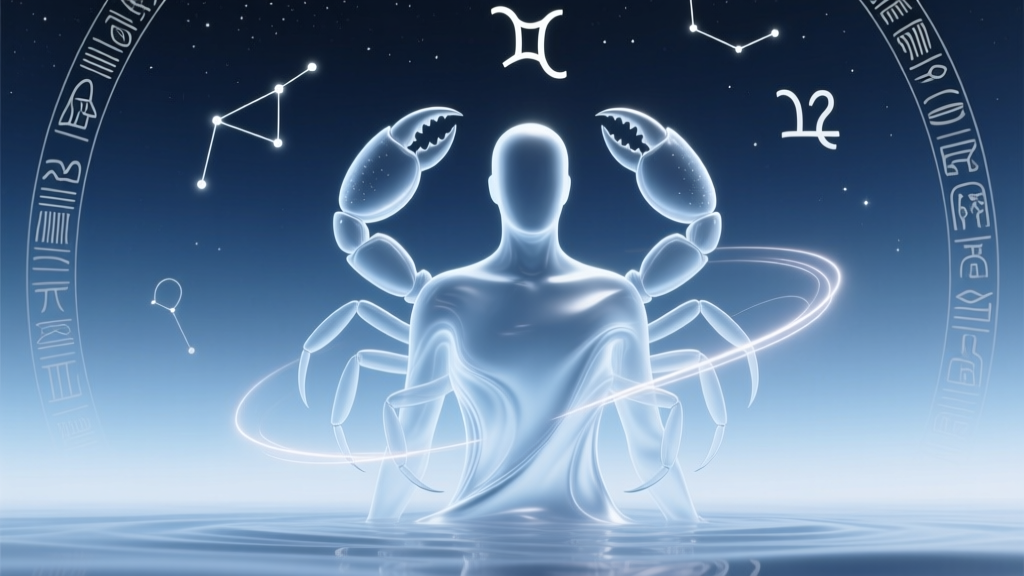
Cancer—the fourth sign of the zodiac, spanning June 21 to July 22—is often associated with nurturing, intuition, emotional depth, and protective instincts. Yet beneath its modern psychological portrait lies a profound mythological lineage stretching back over two millennia. Unlike many zodiac signs whose symbolism derives from heroic or celestial figures, Cancer’s origin is rooted in humility, sacrifice, and cosmic irony—a crab that fought for a god and was immortalized not for victory, but for loyalty in defeat. This article delves into the layered mythology behind Cancer, tracing its emergence in Greek and Roman traditions, examining how ancient civilizations interpreted its celestial presence, and revealing how these ancient narratives continue to inform the psychological and archetypal essence of those born under this water sign.
The Myth Behind Cancer
At first glance, Cancer seems an unlikely candidate for zodiacal distinction: a small, sideways-walking crustacean, armored yet vulnerable, dwelling between land and sea—hardly the stuff of divine legend. Yet its placement in the zodiac is no accident. Cancer occupies the summer solstice point—the celestial ‘gate’ where the Sun reaches its northernmost declination before retreating, symbolizing both culmination and turning inward. In ancient cosmology, this moment mirrored the soul’s retreat into memory, emotion, and ancestral resonance—domains ruled by the Moon, Cancer’s sole planetary ruler. The myth behind Cancer is thus less about grand conquest and more about quiet fidelity, cyclical renewal, and the sacredness of thresholds. Unlike Leo’s lion or Scorpio’s scorpion—both fierce predators—Cancer’s mythic animal embodies resilience through retreat, protection through enclosure, and strength through sensitivity. As astrologer Demetra George observes, ‘The Moon-ruled signs reflect the soul’s capacity to hold, contain, and regenerate life—not through action, but through receptivity.’ This foundational truth echoes across every layer of Cancer’s mythos: it is the sign of the hearth, the womb, the tide pool, and the ancestral archive—all liminal spaces where life is sheltered, remembered, and reborn.
Cancer in Greek Mythology
In Greek mythology, Cancer appears most prominently in the saga of Heracles (Hercules) and his Twelve Labors—specifically during the second labor: the slaying of the Lernaean Hydra. Sent by King Eurystheus to destroy the monstrous serpent, Heracles battled the Hydra in the marshes near Lerna. Each time he severed one of its heads, two more grew in its place—until Hera, who despised Heracles, sent a giant crab to distract him. According to the Bibliotheca of Pseudo-Apollodorus, the crab ‘clamped onto Heracles’ foot with its pincers,’ attempting to halt his progress. Enraged, Heracles crushed it underfoot. Moved by the creature’s devotion—even in failure—Hera placed the crab among the stars as the constellation Cancer. Notably, the crab receives no epithet, no temple, and no cult worship; its immortality is quiet, unassuming, and posthumous. This reflects Cancer’s core archetype: unrecognized service, self-effacing care, and emotional labor performed without expectation of reward. Modern scholars note that the crab’s association with the Hydra—a creature of regeneration and hidden depths—deepens Cancer’s symbolic link to subconscious patterns, inherited trauma, and familial cycles. As historian and mythologist Karl Kerenyi writes in The Heroes of the Greeks, ‘The crab does not fight for glory—it fights for the sanctity of the boundary it guards.’ For Cancer individuals, this translates into fierce loyalty to family, intuitive boundary-setting, and an almost preternatural ability to sense emotional undercurrents before they surface.
Cancer in Roman Mythology
Roman mythology absorbed much of Greek tradition but adapted it to fit civic and imperial values—emphasizing duty (pietas), endurance (patientia), and ancestral reverence (pietas erga maiorum). In Roman retellings, the crab becomes less a pawn of Hera and more an emblem of steadfastness in service to divine order. Ovid’s Metamorphoses, though omitting Cancer’s direct appearance, reinforces the sign’s thematic resonance through stories of maternal sacrifice and cyclical transformation—such as the tale of Alcmene, Heracles’ mortal mother, who endured Juno’s wrath with stoic compassion. Roman astrologers like Marcus Manilius, author of the didactic poem Astronomica, assigned Cancer to the fourth house—the ‘house of the father’ and later reinterpreted as the ‘house of home and ancestry.’ Manilius wrote that Cancer ‘holds the foundations of life, the cradle and the grave, the first milk and the last sigh,’ underscoring its role as guardian of origins and endings. The Romans also linked Cancer to the goddess Luna—their lunar deity—and associated its influence with nocturnal rites, dream incubation, and the veneration of household spirits (lares and penates). These practices reinforced Cancer’s enduring association with domestic sanctity, emotional memory, and intergenerational continuity. As the International Society for Astrological Research (ISAR) notes in its historical archives, ‘Roman astrological texts consistently position Cancer as the axis of emotional inheritance—where personal feeling meets collective memory.’
Ancient Cultural Interpretations of Cancer
Beyond Greco-Roman traditions, Cancer held distinct significance across ancient civilizations—each interpreting its celestial presence through local cosmologies and ecological realities. In Babylonian astronomy, Cancer was known as Alu (“the Crab”) or sometimes Shiru (“the Crab” or “the Turtle”), appearing in the MUL.APIN tablets (c. 1000 BCE)—one of the earliest known star catalogues. Babylonian priests associated Cancer with the summer solstice and the ‘Gate of Men,’ a celestial portal through which souls descended to be born—a concept echoed in later Hellenistic astrology. In Vedic (Jyotish) astrology, Cancer corresponds to Karka Rashi, ruled by the Moon (Chandra) and linked to the water element (Jala Tattva). Ancient Indian sages described Karka as the ‘womb of creation,’ governing nourishment, early childhood, and the mother’s gaze—the first mirror in which the self is reflected. Meanwhile, in Mesoamerican cosmology, the Maya aligned the ecliptic’s northernmost arc with their concept of Pop, the first month of their sacred calendar, symbolizing emergence from watery chaos and the planting of ancestral seeds. Though no direct ‘crab’ glyph appears in Mayan codices, aquatic motifs—turtles, serpents, and lunar glyphs—cluster in the same celestial region, reinforcing Cancer’s universal association with gestation and cyclical return. A comparative overview highlights these convergences:
| Culture | Name/Symbol | Primary Association | Key Mythic Theme |
|---|---|---|---|
| Babylonian | Alu / Shiru | Summer solstice; Gate of Men | Soul descent & earthly incarnation |
| Greek | Cancer (Karkinos) | Hera’s servant; constellation | Loyalty in obscurity; sacrificial service |
| Roman | Cancer / Luna’s sign | House of home & ancestors | Pietas; reverence for lineage |
| Vedic (Indian) | Karka Rashi | Chandra (Moon); Jala Tattva | Womb consciousness; maternal reflection |
| Maya | Pop (first month); lunar waters | Celestial north arc; creation cycle | Emergence from primordial waters |
These parallels suggest that Cancer’s mythic resonance transcends translation—it speaks to a universal human experience: the necessity of shelter, the power of memory, and the quiet authority of origins.
The Constellation Story of Cancer
Astronomically, Cancer is one of the faintest constellations of the zodiac—lacking any first-magnitude stars—and historically posed challenges even for ancient stargazers. Its most notable feature is the open star cluster Praesepe (the Beehive Cluster, Messier 44), known since antiquity as the ‘Manger’ (Phatne in Greek). In Ptolemy’s Almagest (2nd century CE), Cancer is depicted as a crab facing westward, with Praesepe nestled between its ‘pincers.’ Medieval Arab astronomers called it Al-Nathrah (‘the group’), emphasizing its clustered nature rather than its crustacean form. The constellation’s low luminosity may explain why it was often overlooked—yet its very obscurity reinforces its mythic identity: Cancer does not demand attention; it invites contemplation. To locate Cancer in the night sky, observers must look between Leo and Gemini during late winter and spring—when it culminates at midnight. Its modest stars trace a faint ‘Y’ shape, evoking both claws and cradling arms. Notably, the ecliptic passes directly through Cancer’s center, marking the Tropic of Cancer—the northernmost latitude where the Sun appears directly overhead at solstice. This line, named after the constellation (though currently aligned with Taurus due to precession), remains a geographic and symbolic anchor: the threshold of maximum light before the slow turn toward introspection. As the International Astronomical Union explains in its official constellation resources, ‘Cancer’s celestial placement underscores its role as a pivot point—not of dominance, but of integration: where solar will meets lunar receptivity.’ For Cancer natives, this astronomical reality mirrors their inner rhythm: they often shine brightest when supporting others’ growth, holding space for transition, or anchoring change within relational systems.
How Mythology Shapes the Cancer Archetype
Mythology does not merely decorate astrology—it structures its psychological grammar. The Cancer archetype emerges directly from its mythic DNA: the crab’s sideways movement reflects Cancer’s indirect communication style; its molting process symbolizes emotional shedding and rebirth; its dual pincers represent the sign’s capacity to both nurture and defend. Jungian analyst Liz Greene emphasizes that ‘the Cancerian psyche is structured around the image of the container—the womb, the shell, the home, the memory vault.’ In her seminal work The Astrology of Fate, Greene traces how Cancer’s mythic servitude transforms, in the individuation process, into mature emotional sovereignty—the ability to protect without suffocating, to remember without being imprisoned by the past. Likewise, clinical astrologer Steven Forrest observes that Cancer’s deepest challenge is ‘distinguishing between genuine safety and the illusion of security,’ a tension rooted in the crab’s instinct to retreat into its shell—even when the threat has passed. Modern therapeutic frameworks increasingly validate this: attachment theory identifies ‘secure base’ behavior—seeking proximity for co-regulation—as central to healthy development, mirroring Cancer’s evolutionary imperative. Neuroscience further supports this: studies on the default mode network (DMN) show heightened activity in regions tied to autobiographical memory and social cognition—functions strongly correlated with Cancer’s lunar rulership. Thus, the ancient myth of the crab is not obsolete; it is a living metaphor for how humans encode safety, transmit care across generations, and navigate the tides of feeling. As the Center for Psychological Astrology affirms, ‘To understand Cancer is to honor the sacred labor of holding space—emotionally, ancestrally, and cosmically.’
Cancer Mythology Quick Reference
- Primary Myth Source: Greek myth—Heracles’ battle with the Lernaean Hydra (Pseudo-Apollodorus, Bibliotheca 2.5.2)
- Divine Patron: Hera (Greek) / Juno (Roman)—goddess of marriage, sovereignty, and protective wrath
- Astronomical Anchor: Praesepe (Beehive Cluster, M44)—anciently called the ‘Manger,’ flanked by two stars named ‘Aselli’ (donkeys)
- Elemental Affinity: Water—shared with Scorpio and Pisces, but uniquely tied to lunar tides and biological rhythms
- Symbolic Motifs: Shell, cradle, manger, gate, well, tidal pool, ancestral altar
- Core Archetypal Tasks: Establishing emotional safety, honoring lineage, transforming memory into wisdom, protecting vulnerability
- Modern Psychological Expression: Empathic attunement, nostalgia as grounding, caregiving as identity, home as sanctuary, boundary-setting as love
Ultimately, Cancer’s mythology reminds us that greatness need not roar—it can ripple. Its story is not of conquest, but of quiet constancy; not of spotlight, but of hearth-light. For those born between June 21 and July 22, this legacy is both inheritance and invitation: to guard what matters, to feel deeply without losing center, and to recognize that the most powerful shells are those built not of armor, but of love.