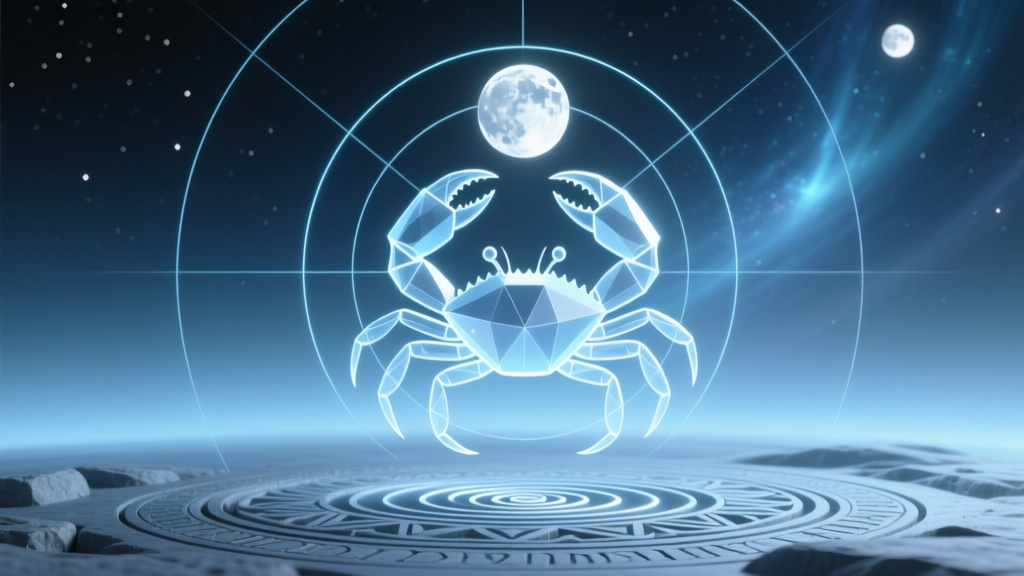
The Cancer zodiac symbol — two looping, comma-like curves resembling crab claws or a sideways '69' — is among the most enigmatic and spiritually rich glyphs in astrology. Unlike the bold, angular symbols of Aries or Leo, Cancer’s glyph whispers rather than shouts: a quiet emblem of emotional intelligence, ancestral memory, and cyclical renewal. Ruling from June 21 to July 22, Cancer is the fourth sign of the zodiac, a cardinal water sign governed by the Moon. Its symbol does not depict a literal crab but encodes centuries of sacred cosmology — from Babylonian star charts to Pythagorean number theory and Hermetic philosophy. To understand Cancer is to understand the language of the soul’s inner tides; to decode its glyph is to access a map of emotional sovereignty, intuitive guardianship, and sacred receptivity. This article delves exclusively into the symbolic architecture of Cancer — tracing its historical lineage, revealing its hidden geometry, interpreting its mythic resonance, and illuminating its enduring spiritual significance across civilizations.
The Cancer Symbol: Origin and History
The Cancer glyph (♋) first appears in its recognizable form in Hellenistic astrology, circa 2nd century BCE, though its conceptual roots stretch much deeper. Ancient Mesopotamian astronomers identified the constellation Al Sartan (“the Crab”) as early as 1000 BCE, associating it with the fourth lunar mansion and linking it to the summer solstice — the turning point when daylight begins its slow retreat, mirroring Cancer’s role as the sign that initiates inward reflection. In the Astro.com Origins of the Zodiac archive, scholars note that the crab was chosen not for its ferocity, but for its paradoxical nature: armored yet soft-bodied, sideways-moving yet deeply anchored, capable of shedding and regrowing its shell — a perfect metaphor for emotional resilience and psychic regeneration.
Greek mythology further cemented the symbol’s meaning through the story of Hera sending a giant crab to distract Hercules during his battle with the Hydra. Though crushed underfoot, the crab was honored by Hera and placed among the stars — transforming vulnerability into celestial immortality. This myth underscores a core Cancerian truth: protection is not always aggressive; sometimes, it is sacrificial, subtle, and rooted in loyalty. Roman astrologers like Manilius, in his 1st-century CE Astronomica, described Cancer as “the gate of men” — the celestial threshold through which souls descend into incarnation, reinforcing its association with birth, origin, and the womb of existence. By the time of Ptolemy’s Tetrabiblos, Cancer was firmly established as the sign of the Moon’s domicile, its glyph evolving to reflect lunar cycles — waxing and waning, ebbing and flowing — rather than zoological accuracy.
Medieval Islamic astrologers preserved and refined this symbolism. Al-Biruni, in his 11th-century The Book of Instructions in the Elements of the Art of Astrology, emphasized Cancer’s connection to the ‘moist’ and ‘cold’ qualities — aligning with water’s receptive nature and the crab’s dependence on tidal moisture. Crucially, the glyph never depicted claws or eyes; instead, scribes rendered it as mirrored, serpentine curves — an intentional abstraction pointing to duality, reflection, and interiority. This historical trajectory reveals that the Cancer symbol was never meant to be literal, but initiatory: a visual koan inviting contemplation of how safety, memory, and nurturing are encoded in the very structure of cosmic order.
Sacred Geometry Behind the Cancer Glyph
At first glance, the Cancer glyph resembles a pair of interlocking spirals or a double helix — but its geometry is far more precise. Each curve is drawn as a closed, asymmetrical loop — not a perfect circle nor a Fibonacci spiral, but a lemniscate variant: a figure-eight lying on its side, split and mirrored. This structure echoes the mathematical concept of the lemniscate of Bernoulli, a curve representing infinite potential and balanced polarity — fitting for a sign that holds both profound sensitivity and unshakable tenacity. Esoteric geometers, including those cited in The Sacred Science Library, interpret the two loops as representations of the Moon’s northern and southern nodes — the points where the Moon’s orbit intersects the ecliptic — symbolizing Cancer’s role as mediator between spirit (north node) and matter (south node), past (ancestry) and future (nurturing new life).
When overlaid on the Vesica Piscis — the almond-shaped intersection of two circles — the Cancer glyph aligns almost perfectly with the upper and lower arcs, suggesting containment within divine proportion. The width-to-height ratio of the glyph approximates 1:√2, a ratio found in sacred architecture from Gothic cathedrals to Hindu temple mandalas — signaling harmony between the temporal and the eternal. Moreover, the glyph’s symmetry reflects the principle of enantiodromia (a term coined by Carl Jung and elaborated in Jung’s Psychological Types): the tendency of extremes to transform into their opposites. Cancer’s outward reticence conceals fierce devotion; its gentle demeanor masks formidable boundaries; its need for privacy fuels deep empathy. This dialectical balance is mathematically embedded: each loop is identical in curvature but inverted — one opening leftward (receptive, yin), the other rightward (protective, yang), united at a central still point — the silent heart of the glyph.
Notably, the Cancer symbol contains no straight lines — only continuous, flowing curves — affirming its elemental alignment with water. In sacred geometry, water is associated with the number 2 (duality, reflection, relationship), and Cancer is the second water sign (after Scorpio, though chronologically fourth). Yet its glyph’s structure embodies the number 4: four directional orientations (up/down/left/right), four phases of the Moon (New, First Quarter, Full, Last Quarter), and four archetypal maternal roles (container, nourisher, protector, initiator). This numerical resonance reinforces Cancer’s function as the cosmic architect of emotional infrastructure — building the inner ‘home’ where identity takes root and evolves.
What the Cancer Symbol Represents
The Cancer glyph is a concentrated lexicon of psychological and spiritual meaning. Its two interwoven curves signify the inseparability of emotion and instinct — not as chaotic impulses, but as intelligent, embodied wisdom. Unlike fire signs that act first and feel later, or air signs that intellectualize feeling, Cancer feels *as* it knows. The glyph thus represents what Jung termed the feeling function: a mode of perception that evaluates based on values, relationships, and resonance — not logic or sensation alone. As noted in the Astro.com MBTI & Astrology Integration Guide, Cancer’s dominant cognitive function is Introverted Feeling (Fi), making its glyph a visual representation of internal value calibration — the quiet, constant adjustment of emotional boundaries and relational authenticity.
Each loop also maps to Cancer’s dual rulership: the Moon (inner world) and, esoterically, Neptune (collective unconscious). The upper curve evokes the Moon’s crescent — luminous, reflective, cyclical — while the lower curve mirrors Neptune’s dissolving, boundary-softening influence. Together, they illustrate Cancer’s capacity to hold both personal memory and ancestral grief — to grieve individually while sensing the sorrow of generations. This is why Cancer individuals often report vivid dreams, strong nostalgia, and uncanny empathy: the glyph encodes a nervous system wired for intersubjective attunement. Furthermore, the absence of sharp angles or piercing points signals Cancer’s aversion to confrontation — not weakness, but strategic preservation. Like a crab withdrawing into its shell, the glyph teaches that retreat is not surrender, but recalibration. Protection, in Cancer’s lexicon, is architectural: building emotional walls not to exclude, but to create sacred space where healing, storytelling, and legacy can unfold.
Crucially, the glyph’s lack of a central dot or crossbar distinguishes it from signs like Virgo (♍) or Libra (♎), which imply analysis or balance through mediation. Cancer requires no external arbiter — its authority resides in embodied knowing. When a Cancer sets a boundary, it is not negotiated; it is emanated — like tides responding to lunar gravity. This self-contained sovereignty is why Cancer is the only sign whose symbol appears in alchemical texts as the sigil for Mercury Argentum Vivum (quicksilver): the fluid, adaptive, ever-changing essence that cannot be pinned down, yet forms the basis of all transformation. To embody the Cancer glyph is to trust that softness is structural, that memory is medicinal, and that home is not a place — but a vibration held in the body.
Cancer in Ancient Art and Architecture
Cancer’s symbolic presence permeates ancient art — not as literal crabs, but as encoded glyphs and architectural motifs reflecting its lunar, maternal, and protective themes. In Egyptian temple reliefs at Dendera, the Cancer constellation appears in the famed Dendera Zodiac ceiling (c. 50 BCE) as a stylized crab flanked by the goddess Isis holding the ankh — directly linking Cancer to rebirth, divine motherhood, and the cyclical nature of life and death. Similarly, Minoan frescoes from Knossos (c. 1600 BCE) feature spiral motifs nearly identical to the Cancer glyph adorning ceremonial vessels used in rites honoring the Great Mother — suggesting early recognition of the sign’s association with fertility, lunar timing, and sacred containment.
In classical Greek architecture, Cancer’s influence emerges in the design of tholos tombs — circular, domed burial chambers like the Treasury of Atreus at Mycenae. Their inward-curving walls echo the glyph’s embracing loops, creating acoustic spaces where whispered words reverberate — a physical manifestation of Cancer’s emphasis on listening, memory retention, and ancestral voice. Roman mosaics from Pompeii frequently depict the zodiac wheel with Cancer positioned at the ‘heart’ quadrant — directly opposite Capricorn — framing the celestial sphere as a womb-like enclosure. Even medieval cathedral rose windows encode Cancer’s geometry: the Chartres Cathedral’s north transept window features a quatrefoil pattern whose interlaced arcs mirror the glyph’s bilateral symmetry, placed adjacent to Marian iconography — reinforcing the Virgin Mary’s astrological link to Cancer as the archetypal nurturer.
Perhaps most compelling is the recurrence of Cancer’s glyph in pre-Columbian Mesoamerican codices. The Aztec Borgia Codex (c. 1400 CE) illustrates the 13-day sign Calli (“House”) — ruled by the Moon and aligned with Cancer — using twin, facing serpentine curves identical to the Western glyph. Here, it marks the beginning of the tonalpohualli cycle, signifying birth, shelter, and lineage — confirming that across hemispheres and millennia, civilizations intuitively converged on the same symbolic syntax for emotional foundation. These artistic echoes testify that Cancer’s glyph was never merely decorative; it was functional — a sacred interface between human psychology and cosmic rhythm, inscribed in stone, pigment, and light to anchor collective memory in emotional truth.
The Deeper Spiritual Meaning of the Cancer Symbol
Spiritually, the Cancer glyph is a portal to the soul’s primordial waters — the realm where identity is not constructed, but remembered. Its loops do not represent separation, but enfolding: the soul gathering itself back into wholeness after fragmentation. In Kabbalah, Cancer corresponds to the sephirah Hod (Glory) on the Pillar of Form, yet its true resonance lies with Yesod (Foundation) — the psychic substrate upon which consciousness builds reality. The glyph thus serves as a reminder that all spiritual practice begins not with transcendence, but with grounding in embodied feeling. As the Moon’s domicile, Cancer governs the subconscious — not as a shadowy basement, but as a luminous aquifer feeding every conscious thought. To meditate on the Cancer symbol is to practice lunar mindfulness: observing emotional tides without resistance, trusting their rhythm as divine intelligence.
This glyph also embodies the Hermetic principle “As above, so below; as within, so without.” The outer loop reflects the collective unconscious — ancestral patterns, cultural conditioning, inherited trauma — while the inner loop holds the individual’s unique emotional signature. Healing occurs not by erasing the outer, but by consciously inhabiting the inner — allowing old wounds to surface, be witnessed, and reintegrate. Modern depth psychology affirms this: attachment theory identifies Cancer’s relational blueprint as the secure base — the internalized sense of safety that allows exploration. When activated, the Cancer glyph becomes a talisman for emotional sovereignty: the courage to say “this is mine to hold” and “this is yours to carry,” without guilt or over-responsibility.
Ultimately, the Cancer symbol invites us into sacred reciprocity — the understanding that to nurture is to be nurtured, to protect is to be protected, to remember is to be remembered. Its enduring power lies in its refusal to valorize strength as hardness. Instead, it sanctifies tenderness as architecture, intuition as epistemology, and home as the first and final sanctuary. In a world increasingly digitized and disembodied, the Cancer glyph remains a quiet, unwavering call: return. Return to feeling. Return to memory. Return to the body as altar, the family as temple, the heart as compass. It is not a sign of escape — but of deep, deliberate, loving re-inhabitation.
Cancer Symbol Quick Facts Table
| Attribute | Detail |
|---|---|
| Zodiac Dates | June 21 – July 22 |
| Element & Quality | Water / Cardinal |
| Ruling Planet | Moon (primary); esoterically, Neptune |
| Glyph Shape | Two mirrored, asymmetrical loops — a lemniscate variant |
| Sacred Number | 2 (duality, reflection) and 4 (foundation, cycles) |
| Key Archetypes | The Nurturer, The Guardian, The Memory-Keeper, The Womb |
| Mythological Association | Hera’s Crab; Isis as lunar mother; Artemis as protector of youth |
| Spiritual Theme | Emotional sovereignty through sacred receptivity and ancestral attunement |