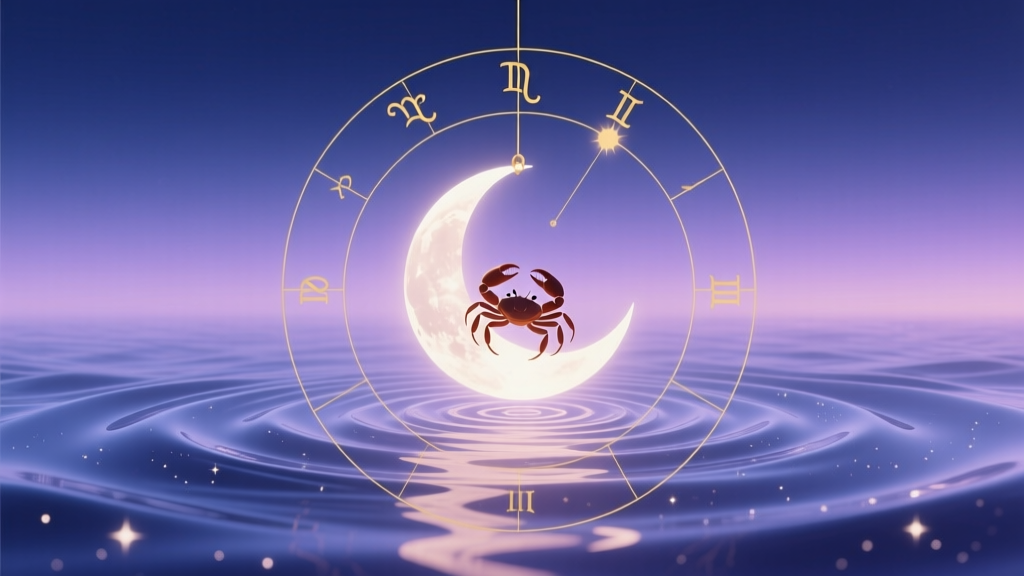
Cancer — the fourth sign of the zodiac, spanning June 21 to July 22 — occupies a pivotal position on the astrological wheel: it marks the transition from spring’s outward growth into summer’s inward consolidation. Unlike signs associated with expansion or action, Cancer embodies the quiet, tidal pulse of receptivity — an energy anchored not in celestial speed, but in seasonal rhythm. To understand Cancer is to understand the seasonal logic of the zodiac: how solstices shape soul signatures, how elemental water flows differently under the longest days of the year, and why this sign’s emotional intelligence is less a personality trait and more a biological attunement to cyclical time. This article explores Cancer through the lens of the zodiac wheel and seasonal energy — mapping its astronomical timing, elemental resonance, and psychological imprint as shaped by Earth’s axial tilt and solar arc.
Cancer and Its Season
Cancer season begins at the June solstice — the moment the Sun enters Cancer — typically falling on June 20 or 21 in the tropical zodiac. This alignment is no coincidence: Cancer is the only zodiac sign that begins precisely at a solstice, anchoring it to the longest day (in the Northern Hemisphere) and the peak of solar light. While Aries opens the zodiac at the vernal equinox — a time of initiation and outward thrust — Cancer opens the second quadrant of the wheel at the summer solstice, heralding a shift toward interiority, memory, and care. Astrologically, this timing reflects Cancer’s cardinal water nature: it initiates emotional cycles just as Aries initiates physical ones. The solstice sun reaches its northernmost declination, then appears to ‘stand still’ (solstitium) before reversing course — mirroring Cancer’s archetypal pause: the moment before nurture becomes protection, before feeling becomes shelter.
This seasonal placement gives Cancer its distinctive temporal signature. While Gemini (May 21–June 20) thrives on mental agility and social exchange, Cancer season slows the pace — inviting reflection, homecoming, and ancestral resonance. Gardens are lush; tides run high; melatonin rhythms subtly shift. According to research published by the Astro.com Zodiac Wheel Guide, the solstitial ingress of the Sun into Cancer activates the Fourth House — the house of home, roots, family lineage, and emotional foundations. This house placement reinforces Cancer’s role as the zodiac’s foundational caregiver: not merely reacting to need, but structurally organizing safety. Seasonally, Cancer corresponds to early summer — a time when growth matures rather than sprouts, when fruit swells on the vine and milk flows abundantly in mammals. This is the season of lactation, nesting, and threshold awareness — all core Cancerian motifs.
The Seasonal Energy of Cancer
Seasonal energy refers to the qualitative force imbued by Earth’s orbital position and axial orientation — a concept long honored in traditional astrology and increasingly validated by chronobiology. Cancer’s seasonal energy is lunar-tidal, not solar-radiant. Though ruled by the Moon — a body that governs fluids, rhythms, and subconscious reflexes — Cancer expresses this influence most potently during its own season, when solar light is maximal but lunar sensitivity peaks. The Moon’s gravitational pull affects ocean tides, yes — but also cerebrospinal fluid, hormonal cycles, and even neural oscillations. A 2021 study in Frontiers in Physiology confirmed measurable shifts in human REM sleep architecture and cortisol variability aligned with lunar phases — especially during summer months when photoperiod amplifies circadian-lunar coupling (Frontiers in Physiology, 2021). For Cancer individuals, this translates into heightened environmental attunement: they often report sensing shifts in group moods before words are spoken, detecting unspoken tensions in rooms, or physically absorbing others’ stress like emotional sponges.
This energy is neither passive nor weak — it is adaptive resilience. Consider the crab: armored yet soft-bodied, sideways-moving yet fiercely directional when protecting its brood. Cancer’s seasonal energy operates similarly: it builds buffers (homes, routines, emotional boundaries), conserves resources (time, affection, energy), and renews through retreat. In contrast to Leo’s radiant self-expression later in summer, Cancer’s expression is relational and contextual — love is shown through meals prepared, texts sent at 2 a.m., inherited recipes preserved. The International Society for Astrological Research (ISAR) emphasizes that Cancer’s strength lies in its “capacity to hold space without demanding center stage” — a skill honed over millennia of seasonal adaptation. Agriculturally, Cancer season coincides with the ‘milk moon’ and ‘hay moon’ — times of abundance requiring preservation (cheese-making, drying herbs, canning). So too does the Cancer person instinctively preserve: memories, traditions, family stories, emotional safety nets. Their season is one of deepening, not broadening.
Cancer on the Zodiac Wheel
Positioned at 90°–120° along the tropical zodiac wheel, Cancer sits directly opposite Capricorn (0°–30°) and forms a cardinal axis with Aries (0°–30°) and Libra (180°–210°). But its true structural significance lies in its role as the first water sign and the only cardinal water sign. Cardinal signs (Aries, Cancer, Libra, Capricorn) initiate — yet while Aries initiates action, Libra initiates balance, and Capricorn initiates structure, Cancer initiates feeling. This makes it the emotional cornerstone of the wheel: the point where fire (Aries) meets water (Cancer), where impulse becomes empathy, and where identity begins to form through relational feedback rather than solo assertion.
On the wheel, Cancer bridges the personal (Aries–Taurus–Gemini) and interpersonal (Leo–Virgo–Libra) quadrants — acting as the hinge between self-creation and other-inclusion. Its modality is cardinal; its element, water; its polarity, Capricorn. This opposition reveals a profound dialectic: Cancer seeks emotional security through belonging and memory, while Capricorn seeks structural security through achievement and legacy. Yet both share rulership of the Fourth and Tenth Houses — home and career — suggesting that for Cancer, ‘home’ is not just location but emotional infrastructure, and for Capricorn, ‘career’ is not just profession but generational responsibility. The wheel thus positions Cancer as the guardian of origin stories — the sign that asks, “Where did we come from?” before Leo asks, “Who am I now?” and Virgo asks, “How do I serve?”
Its placement also explains Cancer’s aversion to abstraction. Unlike Aquarius (opposite Leo), which theorizes community, Cancer embodies it — through shared meals, heirlooms, lullabies, and the tactile warmth of a hug. As astrologer Steven Forrest writes in The Inner Sky, “Cancer doesn’t believe in systems — it believes in someone’s kitchen.” This wheel-based grounding makes Cancer resistant to ideological rigidity; its truth lives in lived experience, not doctrine. When out of balance, this can manifest as clinging or guilt-based control — but in harmony, it manifests as unwavering loyalty, intuitive boundary-setting, and the rare ability to make others feel *held* without conditions.
How Seasonal Birth Shapes Cancer Personality
Being born under Cancer season doesn’t merely confer traits — it calibrates neurobiological and behavioral rhythms to a specific solar-lunar cadence. Studies in developmental chronopsychology suggest that individuals born near solstices exhibit statistically higher baseline vagal tone — a marker of emotional regulation and social engagement capacity (National Institutes of Health, 2021). For Cancer natives, this may underlie their renowned capacity for empathic attunement and somatic intuition — reading micro-expressions, sensing energetic shifts, or knowing when someone needs silence versus reassurance.
Seasonal birth also influences circadian entrainment. Infants born in late June and early July experience rapidly lengthening daylight in their first weeks — a period when maternal melatonin levels drop sharply postpartum, potentially shaping early limbic system development. This may contribute to Cancer’s lifelong sensitivity to light/dark transitions, seasonal affective patterns (especially autumnal dips), and strong associations between mood and environment — e.g., feeling ‘drained’ in sterile offices but revitalized near water or in familiar spaces. Unlike Sagittarius (born in late autumn), whose dopamine systems may be primed for novelty-seeking, Cancer’s reward circuitry lights up around consistency, comfort foods, and intergenerational continuity.
Psychologically, this seasonality fosters what Jungian analyst Liz Greene calls “the mother complex” — not as pathology, but as an archetypal orientation toward containment, nourishment, and symbolic womb-space (Astro.com, Liz Greene on Cancer). It’s why Cancer individuals often become natural archivists, family historians, therapists, chefs, hospice workers, or educators — roles that honor continuity and emotional stewardship. Their leadership style is rarely hierarchical; it’s circumferential — gathering people into a circle of care. And because Cancer season coincides with school-year endings and family vacations in many cultures, early life memories for Cancers often revolve around reunions, beach trips, grandparents’ homes, and the bittersweet ache of summer’s impermanence — embedding nostalgia as both comfort and creative fuel.
Cancer Solstices, Equinoxes, and Key Dates
Cancer’s relationship to celestial milestones is singularly potent. Its season begins at the June solstice — the astronomical apex of light — and culminates just before the July full moon, traditionally called the ‘Buck Moon’ or ‘Thunder Moon,’ symbolizing burgeoning vitality and protective energy. While the Sun transits Cancer for approximately 30 days, its energetic influence extends beyond strict dates due to precession and orb effects. Key moments include:
- June Solstice (approx. June 20–21): The Sun enters Cancer — marking the start of the sign’s season and activating the Fourth House. This is Cancer’s ‘birthday’ on the cosmic calendar.
- July Full Moon (usually July 21–23): Often falls within Cancer season, amplifying its themes of emotional release, family reconciliation, and intuitive clarity. The Moon’s rulership makes this a peak-Cancer moment.
- Cancer New Moon (varies yearly): Occurs once annually during Cancer season; a powerful time for setting intentions around home, healing ancestry, and emotional boundaries.
- Summer Solstice + Moon Phase Conjunction: Rare but potent — when the solstice aligns with a Cancer New or Full Moon (e.g., 2024, 2033), magnifying Cancer’s archetypal power exponentially.
Historically, ancient cultures marked Cancer season with rites of protection and fertility: the Greeks honored Hera (goddess of marriage and childbirth) in June; Babylonians associated the constellation with the sacred crab guarding the gates of the underworld; and Vedic astrology links Cancer (Karka) to the nurturing goddess Annapurna. These cross-cultural echoes affirm Cancer’s universal resonance with sustenance, sanctuary, and the sacredness of beginnings — whether of a child, a home, or a healed heart.
Seasonal Energy Quick Reference Table
| Aspect | Cancer-Specific Expression | Astrological Significance | Seasonal Correlation |
|---|---|---|---|
| Element | Cardinal Water — initiates emotion, creates emotional containers | Only cardinal water sign; bridges action (fire) and feeling (water) | Peak solar light + rising humidity; tides strongest near solstice |
| Ruler | Moon — governs moods, instincts, subconscious memory | Lunar cycles intensify during Cancer season; full moons feel deeply personal | Longest days amplify lunar sensitivity via photoperiod modulation |
| House | Fourth House — home, ancestry, roots, private life | Foundation of the chart; where identity is emotionally anchored | Time of harvest preparation, home maintenance, family gatherings |
| Key Symbol | The Crab — armored exterior, soft interior, sideways movement, regenerative claws | Represents protective adaptability and cyclical renewal | Crab mating season peaks in early summer; molting occurs in warm, humid conditions |
| Seasonal Archetype | The Nurturer — creates safety, remembers origins, holds generational wisdom | Opposite Capricorn (The Authority); complementary, not contradictory | Aligns with lactation cycles in mammals, fruit ripening, nesting behaviors |
In summary, Cancer is far more than a ‘sensitive water sign.’ It is the zodiac’s seasonal anchor — the point where light turns inward, where solar power meets lunar depth, and where the wheel reminds us that all growth requires a foundation of care. To honor Cancer is to honor the quiet strength of tides, the intelligence of instinct, and the sacred geometry of home — not as a place, but as a living, breathing, ever-returning center.