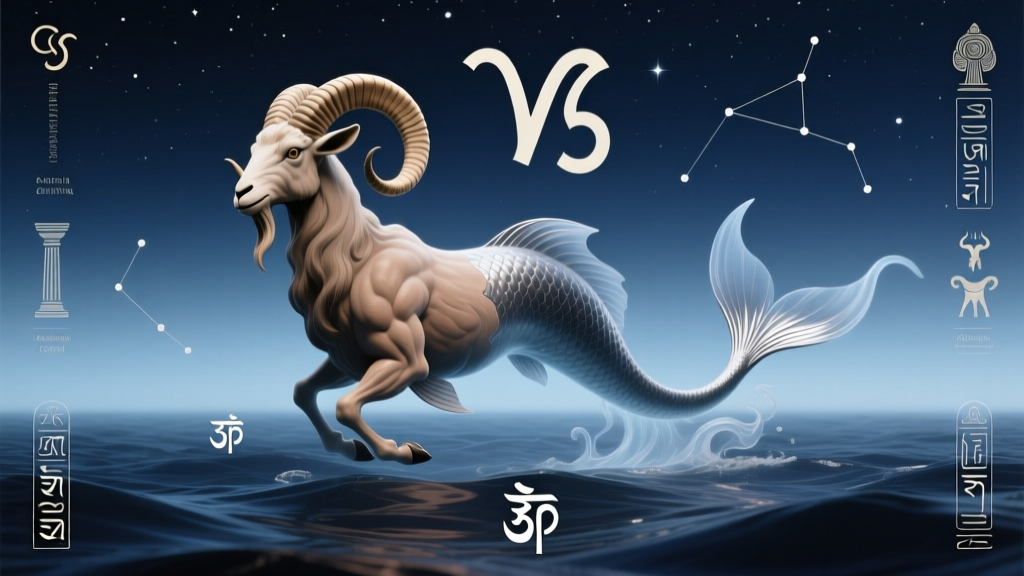
Capricorn—the tenth sign of the zodiac, spanning December 22 to January 19—is often recognized for its unwavering discipline, structural intelligence, and quiet authority. Yet behind this pragmatic earth sign lies one of the most symbolically layered and cross-culturally resonant origin stories in astrology: the enigmatic sea-goat. Unlike many zodiac signs rooted in singular heroic myths, Capricorn’s symbolism emerges from a confluence of ancient cosmologies—Babylonian astronomy, Greek divine metamorphosis, Roman imperial theology, and Vedic star lore. Its hybrid form—a goat’s head and torso fused with a fish’s tail—defies easy categorization, embodying paradoxes that still define the Capricorn personality today: ambition anchored in humility, tradition fused with innovation, and earthly responsibility entwined with spiritual depth.
The Myth Behind Capricorn
The myth behind Capricorn is not a single narrative but a palimpsest—an ancient text overwritten by successive civilizations, each adding meaning while preserving core symbolism. At its heart lies the image of a creature that bridges realms: land and sea, mortality and divinity, labor and transcendence. This duality reflects Capricorn’s astrological rulership by Saturn—the planet of boundaries, time, consequence, and earned wisdom—and its exaltation of Mars in some classical traditions, hinting at latent resilience beneath stoic restraint.
Unlike fiery Aries or luminous Leo, Capricorn lacks a canonical ‘hero’s journey’ in mainstream Western myth. Instead, its story is told through celestial mapping, ritual sacrifice, and theological syncretism. The earliest known reference appears on a Babylonian boundary stone (kudurru) from c. 1100 BCE, where the constellation suḫurmašu—the 'goat-fish'—is depicted alongside Enki/Ea, the god of fresh water, wisdom, and creation. Here, the sea-goat was not a monster but a sacred emblem of divine ingenuity: a being capable of navigating both the fertile silt of riverbanks and the mysterious depths of cosmic waters—mirroring Capricorn’s ability to build enduring structures while remaining attuned to unseen emotional or spiritual currents.
Modern astrologers emphasize that Capricorn’s mythos resists romanticization. As Astro.com notes, "Capricorn does not seek glory for its own sake; it seeks legacy through integrity." This ethos echoes directly from its mythic foundations: no grand battles, no stolen fire—but steady ascent, like a mountain goat climbing sheer rock, or a fish swimming upstream against time itself.
Capricorn in Greek Mythology
In Greek mythology, Capricorn is most closely associated with the god Pan—half-man, half-goat—though the connection is interpretive rather than textual. Pan, the rustic deity of shepherds, flocks, wild nature, and untamed instinct, was said to have leapt into the Nile River to escape the monstrous Typhon, transforming his lower body into a fish to evade capture. While this tale appears in later Hellenistic sources—not Homer or Hesiod—it became central to Capricorn’s symbolic evolution. The transformation reflects Saturnine themes: crisis as catalyst, adaptation as survival, and integration of opposites (wildness + discipline, chaos + order).
A more direct link comes from the myth of Amalthea, the nurturing goat who nursed the infant Zeus on Mount Ida. When Zeus accidentally broke off one of her horns, he transformed it into the Cornucopia—the Horn of Plenty—symbolizing abundance born of sacrifice and care. Though Amalthea herself is not depicted as a sea-goat, her association with nourishment, protection, and divine sustenance aligns with Capricorn’s role as the zodiac’s ‘provider’ and ‘architect’. Astrologer Demetra George writes in Asteroid Goddesses that “Capricorn’s strength lies not in domination, but in stewardship—holding space for growth over generations.” This echoes Amalthea’s quiet, life-sustaining power.
Notably, Capricorn is the only zodiac sign represented by a creature that is neither fully animal nor fully divine—yet wholly necessary to cosmic balance. As scholar Robert Schmidt observes in his work on Hellenistic astrology, the sea-goat represents Project Hindsight’s reconstruction of ancient techniques, where Capricorn functions as the ‘gatekeeper’ of the southern sky—the lowest point of the ecliptic (the Winter Solstice), marking the turning point toward renewal. Its myth thus encodes a profound truth: true authority begins not at the summit, but at the foundation.
Capricorn in Roman Mythology
Roman mythology absorbed and reinterpreted Greek narratives, but elevated Capricorn’s symbolism to imperial stature. The sea-goat became Capricornus, adopted as the personal emblem of Emperor Augustus—the first Roman emperor—who claimed descent from Venus and aligned his reign with cosmic order. Augustus minted coins bearing Capricorn between 18–13 BCE, often with the inscription Capricornus Augusti, linking the sign to his birth chart (though modern calculations suggest he was likely a Libra). This strategic astrological branding positioned Capricorn not merely as a celestial marker, but as a symbol of pax Romana: stability forged through law, infrastructure, and long-term vision.
The Romans associated Capricorn with Saturn—their god of agriculture, liberation, and cyclical time—whose festival, Saturnalia, honored reversal, renewal, and social equity. During Saturnalia, slaves dined with masters, gifts were exchanged, and hierarchies softened—a reflection of Capricorn’s hidden dialectic: structure that serves justice, authority that empowers others. As historian Sarah Iles Johnston notes in her authoritative survey of ancient religion, Saturn’s dual nature—both stern taskmaster and benevolent liberator—mirrors Capricorn’s capacity to enforce boundaries while creating conditions for collective flourishing.
Roman architects, engineers, and jurists—many born under Capricorn—were celebrated for their mastery of proportion, endurance, and civic duty. Vitruvius, author of De Architectura, emphasized that great buildings must harmonize firmitas, utilitas, venustas (strength, utility, beauty)—a triad echoing Capricorn’s integration of practicality, function, and quiet elegance. In this light, the Roman Capricorn is less about individual ambition and more about civilizational stamina: the slow, deliberate work of building what lasts beyond a lifetime.
Ancient Cultural Interpretations of Capricorn
Beyond Greece and Rome, Capricorn’s sea-goat appeared across ancient cosmologies—each culture layering new meaning onto the same celestial shape. In Mesopotamia, the Babylonians identified suḫurmašu as the symbol of Enki (later Ea), god of the Abzu—the subterranean freshwater ocean believed to be the source of all wisdom and life. Enki was credited with creating humanity from clay and bestowing the me—divine decrees governing civilization—including law, art, and agriculture. Capricorn, therefore, carried the weight of cultural genesis: not just survival, but the intentional design of society.
In Vedic astrology (Jyotish), the equivalent lunar mansion is Shravana, ruled by the Moon and associated with listening, learning, and ancestral transmission. Though Jyotish doesn’t use the tropical zodiac, the star cluster corresponding to Capricornus—Uttara Ashadha—is linked to the Vishvadevas (universal gods) and the concept of dharma—righteous duty fulfilled without attachment to reward. This resonates deeply with Capricorn’s karmic orientation: action rooted in principle, not praise.
Even pre-Columbian Mesoamerican cultures echoed Capricorn’s archetypal energy. The Maya Long Count calendar’s ‘Great Cycle’ ended near the Winter Solstice—a time aligned with Capricorn’s solstitial gateway. Their god Itzamna, associated with writing, medicine, and celestial knowledge, shared traits with Enki and Saturn: mediator between heavens and earth, keeper of sacred texts, architect of cosmic cycles. These cross-cultural parallels suggest Capricorn’s myth isn’t accidental—it arises from humanity’s shared observation of the winter sky’s stillness and the universal need for grounded leadership during times of contraction.
The Constellation Story of Capricorn
The constellation Capricornus is among the oldest formally recognized star patterns—listed by Ptolemy in his 2nd-century CE Almagest as one of the original 48 constellations. Located along the southern ecliptic, it straddles the celestial equator and contains no first-magnitude stars, making it faint to the naked eye—yet profoundly significant in observational history. Its most notable feature is the ‘Teapot’ asterism formed by Alpha, Beta, and Theta Capricorni, with the ‘spout’ pointing toward the Milky Way’s dense galactic center.
Astronomically, Capricornus marks the Winter Solstice point in the tropical zodiac—the Sun’s southernmost declination—though due to axial precession, this point has shifted into Sagittarius over the past two millennia. Nevertheless, Capricorn retains its solstitial symbolism: the ‘lowest point’ before the Sun’s return northward. This celestial nadir mirrors the Capricorn archetype’s psychological journey—descent into self-discipline, confrontation with limitation, and eventual rise through earned mastery.
Modern astrophysics reveals Capricornus hosts several fascinating deep-sky objects, including the globular cluster M30—a tightly packed sphere of 150,000+ stars that survived a close pass by the Milky Way’s core. Like Capricorn individuals, M30 endured gravitational stress yet retained cohesion—a fitting metaphor for resilience through adversity. NASA’s Hubble observations confirm M30’s stars are among the galaxy’s oldest, reinforcing Capricorn’s association with time, ancestry, and intergenerational continuity.
How Mythology Shapes the Capricorn Archetype
Mythology does not merely decorate astrology—it forms its psychological architecture. For Capricorn, the sea-goat’s hybrid nature becomes a living metaphor for integration: the goat’s sure-footed climb represents aspiration, strategy, and perseverance; the fish’s tail signifies intuition, empathy, and subconscious depth. Capricorns are rarely understood at surface level because their strength is cumulative, their emotions channeled into craft, service, or systems-building—not spectacle.
This mythic grounding explains why Capricorn is often mischaracterized as ‘cold’ or ‘rigid’. In truth, its Saturnine gravity conceals profound loyalty and protective warmth—like Amalthea’s milk, or Enki’s life-giving waters. Psychologist Carl Gustav Jung observed that Capricorn corresponds to the Senex archetype—the wise elder whose authority derives from experience, not entitlement. In Archetypes and the Collective Unconscious, Jung writes that the Senex “carries the treasure of tradition but must guard against dogmatism”—a precise description of Capricorn’s shadow and gift.
Contemporary astrologers affirm this depth. In AstroStyle’s profile, Capricorn is described as “the CEO of the zodiac—not because they crave power, but because they instinctively organize, optimize, and uplift.” That instinct traces directly to myth: the Babylonian suḫurmašu maintaining cosmic order; Augustus codifying Roman law; Enki designing human civilization. Capricorn’s drive is never purely personal—it answers a call to stewardship.
Capricorn Mythology Quick Reference
| Culture | Name / Symbol | Associated Deity | Core Mythic Theme | Modern Archetypal Echo |
|---|---|---|---|---|
| Babylonian | Suḫurmašu (Goat-Fish) | Enki/Ea | Wisdom from the Abzu; creation of civilization | Systems thinking, ethical leadership, foundational innovation |
| Greek | Pan’s transformation | Pan / Amalthea | Metamorphosis under threat; nurturing sovereignty | Resilience through adaptation; quiet authority rooted in care |
| Roman | Capricornus Augusti | Saturn | Imperial order; Saturnalia’s cyclical justice | Institutional integrity; legacy-building; dignified restraint |
| Vedic | Uttara Ashadha | Vishvadevas | Dharma, universal law, ancestral duty | Moral consistency; commitment to principle over popularity |
This table illustrates how Capricorn’s enduring symbolism transcends era and geography—not as a static icon, but as a dynamic vessel for humanity’s deepest values: responsibility, continuity, wisdom earned, and structures built to shelter others. Whether scaling mountains or navigating oceans, the sea-goat reminds us that true ascent begins with reverence for the ground we stand on—and the depths we carry within.