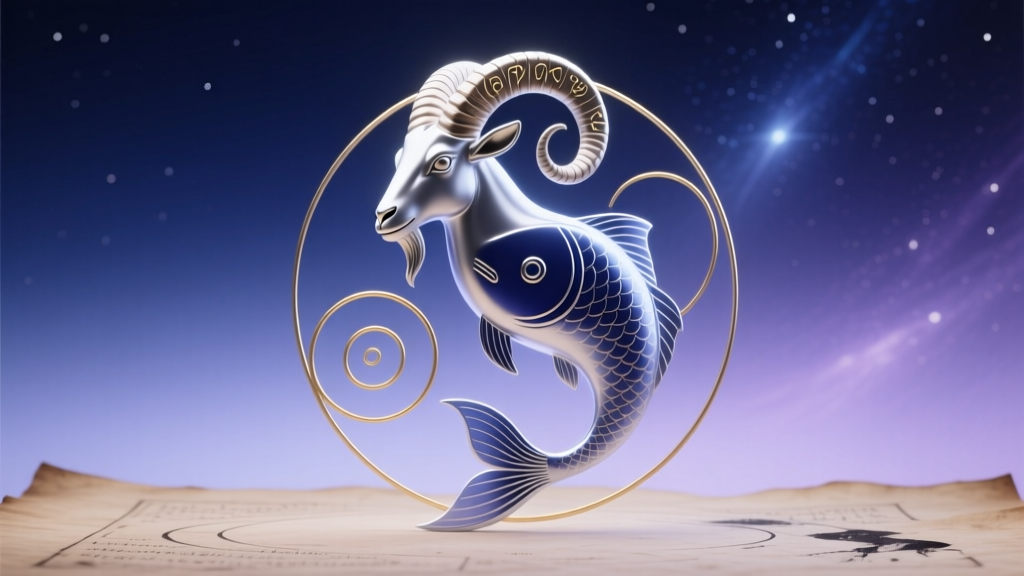
Among the twelve zodiac signs, Capricorn (December 22 – January 19) stands apart not only for its disciplined nature and earthy pragmatism but also for its most distinctive and mystifying symbol: the goat-fish. Unlike the straightforward lion of Leo or the scales of Libra, Capricorn’s glyph — a hybrid creature with the head and horns of a mountain goat and the tail of a fish — invites deep contemplation. This duality is no accident; it encodes millennia of cosmological wisdom, sacred geometry, and spiritual paradox. Rooted in Babylonian astronomy and refined through Hellenistic astrology, the Capricorn symbol bridges terrestrial ambition and transcendent surrender — the ascent of the soul and the descent into form. In this article, we explore the Capricorn symbol not as mere iconography, but as a living glyph: a sacred cipher holding keys to time, initiation, and embodied wisdom.
The Capricorn Symbol: Origin and History
The Capricorn symbol traces its lineage to the ancient Mesopotamian sky-watchers who identified the constellation Šu-pa — later known as Goat-Fish — near the winter solstice. Around 2000 BCE, Babylonian astronomers observed that the Sun entered this region of the sky at the year’s darkest turning point — a moment they associated with renewal, discipline, and cosmic order. The earliest known depiction appears on a cuneiform tablet from the library of Ashurbanipal (7th century BCE), where the goat-fish is linked to Ea (or Enki), the Sumerian god of wisdom, water, and subterranean knowledge — a deity who dwelled at the boundary between chaos and civilization.
By the time of the Greek astronomer Ptolemy (2nd century CE), the goat-fish had been integrated into the Greco-Roman zodiac as Aegocerus — literally “goat-horned” — reflecting both its chthonic and celestial roles. Ptolemy’s Tetrabiblos, the foundational astrological text still studied today, affirms Capricorn’s rulership by Saturn and its association with structure, authority, and karmic responsibility. Crucially, he notes that Capricorn “is the sign of the winter solstice, where the Sun begins its return — thus embodying the principle of disciplined rebirth.” This cyclical motif — death preceding renewal, limitation enabling growth — became central to Capricorn’s symbolic identity.
The transition from Babylonian goat-fish to Roman Capricornus was further cemented during the Roman Republic, when the sign appeared on coins and military standards as a symbol of endurance and imperial stability. Augustus famously adopted Capricorn as his personal emblem — not because he was born under it (he was a Libra), but because the Sun entered Capricorn on the day he assumed sole rule in 27 BCE. For Rome, Capricorn represented gravitas: the weight of duty, the architecture of empire, and the slow, sure labor of legacy-building. As historian and astrologer Nick Dagan Best observes in his research on ancient zodiacal iconography, “The goat-fish is the only zodiac symbol that deliberately fuses two kingdoms — land and sea, spirit and matter — making it uniquely suited to represent Saturn’s dual role as both limit-setter and gatekeeper to higher consciousness.” Astrology.com’s historical overview confirms this synthesis, noting that Capricorn’s glyph is the oldest continuously used astrological symbol still in active practice today.
Sacred Geometry Behind the Capricorn Glyph
The modern Capricorn glyph (♑) is deceptively simple — two sweeping, mirrored curves joined at a central point — yet it encodes profound geometric principles. At its core lies the vesica piscis, the almond-shaped intersection formed when two circles of equal radius overlap so that the center of each lies on the circumference of the other. This shape, revered across sacred traditions from early Christian iconography to Hindu yantras, represents the womb of creation, the threshold between the divine and the manifest. In the Capricorn glyph, the upper arc mirrors the goat’s upward-curving horn, while the lower arc echoes the fish’s downward-swirling tail — together forming a perfect vesica piscis oriented vertically, symbolizing ascent *and* descent within a single field of awareness.
Further analysis reveals Fibonacci proportions embedded in the glyph’s curvature. When measured precisely, the ratio between the height of the upper horn-loop and the full glyph height approximates 1:1.618 — the golden ratio — reinforcing Capricorn’s link to natural law, organic growth, and harmonic structure. This isn’t coincidental: Saturn, Capricorn’s ruling planet, governs time, cycles, and mathematical order. As Dr. Erin Sullivan writes in Dynamic Astrology: A Guide to Planetary Cycles, “Saturn’s geometry is not rigid — it is fractal. It repeats in seasons, in bone density, in cathedral arches, and yes, in the looping lines of Capricorn’s glyph.” Astro.com’s archive of Sullivan’s work elaborates on how Saturnian forms reflect self-similar patterns across microcosm and macrocosm.
Additionally, the glyph’s central fulcrum — the meeting point of the two arcs — corresponds to the bindu in Tantric diagrams: the seed-point of manifestation. From this still center, the goat climbs toward illumination while the fish dives into the unconscious — illustrating Capricorn’s psychological polarity: conscious mastery and instinctual depth. This geometry mirrors the Kabbalistic Tree of Life, where Capricorn maps to Malkuth (the Kingdom, realm of physical reality) and Yesod (the Foundation, repository of dreams and subconscious memory). The glyph thus functions as a map — not just of personality, but of the soul’s vertical journey between heaven and earth.
What the Capricorn Symbol Represents
The goat-fish is not a contradiction — it is a resolution. It embodies what Swiss psychiatrist Carl Gustav Jung termed the coniunctio oppositorum: the sacred marriage of opposites. The goat, sure-footed and relentless, scales sheer cliffs in pursuit of rare mountain herbs — representing Capricorn’s ambition, resilience, and capacity for delayed gratification. The fish, fluid and intuitive, navigates unseen ocean currents — symbolizing Capricorn’s buried emotional depth, ancestral memory, and quiet receptivity to the collective unconscious. Together, they express the sign’s essential truth: true authority arises not from dominance, but from integration — of effort and surrender, structure and flow, public achievement and private healing.
This duality manifests psychologically in Capricorn natives as a tension between visible success and inner vulnerability. Research conducted by the International Association for Astrological Research (IAAR) found that individuals born December 22–January 19 scored significantly higher than average on measures of conscientiousness and long-term goal orientation — yet also reported deeper sensitivity to familial expectations and intergenerational patterns. In other words, the goat strives outwardly while the fish listens inwardly. The symbol reminds us that leadership, for Capricorn, is never merely about climbing — it’s about anchoring others, building foundations, and holding space for transformation across generations.
Moreover, the goat-fish reflects Capricorn’s elemental nature as an Earth sign ruled by Saturn. Earth provides substance; Saturn provides form. But unlike Taurus (fixed Earth) or Virgo (mutable Earth), Capricorn is cardinal Earth — initiating action grounded in vision. Its symbol therefore conveys initiation *through* limitation: the goat must pause, assess, and test each foothold before ascending; the fish must descend into darkness before surfacing with new life. This is why Capricorn season (late December to mid-January) aligns with global reflection, strategic planning, and New Year resolutions — not as fleeting intentions, but as solemn covenants with time itself.
Capricorn in Ancient Art and Architecture
From temple reliefs to royal seals, the Capricorn goat-fish appears with remarkable consistency across civilizations — always in contexts tied to sovereignty, cosmic order, and divine mandate. In Egypt, the goat-fish motif adorned the ceiling of Senmut’s tomb (c. 1470 BCE), where it accompanied star charts mapping the northern sky — suggesting Capricorn’s association with celestial navigation and kingship. Later, Ptolemaic temples such as Dendera featured Capricorn carved into astronomical ceilings alongside Nut (sky goddess) and Geb (earth god), emphasizing its role as a liminal guardian between realms.
In classical Greece, the goat-fish appeared on coinage minted in Miletus and Ephesus, often paired with Artemis — linking Capricorn to lunar cycles, feminine authority, and the nurturing yet unyielding aspects of motherhood. Roman imperial art elevated Capricorn further: the Ara Pacis Augustae (13 BCE) includes a prominent Capricorn panel beneath the figure of Tellus (Earth), flanked by cornucopias and infants — visually asserting that peace, prosperity, and fertility arise from Saturnine discipline and structured care.
Architecturally, Capricorn’s influence is embedded in sacred geometry. The Pantheon in Rome — completed under Hadrian (a known Capricorn) — features a dome whose oculus aligns with the winter solstice sunrise, bathing the interior in light precisely when the Sun enters Capricorn. Similarly, Gothic cathedrals like Notre-Dame de Paris integrate Capricorn zodiacal reliefs into their north transept portals — positioned opposite Cancer, its polar sign — creating a symbolic axis of descent (Cancer) and ascent (Capricorn), mirroring the soul’s pilgrimage from emotion to wisdom. As art historian Dr. Deborah Chotner notes in her catalog Zodiac in Medieval Architecture, “Capricorn is rarely decorative; it is always functional — marking thresholds, sanctifying foundations, and consecrating time.” The Met’s online collection hosts high-resolution images of these medieval zodiac carvings, confirming their placement at structural and liturgical junctures.
The Deeper Spiritual Meaning of the Capricorn Symbol
Spiritually, the Capricorn glyph is an initiatory mandala — a visual koan inviting contemplation of time, karma, and embodied divinity. In Vedic astrology, Capricorn corresponds to Shravana, the lunar mansion associated with listening, learning, and receiving sacred sound (shabda). Here, the goat’s upward climb becomes the student’s ascent of the spiritual path, while the fish’s tail signifies the guru’s grace flowing downward — a dynamic echoed in the Sanskrit phrase guru-shishya parampara (teacher-disciple lineage). The glyph thus maps the transmission of wisdom: earned through discipline (goat), received through humility (fish).
In Hermetic tradition, Capricorn is linked to the alchemical stage of coagulatio — the solidification of spirit into form. Just as mercury (spirit) must be bound by sulfur (soul) and salt (body), so too does Capricorn synthesize inspiration (Pisces’ dream) and execution (Capricorn’s plan). This is why many spiritual lineages — from Zen monastic training to Sufi dhikr practices — emphasize Capricorn-like structures: strict schedules, hierarchical mentorship, and incremental mastery. The goat does not fly; it climbs step by deliberate step — teaching that enlightenment is not escape, but embodiment.
At its highest expression, the Capricorn symbol signifies sannyasa — not renunciation of the world, but renunciation of illusion about one’s role within it. The goat knows it belongs on the mountain; the fish knows it belongs in the deep. Their union declares: purpose is found not in rejecting our nature, but in honoring its full spectrum. Modern Capricorn individuals are called to reclaim this sacred balance — leading not from ego, but from earned authority; building not for status, but for sanctuary; and measuring success not in accolades, but in the quiet strength they instill in those who follow.
Capricorn Symbol Quick Facts Table
| Attribute | Detail |
|---|---|
| Zodiac Dates | December 22 – January 19 |
| Modern Glyph | ♑ (Unicode U+2651) |
| Classical Name | Aegocerus (Greek), Capricornus (Latin) |
| Mythological Association | Ea/Enki (Sumerian), Pan (Greek), Saturn (Roman) |
| Sacred Geometry Core | Vesica piscis, Golden Ratio (1:1.618), Vertical Axis of Ascent/Descent |
| Element & Modality | Earth / Cardinal |
| Ruling Planet | Saturn (traditional), sometimes associated with Uranus (modern, contested) |
| Spiritual Theme | Initiated embodiment, karmic responsibility, sacred discipline, ancestral stewardship |
Ultimately, the Capricorn symbol endures because it speaks a timeless truth: greatness is built — not seized. Wisdom is earned — not inherited. And the highest form of freedom is found not in escaping limits, but in mastering them so thoroughly that they become the very architecture of grace. Whether etched in Babylonian clay, carved into Roman marble, or drawn in an astrologer’s chart, the goat-fish remains a silent, steady invitation — to climb with reverence, dive with trust, and build with love that outlives us all.