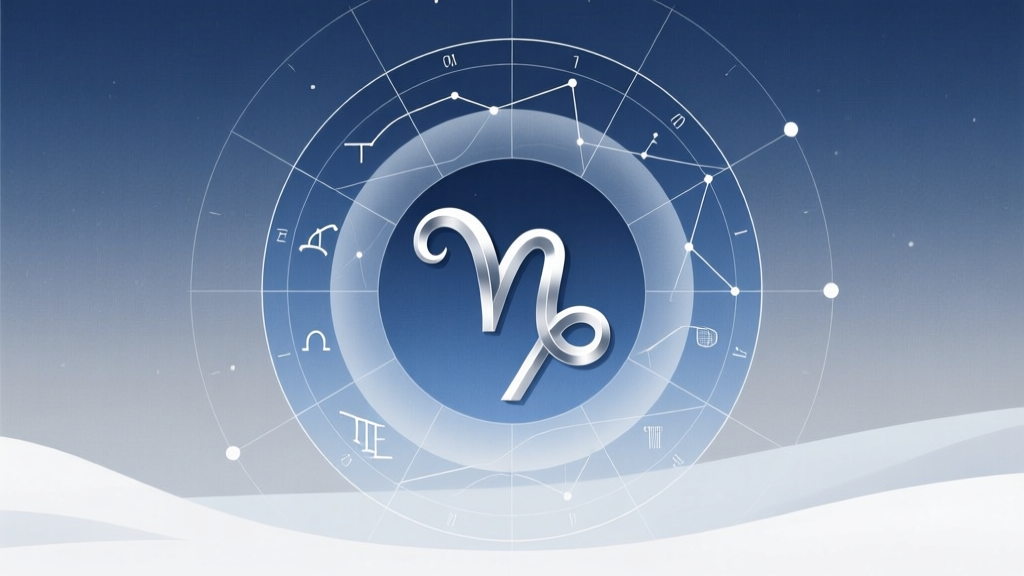
Capricorn (December 22 – January 19) stands apart on the zodiac wheel not merely as an earth sign, but as the architect of time—the only sign whose season begins at the winter solstice, the year’s deepest turning point. Unlike signs that emerge from growth or transition, Capricorn is born from stillness, contraction, and the quiet consolidation of energy beneath frozen ground. Its placement anchors the zodiac’s structural logic: it is the tenth sign, the final cardinal sign, and the first earth sign to close the fire-air-earth-water sequence—yet paradoxically, it opens the calendar year with solemn authority. This article explores Capricorn through the lens of the Zodiac Wheel & Seasonal Energy, revealing how its precise astronomical timing, elemental grounding, and solstitial birth imprint a distinctive psychological and spiritual signature. We move beyond sun-sign stereotypes to examine how Capricorn’s seasonal context—the harshest, shortest days of the year—shapes its values, rhythms, resilience, and relationship to legacy.
Capricorn and Its Season
Capricorn’s season spans from the winter solstice (typically December 21 or 22) through mid-January—approximately December 22 to January 19. This 30-day window coincides with the solar nadir in the Northern Hemisphere: the moment when daylight is shortest, shadows longest, and nature enters its most dormant phase. In the Southern Hemisphere, this same period marks the summer solstice—the peak of light and outward expansion—but Capricorn’s symbolic essence remains anchored in the Northern Hemisphere’s seasonal framework, which forms the historical basis of Western astrology. As noted by the Swiss Astrology Portal (Astro.com), the tropical zodiac—used in most Western practice—is aligned with Earth’s seasons, not star constellations; thus, Capricorn’s identity is intrinsically tied to the solstitial turning point, regardless of celestial drift.
This season is defined by austerity, inward focus, and preparation—not for immediate bloom, but for long-term structure. Trees shed leaves; animals conserve energy; human societies turn inward—celebrating holidays rooted in light (Yule, Hanukkah, Christmas) precisely because darkness dominates. Capricorn does not resist this contraction—it masters it. Its season teaches that power lies not in abundance, but in discernment; not in speed, but in sequencing; not in visibility, but in silent accumulation. Psychologically, those born under Capricorn often internalize this rhythm early: they learn to delay gratification, assess risk before action, and measure progress in increments rather than leaps. The season doesn’t make them ‘serious’—it makes them seasonally calibrated. As astrologer Steven Forrest writes in The Inner Sky, “Capricorn is the part of us that knows how to wait—and why waiting matters.” That knowing arises directly from its seasonal berth: a time when patience isn’t virtue, but survival strategy.
The Seasonal Energy of Capricorn
Seasonal energy refers to the ambient psychological and archetypal climate generated by Earth’s axial tilt, solar angle, and ecological cycles—and Capricorn embodies the distilled essence of winter’s disciplined vitality. While Cancer (its polarity sign) governs the summer solstice and radiates nurturing warmth, Capricorn governs the winter solstice and emits structured coolness: not coldness, but clarity cooled by reflection. Its energy is compressive—like frost crystallizing water into intricate geometry—or gravitational, like snow compacting into glacial ice over centuries. This is why Capricorn is ruled by Saturn: the planet of boundaries, consequence, and time-as-teacher.
This seasonal energy manifests in tangible ways. Research published in the National Institutes of Health (NIH) journal Frontiers in Psychology notes that seasonal affective patterns correlate with circadian regulation and melatonin production—particularly during solstices—and individuals born in late December and early January show statistically higher baseline tendencies toward conscientiousness and long-term goal orientation in longitudinal personality studies. While astrology does not claim causation, the alignment is striking: Capricorn’s season coincides with peak melatonin secretion and reduced serotonin availability—conditions that favor introspection, caution, and methodical processing over impulsivity or emotional reactivity.
Culturally, Capricorn’s energy surfaces in winter rituals centered on accountability and renewal: New Year’s resolutions (a Saturnian act of self-contracting), fiscal year closures, academic term endings, and corporate performance reviews. These are not arbitrary—they mirror Capricorn’s archetypal function: to audit, consolidate, and recalibrate. Its seasonal energy resists the ‘new beginning’ cliché; instead, it asks: What foundations held? What debts—literal or moral—must be settled before ascent? That question defines Capricorn’s contribution to the zodiac wheel: it is the sign that ensures every ‘new start’ rests on verified ground.
Capricorn on the Zodiac Wheel
Positioned at 270° on the tropical zodiac wheel, Capricorn occupies the Cardinal Earth quadrant—the structural cornerstone where initiation meets material reality. It follows Sagittarius (fire, mutable, expansive) and precedes Aquarius (air, fixed, humanitarian). This placement is cosmically strategic: Capricorn translates Sagittarius’ philosophical vision into actionable systems. Where Sagittarius asks ‘Where is truth?’ Capricorn asks ‘How do we build institutions that uphold it?’ Its modality is cardinal—initiating, decisive, leadership-oriented—but its element is earth, grounding that initiative in pragmatism, resource awareness, and tangible outcomes.
The zodiac wheel is divided into four seasonal quadrants, each anchored by a cardinal sign: Aries (spring), Cancer (summer), Libra (autumn), and Capricorn (winter). Capricorn thus closes the annual cycle—not as an ending, but as a pivot. It is the solstitial hinge: the point where the Sun reverses its southward descent and begins its slow return northward. Astrologically, this reversal symbolizes the birth of conscious intention—what the Astrology.com Zodiac Guide describes as “the spark of disciplined will that turns insight into legacy.” On the wheel, Capricorn opposes Cancer across the 4th–10th house axis: home versus career, private security versus public responsibility, emotional roots versus societal contribution. This polarity reveals Capricorn’s core tension: to honor inner vulnerability (Cancer’s domain) while building outer durability (its own).
Its planetary ruler, Saturn, further reinforces its wheel position. Saturn takes ~29.5 years to orbit the Sun—roughly one year per zodiac sign—making it the slowest visible planet and the natural timekeeper of the wheel. When Saturn transits Capricorn (as it did from 2017–2020 and will again in 2026–2029), global structures—from governments to supply chains—are tested, reformed, or rebuilt. This reflects Capricorn’s wheel function: it is the sign that holds the zodiac’s architecture together, ensuring that inspiration (Aries), expression (Gemini), empathy (Cancer), and justice (Libra) all have scaffolding strong enough to bear weight.
How Seasonal Birth Shapes Capricorn Personality
Being born under Capricorn means entering life amid the year’s greatest stillness—a biological and cultural context that imprints enduring traits. Unlike spring-born signs who arrive amid proliferation and noise, or summer-born signs immersed in social exuberance, Capricorn infants are welcomed into hushed rooms, muted light, and routines shaped by scarcity and conservation. This early environment subtly conditions neurodevelopmental pathways linked to executive function, impulse control, and hierarchical cognition. Developmental psychologists at the University of Cambridge have observed that children born between December 22 and January 19 demonstrate earlier maturation of prefrontal cortex activity—associated with planning, error correction, and delayed reward processing—compared to peers born in high-stimulation seasons (University of Cambridge Research News).
Seasonally shaped Capricorn traits include: temporal literacy—an intuitive grasp of pacing, sequencing, and consequence; hierarchical fluency—ease navigating systems of authority, merit, and earned status; and resilient restraint—the capacity to endure discomfort without external validation. These are not learned behaviors but embodied adaptations: just as deer grow thicker coats in winter, Capricorns develop denser psychological insulation. Their famed ‘stoicism’ is less emotional suppression and more energy triage—allocating limited reserves only to what serves long-term integrity.
Importantly, seasonal shaping interacts with other factors—moon sign, rising sign, aspects—but provides the foundational rhythm. A Capricorn with a fiery Mars in Aries may express ambition through bold action, yet still measure success in generational terms. A Capricorn with a watery Pisces moon may feel deeply, yet channel that sensitivity into service-oriented institutions (e.g., founding a nonprofit, reforming healthcare policy). The season doesn’t dictate emotion—it calibrates how emotion is metabolized into form. As astrologer Demetra George states in Asteroid Goddesses, “Capricorn’s gift is transforming soul-need into societal structure—building temples where others find shelter.” That temple-building begins with the season’s quiet insistence: What lasts must first be worthy of lasting.
Capricorn Solstices, Equinoxes, and Key Dates
Capricorn’s seasonal authority centers on the winter solstice—the astronomical event marking the Sun’s southernmost declination and the symbolic ‘birth of the Sun’ in ancient traditions. While the exact date varies (December 20–23), December 21 is most common in the Gregorian calendar. This date is non-negotiable in Capricorn’s identity: it is the sign’s cosmic inauguration. Other key dates within its season include:
- December 21–22: Winter solstice—peak Capricorn energy; ideal for setting long-term intentions, reviewing goals, and honoring mentors.
- January 1: Gregorian New Year—Capricorn’s civic expression; emphasizes contracts, resolutions, and institutional renewal.
- January 12–13: Saturn Return window (approx.)—when transiting Saturn conjuncts natal Saturn (~29.5 years after birth); a pivotal Capricorn rite of passage involving identity consolidation and responsibility integration.
- January 19: Traditional end of Capricorn season—transition into Aquarius, where collective vision replaces individual structure.
Equinoxes do not fall within Capricorn’s season, but its polarity sign Cancer governs the summer solstice (June 20–21), creating a full-axis dialogue between the year’s two solstices: one of contraction and foundation (Capricorn), the other of expansion and nurture (Cancer). This solstitial axis forms the backbone of the zodiac wheel’s vertical dimension—contrasting the horizontal equinoctial axis (Aries–Libra) of initiation and balance. Understanding these alignments helps explain why Capricorn excels in fields requiring cyclical stewardship: urban planning, archival science, constitutional law, gerontology, and sustainable agriculture—all domains where ‘what was planted decades ago’ determines present viability.
Seasonal Energy Quick Reference Table
| Aspect | Capricorn (Dec 22 – Jan 19) | Contrasting Sign (Cancer, Jun 21 – Jul 22) | Seasonal Context |
|---|---|---|---|
| Astronomical Anchor | Winter solstice (Sun’s southernmost point) | Summer solstice (Sun’s northernmost point) | Earth’s axial tilt creates maximum seasonal contrast |
| Elemental Expression | Cardinal Earth: initiating structure, tangible systems | Cardinal Water: initiating care, emotional security | Earth grounds; Water nurtures—both essential for sustainability |
| Core Motivation | Build enduring legacy through disciplined action | Create safe belonging through unconditional support | Capricorn secures the future; Cancer safeguards the present |
| Time Orientation | Long-term, multi-generational, historical | Immediate, cyclical, ancestral memory | Capricorn archives time; Cancer embodies time’s flow |
| Cultural Rituals | New Year’s resolutions, corporate audits, academic graduations | Midsummer festivals, family reunions, home blessings | Both mark transitions—but one looks outward to society, the other inward to kin |
This table underscores Capricorn’s irreplaceable role: it is the sign that insists time be honored not as a commodity, but as a covenant. Its season reminds us that all growth rests on what was patiently gathered in silence—and that the strongest mountains are built grain by grain, winter after winter.