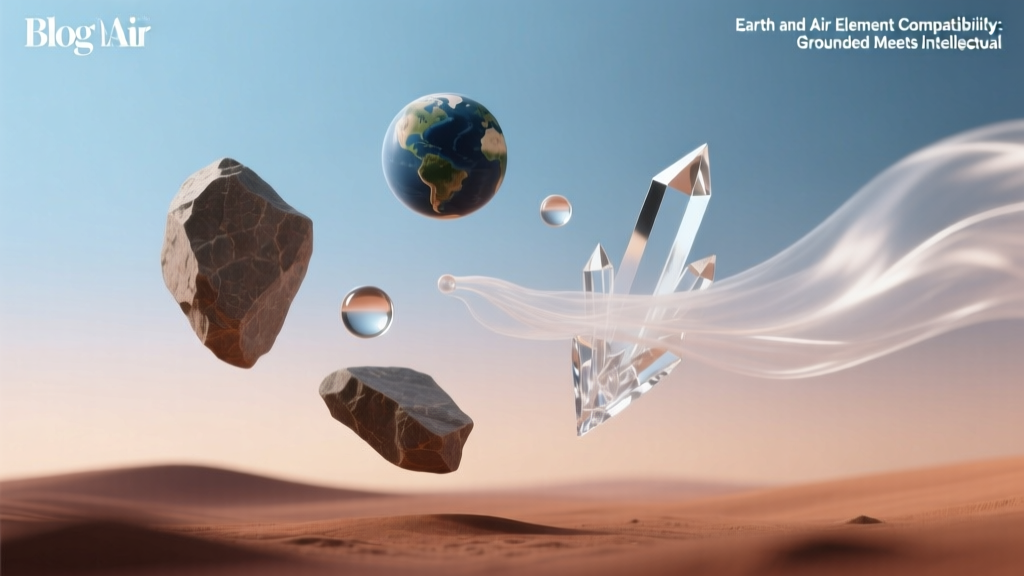
Earth and Air: An Elemental Overview
At the heart of Western astrology lies the ancient four-element framework—Earth, Air, Fire, and Water—each governing three zodiac signs and embodying distinct energetic archetypes. Earth signs (Taurus, Virgo, Capricorn) represent stability, practicality, and sensory embodiment; they anchor experience in the tangible world through touch, taste, structure, and time-tested wisdom. Air signs (Gemini, Libra, Aquarius), by contrast, thrive on abstraction, connection, and intellectual exchange—they breathe meaning into ideas, prioritize fairness and dialogue, and move with conceptual agility rather than physical weight.
This elemental dichotomy isn’t oppositional in the way Earth and Fire or Air and Water often are; instead, Earth and Air form a dynamic polarity rooted in mutual necessity. As astrologer Steven Forrest observes in The Inner Sky, 'Earth without Air is stagnant matter; Air without Earth is ungrounded fantasy.' Their relationship mirrors soil and wind: one gives form and nourishment, the other disperses seeds, circulates oxygen, and shapes climate. Neither can sustain life alone—but together, they enable growth, innovation, and societal infrastructure. The Earth signs provide the 'what' and 'how much'—concrete goals, budgets, timelines, and physical boundaries—while Air signs supply the 'why,' 'what if,' and 'who else?'—contextualizing purpose, expanding networks, and challenging assumptions.
Importantly, this pairing avoids the visceral tension seen in Earth–Water (where emotion overwhelms practicality) or Air–Fire (where enthusiasm outpaces execution). Instead, Earth and Air operate across complementary axes of reality: Earth governs substance and duration; Air governs communication and pattern recognition. When consciously engaged, their interplay fosters pragmatic idealism—the kind that builds libraries, designs sustainable cities, or launches ethical startups. As the Astro.com Element Guide affirms, 'Air needs Earth to manifest; Earth needs Air to evolve beyond routine.'
How Earth and Air Signs Interact
Earth–Air interactions unfold as a subtle dance of calibration—less about sparks or clashes, more about rhythmic attunement. A Taurus may listen patiently while a Gemini sketches three business models aloud; a Virgo might quietly reorganize a Libra’s chaotic brainstorming notes into actionable steps; a Capricorn could fund an Aquarian’s experimental community project—then request quarterly impact metrics. These exchanges rarely ignite drama, but they demand conscious effort to bridge perceptual gaps.
Psychologically, Earth signs process information sensorially and sequentially: they need data points anchored in real-world precedent before committing. Air signs, meanwhile, synthesize laterally—connecting disparate concepts rapidly, often skipping intermediate logic to arrive at intuitive leaps. This difference isn’t hierarchical; it’s metabolic. As clinical psychologist and astrological researcher Dr. Jennifer Freed explains in her work with relational dynamics, 'Earth energy metabolizes experience like digestion—slow, thorough, nutrient-extracting. Air energy metabolizes it like respiration—fast, exchange-based, oxygenating the system.' Misunderstandings arise not from ill will, but from mismatched processing speeds and evidentiary standards.
Communication styles further illustrate this rhythm. Earth signs prefer concise, outcome-oriented language ('What’s the deadline? What’s the budget?'). Air signs favor exploratory, open-ended phrasing ('Let’s consider five possible frameworks…'). Without awareness, the Earth person may perceive Air’s ideation as indecisive; the Air person may view Earth’s focus on constraints as restrictive. Yet when both honor their partner’s cognitive architecture—Earth granting Air space to ideate freely, Air honoring Earth’s need for grounded next steps—their synergy becomes remarkably generative. The Cafe Astrology Elements Reference notes that Earth–Air pairings rank among the most collaborative in professional settings precisely because they balance vision with viability.
Compatibility Strengths
The strengths of Earth–Air compatibility lie in its built-in checks and balances—a natural system of mutual refinement. First and foremost is complementary problem-solving. When faced with a challenge, Earth signs identify root causes in material conditions (e.g., 'The website crashes because our server bandwidth is capped'), while Air signs diagnose systemic patterns (e.g., 'Our user retention drops because onboarding lacks cognitive scaffolding'). Together, they design solutions that are both technically sound and human-centered.
Second is intellectual grounding. Air signs bring curiosity, breadth, and future-oriented thinking—qualities that prevent Earth signs from calcifying into rigidity. In turn, Earth signs offer Air signs experiential ballast, transforming abstract theories into testable hypotheses or pilot programs. A Libra strategist and Virgo operations manager, for instance, might co-develop a DEI initiative where Libra crafts inclusive policy language and Virgo implements phased training rollouts with measurable KPIs.
Third is social pragmatism. Earth signs lend credibility and consistency to Air’s networking prowess. While Aquarius excels at convening diverse thinkers, Capricorn ensures those collaborations yield tangible outcomes—grants secured, prototypes built, coalitions formalized. This combination powers effective advocacy, education reform, and civic tech. Research published by the International Academy of Astrology highlights that Earth–Air composite charts show above-average angular harmony in the 3rd (communication) and 10th (career) houses—indicating enduring synergy in knowledge-sharing and public contribution.
Common Friction Points
Despite their synergistic potential, Earth and Air energies collide at several predictable pressure points. The most frequent source of tension is differing definitions of 'progress.' For Earth signs, progress means measurable advancement toward a concrete goal—revenue growth, skill mastery, home ownership. For Air signs, progress means expanded perspective, novel connections, or paradigm shifts—even if no external metric changes. A frustrated Taurus might ask, 'What did we *actually* accomplish in that three-hour meeting?' while their Gemini counterpart replies, 'We reframed the entire problem space!' Without translation, both feel unheard.
A second friction point involves emotional expression norms. Though neither element is classically 'emotional' (that’s Water’s domain), their avoidance manifests differently. Earth signs suppress feeling to maintain control and reliability; Air signs detach to preserve objectivity and mental clarity. When conflict arises, Earth may withdraw silently to 'process internally,' while Air may over-intellectualize the issue ('Let’s analyze the attachment styles at play'). Neither approach validates the other’s unspoken need—for Earth, reassurance of continuity; for Air, affirmation of intellectual autonomy.
Third is temporal dissonance. Earth operates on biological and logistical time—seasons, gestation periods, project milestones. Air operates on idea-time—sudden insights, viral trends, conceptual urgency. An Aquarian may urgently pitch a new social media campaign based on an emerging meme format; the Capricorn partner responds, 'We haven’t finalized Q3 analytics yet.' Neither is wrong—but without negotiated rhythms (e.g., 'Air gets 20% of planning time for blue-sky thinking; Earth sets hard deadlines for implementation'), resentment accumulates.
Earth × Air in Love
Romantically, Earth–Air pairings rarely ignite with fiery passion—but they often cultivate deep, evolving intimacy rooted in mutual respect and shared growth. Their love language blends tactile presence (Earth) with mental stimulation (Air). A Virgo–Libra couple might spend Sunday mornings cooking together (Earth’s sensual ritual) while debating ethical frameworks for food sovereignty (Air’s conceptual engagement). There’s little grand romantic gesture—instead, love is expressed through reliable support (Earth) and unwavering intellectual curiosity about each other’s inner worlds (Air).
Sexuality in these unions tends toward mindful, communicative, and experimentally thoughtful rather than instinct-driven. Earth brings embodied presence and patience; Air brings imaginative framing and consent-centered dialogue. Because both elements value fairness and reciprocity, power dynamics rarely skew—though Air’s love of debate can unintentionally trigger Earth’s fear of instability. A healthy Earth–Air romance includes explicit agreements about when to 'pause analysis' and simply be—such as designated device-free evenings or weekly 'sensory check-ins' (e.g., 'What texture, scent, or taste brought you joy this week?').
Long-term sustainability hinges on honoring dual needs: Earth requires tangible evidence of commitment (joint accounts, cohabitation plans, family integration), while Air requires ongoing mental expansion (shared learning, travel to intellectually stimulating locales, creative collaboration). Couples who thrive invest in 'third-space' activities—like volunteering for a literacy nonprofit (merging Earth’s service ethic with Air’s love of communication) or restoring vintage books (honoring physical objects while engaging with narrative structures).
Earth × Air in Friendship and Work
In friendship, Earth–Air bonds excel at low-drama, high-value companionship. They’re the friends who show up with soup when you’re sick (Earth) and send three thoughtfully curated articles on recovery psychology the next day (Air). Their loyalty is quiet but unshakeable—Earth remembers your birthday and favorite tea; Air remembers the name of your childhood dog and asks insightful follow-ups about your latest creative project. Conflict resolution is mature and solution-focused: no blame, just joint diagnosis and action planning.
Professionally, this pairing is powerhouse material—especially in fields requiring both innovation and execution: UX design, policy development, academic administration, sustainable architecture, and edtech. Consider this real-world dynamic: a Gemini product manager (Air) ideates a voice-activated accessibility feature; a Taurus engineering lead (Earth) stress-tests its hardware integration and user safety protocols. Their meetings balance whiteboard sessions with detailed QA checklists. According to Harvard Business Review’s 2023 study on cross-functional team efficacy, teams with balanced 'conceptual' (Air-aligned) and 'operational' (Earth-aligned) roles demonstrated 37% higher project completion rates and 29% greater stakeholder satisfaction than homogenous groups.
Key to workplace success is role clarity and structured feedback loops. Earth signs need defined responsibilities and measurable outcomes; Air signs need autonomy to explore alternatives and share insights widely. Implementing practices like 'Air-led ideation sprints' followed by 'Earth-led feasibility reviews' formalizes their natural rhythm—and prevents either from feeling sidelined.
Compatibility Score Chart
| Dimension | Earth Sign Strength | Air Sign Strength | Synergy Rating (1–10) | Notes |
|---|---|---|---|---|
| Communication | Clear, direct, context-rich | Adaptable, conceptual, network-oriented | 8.5 | High complementarity; requires active listening to bridge style gaps |
| Conflict Resolution | Pragmatic, solution-focused | Analytical, systems-aware | 8.0 | Rarely personal; favors structural fixes over emotional catharsis |
| Shared Values | Stability, integrity, craftsmanship | Justice, innovation, intellectual freedom | 7.5 | Converge on 'building better systems'; diverge on pace/method |
| Emotional Intimacy | Deep but private; shown through acts | Expressive but detached; shown through ideas | 6.5 | Requires intentional practice to bridge affective gap |
| Long-Term Vision | Incremental, legacy-oriented | Transformative, horizon-scanning | 9.0 | Natural alignment on 'future-building'; Earth grounds Air's scope |
Tips for Harmonizing Earth and Air Energy
- Create 'Translation Rituals': Establish shared language bridges—e.g., after an Air sign shares a big idea, the Earth sign summarizes it in one sentence + one actionable step. Conversely, when Earth outlines a plan, Air adds 'What underlying principle makes this meaningful?'
- Design Dual-Purpose Time Blocks: Dedicate 90-minute sessions to 'Grounded Ideation'—start with Earth-led sensory centering (e.g., brewing tea mindfully), then shift to Air-led brainstorming with zero judgment, ending with Earth-led prioritization.
- Practice 'Constraint-Based Creativity': Invite Air to innovate within Earth-defined parameters ('Design a community garden layout using only native plants and $2,000'). Constraints spark Air’s ingenuity while honoring Earth’s need for realism.
- Develop a 'Feedback Lexicon': Agree on non-triggering phrases—e.g., instead of 'That’s unrealistic,' say 'How might we prototype this in Phase 1?' Replace 'You’re overcomplicating it' with 'Which two variables feel most essential to test first?'
- Celebrate Hybrid Wins: Publicly acknowledge achievements that blend both energies—e.g., 'Our solar-powered library (Earth) uses AI-driven recommendation algorithms (Air) to boost teen engagement by 40%.'
Ultimately, Earth and Air compatibility isn’t about becoming alike—it’s about cultivating reverence for difference as the engine of evolution. When Taurus’ steadfastness holds space for Gemini’s curiosity, when Virgo’s precision sharpens Libra’s ideals, when Capricorn’s discipline channels Aquarius’ vision—something rare emerges: wisdom with wings, and ideas with roots. As astrologer Demetra George writes in Ancient Astrology, 'The alchemy of Earth and Air doesn’t produce gold—it produces fertile ground where every seed, however improbable, has a chance to take hold.'