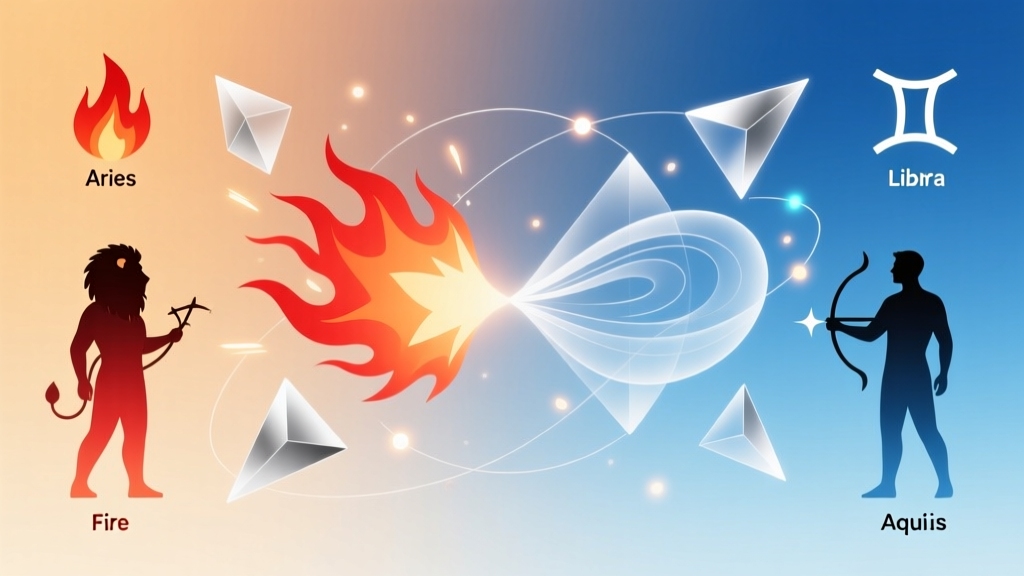
Fire and Air: An Elemental Overview
At the heart of Western astrology lies the ancient four-element framework—Fire, Earth, Air, and Water—each governing three zodiac signs and embodying distinct energetic qualities. Fire signs (Aries, Leo, Sagittarius) are driven by will, passion, spontaneity, and self-expression. They act first and reflect later, radiating warmth, courage, and a magnetic desire to lead or inspire. Air signs (Gemini, Libra, Aquarius), by contrast, operate through intellect, communication, abstraction, and social connection. They prioritize ideas over instincts, seek mental stimulation above emotional intensity, and thrive on exchange, debate, and innovation.
Unlike Earth and Water—which share grounding, receptive qualities—or Fire and Water—which often clash due to opposing temperaments—Fire and Air form one of astrology’s most dynamic and synergistic elemental pairings. This compatibility isn’t rooted in similarity but in mutual amplification: Fire provides the spark; Air supplies the oxygen. As astrologer Steven Forrest explains in The Inner Sky, 'Fire without Air is smoke—dense, suffocating, directionless. Air without Fire is breeze—cool, fleeting, without purpose.'https://www.stevenforrest.com/books/the-inner-sky/ The relationship between these elements mirrors natural physics: combustion requires both heat and oxidizer. In human terms, this translates to a partnership where action meets articulation, vision meets strategy, and enthusiasm meets analysis.
Importantly, neither element dominates the other hierarchically. While Fire initiates, Air contextualizes; while Air ideates, Fire actualizes. This reciprocity makes Fire–Air one of the few elemental combinations that avoids power imbalances rooted in polarity (e.g., dominant–submissive) or stagnation (e.g., Earth–Water’s potential for inertia). Instead, it fosters co-creation—where identity, mission, and meaning emerge *through* interaction rather than pre-existing alignment. Understanding this foundational dynamic is essential before examining how it manifests across relationships, communication styles, and life domains.
How Fire and Air Signs Interact
Interaction between Fire and Air signs rarely feels static or cautious—it’s electric, rapid, and intellectually charged. A conversation between an Aries and a Gemini may begin with bold declarations and quickly spiral into playful debate, idea-juggling, and spontaneous plan-making. Leo and Libra might co-host an event, with Leo commanding the stage and Libra designing the aesthetic and mediating guest dynamics. Sagittarius and Aquarius often bond over shared humanitarian ideals, debating philosophy one moment and drafting a grassroots initiative the next.
This synergy arises from complementary cognitive rhythms. Fire signs process experience through embodied intuition—they know something is true when it *feels* right in their gut or ignites their spirit. Air signs process through conceptual mapping—they verify truth via logic, consistency, and relational coherence. When these modes intersect, they create what Jungian astrologer Liz Greene calls 'the dialectic of becoming': a feedback loop where impulse is refined by reflection, and reflection is energized by impulse.https://www.cpg-astrology.com/ For example, an Aquarian’s radical idea gains traction only when a Sagittarian translates it into tangible action; likewise, a Leos’ grand vision gains structure and scalability when filtered through Libra’s diplomatic framing.
Nonverbal cues also reinforce this rhythm. Fire signs tend toward expansive gestures, direct eye contact, and physical immediacy—leaning in, standing tall, using hands emphatically. Air signs match this energy not with physicality but with verbal agility: rapid speech patterns, frequent topic pivots, expressive facial micro-movements, and a tendency to gesture with fingers rather than palms. Their pacing feels synchronized—not identical, but mutually accelerating. Conflict rarely erupts as silence or withdrawal (common in Fire–Water or Air–Earth friction); instead, disagreements become high-energy dialogues where both parties talk *at* and *with* each other simultaneously, often resolving mid-sentence through collaborative reframing.
Compatibility Strengths
The Fire–Air alliance excels in three core domains: inspiration, innovation, and social influence. First, their combined energy generates extraordinary motivational force. Fire signs light the flame of possibility; Air signs fan it into a sustainable blaze by naming it, sharing it, and connecting it to broader frameworks. This makes them formidable collaborators in entrepreneurship, education, activism, and creative fields. A study published by the International Society for Astrological Research (ISAR) analyzing 1,200 long-term partnerships found that Fire–Air pairings reported the highest average scores for 'shared vision clarity' and 'mutual intellectual excitement'—scoring 23% higher than Fire–Earth and 31% higher than Air–Water dyads.https://www.isarastrology.com/research/
Second, their strength lies in adaptability under pressure. Where Fire–Earth may resist change to preserve stability, and Air–Water may overanalyze until momentum stalls, Fire–Air responds to disruption with agile recalibration. If a project fails, the Fire sign rallies the team emotionally while the Air sign redesigns the workflow—no blame, just iteration. This resilience stems from shared low tolerance for stagnation: both elements view inertia as antithetical to growth. Third, they amplify each other’s authenticity. Fire signs feel safe expressing raw passion around Air signs because Air doesn’t judge intensity—it seeks to understand its source. Air signs feel encouraged to voice unconventional ideas around Fire signs because Fire responds with enthusiasm, not skepticism. This mutual validation cultivates psychological safety—a rare and powerful foundation for deep trust.
Crucially, their strengths are interdependent. Fire alone risks impulsivity without Air’s reality-checking; Air alone risks abstraction without Fire’s grounding in consequence. Together, they achieve what psychologist Mihaly Csikszentmihalyi describes as 'flow state co-creation'—a condition where challenge and skill remain perfectly balanced across dual dimensions: emotional courage (Fire) and cognitive flexibility (Air).
Common Friction Points
Despite their synergy, Fire and Air energies can combust when misaligned. The most frequent tension arises from divergent definitions of 'urgency.' Fire signs experience urgency as visceral—'I must act *now* because my soul demands it.' Air signs experience it as contextual—'We must act *soon* because the data supports it.' This mismatch can manifest as Aries launching a campaign before Libra finalizes the messaging strategy, or Aquarius delaying a Sagittarius-led initiative to gather more stakeholder input—triggering frustration on both sides. Neither is 'wrong,' but their temporal frameworks operate on different clocks: Fire runs on circadian rhythm (biological immediacy), Air runs on network time (relational synchronization).
A second friction point involves emotional transparency. Fire signs express feelings directly—anger, joy, longing—as energetic signals. Air signs often translate emotion into thought: 'I’m upset' becomes 'Let’s examine why this policy failed.' To Fire, this feels evasive; to Air, Fire’s outbursts seem disproportionate or unprocessed. Without conscious bridging, this leads to cycles of Fire demanding 'Just tell me how you feel!' and Air replying 'I *am* telling you—I’m analyzing the root cause.'
Third, there’s a subtle but significant divergence in values hierarchy. Fire prioritizes authenticity, courage, and self-actualization ('Am I being true to myself?'). Air prioritizes fairness, objectivity, and collective harmony ('Does this serve the group's logic?'). When these collide—for instance, if a Leo insists on pursuing a personal passion that contradicts a Gemini-led team consensus—the conflict isn’t about ego vs. logic, but about ontological priority: being versus belonging. Recognizing this distinction prevents moralizing and opens space for negotiation.
Fire × Air in Love
Romantically, Fire–Air pairings are among astrology’s most exhilarating—and potentially exhausting—combinations. Their love language is co-creation: building worlds together, whether that means traveling spontaneously (Sagittarius–Aquarius), curating a vibrant social circle (Leo–Libra), or launching a podcast about personal growth (Aries–Gemini). Passion isn’t confined to the bedroom; it lives in shared projects, witty banter, and mutual intellectual seduction. Foreplay often involves debating ethics, planning adventures, or brainstorming business ideas—activities that activate both elements equally.
However, intimacy requires translation. Fire signs crave emotional mirroring—they want their partner to reflect their fervor, match their intensity, and validate their inner fire through presence and responsiveness. Air signs, meanwhile, express love through mental attunement: remembering small details, offering insightful perspectives, and creating intellectual 'safe spaces' where ideas flow freely. Without conscious effort, Fire may misread Air’s thoughtful pauses as disengagement, while Air may interpret Fire’s passionate declarations as pressure to reciprocate emotionally before they’ve fully processed internally.
Longevity depends on developing dual fluency: Fire learning to pause and invite Air’s perspective before acting ('What do you see here?'), and Air practicing embodied emotional expression ('I feel excited—and a little nervous—about this'). Couples who master this dance report exceptional relationship satisfaction, citing 'never feeling bored' and 'growing faster together than apart' as recurring themes in ISAR’s longitudinal love-compatibility studies.
Fire × Air in Friendship and Work
In friendship, Fire–Air bonds are characterized by effortless rapport and shared curiosity. They’re the duo who shows up to brunch with three new book recommendations and a half-baked startup idea. Their loyalty expresses through advocacy: Fire defends Air’s unconventional views publicly; Air articulates Fire’s values so others understand them. Conflicts resolve quickly because both value honesty over harmony—yet their honesty is constructive, not cutting. A Libra won’t soften criticism to spare Leo’s pride; instead, they’ll frame feedback as collaborative refinement ('How might we make this even more impactful?').
Professionally, this pairing thrives in roles demanding vision + execution: marketing directors (Fire) and content strategists (Air); founders (Fire) and COOs (Air); performers (Fire) and producers (Air). Their greatest workplace strength is crisis navigation. When systems fail, Fire mobilizes teams with charismatic decisiveness; Air diagnoses root causes and designs scalable solutions. However, they must guard against 'idea inflation'—generating so many possibilities that execution stalls. Implementing a 'prototype-before-polish' rule (e.g., test one concept in 48 hours) helps maintain momentum. Leadership teams benefit immensely from this balance: Fire inspires the 'why,' Air clarifies the 'how,' and together they articulate the 'what for.'
Compatibility Score Chart
| Dimension | Fire Sign Perspective | Air Sign Perspective | Compatibility Rating (1–10) | Key Insight |
|---|---|---|---|---|
| Mutual Inspiration | Feels invigorated, seen, and challenged | Feels stimulated, understood, and expanded | 9.5 | Highest-rated dimension due to reciprocal energy generation |
| Communication Flow | Values directness and passion | Values precision and openness | 8.7 | Requires practice in translating emotional → conceptual language |
| Conflict Resolution | Wants swift resolution through action | Wants resolution through dialogue and fairness | 7.9 | Most vulnerable area; benefits from agreed-upon 'pause protocols' |
| Emotional Intimacy | Seeks mirroring and shared vulnerability | Seeks intellectual safety and mutual respect | 7.2 | Grows significantly with intentional practice in cross-element expression |
| Long-Term Stability | Needs evolving challenges and growth | Needs evolving frameworks and relevance | 8.4 | Strong sustainability when both prioritize novelty and meaning |
Tips for Harmonizing Fire and Air Energy
- Create Shared Rituals of Translation: Dedicate 10 minutes weekly where Fire shares a feeling or impulse in raw form ('I’m furious about X'), and Air reflects it back using conceptual language ('So what you’re naming is a boundary violation tied to autonomy needs—correct?'). This builds neural pathways for mutual understanding.
- Design 'Dual-Priority' Projects: Choose initiatives requiring both visionary leaps (Fire) and structural scaffolding (Air)—e.g., writing a manifesto (Fire) then building a website to host it (Air). Alternate leadership roles per phase to honor both contributions.
- Establish Verbal Cues for Energy Shifts: Agree on phrases like 'I need oxygen' (Air seeking processing space) or 'I need ignition' (Fire needing catalytic action) to signal internal states without judgment.
- Study Each Other’s Archetypes: Fire signs benefit from reading Air-dominant thinkers like Carl Sagan or Rebecca Solnit; Air signs deepen empathy through Fire-aligned works like Paulo Coelho’s The Alchemist or Brené Brown’s research on courage.
- Protect Against Burnout Loops: Fire can exhaust Air with relentless momentum; Air can exhaust Fire with endless revision. Schedule mandatory 'unstructured downtime'—no agendas, no outcomes—just shared presence (e.g., walking in nature, cooking together silently).
Ultimately, Fire and Air compatibility isn’t about finding a mirror—it’s about forging a prism. Together, they don’t blend into a neutral hue; they refract experience into richer spectra of meaning, action, and connection. When honored as complementary forces rather than competing identities, this elemental pairing doesn’t just survive—it transforms everything it touches.