What Is the Fire Element?
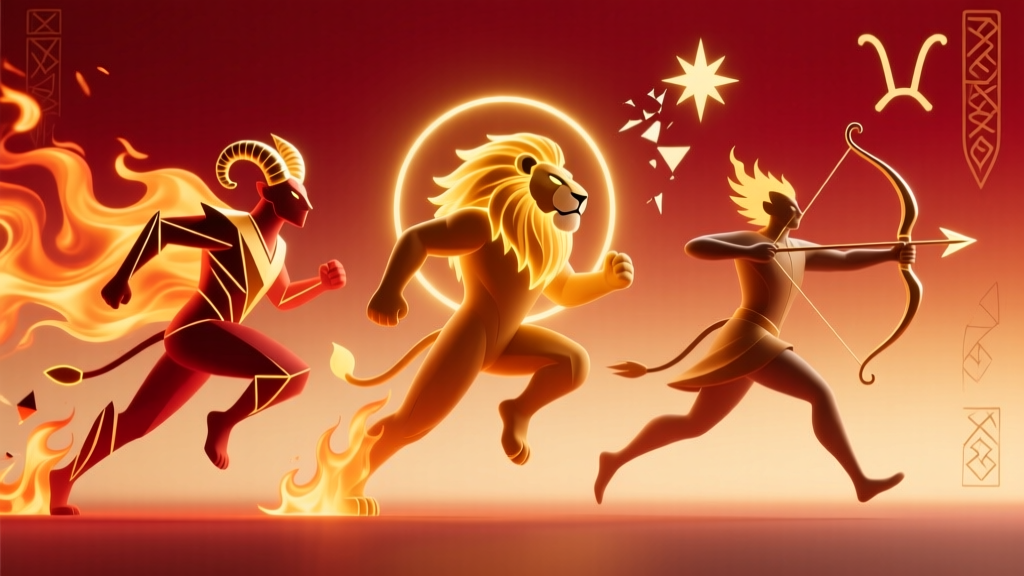
The Fire element is one of the four classical elements—alongside Earth, Air, and Water—that form the foundational framework of Western astrology. Rooted in ancient Greek philosophy and refined through centuries of astrological tradition, Fire represents the primal spark of existence: the impulse to act, create, lead, and ignite. Unlike the tangible solidity of Earth, the intellectual abstraction of Air, or the emotional depth of Water, Fire is dynamic, kinetic, and inherently expressive. It does not wait—it initiates. In the zodiac wheel, Fire governs three signs: Aries (cardinal Fire), Leo (fixed Fire), and Sagittarius (mutable Fire). This triad reflects Fire’s full evolutionary arc—from the first bold step (Aries), to sustained self-expression and identity (Leo), to the expansive search for meaning and truth (Sagittarius).
Astrologically, Fire is associated with the Sun, Mars, and Jupiter—the celestial bodies that rule vitality, willpower, and vision, respectively. According to the Astro.com Element Guide, Fire signs are driven by an inner flame that fuels confidence, spontaneity, and a strong sense of selfhood. This elemental energy isn’t merely metaphorical; modern psychological research on temperament has found correlations between high-energy, approach-oriented behavior—and traits commonly linked to Fire signs—such as assertiveness, optimism, and reward sensitivity (PMC, 2019). Fire is not about destruction alone; it is the catalyst for transformation, illumination, and renewal. Think of fire in nature: it clears underbrush to allow new growth, melts ore to forge tools, and warms homes. Similarly, the Fire element in human psychology clears stagnation, forges identity, and sustains motivation—even when external conditions are uncertain.
Importantly, Fire is not synonymous with anger or volatility—though those can emerge when unbalanced. Rather, its core essence is *intentional ignition*: the capacity to begin, inspire, and radiate. When grounded and conscious, Fire signs embody leadership without domination, enthusiasm without imposition, and faith without dogma. Their elemental signature is unmistakable—not just in how they speak or move, but in how they orient themselves toward possibility itself.
Core Characteristics of Fire Signs
While each Fire sign expresses its elemental nature uniquely, they share a constellation of interwoven traits rooted in the Fire element’s intrinsic qualities. These include initiative, warmth, confidence, idealism, courage, impatience, and a pronounced need for autonomy. Fire signs are naturally drawn to experiences that affirm their agency—whether launching a project, defending a cause, performing on stage, or embarking on a journey of learning. Their internal compass points toward authenticity and self-actualization, often before social approval or practical feasibility.
Psychologically, Fire signs demonstrate high levels of what Carl Jung termed the “extraverted thinking” and “extraverted feeling” functions—especially when supported by dominant or auxiliary Fire placements. As noted by the California Astrologers Association, Fire’s expression correlates strongly with dopamine-driven reward systems: Fire individuals feel most alive when pursuing goals aligned with personal values, receiving recognition for effort, or experiencing novelty and challenge. This neurochemical resonance explains their aversion to routine, boredom, or perceived injustice—conditions that dampen their inner spark.
Fire signs also share a distinctive relationship with time. They operate less from linear planning and more from inspired timing—what astrologer Steven Forrest calls “the rhythm of the heart over the tick of the clock.” Aries acts *now*, Leo embodies presence *in this moment*, and Sagittarius seeks meaning *across time*—yet all three prioritize immediacy of experience over delayed gratification. This temporal orientation contributes to both their charisma and their occasional difficulty with long-term follow-through unless meaning remains vivid. Importantly, Fire signs do not require external validation to feel worthy—but they *do* thrive when their light is seen, mirrored, and honored. Their core vulnerability lies not in insecurity, but in the fear of being ignored, misunderstood, or reduced to a stereotype (“the hothead,” “the drama queen,” “the know-it-all”). When nurtured, Fire becomes generative; when suppressed, it may flare defensively—or retreat into cynicism.
The Fire Signs: Aries, Leo, Sagittarius
Though united by elemental kinship, Aries, Leo, and Sagittarius each channel Fire through distinct modalities—cardinal, fixed, and mutable—creating a rich spectrum of expression. Aries, ruled by Mars and born March 21–April 19, is Fire’s pioneer. As the first sign of the zodiac, Aries embodies raw, undiluted initiation. Its energy is instinctual, direct, and fiercely independent. Aries asks, “What do I want—and how do I claim it *right now*?” There is no rehearsal, no consultation—just action propelled by gut-level certainty. This cardinal quality makes Aries exceptionally adept at breaking new ground, though it can also lead to impulsivity or overlooking consequences.
Leo, ruled by the Sun and spanning July 23–August 22, is Fire’s radiant center. Fixed in nature, Leo consolidates Fire’s energy into enduring identity, creative output, and heartfelt loyalty. Where Aries starts, Leo sustains—and shines. Leos express Fire through generosity, dramatic flair, protective warmth, and a deep need to be admired *for who they are*, not just what they do. Their strength lies in inspiring others through authenticity and joy; their shadow emerges when ego inflates into arrogance or when praise becomes a dependency rather than a reflection.
Sagittarius, ruled by Jupiter and active November 22–December 21, is Fire’s philosopher-archer. Mutable Fire adapts, explores, and synthesizes. Sagittarius seeks truth across cultures, disciplines, and belief systems—not to accumulate facts, but to expand perspective. Its Fire burns with curiosity, optimism, and moral conviction. Sagittarians champion freedom—not just personal liberty, but intellectual and spiritual emancipation. Yet their mutable nature can manifest as restlessness, overpromising, or glossing over emotional nuance in favor of big-picture ideals.
Together, these three signs form Fire’s complete life cycle: Aries plants the seed, Leo tends the flame, and Sagittarius carries the torch forward—illuminating paths beyond the horizon. Understanding their differences prevents homogenizing Fire signs and honors the nuanced ways courage, creativity, and conviction manifest across the zodiac.
How the Fire Element Shapes Personality
The Fire element doesn’t simply add flavor to personality—it fundamentally structures how Fire-dominant individuals perceive reality, process emotion, and relate to agency. At the cognitive level, Fire signs tend toward holistic, intuitive reasoning rather than step-by-step analysis. They grasp patterns quickly, often arriving at conclusions before articulating the logic—a trait sometimes mislabeled as “irrational” but increasingly validated by studies on embodied cognition and rapid pattern recognition (American Psychological Association, 2020). Their decision-making is value-driven: “Does this align with my truth? Does it excite me? Does it honor my integrity?”
Emotionally, Fire signs experience feelings with high intensity and low latency—they feel deeply and express swiftly. Sadness may flash as fiery frustration; grief may ignite into purposeful action. Unlike Water signs, who absorb and reflect emotion, Fire signs metabolize it through movement, speech, or creation. Suppressed Fire energy often surfaces as chronic irritability, burnout, or passive-aggressive withdrawal—signs that the inner flame is starved of oxygen (autonomy) or fuel (inspiration).
Behaviorally, Fire signs are natural leaders—not because they seek authority, but because their presence commands attention and their convictions magnetize alignment. They excel in roles requiring vision, advocacy, innovation, or mentorship. However, their leadership style varies: Aries leads by example and daring, Leo leads by inspiration and heart-centered authority, Sagittarius leads by teaching, questioning, and broadening horizons. Crucially, Fire’s influence extends beyond sun signs: a person with prominent Fire placements in their natal chart—even without a Fire sun—may exhibit pronounced courage, spontaneity, or idealism. The element’s impact multiplies when activated across houses, aspects, and transits—making Fire less a static trait and more a living current within the psyche.
Fire Element Strengths and Gifts
Fire signs bestow irreplaceable gifts upon relationships, teams, and communities. Foremost among these is initiative: the ability to turn vision into motion without waiting for permission. In workplaces, Fire individuals often serve as catalysts for change—launching pilot programs, voicing uncomfortable truths, or rallying morale during uncertainty. Their authenticity is another profound gift: Fire signs rarely perform emotional labor to appease others. What you see is what you get—a transparency that builds trust, even when it’s challenging.
Fire also brings resilience. Because their energy is self-renewing—drawing from internal conviction rather than external validation—Fire signs often recover rapidly from setbacks. Aries bounces back with renewed determination, Leo reclaims dignity through creative rebirth, and Sagittarius reframes failure as data on the path to wisdom. Their enthusiasm is contagious and socially regenerative; they remind others of joy, possibility, and the sheer delight of being alive. In therapeutic or coaching contexts, Fire’s presence often accelerates breakthroughs—because they name truths others avoid and model courageous self-assertion.
Additionally, Fire signs possess extraordinary visionary capacity. Whether envisioning a startup, designing a community garden, or advocating for systemic reform, they think in terms of legacy and impact—not just quarterly metrics. Their optimism isn’t naïve; it’s strategic faith in human potential. As astrologer Susan Miller observes, “Fire signs don’t just see the mountain—they already feel the summit wind on their face” (Susan Miller Astrology). When harnessed ethically, this foresight becomes a compass for collective progress.
Fire Element Challenges and Growth
No elemental energy is without its shadows—and Fire’s greatest challenges arise when its brilliance lacks grounding, reflection, or compassion. The most common pitfall is ego inflation: mistaking personal conviction for universal truth, or equating visibility with virtue. Without humility, Fire can become domineering, dismissive of slower-paced perspectives, or intolerant of ambiguity. Aries may bulldoze collaboration; Leo may monopolize attention; Sagittarius may preach without listening.
Another challenge is impatience with process. Fire signs often undervalue the necessary friction of refinement—editing a draft, rehearsing a speech, or sitting with discomfort before acting. This can lead to half-finished projects, broken promises, or strained partnerships where follow-through matters more than inspiration. Growth occurs when Fire learns to companion its spark with Earth’s patience, Water’s empathy, and Air’s discernment—not to dilute its power, but to multiply its impact.
Emotional maturity for Fire involves developing response-ability—not just reactivity. This means pausing between stimulus and action, asking “What serves life here?” rather than “What proves my strength?” It also means embracing vulnerability not as weakness, but as the ultimate act of courage: showing up authentically, even when unsure. Practices like mindfulness, somatic awareness, and active listening help Fire integrate stillness without extinguishing its flame. As the ancient Stoics taught—and modern neuroscience confirms—true strength lies not in constant combustion, but in regulated, sustainable energy. For Fire signs, growth is measured not by how brightly they burn, but by how wisely they tend their own hearth—and warm others without consuming them.
Fire Element in Relationships
In romantic, familial, and friendship dynamics, Fire signs bring warmth, loyalty, and exhilarating honesty—but their relational success hinges on mutual respect for autonomy and authenticity. With other Fire signs, connections are electric and fast-moving—full of shared adventures and passionate debates. However, clashes can erupt when egos compete for dominance or when spontaneity overrides commitment. Fire-Fire pairings thrive when both partners consciously cultivate humility, active listening, and shared purpose beyond self-expression.
With Earth signs (Taurus, Virgo, Capricorn), Fire finds grounding and practical support—but may chafe against perceived rigidity or caution. Earth appreciates Fire’s vision but needs time and structure to engage; Fire admires Earth’s reliability but may misinterpret deliberation as resistance. Successful Fire-Earth unions balance Fire’s “let’s go!” with Earth’s “let’s plan”—creating ventures that are both inspired and executable.
With Air signs (Gemini, Libra, Aquarius), Fire enjoys intellectual stimulation and social expansion. Air fans Fire’s flames with ideas and novelty; Fire gives Air’s abstractions emotional weight and momentum. Potential friction arises if Air over-analyzes Fire’s instincts or if Fire dismisses Air’s need for objectivity. With Water signs (Cancer, Scorpio, Pisces), Fire offers warmth and encouragement, while Water provides depth and emotional attunement. Yet Fire may unintentionally steamroll Water’s sensitivity, and Water may feel scorched by Fire’s intensity. The healthiest Fire-Water bonds involve Fire learning containment and Water learning assertion.
Ultimately, Fire teaches all signs about courage, authenticity, and the sacredness of selfhood. Its relational gift is reminding others: You are allowed to want. You are allowed to lead. You are allowed to shine.
Fire Element Quick Reference Table
| Attribute | Aries (Cardinal Fire) | Leo (Fixed Fire) | Sagittarius (Mutable Fire) |
|---|---|---|---|
| Ruling Planet | Mars | Sun | Jupiter |
| Key Motivation | To initiate, assert, and pioneer | To express, create, and inspire | To explore, understand, and expand |
| Strengths | Courage, spontaneity, leadership | Generosity, charisma, loyalty | Optimism, honesty, philosophical insight |
| Shadow Tendencies | Impulsivity, aggression, impatience | Egotism, need for admiration, pride | Restlessness, tactlessness, overpromising |
| Growth Focus | Patience, collaboration, reflection | Humility, listening, sharing spotlight | Follow-through, emotional nuance, grounded idealism |