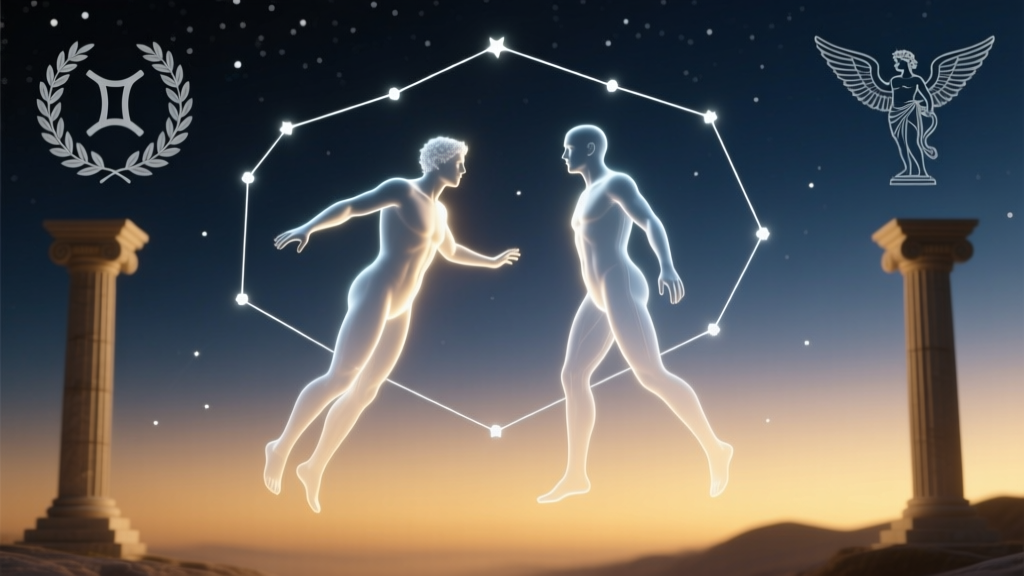
Gemini—the third sign of the zodiac, ruled by Mercury and symbolized by the Twins—holds a uniquely dualistic place in both astrology and world mythology. Unlike many signs whose origins are abstract or celestial, Gemini’s identity is anchored in one of the most enduring archetypes across civilizations: the twin. This duality isn’t merely symbolic—it’s etched into ancient star charts, encoded in sacred texts, and dramatized in foundational myths that continue to inform psychological and astrological interpretations today. To understand Gemini is to journey through layers of myth: from the divine sibling bond of Castor and Pollux in Greece, to the syncretic reinterpretations by Roman priests; from Babylonian boundary markers in the heavens to Vedic twins representing breath and life force. This article traces the full mythic lineage of Gemini (May 21–Jun 20), revealing how ancient narratives forged the modern understanding of adaptability, communication, curiosity, and inner contradiction—the hallmarks of the Gemini archetype.
The Myth Behind Gemini
At its core, the myth behind Gemini is not just about two people—but about the fundamental human experience of duality. Gemini embodies the tension and harmony between opposites: thought and speech, logic and intuition, connection and detachment, truth and perception. This duality predates Greco-Roman storytelling; it appears in Sumerian hymns to the divine pair Lugalbanda and Ninsun, in Egyptian depictions of the twin deities Shu (air) and Tefnut (moisture), and in early Vedic cosmology where the Ashvins—twin horsemen physicians—symbolize the union of day and night, healing and speed. What makes Gemini distinct among zodiacal myths is its consistent emphasis on relational duality: not good vs. evil, but self vs. other, idea vs. expression, mind vs. messenger. Astrologer Demetra George notes that ‘the Gemini archetype emerges wherever two forces interact—not in opposition, but in dialogue’ (Demetra George). This relational framework explains why Gemini is assigned rulership over hands, lungs, shoulders, and the nervous system—organs and systems that mediate between internal states and external reality. In mythic terms, Gemini doesn’t represent a single hero’s journey but a shared voyage: two consciousnesses navigating the same sky, speaking different languages yet bound by blood, oath, or destiny. That bond—fragile, fierce, and forever negotiating—is the mythic engine behind every Gemini’s lifelong dance between consistency and change, depth and breadth, sincerity and performance.
Gemini in Greek Mythology
In Greek mythology, Gemini is inextricably linked to the Dioscuri—Castor and Pollux—semi-divine brothers born of the same mother, Leda, but different fathers. Castor was mortal, sired by King Tyndareus of Sparta, while Pollux was immortal, fathered by Zeus who appeared to Leda as a swan. Their inseparability defined their legend: they fought side-by-side in the Argonautic expedition, rescued Helen (their sister) from Theseus, and avenged their brother-in-law’s death in the Calydonian Boar Hunt. When Castor died—slain in battle by Idas and Lynceus—Pollux, grief-stricken and unwilling to live without his twin, begged Zeus to let him share his immortality. Moved by such devotion, Zeus granted Pollux’s wish: the brothers would alternate days between Olympus and the underworld, ensuring neither was ever truly alone. Later, Zeus placed them together in the sky as the constellation Gemini—a permanent testament to love that transcends mortality. This myth underscores key Gemini traits: loyalty expressed through intellectual and emotional partnership, the capacity for rapid role-shifting (mortal/immortal, earth/heaven), and an almost obsessive need for mirroring and reciprocity. As scholar Dr. Laura C. Hulse observes in her work on mythic astrology, ‘The Dioscuri do not seek individuation like Heracles or Odysseus; their power lies in synergy’ (Astrology Museum Research Archive). Their story also explains Gemini’s association with equanimity under pressure—Pollux did not rage or withdraw but negotiated with the king of gods—and their gift for diplomacy, mediation, and bridging divides. Crucially, Castor and Pollux were patrons of sailors, appearing as St. Elmo’s fire during storms—a phenomenon ancient mariners interpreted as divine twin lights guiding safe passage. This reinforces Gemini’s astrological link to navigation—not just of physical seas, but of ideas, conversations, and social terrain.
Gemini in Roman Mythology
Roman mythology absorbed the Dioscuri wholesale but recontextualized them within the civic and military ethos of the Republic. Known as the Castores, Castor and Pollux became central figures in Rome’s founding mythos. According to Livy and Plutarch, they appeared miraculously at the Battle of Lake Regillus (496 BCE), fighting on horseback for the fledgling Roman Republic against the Latin League—then vanishing after victory to report the triumph to the Senate in the Forum. Their temple, the Temple of Castor and Pollux, was erected in the Roman Forum in 484 BCE and served as both a religious site and the de facto headquarters of the Roman treasury and financial administration. This institutional integration reveals how Rome transformed the Greek twin myth into a symbol of civic virtue: reliability, sworn brotherhood (fraternitas), and the fusion of martial courage with mercantile acumen. Roman astrologers like Marcus Manilius, in his Astronomica, emphasized Gemini’s role in ‘binding alliances and articulating laws’—linking the sign directly to rhetoric, legal contracts, and treaty-making. Unlike the Greeks, who saw the twins as protectors of individuals, Romans viewed them as guarantors of collective stability. This shift explains why Gemini in Western astrology carries such strong associations with networking, journalism, teaching, and public relations—not just personal communication, but communication as infrastructure. The Roman adoption also introduced Mercury (Hermes’ counterpart) as Gemini’s planetary ruler, cementing the sign’s link to messages, commerce, travel, and translation. As the Astro.com Encyclopedia affirms, ‘Mercury’s placement in Gemini amplifies mental agility, linguistic versatility, and the ability to hold multiple perspectives simultaneously’—a direct inheritance from the Castores’ dual nature and civic function.
Ancient Cultural Interpretations of Gemini
Beyond Greece and Rome, Gemini’s twin motif resonated across ancient civilizations—each interpreting duality through its own cosmological lens. In Babylonian astronomy, Gemini was known as MASH.TAB.BA (“The Great Twins”), listed in the MUL.APIN tablets (c. 1000 BCE) as one of the earliest recognized constellations. Here, the twins were associated with the gate of the sun’s northern path and served as celestial timekeepers—marking the summer solstice transition when daylight begins its slow retreat. In Vedic astrology (Jyotish), the sign corresponds to Mithuna, meaning “pair” or “yoked together,” and is ruled by Budha (Mercury). The Ashvins, twin deities of healing and dawn, ride golden chariots drawn by horses or birds, symbolizing the vital breath (prana) and the life-sustaining rhythm of inhalation/exhalation—mirroring Gemini’s physiological domain over lungs and nervous system. In ancient Egypt, the twins appeared as Shu (god of air) and Tefnut (goddess of moisture), children of Atum who emerged from the primordial waters to create atmospheric balance—again reflecting Gemini’s theme of mediation between opposing forces. Even Mesoamerican cultures echoed this pattern: the Maya revered the Hero Twins, Hunahpu and Xbalanque, whose mythic descent into Xibalba (the underworld) and triumphant return symbolized resurrection through wit, dialogue, and strategic duality—not brute strength. A comparative overview highlights recurring themes:
| Culture | Name / Title | Core Symbolism | Astrological Resonance |
|---|---|---|---|
| Greek | Dioscuri (Castor & Pollux) | Mortality/immortality, brotherly devotion | Adaptability, loyalty in relationships, dual identity |
| Roman | Castores | Civic duty, sworn alliance, mercantile trust | Networking, contract negotiation, public communication |
| Vedic | Ashvins | Healing, dawn, breath, motion | Nervous system vitality, curiosity, restorative dialogue |
| Babylonian | MASH.TAB.BA | Celestial gate, solstice marker, timekeeping | Transitional awareness, timing, information flow |
| Maya | Hero Twins (Hunahpu & Xbalanque) | Wit over force, resurrection through dialogue | Problem-solving via conversation, intellectual resilience |
These cross-cultural parallels confirm that Gemini’s mythic essence transcends any single tradition—it expresses a universal human imperative: to connect, compare, translate, and reconcile. As historian Dr. Nicholas Campion writes in The Dawn of Astrology, ‘The twin motif recurs wherever societies value balance, exchange, and the spoken word as civilizing forces’ (Historical Astrology Society).
The Constellation Story of Gemini
The constellation Gemini occupies a prominent position on the ecliptic, straddling the winter-spring boundary between Taurus and Cancer. Its two brightest stars—Castor (Alpha Geminorum) and Pollux (Beta Geminorum)—anchor the celestial twins’ heads, though intriguingly, Pollux is brighter and more luminous than Castor despite Castor’s mythic precedence. Modern astronomy reveals Castor is actually a sextuple star system—six stars gravitationally bound in complex orbits—while Pollux is a single, evolved orange giant with a confirmed exoplanet. This astronomical duality mirrors the myth: apparent simplicity concealing layered complexity. Ancient stargazers, including those who carved the Nebra Sky Disk (c. 1600 BCE), identified Gemini as a pair long before formal zodiacal division. Ptolemy catalogued it in the Almagest (2nd century CE) as one of the 48 classical constellations, noting its role in marking the vernal equinox until ~100 BCE—when precession shifted that point into Aries. The constellation’s location near Orion, Canis Minor, and the Milky Way made it a navigational anchor for Mediterranean seafarers, reinforcing its mythic association with guidance and safe passage. Notably, Gemini contains the radiant Geminid meteor shower—one of the year’s most reliable and prolific—peaking each December when Earth passes through debris left by the extinct comet 3200 Phaethon. Ancient observers likely interpreted these ‘twin stars falling as gifts’ as divine affirmation of the Dioscuri’s protective presence. Contemporary astrophysicist Dr. Elizabeth Tasker emphasizes that ‘Gemini’s stellar composition—multiple binaries, variable stars, and interstellar dust lanes—makes it a laboratory for studying cosmic relationships’ (JAXA Astrophysics Division). Thus, even in deep space, Gemini remains a realm of dynamic interaction—not isolated points, but systems in constant dialogue.
How Mythology Shapes the Gemini Archetype
Mythology does not merely decorate the Gemini archetype—it constitutes its psychological architecture. Carl Gustav Jung identified the Dioscuri as a prime example of the ‘divine twin’ archetype, representing the conscious-unconscious split that every individual must integrate. For Gemini, this manifests not as inner conflict, but as cognitive multiplicity: the ability to hold contradictory ideas without collapse, to argue both sides of a debate with equal conviction, and to shift personas fluidly across contexts. Modern psychological astrology affirms that Gemini’s core challenge—and gift—is relational coherence: maintaining authenticity while adapting to others’ needs. Therapist and astrologer Glenn Perry explains, ‘Gemini’s developmental task is to unify the “I” and the “you” not through merger, but through articulate, empathic exchange’ (Glenn Perry Astrology). This stems directly from the myth: Pollux could not exist without Castor’s grounding mortality, nor Castor without Pollux’s transcendent vision. In clinical practice, Gemini clients often present with strengths in mediation, education, or tech communication—but may struggle with follow-through or perceived inconsistency, misread as flakiness rather than fidelity to process over product. The myth teaches that Gemini’s ‘inconsistency’ is actually fidelity to truth-in-relation: what is true for one person at one moment may shift when new data or perspective arrives. This is why Gemini excels in fields requiring synthesis—journalism, UX design, language interpretation, crisis counseling—where meaning emerges not from fixed answers but from dynamic co-construction. Ultimately, the twin myth invites us to see Gemini not as fragmented, but as fundamentally connective: a living bridge between self and other, past and future, silence and speech.
Gemini Mythology Quick Reference
- Primary Mythic Pair: Castor (mortal) and Pollux (immortal), sons of Leda
- Divine Patronage: Zeus (granted shared immortality); Hermes/Mercury (ruler of communication)
- Key Symbols: Twins, masks, pillars, roads, birds (doves, swans), caduceus
- Constellation Facts: 30th largest constellation; contains Castor (6-star system) and Pollux (exoplanet host); Geminid meteor shower origin
- Cross-Cultural Equivalents: Ashvins (Vedic), MASH.TAB.BA (Babylonian), Hero Twins (Maya), Shu & Tefnut (Egyptian)
- Astrological Keywords: Duality, adaptability, curiosity, communication, mediation, versatility, restlessness, intellectual rapport
- Modern Archetypal Expression: The Networker, The Teacher, The Translator, The Journalist, The Mediator, The Lifelong Learner
Gemini (May 21–Jun 20) endures not because it offers easy answers, but because it honors the beautiful, bewildering complexity of human connection. Its mythology reminds us that wisdom rarely lives in singularity—but in the space between two voices, two stars, two breaths, two minds daring to meet.