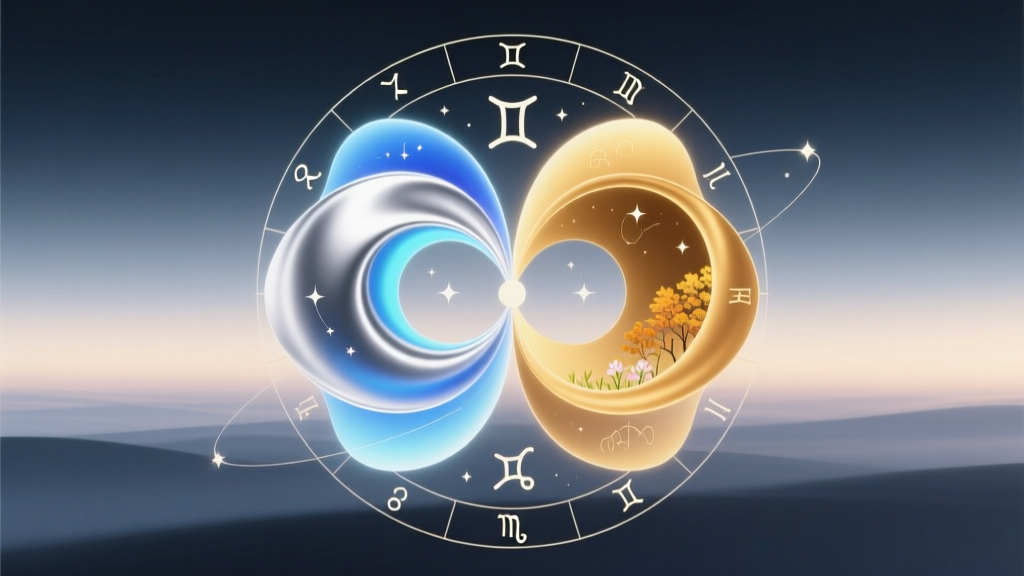
Gemini — the third sign of the zodiac, ruled by Mercury and symbolized by the Twins — occupies a uniquely dynamic position on the zodiac wheel. Unlike signs associated with solstices or equinoxes, Gemini embodies the energetic pivot between spring’s blossoming vitality and summer’s radiant expansion. Its dates (May 21–June 20) place it squarely in the heart of late spring in the Northern Hemisphere — a time of rapid growth, pollination, cross-pollination of ideas, and heightened sensory engagement with the world. This article explores Gemini not merely as a personality archetype but as a seasonal phenomenon: a living expression of Earth’s cyclical rhythms, encoded in the zodiac wheel’s architecture. By examining Gemini through the lens of seasonal energy, we uncover why its traits — adaptability, curiosity, wit, restlessness, and communicative fluency — are not arbitrary character sketches but natural reflections of its celestial timing and axial position.
Gemini and Its Season
Gemini season begins at the moment the Sun enters the tropical sign of Gemini — typically around May 21 — and lasts until approximately June 20. Astronomically, this period falls after the Taurus season and before Cancer, bridging the fertile, grounded energy of early spring with the nurturing, emotionally attuned energy of early summer. In the Northern Hemisphere, Gemini season coincides with the peak of spring: trees are fully leafed, flowers bloom in overlapping waves, birds nest and raise fledglings, and daylight hours lengthen rapidly — reaching near-maximum duration by the summer solstice just days after Gemini season ends. This is not a season of slow rooting (like Taurus) or emotional deepening (like Cancer), but one of connection: bees shuttle between blossoms, breezes carry pollen and scent across fields, and human activity surges with outdoor festivals, academic graduations, and social re-engagement after winter’s inward turn.
From an agricultural and phenological perspective, Gemini season marks the transition from planting to early harvest — think of strawberry picking, early lettuce and radish yields, and the first cuttings of herbs. It’s a time when nature emphasizes multiplicity: one flower produces dozens of seeds; one vine bears clusters of fruit; one tree hosts countless leaves, each subtly unique. This mirrors Gemini’s core symbolic motif — duality not as contradiction, but as complementary variation. As astrologer Steven Forrest writes in The Inner Sky, “Gemini is where the One becomes Many — not through fragmentation, but through joyful proliferation.”https://www.stevenforrest.com/books/the-inner-sky/ That proliferation is mirrored in the season’s biological exuberance and its invitation to gather, compare, synthesize, and share information.
Culturally, many traditions honor this phase of communicative abundance: ancient Greeks celebrated Hermes — Gemini’s planetary ruler — during the Hermesia, a festival of trade, travel, and message-bearing. In modern life, Gemini season aligns with the end of the academic year, commencement speeches, journalism awards, podcast launches, and the surge of digital content creation — all activities rooted in exchange, translation, and dissemination. To be born under Gemini is thus to arrive at a moment when the world is linguistically, sensorially, and socially saturated — priming the native for lifelong engagement with ideas, dialogue, and the art of making meaning through connection.
The Seasonal Energy of Gemini
Seasonal energy refers to the ambient psychological and archetypal climate generated by Earth’s tilt, orbit, and resulting light-temperature cycles — a framework long recognized in traditional astrology, Chinese medicine, and Indigenous seasonal calendars. Gemini’s seasonal energy is best understood as lateral activation: horizontal rather than vertical, expansive rather than deep, associative rather than hierarchical. While Aries initiates action and Taurus consolidates form, Gemini activates relationship between forms. Its energy doesn’t dig roots or build walls — it builds bridges, maps networks, and translates codes.
This lateral quality manifests physiologically and psychologically. Research in chronobiology shows that cognitive flexibility — the ability to switch between thinking about two different concepts or to think about multiple concepts simultaneously — peaks in late spring, correlating with increased serotonin and dopamine availability under longer photoperiods.https://www.ncbi.nlm.nih.gov/pmc/articles/PMC7367184/ These neurochemical shifts support Gemini’s hallmark mental agility: rapid association, pattern recognition across domains, and comfort with ambiguity. Gemini natives often report feeling most mentally alert and socially energized during their birth season — not because they’re ‘in sync’ with external conditions, but because their nervous system evolved (over generations) to thrive in precisely this high-bandwidth, multi-stimulus environment.
Gemini’s seasonal energy also carries an inherent tension: the exhilaration of infinite possibility versus the exhaustion of perpetual motion. Like bees darting from bloom to bloom, Gemini energy resists staying still — not out of avoidance, but because stillness feels biologically incongruent during a season defined by movement, migration, and messenger winds. This explains why Geminis may struggle with sustained focus on single tasks yet excel at project management, editing, teaching, or crisis coordination — roles demanding constant contextual switching and real-time synthesis. As the California Astrologers Association notes in its foundational competency guidelines, “Gemini’s strength lies not in depth of immersion, but in breadth of integration — a skill increasingly vital in our hyperlinked world.”https://caastrologers.org/
Gemini on the Zodiac Wheel
The zodiac wheel is more than a circle of twelve signs — it’s a geometric map of cosmic timing, anchored by four cardinal points: the equinoxes and solstices. Gemini sits at the 60° mark — exactly one-third of the way around the wheel from the Aries equinox point (0° Aries). Positioned between Taurus (30°–60°) and Cancer (60°–90°), Gemini occupies the first air sign and the second mutable sign — a dual designation that defines its function within the wheel’s architecture.
As the first air sign, Gemini introduces the element of intellect, communication, and abstraction into the zodiac sequence. Fire (Aries) acts, Earth (Taurus) stabilizes, and Air (Gemini) interprets. It’s the moment the raw impulse of Aries and the embodied value of Taurus gets translated into language, symbol, and shared understanding. Without Gemini, intention remains unarticulated and value remains unshared. Its placement ensures that every cycle includes a built-in mechanism for reflection, naming, and transmission — a necessary pause before emotional embodiment (Cancer) can begin.
As a mutable sign, Gemini shares this modality with Virgo, Sagittarius, and Pisces — signs positioned at the transition points between seasons. Mutable signs are the zodiac’s adapters, synthesizers, and translators. Gemini, specifically, governs the transition from spring to summer — the shift from growth-in-potential (Taurus) to growth-in-expression (Cancer). Its mutability expresses as mental flexibility, conversational pivots, and the ability to hold contradictory ideas without collapsing into dogma. On the wheel, Gemini is the hinge — not the door itself, but the turning mechanism that allows consciousness to swing between perspectives. This is why astrological charts place such emphasis on Gemini’s house placement and Mercury’s condition: it reveals how a person processes, questions, learns, and connects ideas across life domains.
Geometrically, Gemini’s 60° position forms a sextile (60° angle) to both Aries and Leo — reinforcing its role as a catalyst for initiative (Aries) and creative self-expression (Leo). It also forms a trine (120°) to Libra and Aquarius, linking it to partnership, justice, and collective innovation. These aspects aren’t abstract; they reflect the wheel’s design logic: Gemini doesn’t operate in isolation but serves as a neural node — receiving input from cardinal fire and radiating insight toward fixed air and fixed water.
How Seasonal Birth Shapes Gemini Personality
While sun sign astrology offers broad archetypal themes, the lived experience of being a Gemini is profoundly shaped by the actual seasonal conditions present at birth — especially for those born in the Northern Hemisphere, where astrological seasons were codified. Seasonal birth theory posits that environmental stimuli during gestation and early infancy imprint neurological and behavioral tendencies aligned with the dominant energies of that time. For Gemini natives, this means prenatal exposure to increasing daylight, warming temperatures, and rising atmospheric ionization — all of which correlate with enhanced cortical plasticity and sensory receptivity.
Gemini babies born in late May or early June often display early vocalization, rapid eye-tracking, and acute responsiveness to auditory and visual stimuli — traits consistent with heightened limbic-system development and prefrontal cortex maturation during springtime gestation.https://www.ncbi.nlm.nih.gov/pmc/articles/PMC6472527/ These developmental patterns lay the groundwork for signature Gemini traits: verbal precocity, curiosity-driven exploration, and a preference for novelty over routine. Importantly, this isn’t deterministic — it’s probabilistic scaffolding. A Gemini born during a prolonged cold snap or in a high-latitude region with muted seasonal shifts may express the archetype differently, perhaps with more reflective restraint or a stronger emphasis on written (vs. spoken) communication.
Seasonal shaping also influences relational style. Gemini’s birth season is culturally saturated with rites of passage — graduations, confirmations, bar/bat mitzvahs — all ceremonies centered on public articulation of identity. This reinforces the Gemini developmental imperative: to define the self through interaction. Unlike Capricorn (born in midwinter, when identity is forged through endurance and structure) or Scorpio (born in autumn, when transformation occurs in privacy and intensity), Gemini learns early that who they are emerges in conversation, debate, storytelling, and shared laughter. Their personality isn’t static; it’s co-created — a living transcript of their relational ecology.
Even temperamentally, Gemini’s seasonal alignment supports what psychologists call ‘behavioral activation’ — a drive toward engagement, exploration, and reward-seeking via novelty. This helps explain why many Geminis report feeling ‘recharged’ after social interaction or learning something new — not because they’re inherently extroverted, but because their neurobiology evolved to reward cognitive and social stimulation during this specific window of ecological abundance.
Gemini Solstices, Equinoxes, and Key Dates
Gemini does not contain a solstice or equinox — those pivotal astronomical moments fall at the cardinal signs: Aries (spring equinox), Cancer (summer solstice), Libra (autumn equinox), and Capricorn (winter solstice). However, Gemini’s proximity to the summer solstice (which occurs at 0° Cancer, usually June 20–21) gives it profound seasonal resonance. The final week of Gemini season is bathed in near-maximum daylight — a time astrologers call the ‘solstice threshold,’ where Gemini’s airy intellect meets Cancer’s watery intuition in a potent liminal space.
Key dates within Gemini season include:
- May 21–22: The Sun’s ingress into Gemini — traditionally marked by increased mental clarity and social initiative.
- May 29: Mercury (Gemini’s ruler) often stations direct or retrograde near this date, amplifying communication themes — tech updates, contract revisions, or breakthrough conversations.
- June 5–7: The ‘Gemini midpoint,’ when daylight duration peaks in many latitudes — a natural high point for collaborative projects and public speaking.
- June 18–20: The solstice threshold — a period of emotional-intellectual synthesis where Geminis may experience sudden insights tied to family, memory, or belonging.
Astrologically, Gemini season also interacts with lunar phases. The Full Moon in Sagittarius (opposite Gemini) — occurring once per Gemini season — creates a powerful polarity between factual inquiry (Gemini) and philosophical meaning-making (Sagittarius). This Full Moon often triggers revelations about belief systems, travel plans, or educational goals — urging Geminis to move beyond data collection toward wisdom integration.
Historically, several cultural observances align with Gemini season: the Greek festival of Hermesia (honoring Mercury/Hermes), the Celtic celebration of Coilleach (the ‘Hag Moon,’ emphasizing adaptability), and the Hindu festival of Vat Purnima (celebrating marital communication and vows). These cross-cultural echoes reinforce Gemini’s universal archetype: the sacredness of the message, the power of the question, and the dignity of the bridge.
Seasonal Energy Quick Reference Table
| Aspect | Gemini Seasonal Expression | Contrast with Adjacent Signs |
|---|---|---|
| Light & Temperature | Lengthening days (14–16 hrs), warming but variable temps; frequent breezes; high UV index | Taurus: Stable warmth, soil moisture; Cancer: Humid, stable heat, longer twilight |
| Natural Motif | Pollination, seed dispersal, avian migration, rapid leaf unfurling | Taurus: Rooting, flowering; Cancer: Nesting, lactation, tidal rhythms |
| Psychological Climate | High cognitive bandwidth, associative thinking, low tolerance for silence or monotony | Taurus: Sensory grounding, patience; Cancer: Emotional attunement, protective instinct |
| Archetypal Role | The Messenger, The Synthesizer, The Questioner | Taurus: The Steward; Cancer: The Nurturer |
| Developmental Focus | Language acquisition, social mirroring, pattern recognition, information curation | Taurus: Motor coordination, sensory discrimination; Cancer: Attachment bonding, emotional vocabulary |
This table illustrates how Gemini’s seasonal energy isn’t merely background context — it’s an active participant in the formation of identity, cognition, and relational strategy. Recognizing these patterns allows Geminis — and those who love them — to work with the season rather than against it: scheduling complex decisions during Gemini’s peak clarity windows, honoring rest needs during transitional lunar phases, and framing personal growth not as linear progress but as iterative, conversational evolution.
In conclusion, viewing Gemini through the zodiac wheel and seasonal energy lens transforms it from a caricature of ‘chatterbox’ or ‘fickle thinker’ into a sophisticated, ecologically embedded intelligence — one calibrated to the precise frequency of late spring’s vibrant, connective hum. To understand Gemini is to understand how meaning is made not in solitude, but in the shimmering space between minds — a space that, every year, opens wide beneath the late-spring sun.