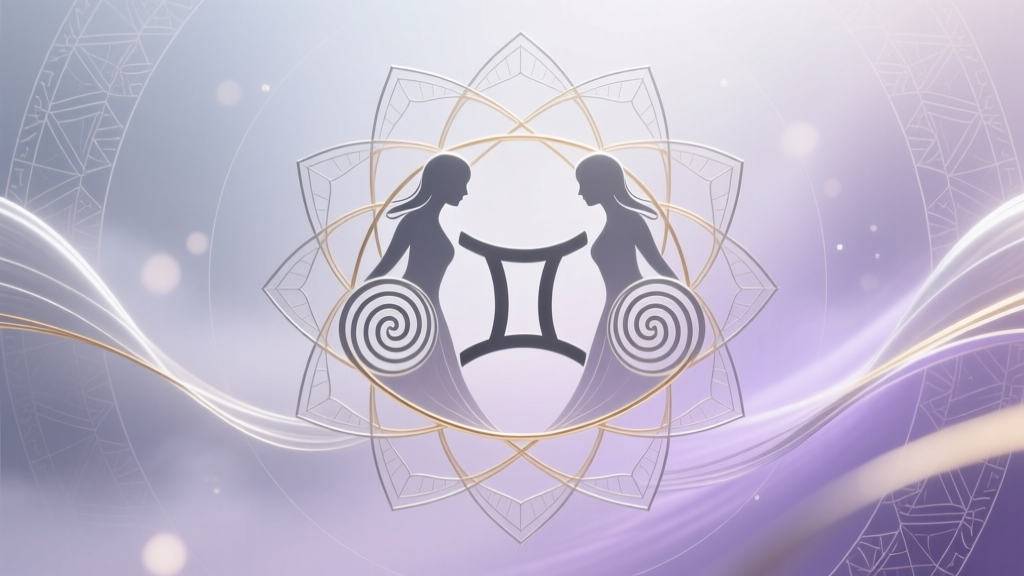
The Gemini symbol — two parallel vertical lines connected by a horizontal bar at the top — is among the most instantly recognizable glyphs in astrology. Yet beneath its minimalist appearance lies a rich tapestry of myth, sacred geometry, ancient cosmology, and spiritual philosophy. Unlike many zodiac signs whose symbols evoke animals or celestial bodies, Gemini’s glyph embodies duality itself: not as division, but as dynamic relationship, dialogue, and conscious integration. As the third sign of the zodiac and the first air sign, Gemini governs communication, perception, adaptability, and the bridge between inner thought and outer expression. Its dates — May 21 to June 20 — mark the height of spring in the Northern Hemisphere, a time of intellectual blossoming and relational expansion. This article delves exclusively into the Gemini symbol through the lens of sacred meaning: tracing its historical roots, decoding its geometric language, interpreting its archetypal resonance, examining its presence in ancient sacred spaces, and revealing its enduring spiritual invitation. Grounded in astrological tradition and cross-cultural symbolism, this exploration honors Gemini not as mere 'chatterbox' or 'indecisive twin,' but as a profound emblem of the human capacity for synthesis — the sacred art of holding opposites in awareness without collapsing into contradiction.
The Gemini Symbol: Origin and History
The Gemini glyph (♊) traces its lineage to ancient Mesopotamian and later Hellenistic astrology, evolving from pictographic representations of the Twin deities Castor and Pollux — the Dioscuri — who were venerated across Greece, Rome, and the wider Mediterranean world. Early Babylonian star catalogues, such as the MUL.APIN tablets (c. 1000 BCE), identified the constellation now known as Gemini as MAŠ.TAB.BA.GAL.GAL, meaning 'Great Twins,' associated with divine brothers who mediated between mortality and immortality. By the time of Claudius Ptolemy’s Tetrabiblos (2nd century CE), the sign was firmly codified as Gemini, ruled by Mercury, and symbolized by the Twins — a pairing that reflected not only mythic narrative but also astronomical observation: the two brightest stars in the constellation, Castor (Alpha Geminorum) and Pollux (Beta Geminorum), appear as a matched pair in the night sky, reinforcing the duality motif.
Crucially, the glyph’s stylized form emerged during the Hellenistic period as scribes and astrologers sought efficient, symbolic shorthand. The two upright strokes represent the Twins themselves — distinct yet inseparable — while the connecting bar signifies their bond: shared origin, mutual recognition, and covenantal unity. This visual distillation predates modern typographic standardization; medieval Arabic astrologers rendered it with subtle curvatures, and Renaissance manuscripts often added small crowns or halos to denote their semi-divine status. According to the Astro.com Zodiac Encyclopedia, the glyph’s earliest attested linear form appears in Byzantine astrological codices from the 6th century, where it consistently accompanies Mercury-ruled interpretations of intellect, mediation, and linguistic agility. What distinguishes Gemini’s origin story from other signs is its grounding in a specific, historically worshipped pair — not abstract forces or mythical beasts, but heroic brothers whose myth encodes initiatory truths about identity, sacrifice, and transcendence through relationship.
Sacred Geometry Behind the Gemini Glyph
At first glance, the Gemini symbol appears deceptively simple — two vertical lines capped by a single horizontal stroke. Yet within sacred geometry, simplicity is never superficial; it is density made visible. Each element of the glyph corresponds to precise metaphysical principles. The two vertical lines are not merely 'twins' but represent the pillar of mercy and the pillar of severity — foundational columns in Kabbalistic Tree of Life symbolism — signifying the complementary poles of expansion and contraction, empathy and discernment, receptivity and assertion. Their parallel nature indicates non-hierarchical balance: neither line dominates; both stand equally tall, grounded in the same plane of existence (the baseline of consciousness). The horizontal bar functions as the veil of illusion (in Hermetic terms) or the tiphereth (beauty/synthesis) on the Tree of Life — the reconciling principle that harmonizes opposites without erasing distinction.
Mathematically, the glyph approximates a 1:√2 ratio when measured proportionally — echoing the sacred rectangle found in temple architecture and manuscript illumination. When inscribed within a circle (as seen in some Tantric and Neoplatonic diagrams), the two verticals subtend an angle of precisely 60°, mirroring the sextile aspect in astrology — the most natural, harmonious angle of opportunity and mental alignment. Furthermore, rotating the glyph 90° yields a shape reminiscent of the alchemical symbol for mercury (☿), reinforcing Gemini’s rulership under the winged messenger god. As noted by Dr. Nick Kollerstrom in his study of planetary glyphs, The Origins of Astrological Glyphs (Skyscript), the Gemini symbol’s geometry encodes 'the mind’s capacity to hold two thoughts simultaneously while maintaining integrity of each — a cognitive architecture mirrored in neural lateralization studies.' Modern neuroscience confirms that Gemini-ruled functions — rapid associative thinking, code-switching, and contextual framing — rely on robust interhemispheric connectivity, lending empirical resonance to the glyph’s bilateral symmetry.
What the Gemini Symbol Represents
The Gemini symbol represents far more than sociability or curiosity — it is the visual mantra for relational intelligence: the soul’s innate drive to mirror, compare, translate, and connect. Its two upright forms signify not duplication, but differentiation-in-relation: self and other, subject and object, question and answer, past and future tense. In Jungian terms, the glyph maps the dynamic between the Persona (social mask) and the Shadow (repressed contrary), inviting conscious dialogue rather than projection. Unlike Libra — which seeks external balance through partnership — Gemini’s duality is internalized: it is the mind conversing with itself, the writer editing her own draft, the diplomat rehearsing opposing arguments to find common ground. This is why Gemini is ruled by Mercury, the psychopomp: the symbol does not depict static twins, but an active, flowing circuit of meaning-making.
Each component carries layered significance. The vertical lines embody the axis of vertical knowing — ascent toward insight and descent into embodied experience — while the bar is the horizontal axis of relationship, exchange, and translation across domains (language, culture, logic, emotion). Together, they form a gate — not a barrier, but a threshold. In Vedic astrology, Gemini (Mithuna) is linked to the Vishuddha (throat) chakra, where vibration becomes articulation; the glyph thus mirrors the anatomy of speech: two vocal cords (verticals) vibrating in unison beneath the soft palate (the bar). The absence of a base line in the glyph — unlike Taurus (♉) or Cancer (♋) — signals Gemini’s inherent lightness, mobility, and resistance to fixed foundations. As astrologer Steven Forrest observes in The Changing Skies, 'Gemini doesn’t ask “Who am I?” as a final declaration — it asks “Who am I *in relation to this person, this idea, this moment?”’ — making the symbol a living grammar of context-dependent selfhood.'
Gemini in Ancient Art and Architecture
The Twins appear repeatedly in sacred art not as decorative motifs, but as structural and symbolic keystones. In the Temple of Horus at Edfu (built 237–57 BCE), reliefs depict the Dioscuri flanking the central doorway — not as statues, but as engraved glyphs integrated into the architrave, their forms aligned with solstitial sunrise vectors. Similarly, the Roman Mithraeum of Santa Prisca in Rome features a ceiling fresco where Gemini occupies the northern meridian, bracketed by Cancer and Taurus, with the Twins rendered as intertwined serpents — a clear syncretic fusion with the caduceus, Mercury’s staff. These placements were deliberate: Gemini marked the celestial ‘gateway’ between the solar and lunar realms, governing the transition from subjective feeling (Cancer) to objective action (Leo).
In Greek temple design, the number two held consecrated status — reflected in the paired columns of the Temple of Apollo at Delphi and the double-apsed layout of early Christian basilicas influenced by Gemini’s dual-nature theology. Even Gothic cathedrals encode Gemini principles: the north and south portals of Chartres Cathedral present contrasting iconographies — Law vs. Grace, Old Testament vs. New — yet unified under one rose window, mirroring the glyph’s bar unifying verticals. Archaeoastronomer Dr. Giulio Magli notes in Archaeoastronomy: Introduction to the Science of Stars and Stones that Gemini’s rising at dawn during the spring equinox aligned with foundation rituals for libraries and academies across Hellenistic cities — places dedicated to dialogue, debate, and dialectic. The symbol thus functioned architecturally as both orientation marker and philosophical compass: wherever Gemini appeared in sacred space, it signaled a site designed for exchange, education, and epistemological bridging.
The Deeper Spiritual Meaning of the Gemini Symbol
Spiritually, the Gemini glyph is an initiation diagram — a map for the soul’s evolution from duality to dialogical unity. It does not promise oneness in the sense of erasure (as in some monistic traditions), but invites the sacred discipline of holding paradox: loving fiercely while honoring autonomy; speaking truth while listening deeply; embracing change without abandoning continuity. In Sufi cosmology, the Twins correspond to the twin stations of jam’ (gathering/unity) and farq (distinction/differentiation) — essential movements of divine manifestation. The horizontal bar is the breath between them: the pause in conversation where understanding crystallizes.
Gemini’s spiritual path is one of radical hospitality — not just to others, but to the multiplicity within. The glyph reminds us that identity is not a statue, but a symphony: multiple voices cohering without homogenizing. Contemporary contemplative practices aligned with Gemini include journaling dialogues between inner parts, studying comparative religion, learning polyphonic singing, or practicing nonviolent communication — all methods that train the nervous system to tolerate complexity without fragmentation. As emphasized by the International Academy of Astrology, 'Gemini’s highest expression is not information accumulation, but wisdom-generation through relational friction — the spark that leaps across the gap between the two lines.' To meditate on the glyph is to sit with tension as generative space: the silence before the question, the stillness between inhalation and exhalation, the threshold before choice emerges. In this light, Gemini is not the sign of superficiality — it is the guardian of the liminal, the patron of thresholds, and the eternal reminder that meaning is born not in singularity, but in sacred encounter.
Gemini Symbol Quick Facts Table
| Attribute | Detail |
|---|---|
| Glyph | ♊ (Two parallel vertical lines joined by a horizontal bar at the top) |
| Zodiac Position | 3rd sign; cardinal air sign |
| Dates | May 21 – June 20 |
| Ruling Planet | Mercury (planet of communication, logic, travel, and mediation) |
| Mythological Archetype | Castor and Pollux — mortal and immortal brothers bound by oath and love |
| Sacred Geometry Ratio | Vertical lines approximate 1:√2 proportion; enclosed angle = 60° (sextile) |
| Chakra Association | Vishuddha (Throat Chakra) — center of authentic expression and discernment |
| Spiritual Practice Alignment | Dialogue meditation, comparative theology study, bilingual journaling, active listening disciplines |
Ultimately, the Gemini symbol is an enduring cipher for the human condition at its most awake: perpetually translating experience into meaning, reaching across difference, and finding coherence not in sameness, but in resonance. It challenges us to honor both sides of every truth — and in doing so, discover a third space: the sacred bar where understanding is born.