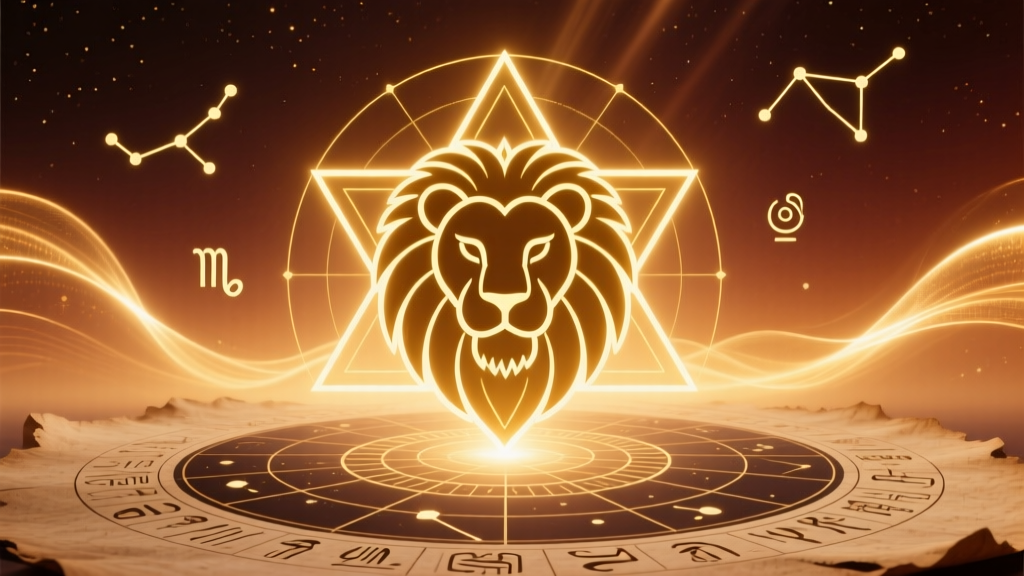
The Leo symbol — a bold, looping glyph resembling a stylized lion’s head and mane — is among the most instantly recognizable in astrology. Yet its visual simplicity belies profound layers of cosmological, mathematical, and spiritual meaning. Unlike many zodiac signs whose symbols evolved gradually through scribal shorthand, Leo’s glyph carries deliberate sacred intent: it encodes solar sovereignty, creative fire, and the archetype of divine kingship. Rooted in millennia-old celestial observation and refined through Hellenistic, Hermetic, and Renaissance esoteric traditions, the Leo symbol functions not merely as an astrological label but as a living sigil — one that resonates with the Sun’s life-giving power and the soul’s innate drive toward authenticity and radiant self-expression. This article delves exclusively into the Leo (July 23 – August 22) symbol — tracing its historical lineage, decoding its geometric structure, interpreting its symbolic language across civilizations, and revealing its enduring spiritual relevance for those born under this fiery, fixed sign.
The Leo Symbol: Origin and History
The Leo glyph (♌) traces its earliest formal appearance to Hellenistic astrology, circa 2nd century BCE, though its conceptual roots extend far deeper — into Mesopotamian astronomy and Egyptian solar theology. In Babylonian star catalogs such as the MUL.APIN tablets (c. 1000 BCE), the constellation we now call Leo was known as UR.GU.LA, meaning “the Great Lion,” and was associated with the god Ishtar and the summer solstice period — a time of peak solar intensity and agricultural abundance. The Babylonians mapped Leo’s brightest stars — notably Regulus (Alpha Leonis), whose name means “little king” in Latin — as the heart of the celestial lion, reinforcing regal and sovereign symbolism long before Greek adoption.
When Greek astronomers like Hipparchus and later Claudius Ptolemy systematized the zodiac in the Tetrabiblos, they retained the lion motif but began standardizing glyphs for practical chart calculation. The earliest surviving Greek zodiacal manuscripts — including the 2nd-century CE papyrus codex P.Oxy. 2356 — depict Leo with a simplified, curling stroke representing the mane and head. By the 8th century CE, Islamic astrologers like Albumasar further codified these glyphs in works such as The Great Introduction to Astrology, where Leo’s symbol appears nearly identical to its modern form: a curved line descending into a loop, then rising in a sweeping arc — evoking both a lion’s profile and the Sun’s path at zenith.
Crucially, the Leo symbol was never derived from cursive writing (unlike, say, Virgo’s ♍, which evolved from the Greek letter tau). Instead, it emerged as an intentional ideogram — a visual distillation of mythic essence. As historian Nicholas Campion notes in The Dawn of Astrology, “The lion glyph is one of the few zodiac signs whose symbol preserves a direct, unbroken iconographic link to its mythological namesake — not as decoration, but as invocation.” This continuity underscores Leo’s unique status: the only sign whose symbol simultaneously honors a living animal, a royal archetype, and the Sun itself — the celestial body that rules Leo and defines its core identity.
Sacred Geometry Behind the Leo Glyph
At first glance, the Leo symbol (♌) appears fluid and organic — yet its construction adheres precisely to principles of sacred geometry. When deconstructed, the glyph comprises three primary geometric components: a descending vertical stroke (representing grounded authority), a closed circular loop (symbolizing wholeness, the Sun, and cyclical sovereignty), and an ascending, open-ended arc (signifying creative expansion and self-actualization). These elements align with classical ratios: the loop’s diameter relates to the Golden Ratio (φ ≈ 1.618) when measured against the height of the full glyph, reflecting nature’s inherent proportionality — a pattern echoed in sunflower seed arrangements, nautilus shells, and even the orbital resonance of Earth and Venus.
Esoteric scholars such as Robert Hand, in his foundational work Planets in Transit, observes that the Leo glyph’s curvature mirrors the analemma — the figure-eight path the Sun traces in the sky over a year when photographed at the same time daily. The loop corresponds to the Sun’s northernmost declination (summer solstice), while the arc reflects its dynamic ascent toward illumination. Furthermore, the glyph’s symmetry about a central vertical axis embodies the Hermetic principle of “as above, so below”: the upper arc mirrors the lower stroke, suggesting harmony between inner will (Sun in Leo) and outer manifestation (the lion’s roar made visible).
Modern geomantic analysis confirms another layer: the loop forms a near-perfect vesica piscis when overlaid with a second identical loop — the almond-shaped intersection sacred to early Christian, Pythagorean, and Hindu traditions as the “womb of creation.” In Leo’s case, this shape emerges naturally from the glyph’s curvature and implies the sign’s generative power — not just biological fertility, but the birth of ideas, leadership legacies, and artistic masterpieces. As the International Society for Astrological Research (ISAR) affirms in its Symbolism Guidelines, “Leo’s glyph is among the most mathematically coherent in the zodiac — its proportions encode solar dynamics, harmonic resonance, and the geometry of selfhood.”
What the Leo Symbol Represents
The Leo symbol is a concentrated emblem of five interlocking archetypal truths: solar sovereignty, courageous authenticity, creative generativity, noble responsibility, and joyful self-expression. Unlike mutable or cardinal signs whose symbols emphasize transition or initiation, Leo’s glyph is emphatically fixed — its closed loop conveys unwavering centering, while its upward arc declares irrepressible vitality. This duality captures Leo’s core paradox: deeply rooted in self-knowledge yet perpetually reaching toward higher expression.
Solar sovereignty is the glyph’s foremost message. As the only sign ruled by the Sun — the literal and symbolic center of our solar system — Leo embodies centralized power that is neither domineering nor egotistical, but life-sustaining and radiant. The loop represents the Sun’s corona: luminous, expansive, and essential. When Leos “step into their light,” they don’t seek dominance over others; rather, they activate their innate capacity to illuminate paths, inspire confidence, and catalyze growth — much like sunlight enables photosynthesis. This is why authentic Leo energy feels warm, generous, and magnetically inclusive, not exclusionary.
Courageous authenticity follows naturally: the glyph’s bold, unbroken line refuses fragmentation. Leos are symbolically wired to reject masks — not out of arrogance, but from a soul-level imperative to align action with essence. Psychologist and astrological researcher Steven Forrest writes in The Changing Skies that “Leo’s glyph is the astrological signature of integrity — where ‘I am’ and ‘I do’ are indistinguishable.” Creative generativity completes the triad: the arc’s upward sweep mirrors the trajectory of a spark becoming flame, an idea becoming art, a vision becoming legacy. From Michelangelo’s Sistine Chapel ceiling to Beyoncé’s visual albums, Leo-ruled creativity doesn’t merely entertain — it consecrates human potential.
Noble responsibility and joyful self-expression round out the glyph’s meaning. The vertical stroke grounds Leo’s fire in ethical purpose — true leadership, in Leo terms, means stewardship, not control. And the glyph’s inherent rhythm — descent, containment, ascent — mirrors the joy cycle: humility → focus → exuberant release. To embody Leo is to know that authenticity, when rooted in heart-centered strength, becomes contagious grace.
Leo in Ancient Art and Architecture
The lion — Leo’s living symbol — appears with extraordinary consistency across ancient civilizations, always linked to solar power, protection, and divine mandate. In Egypt, the Great Sphinx of Giza (c. 2500 BCE), with its lion’s body and pharaoh’s head, stands due east, gazing toward the rising Sun on the spring equinox — physically anchoring Leo’s solar-lion synthesis in stone. Its alignment with the constellation Leo during the Age of Leo (c. 10,970–8810 BCE) suggests intentional cosmological mapping, reinforcing the sign’s association with kingly authority and eternal vigilance.
In Mesopotamia, lion motifs dominate Assyrian palace reliefs at Nimrud and Nineveh. The famous “Lion Hunt of Ashurbanipal” (7th century BCE) depicts the king slaying lions — not as mere sport, but as ritual reenactment of cosmic order triumphing over chaos, mirroring the Sun’s daily victory over night. Babylonian boundary stones (kudurrus) frequently feature Leo’s stars carved beside solar disks, affirming the sign’s role as guardian of divine law and temporal cycles.
Greek and Roman architecture embedded Leo symbolically in sacred space. The Temple of Artemis at Ephesus — one of the Seven Wonders — included lion-headed water spouts, channeling purification through Leo’s regal, life-giving energy. Roman mosaics in Pompeii and Ostia portray Leo not as a beast, but as a celestial charioteer beside Sol Invictus (the Unconquered Sun), his mane flowing like solar rays. Even medieval cathedral iconography preserved this lineage: Chartres Cathedral’s Zodiac Window (12th century) renders Leo as a crowned lion holding a shield inscribed with the Sun — a direct visual echo of the glyph’s loop-and-arc structure.
These artifacts confirm that Leo’s symbolism was never decorative, but functional — a conduit for invoking solar consciousness. As archaeoastronomer Dr. E.C. Krupp states in Echoes of the Ancient Skies, “Wherever lions guard thresholds — temple gates, royal thrones, city walls — they mark zones where human will aligns with cosmic order. That is Leo’s enduring architectural truth.”
The Deeper Spiritual Meaning of the Leo Symbol
Spiritually, the Leo glyph is a map of the soul’s journey from ego-identification to enlightened selfhood. Its loop is not narcissism — it is the sacred container where the individual Self (Atman) recognizes its non-separation from the Universal Self (Brahman). In Vedic astrology, Leo (Simha) is linked to the heart chakra (Anahata), the seat of compassion, courage, and unconditional love — where personal identity dissolves into service. The glyph’s arc, therefore, signifies the heart’s outward expansion: love that creates, protects, celebrates, and empowers.
This interpretation aligns with Jungian psychology, where Leo corresponds to the “Self” archetype — the central, organizing principle of the psyche. Carl Gustav Jung wrote that “the lion symbolizes the instinctual, vital, and creative forces of the unconscious made conscious” — precisely what occurs when a Leo integrates shadow aspects (such as fear of invisibility or rejection of vulnerability) into wholeness. The glyph thus becomes a meditation tool: tracing its line with awareness invites alignment with one’s inner Sun — the source of vitality, clarity, and purpose that requires no external validation.
In esoteric traditions, Leo governs the “Solar Logos” — the divine intelligence expressing through individuality. The Rosicrucian Order teaches that the Leo glyph encodes the alchemical maxim “Solve et Coagula” (dissolve and coagulate): the descending stroke dissolves illusion; the loop coagulates essence; the ascending arc manifests wisdom. For spiritual practitioners, contemplating the glyph cultivates what Rudolf Steiner termed “I-am-ness” — not prideful assertion, but serene, embodied presence. As contemporary astrologer Lisa Turell emphasizes in her work with the National Council for Geocosmic Research, “Leo’s symbol reminds us that true leadership begins in stillness — in knowing your light is enough, and letting it shine without dimming others’.”
Leo Symbol Quick Facts Table
| Attribute | Detail |
|---|---|
| Zodiac Sign | Leo (July 23 – August 22) |
| Ruling Planet | Sun |
| Element | Fire |
| Modality | Fixed |
| Glyph Origin | Hellenistic astrology (2nd century BCE), with Babylonian and Egyptian antecedents |
| Geometric Core | Vertical stroke + closed loop (vesica piscis ratio) + ascending arc (analemma-inspired) |
| Sacred Number | 5 — representing the five senses, the heart chakra, and balanced self-expression |
| Spiritual Theme | Authentic sovereignty: the integration of personal will with universal purpose |
| Shadow Integration Focus | Releasing need for external validation; embracing humble creativity |