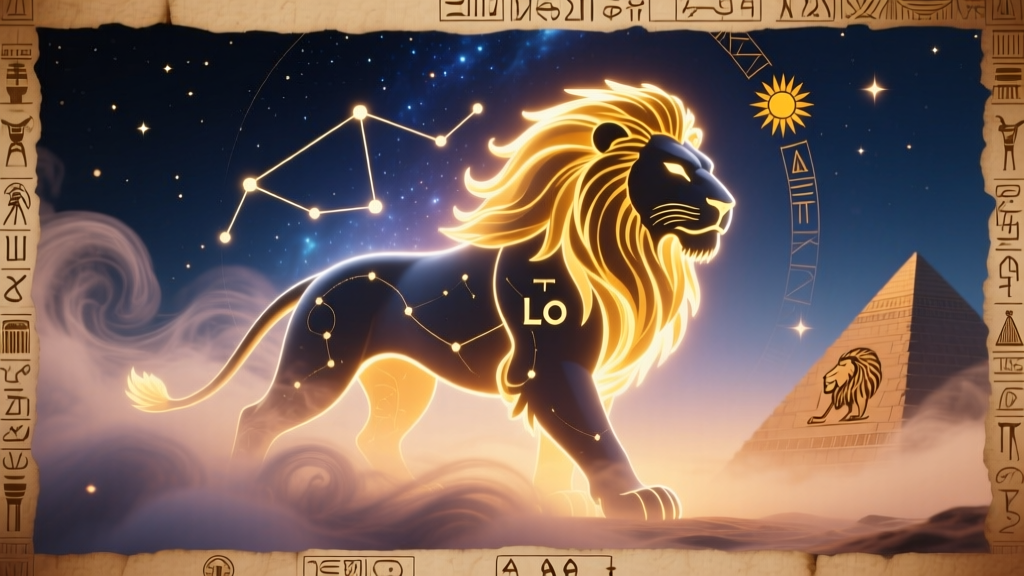
Leo—the radiant, golden-hearted lion of the zodiac—stands as one of the most symbolically potent signs in the astrological canon. Born between July 23 and August 22, Leos embody courage, leadership, creativity, and regal presence. Yet long before modern horoscopes or personality typologies, Leo was etched into the heavens not as a psychological profile—but as a sacred emblem rooted in millennia of myth, ritual, and celestial observation. This article delves exclusively into the mythology and origin story of Leo, tracing its lineage from Babylonian star maps to Greek heroic cycles, Roman imperial iconography, and cross-cultural cosmologies. Unlike generic overviews, this exploration centers on historically grounded narratives that directly informed Leo’s enduring symbolic identity—revealing why the lion remains inseparable from the sign’s essence.
The Myth Behind Leo
The myth behind Leo is not a single tale but a layered tapestry woven across civilizations, each adding threads of sovereignty, sacrifice, and cosmic order. At its core lies the lion—not merely as an animal, but as a cosmic sovereign: a creature whose roar commands attention, whose mane evokes solar radiance, and whose dominance in the natural world mirrors the Sun’s supremacy in the sky. Astrologically, Leo is ruled by the Sun—the celestial body governing vitality, self-expression, and identity—and this rulership is no coincidence. Ancient observers noted that the Sun passes through the Leo constellation during the height of summer in the Northern Hemisphere, when daylight peaks and nature flourishes with maximal intensity. This astronomical alignment fused the lion with solar divinity across cultures—from the Mesopotamian sun god Shamash to the Egyptian Ra, often depicted with a lion-headed form (as Sekhmet or Ruti). As scholar Dr. Nicholas Campion observes in The Dawn of Astrology, 'The lion became the archetypal symbol of luminous authority precisely because it embodied both ferocity and nobility—qualities essential to kingship and divine mandate.'https://www.astrology.com/astrology-history/early-astrology This duality—power tempered by dignity—anchors Leo’s mythic foundation. Unlike mutable or watery signs associated with emotion or adaptation, Leo’s mythology emphasizes unapologetic presence, legacy-building, and the sacred duty of leadership. Its origin story begins not with birth charts or planetary aspects, but with humanity’s earliest attempts to mirror cosmic hierarchy in earthly rule—and to locate the divine in the bold, golden heart of the lion.
Leo in Greek Mythology
In Greek mythology, Leo is indelibly linked to the Nemean Lion, the first of Heracles’ (Hercules’) Twelve Labors. This monstrous beast terrorized the region of Nemea, its golden fur impervious to weapons and its claws sharper than iron. According to Hesiod’s Theogony and later retellings by Apollodorus, the lion was either born of Selene (the Moon goddess) and Zeus—or sired by Orthrus and Echidna, making it kin to Cerberus and the Hydra. Its invulnerability stemmed from divine origin: Hera, resentful of Heracles’ divine parentage, placed the lion in Nemea to thwart him. When Heracles strangled the beast barehanded—a feat requiring superhuman strength and raw courage—he used its own claws to skin it, thereafter wearing its pelt as armor. This act transformed the lion from a destructive force into a symbol of earned sovereignty. The pelt shielded Heracles not only physically but spiritually—it marked his transition from mortal hero to semi-divine exemplar. As classicist Dr. Emma Stafford writes in Hercules: A Heroic Life, 'The Nemean Lion represents the first trial of self-mastery: confronting chaos not with intellect or stealth, but with embodied will and fearless authenticity.'https://www.britishmuseum.org/learn/schools/ages-7-11/greeks/hercules Crucially, after Heracles’ victory, Zeus placed the lion among the stars as the constellation Leo—enshrining it as an eternal monument to courage under trial. This narrative directly informs the Leo archetype: the sign’s famed confidence isn’t arrogance, but the hard-won assurance of one who has faced existential threat and emerged unbroken. Leos are mythically coded as initiators—those who step forward when others retreat, who lead not for glory alone, but to restore balance and protect their ‘pride.’
Leo in Roman Mythology
Roman mythology absorbed and recontextualized Greek stories, often amplifying their political and imperial resonance. For Rome, Leo was less about individual heroism and more about state power, divine sanction, and civic virtue. The Romans identified Heracles with Hercules, but elevated him to a patron deity of emperors—especially under Augustus, who claimed descent from Venus and aligned himself with Hercules’ moral authority. Temples dedicated to Hercules Victor stood in key Roman forums, and his image adorned coins bearing imperial portraits. The lion, already a symbol of Jupiter (Jove), the king of gods, became doubly significant: Jupiter’s chariot was drawn by lions, and his sacred animal represented dominion over both nature and nations. In Virgil’s Aeneid, lions flank the gates of Carthage—symbolizing martial strength and sovereign legitimacy. Roman astrologers like Manilius, in his first-century CE work Astronomica, explicitly tied Leo to regal destiny: 'Leo rules those born to command, whose souls burn with the fire of Jove himself.'https://www.loebclassics.com/view/manilius-astronomica/2011/pb_LCL127.3.xml This reframing shifted Leo’s mythic emphasis from personal triumph (Greek) to collective stewardship (Roman). A Leo-born emperor wasn’t just brave—he was divinely appointed to uphold pax Romana, to inspire loyalty through charisma, and to embody virtus (manly excellence) and pietas (duty to gods, family, and state). Thus, the Roman Leo archetype carries gravitas: generosity rooted in responsibility, pride anchored in service, and leadership expressed through mentorship and legacy-building—traits still echoed in modern Leo profiles.
Ancient Cultural Interpretations of Leo
Beyond Greece and Rome, Leo held profound significance across ancient civilizations—each interpreting the lion through distinct cosmological lenses. In Mesopotamia, the earliest known zodiac (c. 5th century BCE, Babylonian) designated Leo as the fourth sign, associated with the month of Abu (July–August) and the god Ishtar—the fierce, fertile goddess of love and war. Lions flanked her temple gates in Nineveh, symbolizing protective fury and life-giving power. In Egypt, the lion was inseparable from solar theology: the goddess Sekhmet, lioness-headed, personified the scorching, destructive aspect of Ra’s eye—yet she could also heal and restore Ma’at (cosmic order) when appeased. Statues of sphinxes—lion bodies with human heads—guarded pyramids, merging royal intellect with leonine strength. In Vedic astrology (Jyotish), Leo corresponds to Simha, ruled by the Sun (Surya), and is considered the sign of raja yoga—indicating innate leadership and karmic authority. Ancient Indian texts like the Brihat Parashara Hora Shastra describe Simha natives as naturally commanding, generous, and intolerant of injustice. These cross-cultural parallels reveal a consistent archetype: the lion as mediator between heaven and earth, destruction and renewal, individual will and collective good. A comparative summary highlights these convergences:
| Civilization | Lion Symbolism | Associated Deity/Concept | Leo’s Mythic Role |
|---|---|---|---|
| Babylonian | Guardian of gates; solar heat | Ishtar (love/war) | Protector of sacred time; herald of peak summer |
| Egyptian | Dual nature: destroyer & healer | Sekhmet / Ra | Agent of divine justice; restorer of cosmic balance |
| Greek | Invulnerable monster turned celestial emblem | Hera / Zeus / Heracles | Test of heroic virtue; symbol of earned kingship |
| Roman | Imperial authority; civic strength | Jupiter / Hercules | Embodiment of state virtue; divine mandate for rule |
| Vedic | Regal dignity; spiritual sovereignty | Surya (Sun god) | Sign of karmic leadership and righteous governance |
What unites these interpretations is Leo’s association with legitimacy—not mere dominance, but authority validated by cosmic law, moral action, or divine favor. This explains why Leos are often drawn to roles where they can champion others, create inspiring visions, or uphold ethical standards—not for ego, but because their mythic DNA encodes leadership as sacred trust.
The Constellation Story of Leo
The constellation Leo occupies a prominent position in the northern sky, stretching across 947 square degrees—the 12th largest of the 88 modern constellations. Its most recognizable feature is the Sickle, an asterism resembling a backward question mark, marking the lion’s head and mane. Stars like Regulus (Alpha Leonis)—whose name means “little king”—shine at magnitude 1.4 and lie almost exactly on the ecliptic, making it one of the four Royal Stars of Persia (alongside Aldebaran, Antares, and Fomalhaut). Ancient Persian astronomers revered Regulus as the Watcher of the North, believing its conjunction with the Sun signaled the start of the new year and the zenith of solar power. The constellation’s shape has remained remarkably stable in star charts for over 4,000 years: Babylonian boundary stones from c. 1000 BCE depict a lion figure aligned with Leo’s stars, and Ptolemy’s Almagest (2nd century CE) formally cataloged 17 stars within Leo. Notably, Leo contains several deep-sky objects visible to amateur astronomers—including the Leo Triplet (M65, M66, NGC 3628), a group of interacting spiral galaxies that evoke the interconnectedness of a pride. Modern astrophysics confirms Leo’s stellar composition reflects its mythic themes: Regulus is a quadruple star system with a rapidly rotating blue-white primary star—its intense energy output mirroring the Sun’s vitality. As NASA’s Stellar Classification Archive notes, 'Regulus’ equatorial spin velocity approaches 317 km/s—so fast it bulges at the equator, embodying dynamic, radiant force.'https://stars.nasa.gov/catalog/Regulus Thus, the constellation itself performs Leo’s myth: a radiant, commanding presence amid the celestial sphere—unchanging in form, yet dynamically alive with light and motion.
How Mythology Shapes the Leo Archetype
Mythology doesn’t merely decorate Leo—it constitutes its psychological and behavioral architecture. Carl Gustav Jung observed that archetypes emerge from recurring mythic motifs embedded in the collective unconscious; Leo’s enduring lion symbolism functions precisely as such an archetype. The Nemean Lion’s invulnerability translates psychologically into Leo’s resistance to external criticism—they don’t crumble under judgment because, mythically, their core strength is unassailable. Heracles’ use of the lion’s own claws to skin it mirrors Leo’s capacity for self-transformation: turning challenges into tools, pain into purpose. Roman emphasis on civic duty manifests as Leo’s instinct to uplift others—to ‘roar’ not for attention, but to rally, inspire, or defend. Even Leo’s reputed vanity stems from mythic precedent: the lion’s mane is not ornamentation, but biological armor and signal of health—a visual assertion of vitality. Contemporary astrologer Steven Forrest, in The Inner Sky, affirms this depth: 'A Leo’s need for recognition is not shallow narcissism; it’s the soul’s echo of ancient rites where the king’s radiance ensured the land’s fertility.'https://www.stevenforrest.com/books/the-inner-sky/ Modern Leos may express this through artistry, teaching, entrepreneurship, or advocacy—but the impulse remains mythic: to shine so brightly that others remember their own worth. When a Leo takes center stage, hosts a gathering, mentors a protégé, or creates something enduring, they enact a ritual older than writing: affirming life’s grandeur against entropy. Their warmth isn’t performative—it’s solar, generative, and necessary. To understand Leo is to recognize that every confident laugh, every generous gesture, every bold creative risk is a quiet invocation of the lion in the stars—roaring, still, across four thousand years.
Leo Mythology Quick Reference
- Primary Greek Myth: Heracles’ slaying of the Nemean Lion—the first Labor—symbolizing courage, mastery over chaos, and earned sovereignty.
- Key Roman Link: Association with Jupiter and Hercules, framing Leo as emblem of imperial virtue, civic duty, and divinely sanctioned leadership.
- Ancient Constellation: One of the oldest recognized constellations; home to Regulus (“little king”), a Royal Star on the ecliptic.
- Cross-Cultural Themes: Solar power, protective fury, regal dignity, restorative justice, and karmic authority.
- Modern Archetypal Echoes: Natural leadership, creative self-expression, loyalty to ‘pride’ (family/friends), intolerance of inauthenticity, and a drive to leave meaningful legacies.
This mythic inheritance makes Leo far more than a sun-sign stereotype. It is a living lineage—a call to lead with heart, protect with fierceness, create with joy, and shine with integrity. As the lion endures in starlight and story, so too does the Leo spirit: golden, unflinching, and eternally luminous.