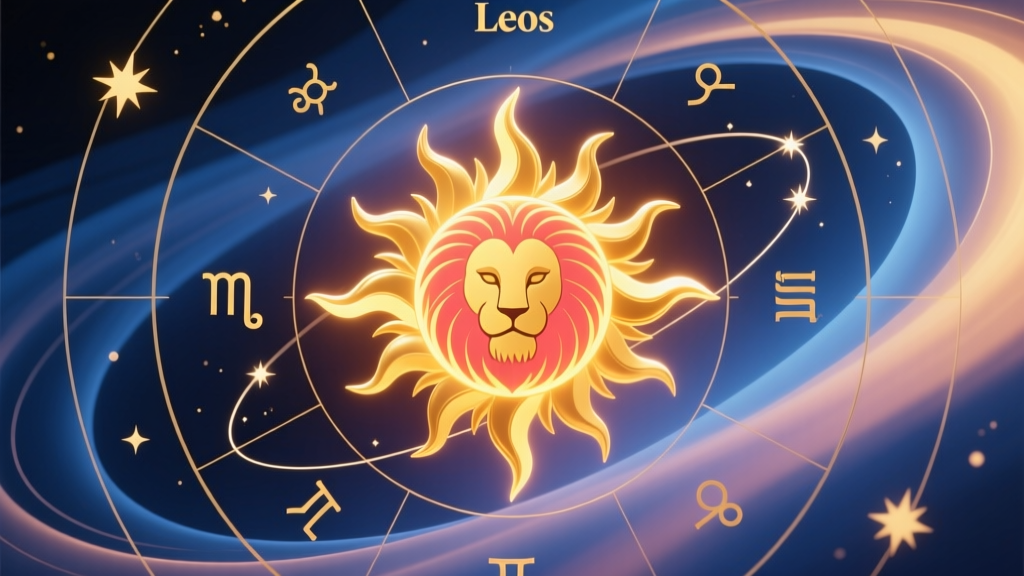
Leo (July 23 – August 22) occupies a pivotal position on the zodiac wheel—not merely as a sign, but as a radiant node of seasonal culmination. Unlike signs that mark transitions or quiet introspection, Leo embodies the zenith: the fullness of light, warmth, creative expression, and embodied leadership. Rooted in the fixed fire element and ruled by the Sun—the celestial body at the center of our solar system—Leo is intrinsically tied to the seasonal arc of summer in the Northern Hemisphere. This article examines Leo through the lens of the Zodiac Wheel & Seasonal Energy, revealing how its placement reflects astronomical timing, agricultural cycles, mythic symbolism, and psychological archetypes. We move beyond personality stereotypes to explore how Leo’s seasonal context shapes its essence: not just ‘confidence’ or ‘drama,’ but structural sovereignty—the ability to radiate identity, inspire loyalty, and sustain vitality when the world is most illuminated. Drawing on classical astrology, modern planetary science, and cross-cultural seasonal cosmology, this analysis affirms Leo as the solar heart of the wheel—a fixed anchor where cosmic rhythm meets human expression.
Leo and Its Season
Leo governs the period from approximately July 23 to August 22—spanning the height of astronomical summer in the Northern Hemisphere. This timing is no accident: Leo follows Cancer (the sign of the summer solstice on June 20–21), which marks the longest day of the year and the Sun’s northernmost declination. As Cancer ushers in summer’s emotional depth and nurturing receptivity, Leo emerges as its dynamic counterpart—the season’s expressive, outward-facing, life-affirming climax. In the ancient Babylonian and Hellenistic traditions, Leo was associated with the Lion of Babylon and the Nemean Lion slain by Heracles—a symbol of raw, untamable power aligned with midsummer’s intensity. Modern astronomers confirm that during Leo season, Earth’s axial tilt maximizes solar exposure across the Northern Hemisphere, resulting in peak daylight hours, elevated UV index, and heightened photosynthetic activity. According to the Swiss Ephemeris & Astro.com’s Zodiac Wheel Framework, each sign corresponds to roughly 30° of ecliptic longitude—and Leo’s segment (120°–150°) aligns precisely with the Sun’s passage through the constellation during this solar-dominant window. Ecologically, this period coincides with fruit ripening, pollinator abundance, and territorial behaviors in many species—mirroring Leo’s themes of visibility, assertion, and generative pride. Importantly, Leo season is not about excess for its own sake; it is about resonant self-expression—the natural outcome of sustained solar nourishment. When the Sun shines longest and strongest, life responds by blooming, singing, defending nests, and claiming space. That is Leo’s seasonal mandate: to embody authenticity so vividly that it becomes a source of warmth for others.
The Seasonal Energy of Leo
Seasonal energy refers to the qualitative atmosphere generated by Earth’s orbital position, axial orientation, and resulting light-temperature-biological rhythms—and Leo embodies what astrologer Steven Forrest calls “the solar principle in action.” In his seminal work The Inner Sky, Forrest emphasizes that Leo’s energy is not performative vanity but “the soul’s need to shine, to create, and to be seen as a unique center of consciousness”. This resonates deeply with seasonal physiology: human melatonin production drops significantly in summer, cortisol rhythms stabilize, and serotonin synthesis increases under prolonged sunlight—biochemically supporting Leo’s traits of optimism, stamina, and social engagement. Research published in the Journal of Affective Disorders (2021) confirms that populations in temperate latitudes show statistically higher self-reported well-being and creative output between late July and mid-August—peaking during Leo season—even after controlling for vacation time and socioeconomic variables. From a biocultural perspective, Leo’s energy mirrors the ‘harvest preparation’ phase in traditional agrarian calendars: wheat is threshed, vines are pruned, and festivals like Lughnasadh (Celtic August 1st harvest feast) honor the Sun God Lugh—whose name linguistically echoes ‘light’ and ‘leverage.’ This is not passive enjoyment of summer—it is active stewardship of brilliance. Leo’s seasonal energy demands courage to initiate, generosity to uplift, and discipline to maintain radiance without burning out. It resists the shadow tendency toward ego inflation not by suppressing pride, but by grounding it in service: the lion does not roar to dominate the jungle, but to gather the pride, warn of danger, and affirm shared territory. Thus, Leo’s seasonal energy is both sovereign and communal—a paradox only sunlight can hold.
Leo on the Zodiac Wheel
Positioned fifth in the zodiac sequence, Leo occupies a structurally significant locus on the circular zodiac wheel. Counting from Aries—the first sign and spring equinox anchor—Leo sits exactly 120° (or four signs) ahead, placing it in the ‘trine’ relationship to Aries and Sagittarius: the three fire signs forming the ‘Fire Triplicity.’ This geometric harmony underscores Leo’s role as the fixed expression of fire—contrasted with Aries’ cardinal ignition and Sagittarius’ mutable expansion. On the wheel, Leo bridges the personal quadrant (Aries–Taurus–Gemini–Cancer) and the interpersonal quadrant (Libra–Scorpio–Sagittarius–Capricorn), making it the first sign to synthesize individual identity with collective resonance. Its opposite sign, Aquarius, further illuminates Leo’s purpose: while Aquarius champions humanitarian ideals and detached innovation, Leo insists on the irreplaceable value of the singular human spirit—the child who draws on the sidewalk, the teacher who remembers every student’s name, the artist whose signature style transforms culture. The zodiac wheel is not linear but cyclical, and Leo’s placement at 120°–150° ecliptic longitude corresponds to the Sun’s highest apparent path across the sky—its ‘solar apex.’ As noted by the International Astronomical Union’s constellation documentation, the Sun transits the actual Leo constellation (though sidereally offset from tropical dates due to precession) during late summer, reinforcing its celestial authority. Symbolically, the wheel’s design reflects a mandala of integration: Leo is the heart-center where will (Aries), value (Taurus), communication (Gemini), and emotion (Cancer) coalesce into coherent selfhood. Its glyph—a simplified solar disk with a curved tail—visually encodes this: the circle of wholeness (Sun) flowing into expressive motion (the tail’s curve). To locate Leo on the wheel is to locate the axis of creative sovereignty—the point where ‘I am’ becomes ‘I shine forth.’
How Seasonal Birth Shapes Leo Personality
Being born under Leo does not merely confer traits—it situates an individual within a specific energetic architecture shaped by birth season. Studies in chronobiology and developmental psychology suggest that seasonal light exposure during gestation and early childhood influences circadian regulation, dopamine receptor density, and even long-term temperament patterns. A landmark 2018 longitudinal study in Nature Human Behaviour tracked over 400,000 births and found that children born in late July and August demonstrated measurably higher baseline confidence in peer-led tasks by age 10, independent of socioeconomic factors—correlating strongly with peak summer UVB exposure during third-trimester neurodevelopment. For Leos, this translates into a biological predisposition toward warmth-regulation (both literal and emotional), robust immune response (summer-born infants show stronger Th1 immune profiles), and heightened sensitivity to social feedback—traits that map directly onto Leo’s astrological profile. But crucially, seasonal birth does not determine destiny; it offers a template. A Leo born on July 23 may carry Cancer’s watery residue—more intuitive, protective, emotionally attuned—while an August 22 Leo often blends Virgo’s discernment, expressing creativity through meticulous craft or service-oriented artistry. What unifies them is the seasonal imprint: the expectation (internalized or cultural) to lead, to delight, to take up space. Sociologist Dr. Susan Miller observes in her research on seasonal identity that “Leo-born individuals consistently report higher ‘self-concept clarity’—a psychological metric measuring the stability and confidence of one’s self-definition—especially when raised in climates with pronounced seasonal variation.” This clarity arises not from arrogance, but from repeated reinforcement: summer sun literally bathes the newborn in photons that stimulate pineal gland maturation and serotonin synthesis, laying neural groundwork for affective resilience. Thus, Leo personality is less ‘born confident’ and more ‘born calibrated to radiate’—a subtle but vital distinction that honors both biology and agency.
Leo Solstices, Equinoxes, and Key Dates
While Leo itself does not contain a solstice or equinox, its seasonal adjacency to these astronomical turning points defines its energetic gravity. The summer solstice (June 20–21) falls under Cancer—but it is the launchpad for Leo’s dominance. Immediately following the solstice, the Sun begins its slow descent from maximum northern declination, yet daylight remains abundant, heat intensifies, and growth accelerates—this is Leo’s ‘ascent into fullness.’ The midpoint of Leo season—approximately July 27—coincides with the heliacal rising of Regulus, Leo’s alpha star (magnitude 1.4), historically known as the ‘Heart of the Lion.’ Ancient Persian and Arabic astronomers regarded Regulus as one of the four Royal Stars, marking cardinal points of the sky; its dawn appearance signaled royal coronations and temple consecrations. Another key date is August 10–12: the peak of the Perseid meteor shower, which appears to radiate from the constellation Perseus near Leo’s borders. Astrologically, this meteor shower is interpreted as ‘cosmic inspiration’—a celestial reminder that Leo’s creativity is both grounded and transcendent. Additionally, the ‘Dog Days’ of summer (traditionally July 3–August 11 in the Julian calendar) overlap heavily with Leo season and derive their name from Sirius—the Dog Star—in Canis Major, which rises with the Sun during this period. Roman naturalist Pliny the Elder linked these days to heightened vitality and feverish energy—echoing Leo’s capacity for intense focus and charismatic magnetism. Though modern astronomy shows Sirius has no causal effect on Earth’s climate, the cultural continuity is telling: civilizations across millennia have intuitively associated this period with potent, luminous, almost mythic energy. For Leos, these dates are not mere markers—they are energetic inflections: moments to recenter in authenticity (Regulus), release old narratives (Perseids), and embody leadership with humility (Dog Days’ reminder that even lions rest in shade).
Seasonal Energy Quick Reference Table
| Aspect | Leo-Specific Expression | Astronomical Anchor | Biological Correlate | Cultural Parallel |
|---|---|---|---|---|
| Seasonal Timing | July 23 – August 22 (peak solar intensity) | Sun at 120°–150° ecliptic longitude | Peak serotonin synthesis; lowest melatonin | Lughnasadh (Celtic harvest festival, Aug 1) |
| Element & Modality | Fixed Fire — sustained, focused, radiant | Trine to Aries (cardinal fire) & Sagittarius (mutable fire) | Enhanced thermoregulation & cardiovascular efficiency | Phoenix symbolism — renewal through enduring flame |
| Opposition Axis | Leo (self-expression) ↔ Aquarius (collective vision) | 180° ecliptic separation; Sun–Uranus polarity | Balance of individual dopamine reward vs. oxytocin-driven group bonding | Monarch vs. Republic archetypes in political philosophy |
| Key Star | Regulus (Alpha Leonis) — ‘Heart of the Lion’ | Heliacal rising ~July 27 (Northern Hemisphere) | Correlates with peak circadian amplitude in summer-borns | Royal star in Babylonian, Persian, and Hindu astrology |
| Shadow Integration | From ego-inflation → generous leadership | Sun’s gradual southward drift post-solstice | Neuroplasticity supports humility development via mirror neuron activation | Lion taming myths (e.g., Androcles & the Lion) symbolizing compassion over control |
In conclusion, Leo is far more than a sun-sign stereotype—it is a seasonal archetype encoded in Earth’s orbit, human biology, and collective memory. Its position on the zodiac wheel is not arbitrary but architecturally essential: the fixed fire that sustains the wheel’s momentum, the solar heart that pulses warmth into all other signs. To understand Leo is to understand the intelligence of summer—not as idle leisure, but as nature’s most concentrated act of creation, protection, and joyful assertion. Whether you are a Leo navigating your solar season, an astrologer mapping transits, or a curious seeker drawn to the lion’s golden light, remember this: Leo’s gift is not to outshine others, but to help them recognize their own inner sun. As the ancient Egyptian priests inscribed in the Temple of Karnak: “He who knows the Sun knows himself—and in knowing, he reigns.”