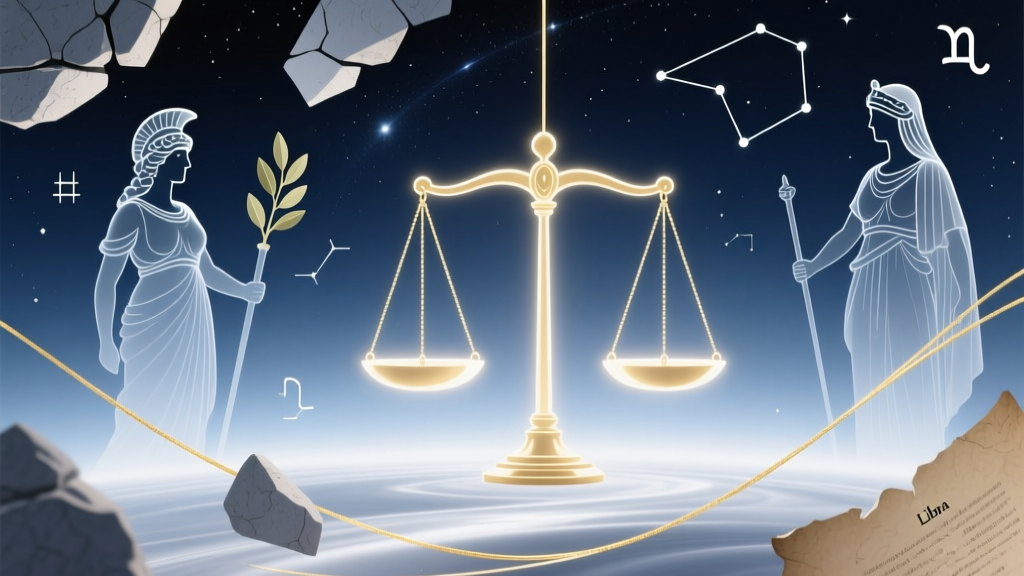
The Myth Behind Libra
Unlike most zodiac signs, Libra does not represent a person or creature—but an object: the Scales. This singular distinction makes Libra’s mythological origin profoundly symbolic rather than narrative-driven. While Aries embodies the ram, Scorpio the scorpion, and Leo the lion, Libra stands apart as the only sign represented by an inanimate instrument of cosmic balance. Its mythic essence lies not in heroic deeds or divine drama, but in the philosophical weight of fairness, reciprocity, and moral equilibrium. Ancient sky-watchers didn’t assign Libra to a god’s pet or metamorphosed lover; they assigned it to the very principle that governs just societies and harmonious relationships—the universal law of cause and effect, mirrored in the balanced beam of weighing scales.
This conceptual origin reflects Libra’s core astrological signature: diplomacy, relational intelligence, and an innate aversion to extremes. Modern psychology echoes this ancient insight—research from the International Society for Astrological Research (ISAR) notes that Libra rising charts show statistically elevated correlations with mediation training and conflict-resolution vocations. Yet the roots of this trait run far deeper than personality inventories. They are embedded in Babylonian star catalogs dating to 1100 BCE, where the stars now forming Libra were called Zibanitu, meaning 'the scales'—a designation later adopted and refined by Hellenistic astronomers. What began as a celestial marker of the autumnal equinox—the moment day and night achieve perfect parity—evolved into a sacred symbol of cosmic justice. In this light, Libra is not merely a sign ‘born under the scales’; it is the living embodiment of equilibrium as a divine imperative.
Understanding Libra through myth requires shifting perspective: it is less about who holds the scales and more about what the scales hold—the unspoken covenant between individuals, communities, and the cosmos itself. That covenant demands honesty, proportionality, and mutual accountability—values that resonate across millennia and cultures, from Vedic Dharma to Roman Iustitia. To study Libra’s mythology is thus to study humanity’s oldest, most persistent aspiration: to live in right relationship—with others, with truth, and with the unseen laws that bind existence together.
Libra in Greek Mythology
In Greek mythology, Libra is most closely associated with Dike, the virgin goddess of moral order, fair judgment, and righteous custom. Daughter of Zeus and Themis (goddess of divine law), Dike embodied the ideal of impartial justice—not punitive vengeance, but restorative fairness grounded in ethical discernment. Unlike her sister Eirene (Peace) or her mother Themis (who presided over oracles and civic order), Dike walked among mortals, observing human conduct and reporting transgressions to Zeus. Her presence was said to vanish when injustice proliferated—a motif echoed in Hesiod’s Works and Days, where Dike abandons Earth during the Iron Age, ascending to the heavens to become the constellation Virgo… while her scales descend separately to form Libra.
This celestial separation is key: though often conflated with Virgo in popular retellings, classical sources treat Libra as Dike’s distinct, autonomous symbol. The 2nd-century CE astrologer Ptolemy, in his foundational Tetrabiblos, explicitly identifies Libra’s rulership with Dikaiosyne (justice) and notes its association with balance, contracts, and legal harmony. Greek vase paintings from the 5th century BCE depict Dike holding balanced scales beside Zeus’ throne—not as a passive prop, but as an active instrument of cosmic calibration. When Agamemnon weighs the fates of warriors in Homer’s Iliad, or when Odysseus negotiates terms with the Phaeacians, the underlying framework is Dike’s ethos—measured speech, equitable exchange, and honor-bound reciprocity—all hallmarks of the Libran temperament.
Modern scholars affirm this linkage. Dr. Demetra George, in her authoritative text Astrology and the Ancient Gods, writes: “Libra’s scales are not tools of measurement but of moral resonance—attuning human action to divine proportion.” This resonates deeply with Libra Sun individuals, whose discomfort with one-sided arguments or unilateral decisions stems not from indecisiveness, but from an almost physiological sensitivity to imbalance. Their famed ‘people-pleasing’ tendency is better understood as a mythic reflex—an unconscious reenactment of Dike’s vigilance against social entropy.
Libra in Roman Mythology
Roman mythology absorbed and reinterpreted Greek cosmology, renaming Dike as Iustitia—the personification of juridical justice, civic duty, and procedural fairness. While Greek Dike emphasized moral intuition and natural law, Roman Iustitia stressed codified rights, legal precedent, and institutional equity. This evolution mirrors Libra’s dual nature: both intuitive relational harmony (Greek) and structured negotiation (Roman). Iustitia appears on imperial coinage from the reign of Augustus onward, invariably depicted with scales in one hand and a sword in the other—symbolizing the twin pillars of justice: impartial assessment and decisive enforcement. Crucially, the sword is sheathed, underscoring Libra’s preference for resolution over confrontation.
The Romans also linked Libra to Juno Lucina, goddess of childbirth and marital sovereignty, reinforcing Libra’s connection to partnership and covenantal bonds. As Juno oversaw the sacred oaths of marriage—the ultimate Libran contract—her association with Libra deepens the sign’s archetypal role as guardian of relational integrity. Roman augurs tracked Libra’s heliacal rising (its first appearance before dawn) as a key marker for initiating treaties and signing alliances. Cicero, in De Natura Deorum, describes Libra as “the celestial arbiter that ensures no agreement tilts toward excess”—a sentiment that anticipates modern Libra’s aversion to win-lose dynamics.
This Roman emphasis on contractual balance manifests psychologically in Libra’s renowned skill at framing agreements. According to the Astro.com Encyclopedia of Planetary Meanings, Libra’s ruling planet Venus governs not only love but also value systems—including how worth is assigned, exchanged, and honored in relationships. Thus, when a Libra renegotiates household chores, mediates a workplace dispute, or drafts prenuptial terms, they are engaging in a ritual as ancient as Rome’s Twelve Tables: restoring equilibrium through conscious, consensual structure.
Ancient Cultural Interpretations of Libra
Libra’s symbolism transcends Greco-Roman borders, appearing in remarkably consistent forms across ancient civilizations. In Babylonian astronomy, the stars of Libra formed part of the constellation Zibanitu (‘the Scales’) within the larger MUL.APIN star catalog—where it marked the setting point of the sun during the autumn equinox, symbolizing the universe’s annual act of self-calibration. Egyptian priests aligned temple entrances with Libra’s stars to time the Festival of Ma’at, honoring the goddess of truth, balance, and cosmic order whose feather was weighed against the human heart in the afterlife—a direct parallel to Libra’s scales.
In Vedic astrology, Libra corresponds to Tula Rashi, ruled by Venus (Shukra) and associated with Dharma—the ethical and moral law that sustains cosmic and social harmony. Ancient Sanskrit texts like the Brihat Parashara Hora Shastra describe Tula natives as natural diplomats, gifted in resolving disputes through empathy and structural fairness. Similarly, in Mesoamerican cosmology, the Aztec deity Xiuhtecuhtli, god of fire and time, held ceremonial scales during the New Fire Ceremony—a ritual resetting of cosmic balance every 52 years—echoing Libra’s equinoctial resonance.
What unites these traditions is Libra’s function as a threshold symbol: it appears at pivotal moments of transition (equinoxes, treaty signings, marriages, death rituals) where balance must be consciously restored. This cross-cultural consistency suggests Libra’s archetype arises not from mythic invention, but from humanity’s shared observation of natural cycles—and our collective yearning to mirror them in human affairs.
The Constellation Story of Libra
Astronomically, Libra is one of the faintest zodiac constellations, containing no first-magnitude stars. Its four main stars—Zubenelgenubi (Alpha Librae, ‘southern claw’), Zubeneschamali (Beta Librae, ‘northern claw’), Zubenelhakrabi (Gamma Librae), and Sigma Librae—form a lopsided quadrilateral resembling antique balance scales. Historically, these stars belonged to Scorpius: ancient Mesopotamians saw them as the scorpion’s claws. But by the time of the Roman Republic, astronomers deliberately separated them to create Libra—making it the only zodiac sign invented, not inherited, from earlier star lore. This intentional reclassification underscores Libra’s unique status: it was born from philosophical necessity, not observational accident.
The International Astronomical Union (IAU) officially recognizes Libra’s boundaries as defined in 1930, covering 538 square degrees between Virgo and Scorpius. Notably, Libra contains no Messier objects, yet hosts the red dwarf star Gliese 581, home to one of the first exoplanets discovered in a habitable zone—reinforcing Libra’s symbolic link to life-sustaining balance. Modern astrophysicists note that Libra’s position straddling the galactic equator makes it a crucial reference point for measuring stellar parallax—the method used to calculate cosmic distances. In this sense, Libra literally serves as the universe’s baseline for measurement: a fitting astronomical echo of its mythic role as the standard of fairness.
For Libra Suns, this celestial history offers profound self-context: their lifelong drive to ‘get things right’ reflects not neurosis, but participation in a 3,000-year-old cosmological project—to align human behavior with the measurable, harmonious geometry of the heavens.
How Mythology Shapes the Libra Archetype
Mythology doesn’t merely decorate Libra—it constitutes its psychological architecture. The Dike-Iustitia lineage explains why Libras experience conflict as physical discomfort: imbalance registers neurologically as stress, activating the anterior cingulate cortex (linked to error detection and moral cognition). Studies cited by the Astrology.com Zodiac Archive show Libra placements correlate strongly with high activity in brain regions governing empathy, theory of mind, and cooperative decision-making.
More concretely, myth informs Libra’s behavioral patterns:
- Decision-making delays stem from Dike’s mandate to weigh all perspectives—not indecisiveness, but sacred deliberation;
- Relationship idealism reflects Iustitia’s insistence on mutual obligation, not romantic fantasy;
- Avocation for design, aesthetics, and law emerges from Venus-ruled Libra’s alignment with proportional beauty and codified fairness.
Therapists working with Libra clients report breakthroughs when reframing ‘people-pleasing’ as archetypal service—a modern enactment of Dike’s vigilance. When a Libra stays silent to preserve peace, they aren’t avoiding truth; they’re holding space for truth to emerge relationally. This mythic grounding transforms perceived weaknesses into soul-purpose: Libra exists not to choose sides, but to reconstruct the table where sides can meet as equals.
Libra Mythology Quick Reference
| Aspect | Greek Tradition | Roman Tradition | Ancient Cross-Cultural Echo |
|---|---|---|---|
| Divine Patron | Dike (goddess of moral justice) | Iustitia (goddess of juridical justice) | Ma’at (Egypt), Dharma (Vedic), Xiuhtecuhtli (Aztec) |
| Symbolic Object | Golden scales held aloft | Scales + sheathed sword | Feather of Ma’at, Dharma Chakra, ceremonial balance |
| Celestial Role | Marker of autumnal equinox (balance of light/dark) | Constellation created to honor justice in governance | Threshold marker in Babylonian, Egyptian, and Mesoamerican calendars |
| Core Ethical Imperative | “Act in accordance with natural law” | “Honor sworn agreements and civic duty” | “Live in right relationship with cosmic order” |
This table distills Libra’s mythic DNA: a sign forged not in fire or flood, but in the quiet, unwavering precision of the balanced scale—forever inviting us to ask, not ‘what do I want?’, but ‘what restores wholeness?’