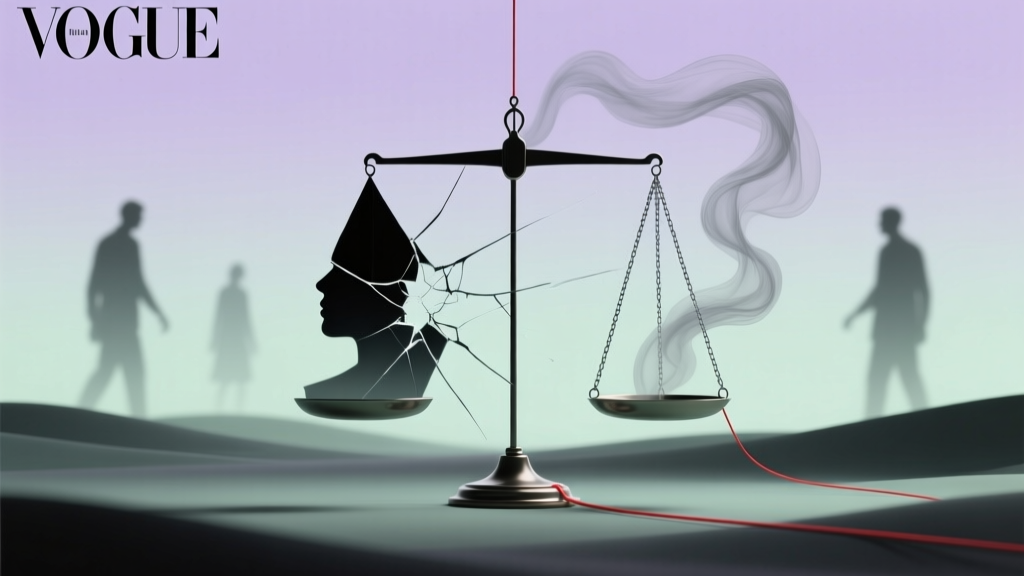
Libra, ruled by Venus and symbolized by the Scales, is often celebrated for grace, diplomacy, and aesthetic sensibility. Yet beneath this harmonious exterior lies a complex psychological terrain — one where the pursuit of balance can devolve into self-abandonment, where fairness morphs into moral relativism, and where peace becomes a prison of silence. Understanding Libra’s shadow side isn’t about vilifying the sign; it’s about reclaiming authenticity through honest self-confrontation. This article moves beyond sun-sign stereotypes to examine the unconscious patterns that emerge when Libra’s core gifts become distorted under pressure, neglect, or unexamined conditioning. Drawing on depth psychology, astrological tradition, and contemporary therapeutic frameworks, we map the terrain where Libra’s light dims — and how to reignite it with integrity.
The Shadow Side of Libra
The shadow, in Jungian psychology, represents the repressed, disowned, or undeveloped aspects of the psyche — those qualities we deny in ourselves but often project onto others. For Libra, the shadow emerges most vividly around themes of imbalance disguised as harmony. While Libra’s conscious mission is to mediate, reconcile, and create beauty, its shadow manifests as avoidance of necessary conflict, covert manipulation through charm, and an over-identification with external validation. Because Libra’s sense of self is deeply relational — rooted in how they are perceived and how well they ‘fit’ within social systems — the shadow arises when authenticity is sacrificed at the altar of approval. Astrologer Liz Greene notes that Libra’s Venusian rulership imbues it with a profound need for love and acceptance, making rejection feel existentially threatening — a wound that often triggers compensatory behaviors like excessive accommodation or performative neutrality (Greene, Astro.com). When Libra suppresses anger, disagreement, or personal boundaries to preserve surface-level peace, it doesn’t vanish — it festers, mutates, and resurfaces as passive aggression, chronic indecision, or sudden emotional withdrawal. Unlike fire signs whose shadows may flare outward in rage, Libra’s darkness operates quietly: a withheld opinion that sabotages collaboration, a compliment laced with subtle condescension, or a ‘fair’ compromise that quietly erases the Libran’s own needs. This is not hypocrisy — it’s fragmentation. The Libran soul, seeking wholeness, must integrate the warrior (Mars) and the truth-teller (Saturn) alongside the diplomat (Venus), recognizing that true balance includes tension, dissent, and the courage to stand alone.
Libra Fears and Insecurities
At the heart of Libra’s shadow lies a constellation of deep-seated fears — not trivial anxieties, but existential vulnerabilities that shape behavior across decades. Primary among them is the fear of being perceived as unlovable, unfair, or unattractive. Because Libra’s identity is co-constructed in relationship, rejection isn’t just painful — it threatens ontological security. This fuels a secondary fear: being seen as selfish, harsh, or divisive. To avoid this, Libras may preemptively mute their desires, delay decisions indefinitely, or absorb others’ emotions as if they were their own. A 2022 study published in the Journal of Analytical Psychology observed that air signs, particularly Libra, demonstrate heightened neural sensitivity to social dissonance — registering interpersonal friction more acutely than other modalities, which correlates with elevated cortisol responses during unresolved conflict (Wiley Online Library, JAP). This biological attunement reinforces behavioral patterns: rather than engage conflict, many Libras instinctively recalibrate — smoothing edges, softening language, deflecting blame — even when doing so compromises their integrity. Another core insecurity is the fear of moral failure: the dread of acting unjustly or appearing biased. Ironically, this fear can lead to ethical paralysis — choosing ‘neutrality’ in situations demanding clear moral stance (e.g., staying silent amid injustice to avoid ‘taking sides’). Libra may also harbor shame around envy — especially of partners’ autonomy or others’ unapologetic self-assertion — a feeling Venus-ruled signs often disown due to its perceived ‘ungraceful’ nature. These fears rarely surface as raw emotion; instead, they animate habits: over-apologizing, over-explaining, chronically comparing relationships, or romanticizing ‘the one who got away’ as proof of their capacity for ideal love — all attempts to reassure the self that they remain worthy of connection.
Defense Mechanisms of Libra
Libra employs several sophisticated, socially adaptive defense mechanisms — tools honed over lifetimes of navigating relational complexity. These aren’t flaws; they’re survival strategies that become maladaptive when overused or unconscious. Chief among them is rationalization: reframing uncomfortable truths into palatable narratives (e.g., ‘I didn’t speak up because I was giving them space,’ rather than ‘I was afraid of their reaction’). Closely related is intellectualization — detaching from embodied emotion by analyzing conflict as an abstract philosophical problem, thereby avoiding the vulnerability of feeling hurt or angry. Another hallmark is reaction formation: expressing exaggerated kindness or agreement to mask resentment or disapproval. A Libra might lavish praise on a colleague they deeply distrust, or enthusiastically endorse a decision they privately oppose — the intensity of the positive expression betraying the suppressed negative affect. Projection also features prominently: attributing their own unacknowledged competitiveness, jealousy, or desire for control to others (e.g., ‘They’re so manipulative’ when, in fact, the Libra has been subtly steering outcomes through charm and omission). Perhaps most insidious is compartmentalization, where Libra segregates contradictory parts of themselves — the devoted partner vs. the secretly resentful one, the fair mediator vs. the covert scorekeeper. This allows short-term functionality but erodes self-trust long-term. As astrologer Steven Forrest writes in The Inner Sky, ‘Libra’s greatest challenge is not learning to get along with others — it’s learning to get along with the parts of itself it has exiled in the name of harmony’ (Forrest, The Inner Sky). Recognizing these mechanisms isn’t about self-condemnation; it’s about developing meta-awareness — the ability to witness one’s own patterns without judgment, creating space for choice instead of reactivity.
When Libra Is Under Stress
Stress reveals the architecture of the psyche — what’s solid, what’s brittle, and what collapses first. For Libra, stress typically follows a predictable arc: initial over-effort to restore equilibrium → escalating internal dissonance → eventual fragmentation. Early-stage stress looks like hyper-diplomacy: over-scheduling mediation efforts, drafting multiple versions of a text to avoid offense, or absorbing others’ moods to ‘keep the peace’. As pressure mounts, Libra enters the ‘Aries shadow’ phase — a psychological inversion where the sign’s opposite archetype emerges chaotically. Instead of measured dialogue, there’s impulsive confrontation; instead of fairness, there’s vindictive score-settling. This isn’t authentic assertiveness — it’s backlash energy, raw and unprocessed. Physical symptoms often accompany this: jaw clenching, insomnia, or skin flare-ups (Venus governs skin and kidneys, areas commonly stressed in Libra). Emotionally, Libra may oscillate between icy detachment and tearful overwhelm — unable to locate a stable center. Cognitive function falters: decision fatigue intensifies, memory gaps appear (especially around personal preferences), and moral reasoning becomes rigid or paradoxical (e.g., justifying dishonesty ‘to protect someone’s feelings’). In extreme cases, Libra may develop somatic symptoms tied to Venusian physiology — migraines triggered by aesthetic discord (e.g., cluttered spaces), or digestive issues linked to swallowed words. Crucially, stressed Libra rarely identifies the root cause as *internal* conflict; instead, they externalize it as ‘others being unreasonable’ or ‘the situation being impossible’. Recovery requires grounding in the body (not just the mind), reconnecting with sensory pleasure (Venus’s domain), and permission to prioritize one’s own needs without negotiation. As the International Society for Astrological Research (ISAR) emphasizes, ‘Transiting Saturn conjunct Libra’s Sun point often catalyzes the most profound shadow integration — demanding accountability for relational patterns previously blamed on fate or others’ (ISAR, Libra & Saturn).
Toxic Libra Patterns and How to Heal
‘Toxic’ is a misused term — it implies inherent corruption rather than unhealed wounding. Libra’s challenging patterns stem from unmet developmental needs, not malice. Below is a structured comparison of common toxic manifestations versus their healed expressions:
| Toxic Pattern | Root Wound | Healed Expression | Practical Step |
|---|---|---|---|
| Chronic indecision masking fear of accountability | Belief that choosing = risking rejection or proving oneself ‘unfair’ | Confident discernment grounded in values, not external validation | Practice ‘micro-decisions’: Choose a coffee order, outfit, or route — then sit with the feeling for 60 seconds without justification. |
| People-pleasing disguised as generosity | Fear that saying ‘no’ will dissolve relational bonds | Boundaried care: Giving freely *only* when energetically sustainable | Implement the ‘3-Second No’: When asked for a favor, pause — breathe — then respond. If hesitation exceeds 3 seconds, default to ‘Let me check my calendar and get back to you.’ |
| Passive-aggressive communication (sarcasm, backhanded compliments) | Unexpressed anger + belief that directness is ‘un-Libran’ | Clear, kind, non-negotiable assertion | Use the ‘Venus-Voice Template’: ‘I feel ______ when ______. What I need is ______.’ (e.g., ‘I feel overwhelmed when meetings lack agendas. What I need is a 3-bullet outline 24hrs prior.’) |
| Moral relativism used to avoid taking a stand | Equating ‘neutrality’ with virtue, conflating fairness with abdication | Contextual ethics: Knowing when balance requires asymmetry (e.g., supporting the marginalized over the privileged) | Study historical justice movements — note how ‘balanced’ positions often upheld oppression. Journal: ‘Where have I mistaken silence for peace?’ |
Healing begins not with fixing, but with befriending the disowned self. Libra benefits profoundly from somatic practices (yoga, tai chi) that reconnect mind and body, artistic expression (painting, dance) that bypass verbal filters, and therapy modalities emphasizing relational dynamics (e.g., attachment-based or Imago therapy). Crucially, healing requires tolerating the discomfort of being ‘unlikeable’ in small doses — saying no, stating a preference, sitting with silence without filling it. Each act rebuilds neural pathways linking self-worth to authenticity, not appeasement.
Embracing the Full Spectrum of Libra
True Libran mastery isn’t the absence of shadow — it’s the integration of polarity. The fully realized Libra holds Venusian grace *and* Martian courage, diplomatic finesse *and* unwavering principle, relational attunement *and* sovereign selfhood. This spectrum includes the ‘dark’ traits not as flaws to purge, but as vital data: the envy pointing to unmet desires, the indecision revealing unclarified values, the people-pleasing signaling unmet needs for safety. Ancient Hellenistic astrology viewed Libra’s scales not as instruments of passive weighing, but as active tools of *discernment* — requiring weight, friction, and sometimes imbalance to calibrate truth. Modern psychology affirms this: research from the University of Cambridge’s Personality Dynamics Lab shows that individuals who engage regularly in shadow work demonstrate higher emotional granularity, stronger boundary maintenance, and greater resilience in long-term relationships (Cambridge Personality Dynamics Lab). Embracing the full Libra means honoring the sign’s divine mandate — not to eliminate conflict, but to transform it into creative tension; not to be loved by all, but to love oneself enough to risk rupture for authenticity; not to achieve perfect symmetry, but to hold the sacred asymmetry of being human. It means understanding that the most beautiful art contains chiaroscuro — light defined by shadow — and that Libra’s highest expression is not flawless harmony, but courageous, compassionate wholeness.
Shadow Work Prompts for Libra
Shadow work is iterative, not linear. These prompts invite gentle, consistent inquiry — best journaled weekly, without expectation of resolution:
- When did I last apologize for something I didn’t do? What need was I trying to meet?
- What topic or person makes me unusually defensive? What part of myself might I be rejecting in them?
- Describe a time I compromised my values ‘for the relationship.’ What did I gain? What did I lose — and what would reclaiming it cost me now?
- List three things I’ve never said aloud — to anyone — about my romantic or creative life. Why are they unspeakable?
- What does ‘justice’ mean to me — separate from what I think others expect it to mean? Write it in one sentence, then burn the paper and write it again from the gut.
For Libra, shadow work isn’t about becoming ‘less relational’ — it’s about becoming *more relationally honest*. It’s the quiet revolution of choosing self-truth over social ease, knowing that the deepest harmony isn’t found in silence, but in the resonant frequency of aligned action. As the scales settle, not into stillness, but into dynamic equilibrium — weighted, aware, and wholly, unapologetically real.