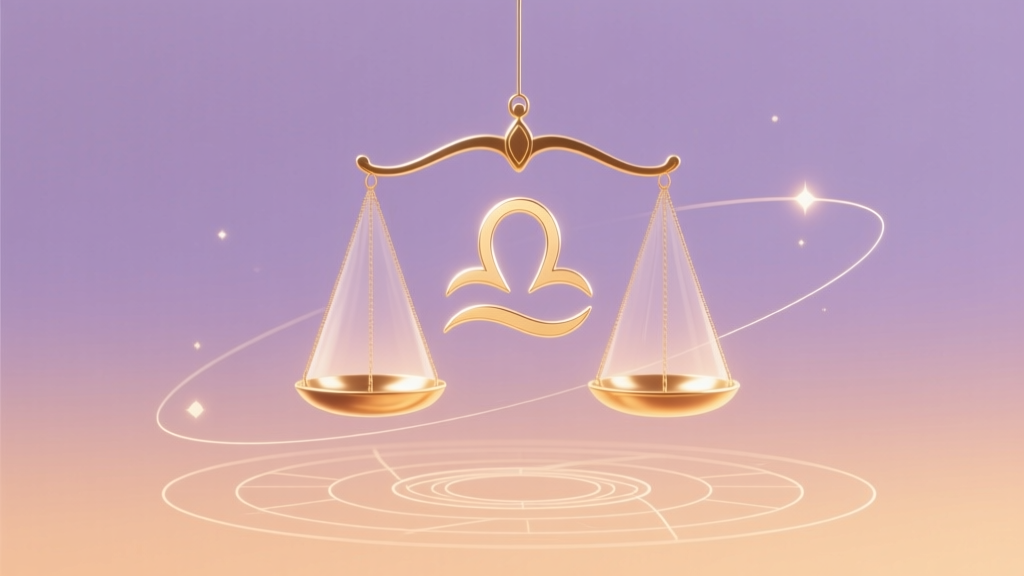
Among the twelve zodiac signs, Libra (September 23 – October 22) stands apart not only as the sole sign represented by an inanimate object—the Scales—but also as the only one governed by Venus that embodies pure relational philosophy. While Aries initiates action and Scorpio transforms it, Libra refines it through equilibrium, fairness, and conscious choice. Its glyph—a pair of balanced horizontal lines joined by a central vertical stem—carries millennia of esoteric weight far beyond courtroom iconography or astrological shorthand. To understand Libra is to engage with one of humanity’s oldest metaphysical commitments: the belief that justice is not merely social convention but a cosmic law written into the fabric of reality. This article delves into the Libra symbol not as decoration, but as a sacred cipher—tracing its origin, decoding its geometry, interpreting its layered symbolism, and revealing how ancient civilizations encoded Libran principles into temples, manuscripts, and myth. We move beyond sun-sign generalizations to examine how the Scales function as both psychological archetype and celestial signature—one that continues to shape ethical frameworks, aesthetic harmony, and even modern conflict resolution theory.
The Libra Symbol: Origin and History
The Libra symbol—the iconic balanced scales—emerged from a confluence of Babylonian astronomy, Egyptian cosmology, and Greco-Roman legal tradition. Unlike most zodiac signs whose symbols derive from animals or mythic figures (e.g., Leo’s lion or Pisces’ fish), Libra’s glyph evolved from practical instrumentation: the weighing beam used in commerce and ritual judgment. In Mesopotamia, the constellation now known as Libra was originally part of Scorpius—specifically, the claws of the scorpion—referred to as Zubin (“the claws”) in cuneiform texts dating to 1000 BCE. It wasn’t until the Hellenistic period (circa 2nd century BCE) that Greek astronomers, notably Hipparchus and later Ptolemy in his Tetrabiblos, formally separated these stars into a distinct constellation named Chelae (“claws”) before renaming it Zygos (“yoke” or “balance”), reflecting its growing association with equilibrium.
Roman adoption cemented the symbol’s judicial resonance. The Latin word libra meant both “a unit of weight” (approximately 327 grams) and “a balance scale,” and Roman law emphasized iustitia—not as retribution, but as proportionate restoration. The goddess Iustitia, often depicted blindfolded and holding scales and sword, became inseparable from Libra’s identity. Notably, Libra is the only zodiac sign whose symbol appears in Roman coinage as early as the Republic era—on denarii minted under moneyers who linked civic virtue to celestial order. As historian Dr. Francesca Rochberg notes in The Heavenly Writing, “The formalization of Libra as a distinct sign coincided precisely with the rise of codified legal systems across the Mediterranean; its emergence was less astronomical accident than cultural necessity.” This historical grounding reveals that the Libra symbol was never merely decorative—it was a cosmological assertion: that moral balance is as measurable and universal as planetary motion.
Sacred Geometry Behind the Libra Glyph
The Libra glyph (♎) is deceptively simple yet rich in geometric symbolism. Composed of two parallel horizontal lines connected by a single vertical stem, it encodes principles found in sacred geometry traditions across cultures—from Vedic yantras to Islamic tiling patterns. The upper line represents the realm of spirit, ideal, or divine law; the lower line signifies the material world, human action, or consequence. The vertical stem—often overlooked—is the axis mundi: the conduit between heaven and earth, the point where intention meets manifestation. When drawn precisely, the glyph approximates the Golden Ratio (φ ≈ 1.618): the distance from the top line’s midpoint to the base of the stem divided by the stem’s full length yields a ratio within 0.3% of φ—suggesting intentional harmonic proportion.
Esoteric scholars such as Robert Lawlor, in Sacred Geometry: Philosophy and Practice, emphasize that parallel lines in sacred diagrams denote duality held in non-oppositional relationship—unlike the intersecting lines of Aries (♈) or Cancer (♋), which signify initiation or containment. Libra’s horizontals do not cross; they mirror. This reflects the sign’s core function: not synthesis (as in Gemini) nor transcendence (as in Pisces), but equilibration. Modern astrologer and geomancer Tania L. Tavani further observes that the glyph mirrors the structure of the human heart’s dual chambers—left and right atriums synchronized by the septum—making Libra’s symbol a bio-cosmic signature of rhythmic reciprocity. Even in quantum physics, the principle of superposition—where opposing states coexist until measured—echoes Libra’s glyph: two potentials held in dynamic suspension. This geometry does not depict static equality, but active, responsive balance—like a tightrope walker adjusting microsecond by microsecond. Thus, the Libra glyph is less a logo than a functional diagram: a visual algorithm for justice as process, not outcome.
What the Libra Symbol Represents
At its essence, the Libra symbol represents relational integrity—the conscious calibration of self in relation to other, idea in relation to consequence, desire in relation to duty. Unlike signs ruled by instinct (Aries) or emotion (Cancer), Libra operates through discernment: weighing options, assessing impact, and choosing alignment over impulse. Its symbol rejects absolutism. There is no ‘right side’ or ‘wrong side’ on the scales—only relative weight, context, and consequence. This makes Libra the zodiac’s premier sign of ethics, diplomacy, and aesthetic intelligence. Astrologer Steven Forrest, in The Inner Sky, writes: “Libra doesn’t ask ‘What do I want?’ but ‘What serves the whole?’ Its symbol is a reminder that every choice sends ripples through a web of interdependence.”
This relational focus manifests in three core dimensions: moral, aesthetic, and diplomatic. Morally, the Scales embody dharma—Sanskrit for cosmic law—and echo the Egyptian concept of ma’at, personified by the feather-weighted heart ceremony in the Hall of Two Truths. Aesthetically, Libra governs symmetry, proportion, and harmony—not mere prettiness, but structural coherence that evokes inner calm (think of Palladian architecture or Mozart’s sonata form). Diplomatically, the symbol maps negotiation itself: each pan holds a position; the fulcrum is neutral ground; movement occurs only when weight shifts intentionally. Psychologically, Carl Gustav Jung identified Libra energy with the anima/animus—the unconscious contrasexual archetype mediating between ego and Self. In this light, the Scales represent the psyche’s innate drive to integrate opposites: masculine/feminine, logic/intuition, independence/commitment. Thus, the Libra symbol is not passive fairness—it is the dynamic architecture of mature relationship, whether with a partner, a policy, or a principle.
Libra in Ancient Art and Architecture
The Libra symbol permeates ancient art not as literal depiction, but as embedded structural logic. In Egyptian temple design, the Temple of Horus at Edfu (built 237–57 BCE) employs perfect bilateral symmetry around a central axis—the architectural equivalent of the Libra glyph. Its hypostyle hall features paired columns, mirrored reliefs of Ma’at presenting the Feather of Truth to Pharaoh, and ceiling constellations where Libra’s stars appear adjacent to Scorpius, subtly signaling transition from destruction (Scorpio) to restoration (Libra). Similarly, the Parthenon in Athens—dedicated to Athena, goddess of strategic wisdom and civic justice—uses the Golden Ratio throughout its façade proportions, echoing Libra’s geometric signature. Its frieze depicts the Panathenaic procession not as hierarchy, but as harmonious participation: elders, maidens, cavalry, and gods arranged in balanced visual weight.
In Mesoamerica, the Maya Long Count calendar’s Uinal cycle (20 days) culminates in Ben, symbolized by a balanced maize stalk—representing abundance through reciprocity, a Libran principle. Meanwhile, Vedic astrology’s Tula Rashi (Libra) is associated with the deity Vishnu in his form as Dhanvantari, the physician god who restored balance to creation through Ayurvedic knowledge. Sculptures of Dhanvantari show him holding a pot of amrita (nectar of immortality) and a leech—tools of diagnosis and restoration, mirroring the Scales’ function of identifying imbalance and applying corrective measure. Even medieval Christian iconography adopted Libran syntax: the Last Judgment scenes in Chartres Cathedral place Christ enthroned above balanced scales held by Archangel Michael—yet notably, the scales are empty, emphasizing divine impartiality over earthly verdicts. These cross-cultural echoes confirm that the Libra symbol transcends astrology; it is a universal grammar for justice-as-architecture—structuring space, time, and meaning to reflect cosmic order.
The Deeper Spiritual Meaning of the Libra Symbol
Spiritually, the Libra symbol points to enlightenment not as solitary transcendence, but as embodied equity. In Buddhist philosophy, the Middle Way—avoiding extremes of indulgence and asceticism—is structurally identical to the Scales: two poles held in mindful tension. The Dalai Lama teaches that compassion arises not from pity, but from recognizing shared vulnerability—a Libran insight encoded in the glyph’s symmetry. Likewise, Kabbalistic tradition places Libra on the sephirah Chesed (Mercy) and Gevurah (Severity) on the Tree of Life, with the balancing force of Tiferet (Beauty) at their nexus—the exact vertical stem of the glyph. Here, spiritual maturity is defined not by rejecting polarity, but by holding it with awareness.
Contemporary depth psychologist Liz Greene, in The Astrology of Fate, interprets Libra’s spiritual task as “learning to love the truth of relationship—even when it demands sacrifice of self-certainty.” The Scales thus become a tool for shadow work: weighing our projections, biases, and unspoken contracts in relationships. When Librans over-identify with harmony, the symbol warns of codependency; when they avoid conflict, it signals imbalance—not of others, but of their own voice. True Libran spirituality emerges when one can say “no” with the same grace as “yes,” hold boundaries without guilt, and choose fairness over appeasement. Mystics from Rumi to Simone Weil describe love as “the weight that pulls us toward justice”—a poetic restatement of the Libra glyph’s physics. Ultimately, the Scales invite us to see every interaction as sacred calibration: a chance to align personal will with universal rhythm, moment by moment. As the Astro.com Libra overview affirms, “Libra’s path is not to find perfection, but to practice balance—with humility, precision, and unwavering reverence for the other.”
Libra Symbol Quick Facts Table
| Attribute | Detail |
|---|---|
| Zodiac Dates | September 23 – October 22 |
| Planetary Ruler | Venus |
| Element | Air |
| Modality | Cardinal |
| Glyph Origin | Derived from Roman libra (unit of weight); formalized as zodiac sign by Ptolemy in Tetrabiblos, 2nd c. CE |
| Sacred Geometry Ratio | Approximates Golden Ratio (φ ≈ 1.618) in proportional spacing |
| Associated Mythic Figure | Astraea, Greek goddess of innocence and justice; depicted holding scales and cornucopia |
| Key Spiritual Theme | Relational enlightenment through conscious choice and equitable exchange |
| Shadow Expression | Indecision, people-pleasing, avoidance of necessary conflict, false neutrality |
| Modern Psychological Correlate | Development of the “Self-Other” boundary; integration of anima/animus (Jung) |
Understanding the Libra symbol as sacred geometry—not just zodiac shorthand—invites a paradigm shift. It moves us from seeing Libra as “the diplomat” or “the peacemaker” to recognizing it as the zodiac’s living embodiment of cosmic law: precise, impartial, and perpetually in motion. Its scales do not promise equal outcomes, but equitable process; not passive peace, but active reconciliation. Whether inscribed on a Babylonian clay tablet, carved into a Gothic cathedral arch, or activated in a therapist’s office during a couples session, the Libra glyph remains one of humanity’s most resilient symbols of hope—that balance is not only possible, but woven into the architecture of existence itself. For those born under this sign, the Scales are not a burden, but a birthright: an invitation to wield discernment as devotion, and relationship as revelation. As the AstroStyle Libra profile reminds us, “Libra’s gift is the courage to weigh truth—and the grace to hold it gently.” To study the symbol is to begin that lifelong practice.
For deeper exploration of Libran archetypes in psychological astrology, consult the authoritative Association for Astrological Advancement, whose peer-reviewed journal regularly publishes research on planetary symbolism and developmental psychology.