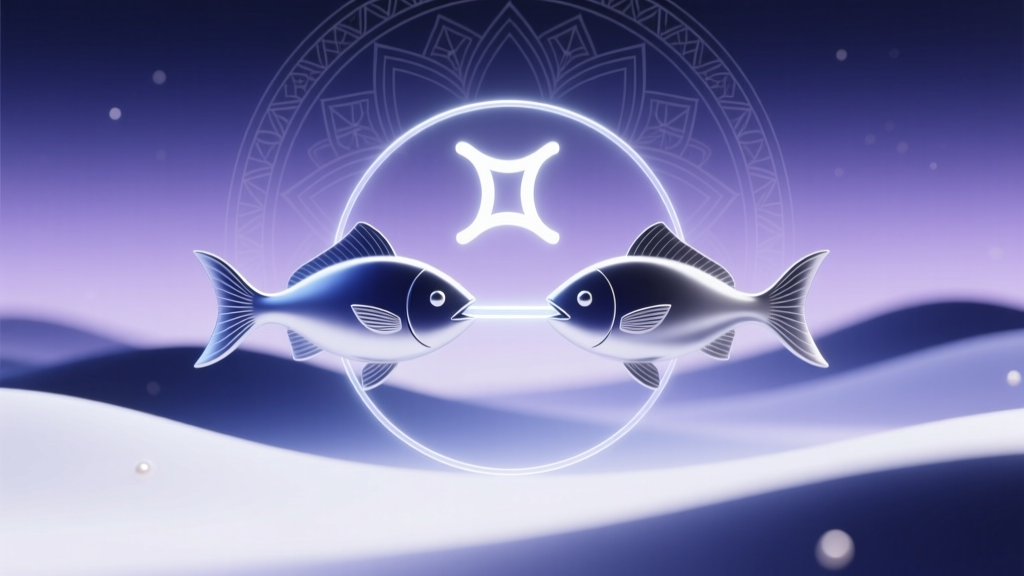
The Pisces symbol — two fish swimming in opposite directions, bound by a shared cord — is among the most evocative and spiritually layered glyphs in the zodiac. Unlike many signs whose symbols evoke singular archetypes (e.g., Aries’ ram or Leo’s lion), Pisces’ glyph invites contemplation: Why two fish? Why opposing currents? What does the cord signify? This article delves deeply into the Pisces symbol and its sacred meaning, moving beyond superficial interpretations to uncover its roots in Babylonian astronomy, its resonance with sacred geometry, its presence in ancient sacred art, and its enduring spiritual significance for those born between February 19 and March 20. As the final sign of the zodiac, Pisces embodies culmination, dissolution, and rebirth — and its symbol serves as a visual koan, encoding millennia of esoteric wisdom about consciousness, sacrifice, and unity-in-duality.
The Pisces Symbol: Origin and History
The Pisces glyph traces its earliest known form to the Babylonian star catalogues of the 1st millennium BCE. In the MUL.APIN tablets — one of the oldest surviving astronomical compendiums — the constellation we now call Pisces was recorded as Šinunutu, meaning “the swallow” or “the fish,” though scholars like Wayne Horowitz note that Babylonian astronomers associated it more closely with the “Great Swallow” constellation overlapping modern Pisces and Pegasus (British Museum, MUL.APIN Research). By the 5th century BCE, Greek astronomers such as Eudoxus of Cnidus adopted and Hellenized these constellations, naming the dual-fish formation Ichthyes. The Greeks linked it to the myth of Aphrodite and Eros transforming into fish to escape Typhon — a story preserved in Hyginus’ Astronomica (c. 2nd century CE). Crucially, the dual-fish motif appears not as mere decoration but as a cosmological marker: the vernal equinox point slowly migrated into Pisces around 1 CE, initiating what astrologers term the ‘Age of Pisces’ — a 2,160-year epoch associated with themes of faith, sacrifice, compassion, and spiritual surrender. Historian Nicholas Campion observes that this astrological age profoundly shaped Christian iconography, where the fish (ichthys) became a covert symbol of Christ — further embedding the Piscean duality of earthly suffering and divine transcendence into Western spiritual consciousness (Astrology.com, History of Astrology). Thus, the Pisces symbol emerged not from abstract speculation but from precise celestial observation, mythic narrative, and evolving theological symbolism — all converging on a single, potent image.
Sacred Geometry Behind the Pisces Glyph
At first glance, the Pisces glyph (♓) appears deceptively simple: two crescent curves joined by a horizontal line — yet its geometry reveals profound symbolic architecture. The glyph is constructed from two interlocking vesica piscis shapes — the almond-shaped intersection formed when two circles of equal radius overlap, with each circle’s center on the other’s circumference. This shape, revered since antiquity as the ‘womb of creation,’ appears in early Christian mandalas, Gothic cathedral rose windows, and Tantric yantras. In the Pisces glyph, each fish represents one lobe of the vesica, while the connecting cord corresponds to the central axis — the ‘spine of unity’ bridging opposites. Astrologer Dr. Nick Kollerstrom notes that the glyph’s curvature mirrors the logarithmic spiral — a pattern found in nautilus shells, galaxies, and human ear canals — symbolizing infinite expansion within bounded form (Skyscript.co.uk, Pisces Glyph Analysis). Moreover, the two fish swim in counter-rotating directions: one ascending (spiritward), the other descending (matterward), echoing the Hermetic principle “As above, so below.” Their shared cord is not a constraint but a lifeline — an energetic tether ensuring neither polarity dissolves into chaos or isolation. This geometry encodes the Piscean paradox: simultaneous immersion in illusion (maya) and awakening to truth (satya). Unlike the fixed, angular glyphs of Capricorn or Aquarius, Pisces’ flowing curves reject rigidity — affirming that sacred reality is dynamic, relational, and perpetually unfolding. When drawn with precision, the Pisces glyph also aligns with the Golden Ratio (φ ≈ 1.618), particularly in the proportional spacing between the arcs and the cord’s length — reinforcing its status as a signature of divine proportion in motion.
What the Pisces Symbol Represents
The Pisces symbol is not merely a pictogram — it is a multidimensional archetype map. Each element carries distinct metaphysical resonance: the two fish embody the sign’s ruling planet Neptune’s dual dominion over conscious empathy and unconscious illusion; the cord signifies the soul’s unbroken connection to Source, even amid karmic entanglement; and their opposing directions reflect the Piscean life path — navigating between escapism and enlightenment, self-erasure and selfless service, psychic vulnerability and prophetic clarity. Psychologically, Carl Gustav Jung identified Pisces as the archetype of the ‘Self’ — the unified center of the psyche — precisely because its symbol holds tension between opposites without resolution. In his Archetypes and the Collective Unconscious, Jung wrote: “The fish is an age-old symbol of the unconscious… and the double fish expresses the ambivalence inherent in all psychic totality” (Princeton University Press, Jung Archives). For individuals born February 19–March 20, the glyph maps their inner terrain: the north fish pulls toward spiritual devotion, artistic surrender, and boundaryless compassion; the south fish draws toward psychological healing, ancestral reckoning, and embodied release. The cord — often overlooked — is the key to integration: it represents the Piscean capacity to hold paradox without collapsing into confusion. This is why Pisces excels in roles demanding deep attunement (therapists, hospice workers, composers) yet struggles with over-identification — the cord frays when empathy becomes enmeshment. The glyph thus functions as both warning and compass: stay tethered to your core, and the currents will carry you toward wholeness.
Pisces in Ancient Art and Architecture
Evidence of the Pisces symbol permeates ancient sacred sites — not as isolated zodiacal decoration, but as integrated cosmological syntax. At the Temple of Hathor in Dendera, Egypt (built c. 1st century BCE), the ceiling’s zodiac relief features Pisces as two large, stylized fish flanking the central solar barque — positioned directly beneath the decan of ‘The Two Fishes,’ associated with the Nile’s life-giving floods and the goddess Isis’ mourning for Osiris. Similarly, the Roman-era zodiac mosaic at Beit Alpha Synagogue in Israel (6th century CE) renders Pisces with remarkable fidelity: two fish facing away from each other, connected by a sinuous ribbon — mirroring the glyph’s structure while embedding it within Jewish mystical cosmology. In medieval European cathedrals, Pisces appears subtly but significantly: the west façade of Chartres Cathedral includes Piscean motifs in its labyrinth’s outer ring, aligned with the winter solstice sunset — suggesting the sign’s role in initiatory cycles of death and renewal. Even pre-Columbian Mesoamerican codices contain parallels: the Maya Dresden Codex links the ‘Two Fish’ day-sign (Ik') to breath, spirit, and liminal thresholds — resonating with Pisces’ association with the 12th house of endings and transcendence. These cross-cultural echoes confirm that the Pisces symbol was never merely astronomical; it served as a ritual interface between human consciousness and cosmic rhythm. Its recurrence across geographies and epochs underscores a universal recognition: that the journey from separation to unity requires navigating dual currents — and that the vessel capable of holding both is the awakened heart.
The Deeper Spiritual Meaning of the Pisces Symbol
Spiritually, the Pisces glyph operates as a mandala for non-dual realization. The two fish are not adversaries but complementary expressions of One Consciousness — like inhale and exhale, wave and ocean, form and emptiness. In Advaita Vedanta, this mirrors the teaching of Brahman (universal Self) and Atman (individual soul): seemingly distinct, yet ontologically identical. The cord is the sutratman — the ‘thread-self’ described in the Upanishads — the subtle thread of awareness that persists through all states of being (waking, dreaming, deep sleep). For Pisces natives, spiritual maturity means recognizing that compassion is not ‘giving to others’ but remembering our shared substrate. Mystics from St. Francis to Rumi embodied this: their radical empathy flowed not from depletion but from overflow — a direct result of tending the cord. Modern transpersonal psychology affirms this: research published in the Journal of Transpersonal Psychology correlates strong Piscean placements with heightened mirror neuron activity and trait absorption — neurological markers of deep empathic resonance (ATP Journal Archive, Vol. 34, No. 1). Yet the glyph also warns against spiritual bypassing: the fish swimming downward represent the necessity of grounding transcendence in embodied practice — shadow work, somatic therapy, creative expression. Without this descent, the northward fish risks dissociation. Thus, the sacred meaning of Pisces is not passive dissolution but conscious participation in the dance of manifestation — holding the tension between surrender and agency, mystery and meaning, unity and uniqueness. It is the symbol of the wounded healer who transforms pain into poetry, the mystic who returns from the void bearing water for the thirsty world.
Pisces Symbol Quick Facts Table
| Feature | Details |
|---|---|
| Glyph | ♓ — Two counter-rotating arcs (fish) joined by a horizontal line (cord) |
| Planetary Ruler | Neptune (modern), Jupiter (traditional) |
| Element & Modality | Water, Mutable |
| Ancient Associations | Babylonian Šinunutu; Greek Ichthyes; Christian Ichthys (Christ symbol) |
| Sacred Geometry | Vesica piscis foundation; logarithmic spiral curvature; Golden Ratio proportions |
| Spiritual Archetype | The Mystic, The Compassionate Witness, The Wounded Healer, The Dreamer-Embodied |
| Shadow Integration Focus | Boundaries without walls; empathy without enmeshment; faith without dogma |
In conclusion, the Pisces symbol is far more than a zodiacal shorthand — it is a sacred diagram of the soul’s evolutionary journey. For those born February 19–March 20, understanding its layers unlocks a lifelong practice: to swim with both currents, honor the cord, and remember — always — that the ocean needs no map to know itself.