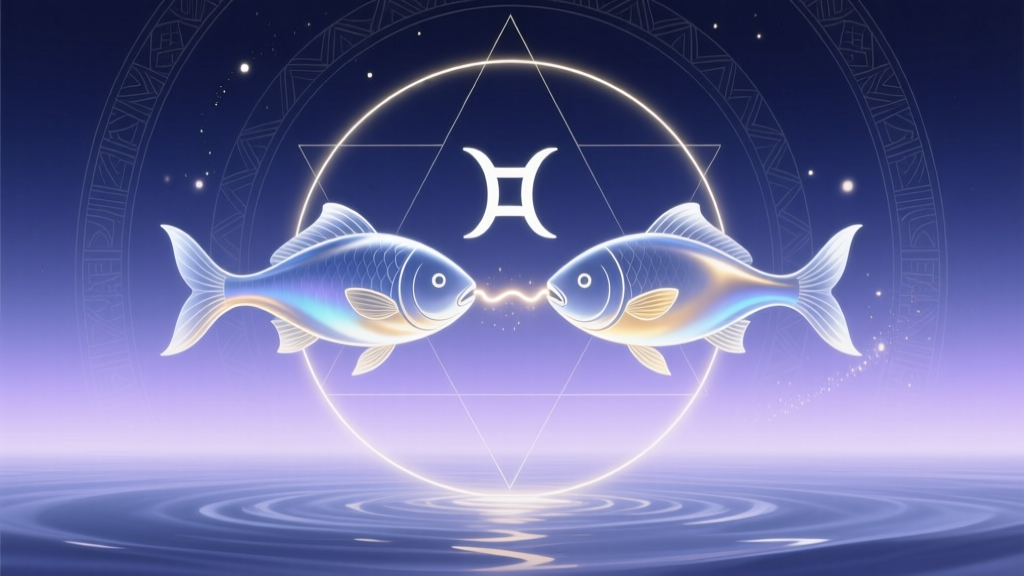
The Pisces symbol — two crescent-tailed fish swimming in opposite directions, connected by a shared cord — is among the most evocative and spiritually layered glyphs in the zodiac. Unlike the bold, angular symbols of Aries or Capricorn, Pisces’ glyph whispers rather than declares. It invites contemplation, dissolution of boundaries, and surrender to the unseen currents of consciousness. For those born between February 19 and March 20, this symbol is not merely an astrological shorthand; it is a sacred diagram encoding millennia of mystical insight, cosmological wisdom, and soul-level archetypes. To understand Pisces is to understand the symbol — and to understand the symbol is to glimpse the sacred architecture of empathy, intuition, and divine paradox.
The Pisces Symbol: Origin and History
The Pisces glyph traces its roots to ancient Mesopotamian and Babylonian astronomy, where the constellation was associated with the Akkadian deity Annunitum, goddess of fertility and celestial waters. By the 5th century BCE, Babylonian star catalogues — such as the MUL.APIN tablets — identified the region of sky now known as Pisces as Šinunutu, meaning “the fish” or “the great fish,” often depicted as a pair swimming head-to-tail. This dual-fish motif entered Hellenistic astrology via Greek adaptation around the 2nd century BCE, when scholars like Berossus and later Claudius Ptolemy formalized the zodiac’s 12 signs in the Tetrabiblos. Ptolemy described Pisces as ruled by Jupiter (then considered the planet of expansion and divine providence) and linked it to the myth of Aphrodite and Eros transforming into fish to escape Typhon — a story that cemented the symbol’s association with salvation through surrender and metamorphosis.
Early Greek manuscripts, including those preserved in the Vatican Library’s Palatine Codex, show the glyph evolving from pictographic fish drawings into the stylized, mirrored crescents we recognize today. Notably, the earliest known use of the modern glyph appears in the 1st-century CE Roman astrological papyrus P. Oxy. 436, housed at Oxford’s Ashmolean Museum — where scribes rendered Pisces with two opposing arcs joined at the center by a horizontal line, mirroring the visual language of later Hermetic and Neoplatonic diagrams. As Christianity rose, the fish symbol (ichthys) became a covert sign of faith, further reinforcing Pisces’ cultural resonance with hidden truth, sacrifice, and spiritual nourishment. According to historian and astrologer Nick Campion, "The Pisces symbol absorbed layers of meaning across religious traditions — from Babylonian water deities to Christian mysticism — precisely because its form resists literal interpretation and opens space for symbolic multiplicity." Astrology.com’s historical overview of Pisces affirms that no other sign’s symbol carries such dense interfaith symbolism without contradiction.
Sacred Geometry Behind the Pisces Glyph
At first glance, the Pisces glyph appears simple: two curved lines resembling fish tails, mirrored across a central axis, joined by a straight horizontal bar. Yet beneath its elegance lies profound sacred geometry. Each crescent is drawn as a perfect arc — mathematically, a segment of a circle with radius equal to half the glyph’s total width — echoing the Vesica Piscis, the almond-shaped intersection of two overlapping circles. The Vesica Piscis is one of the foundational forms in sacred geometry, representing the intersection of divine and material realms, the womb of creation, and the threshold of conscious awareness. In fact, the Pisces glyph can be seen as a stylized, linear abstraction of the Vesica — with the two fish embodying the dual yet inseparable forces of spirit and matter, light and shadow, self and other.
The horizontal bar connecting the fish is not merely decorative; it functions as the axis mundi — the world axis — anchoring the duality in stillness. This reflects the Kabbalistic concept of Tzimtzum, where divine contraction creates space for creation while maintaining connection to the source. Similarly, in Tantric tradition, the cord mirrors the sushumna nadi, the central channel through which kundalini energy rises — flanked by the ida and pingala (the left and right serpentine channels), represented by the two fish swimming in opposite directions. Modern geometers have analyzed the glyph using golden ratio proportions: the distance between the outer tips of the arcs to the length of the connecting bar approximates φ (1.618), suggesting intentional harmonic design. As Dr. Deborah Houlding notes in her treatise on planetary glyphs, "The Pisces symbol is perhaps the most geometrically integrated of all zodiac signs — every curve, angle, and junction serves both astronomical function and metaphysical purpose." Skyscript’s authoritative glyph analysis confirms that the Pisces symbol is unique in its bilateral symmetry and absence of sharp angles — a deliberate visual expression of non-duality.
What the Pisces Symbol Represents
The Pisces symbol is a masterclass in paradoxical representation. Its two fish do not swim side-by-side in harmony — they move in opposition: one ascending, one descending; one toward illumination, one toward the depths. This is not conflict, but complementarity — the essential dance of polarity that underpins all manifestation. Astrologically, this reflects Pisces’ dual rulership: traditional ruler Jupiter (expansion, faith, higher learning) and modern ruler Neptune (dissolution, imagination, collective unconscious). The cord binding them signifies the unbreakable thread of soul identity — the part of the Piscean that remains centered even amid emotional tides, psychic permeability, or existential ambiguity.
Each fish carries symbolic weight. The upward-swimming fish embodies aspiration — the longing for transcendence, artistic vision, and mystical union. It is the part of Pisces that composes symphonies in silence, translates dreams into poetry, or feels God in a raindrop. The downward-swimming fish represents grounding through compassion — the willingness to descend into suffering, addiction, grief, or illusion to heal, witness, and redeem. This is the healer, the hospice worker, the trauma-informed therapist, the activist who sits with injustice not to fix it instantly, but to hold its weight with reverence. As astrologer Steven Forrest writes in The Inner Sky, "Pisces doesn’t choose between heaven and earth — it builds bridges between them, using empathy as mortar and intuition as blueprint." Steven Forrest’s definitive work on evolutionary astrology emphasizes that the Pisces glyph visually encodes this bridge function: the cord is neither rope nor chain, but a lifeline — flexible, resilient, and always anchored in love.
Importantly, the fish are not identical. Their tails curl in subtly different directions — one more open, receptive; the other more contained, protective — mirroring the sign’s mutable quality: adaptability rooted in deep inner knowing. This mutability isn’t indecisiveness; it’s the capacity to shift form without losing essence — like water taking the shape of any vessel while remaining H₂O. For the Pisces native (Feb 19–Mar 20), the symbol is a lifelong invitation: to honor both the call to rise and the call to descend, knowing that true wholeness lives in the tension — and tenderness — between them.
Pisces in Ancient Art and Architecture
The Pisces symbol appears with striking consistency across civilizations — not as mere decoration, but as encoded cosmology embedded in sacred spaces. In the Temple of Hathor at Dendera, Egypt (built c. 1st century BCE), ceiling zodiac reliefs depict Pisces as two large, stylized fish flanking the solar barque — a placement indicating its role as guardian of the threshold between earthly and celestial realms. Similarly, the Roman Mithraeum of Santa Prisca in Rome features a 2nd-century CE zodiac frieze where Pisces occupies the western gate — the direction of sunset, endings, and the subconscious — reinforcing its liminal nature.
In early Christian catacombs, such as those beneath St. Domitilla in Rome, the ichthys (fish) symbol appears over 300 times — often paired, intersecting, or bound by a single line — unmistakably echoing the Pisces glyph. Scholars like David Ulansey argue these were not just Christological acronyms (Iēsous Christos Theou Yios Sōtēr) but deliberate astrological references aligning Christ’s mission with the Age of Pisces, believed to have begun around 1 CE. Medieval cathedral builders continued this tradition: the west façade of Chartres Cathedral includes a Pisces medallion carved above the Royal Portal — its two fish entwined around a chalice, symbolizing the Eucharist as both sacrifice and sustenance.
Even Islamic astrolabes from 10th-century Baghdad render Pisces with exceptional precision — the two arcs drawn with compass-guided symmetry, the connecting bar aligned exactly with the instrument’s meridian line. These were not ornamental additions but functional components: the Pisces glyph marked the point where celestial longitude crossed the ecliptic’s 330°–360° segment — critical for calculating prayer times during the vernal equinox period. As noted by the Institute for the Study of Ancient Cultures at the University of Chicago, "The persistence of the Pisces glyph across religious and scientific contexts reveals its status as a universal symbol of cyclical renewal and boundary dissolution." University of Chicago’s SAOC 64 on Mesopotamian astronomy documents how Pisces’ placement marked the ‘gateway of the gods’ in Babylonian cosmology — the celestial doorway through which souls ascended after death.
The Deeper Spiritual Meaning of the Pisces Symbol
Spiritually, the Pisces symbol is a mandala for embodied mysticism — a visual koan inviting the practitioner to dissolve the illusion of separation. The two fish represent the twin movements of the awakened heart: outflow (compassion) and inflow (receptivity). Their opposing directions mirror the tantric principle of pravritti (engagement with the world) and nivritti (withdrawal into stillness) — both necessary for enlightenment. The cord is the thread of awareness that remains unbroken whether one is immersed in service or lost in meditation. In Advaita Vedanta, this reflects the teaching of sat-chit-ananda: being-consciousness-bliss — the unchanging substratum beneath all dualistic experience.
For Pisces individuals, the glyph maps their soul’s curriculum: learning to hold paradox without collapsing into confusion; to feel everything without being consumed; to serve without losing self; to dream without denying reality. The symbol teaches that spiritual maturity is not about escaping the world, but about seeing it — and everyone in it — as luminous, interconnected, and sacred. This is why Pisces is associated with institutions of healing, asylum, and sanctuary: hospitals, monasteries, shelters, and art schools — places where boundaries soften to make space for transformation. Jungian analyst Liz Greene observes, "The Pisces symbol is the psyche’s image of itself as both subject and object, seer and seen, wounded and healer — a living emblem of the Self as totality." The Centre for Psychological Astrology offers extensive case studies illustrating how Pisces natives repeatedly encounter situations demanding this integration — from codependency patterns that reveal hidden needs for autonomy, to creative breakthroughs emerging from periods of apparent dissolution.
Ultimately, the Pisces glyph is a promise: that even in fragmentation, there is unity; even in sorrow, there is song; even in surrender, there is sovereignty. It reminds us that the most profound truths cannot be grasped — only held, like water in open hands.
Pisces Symbol Quick Facts Table
| Feature | Detail | Symbolic Significance |
|---|---|---|
| Glyph Form | Two mirrored crescents (fish) joined by a horizontal bar | Represents duality unified by consciousness; the Vesica Piscis made manifest |
| Astrological Dates | February 19 – March 20 | Final sign of the zodiac; season of vernal transition and psychic sensitivity |
| Element & Quality | Water, Mutable | Emotional depth + adaptive flow; mastery of change through feeling |
| Traditional Ruler | Jupiter | Expansive faith, moral intuition, philosophical compassion |
| Modern Ruler | Neptune | Dissolution of ego, artistic inspiration, collective empathy, spiritual idealism |
| Sacred Geometry Root | Vesica Piscis + Golden Ratio proportions | Symbolizes the birthplace of form, divine intersection, and harmonic balance |
| Key Archetypes | The Mystic, The Healer, The Artist, The Refugee, The Dreamer | All embody Pisces’ core mission: to transmute suffering into beauty, isolation into belonging |
For those born under Pisces (Feb 19–Mar 20), the symbol is far more than an astrological signature — it is a sacred covenant. It asks not for perfection, but presence; not for answers, but awe; not for control, but courageous trust in the current. When you see the two fish — swimming apart yet eternally bound — remember: you carry that same sacred tension within you. And in that tension lies your power, your purpose, and your profound, unbreakable connection to all that is.