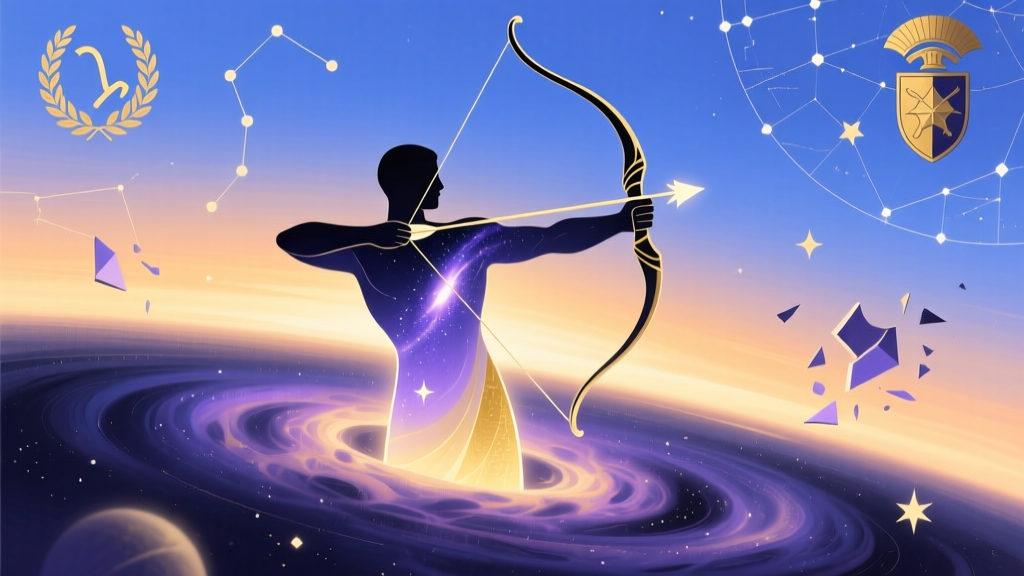
Sagittarius—the ninth sign of the zodiac, spanning November 22 to December 21—is instantly recognizable by its iconic symbol: the archer. Yet behind that bow and arrow lies a tapestry of ancient myth, celestial reverence, and cross-cultural symbolism stretching back over three millennia. Unlike many zodiac signs whose origins are vague or syncretic, Sagittarius boasts one of the most vividly documented mythological lineages in Western astrology—rooted in divine hybridity, philosophical pursuit, and cosmic order. This article delves exclusively into the mythology and origin story of Sagittarius, tracing its evolution from Babylonian star maps to Greek heroic lore, Roman imperial iconography, and enduring archetypal resonance. We examine not just who Sagittarius was in myth—but why it mattered, how it was worshipped, and how those ancient narratives continue to inform modern psychological interpretations of Sagittarian traits: truth-seeking, intellectual restlessness, moral idealism, and an unquenchable thirst for meaning.
The Myth Behind Sagittarius
At its core, the myth behind Sagittarius is not a single tale but a layered convergence of celestial observation, theological synthesis, and human aspiration. The sign’s identity emerges from the intersection of astronomy and allegory: early stargazers noted that the constellation Sagittarius occupies a pivotal position near the galactic center of the Milky Way—what ancient Mesopotamians called the ‘path of the gods.’ Its teapot-shaped asterism, with its prominent ‘spout’ pointing toward the dense star fields of Scorpius, suggested movement, direction, and purpose. To the ancients, this wasn’t merely a pattern of stars—it was a divine emissary aiming toward cosmic truth. Unlike fixed signs tied to static deities or mutable signs associated with transformation alone, Sagittarius embodies intentional motion: the act of aiming, seeking, and releasing—not for destruction, but for revelation. This distinguishes Sagittarius from other warrior-adjacent signs like Aries or Scorpio; its aggression is channeled, its fire tempered by philosophy. As astrologer Demetra George explains in Asteroid Goddesses, ‘Sagittarius represents the soul’s yearning to expand beyond limitation—not through conquest, but through understanding.’ That yearning is encoded in every layer of its mythos, from Sumerian boundary stones to Stoic cosmologies.
Sagittarius in Greek Mythology
In Greek tradition, Sagittarius is most commonly identified with Chiron, the wise, immortal centaur renowned for his mastery of medicine, music, prophecy, and mentorship. Though born of Cronus and the nymph Philyra, Chiron was unlike his bestial, lustful kin—his lineage marked him as both divine and compassionate. Abandoned at birth due to his hybrid form, he was raised by Apollo and Artemis, who gifted him knowledge of healing herbs, celestial navigation, and ethical warfare. Chiron became tutor to heroes including Achilles, Jason, and Asclepius—the very figures who shaped Greek heroic ideals. His tragedy—wounded by a poisoned arrow meant for another, suffering eternal pain he could neither heal nor die from—elevated him beyond mortal heroism into mythic sacrifice. When Zeus granted him release by placing him among the stars, Chiron became the constellation Sagittarius: not as a hunter, but as a teacher aiming his bow toward higher wisdom. This interpretation appears in Ptolemy’s Tetrabiblos (2nd century CE), where Sagittarius is described as ‘philosophical, truthful, and fond of learning’—traits directly inherited from Chiron’s pedagogical legacy. Importantly, Chiron’s dual nature—half-human, half-horse—mirrors the Sagittarian tension between instinctual freedom (the horse) and rational aspiration (the human). As scholar Dr. Nick Campion notes in Astrology.com’s Zodiac Guide, ‘Chiron’s wound is not weakness—it’s the source of his empathy and authority. Sagittarians don’t avoid pain; they translate it into insight.’
Sagittarius in Roman Mythology
Roman mythology absorbed and adapted Greek celestial lore, but reinterpreted Sagittarius through the lens of imperial ideology and civic virtue. While retaining Chiron’s association, Roman astrologers—including Marcus Manilius in his first-century CE poem Astronomica—emphasized Sagittarius as Cretan archer or divine huntsman, often conflated with the god Artemis’ companion or even a personification of Jupiter Optimus Maximus himself. Jupiter—the Roman counterpart to Zeus—was the supreme sky father, lawgiver, and protector of oaths; his connection to Sagittarius reinforced the sign’s link to justice, expansion, and moral authority. Roman mosaics from Pompeii and Ostia depict Sagittarius not with centaur anatomy, but as a bearded, laurel-crowned archer in military attire, sometimes holding a thunderbolt alongside his bow—a clear syncretism of Jupiter’s power and Sagittarius’ precision. This fusion reflected Rome’s self-image: a civilization guided by divine mandate (mos maiorum) and disciplined pursuit of universal order. The Roman Senate consulted Sagittarius’ rising for treaties and declarations of war, believing its influence conferred strategic clarity and righteous cause. As historian Francesca Rochberg states in The Heavenly Writing, ‘Roman astrology transformed Babylonian star omens into instruments of statecraft—and Sagittarius, as Jupiter’s emissary, became the celestial seal of legitimacy.’ Thus, while Greeks saw Sagittarius as wounded healer, Romans saw it as sovereign arbiter: two facets of the same archetypal drive—to align action with transcendent principle.
Ancient Cultural Interpretations of Sagittarius
Beyond Greece and Rome, Sagittarius held profound significance across ancient civilizations—each interpreting its celestial form through distinct cosmological frameworks. In Mesopotamian astronomy, the constellation was known as Pabilsag (“The Great Lord”)—a lion-centaur hybrid associated with the god Ninurta, patron of agriculture, law, and exorcism. Cuneiform tablets from the Library of Ashurbanipal (7th c. BCE) describe Pabilsag as ‘he who opens the way for the righteous,’ linking Sagittarius to divine justice and cosmic gatekeeping. In Vedic astrology, Sagittarius corresponds to Dhanus (‘bow’), ruled by Jupiter (Guru) and linked to the nakshatra Mula—the ‘root star,’ symbolizing radical truth-seeking and spiritual excavation. The Brihat Parashara Hora Shastra, a foundational Vedic text, declares Dhanus as ‘the sign of dharma-yuddha (righteous war) and vidya (sacred knowledge).’ Meanwhile, Egyptian priests associated Sagittarius with the god Khnum, the ram-headed creator who shaped humanity on his potter’s wheel—an echo of Sagittarius’ role as cosmic shaper of destiny. A relief in the Temple of Esna depicts Khnum aiming a bow toward the southern sky during the winter solstice, aligning with Sagittarius’ heliacal rising. These diverse interpretations converge on three consistent themes: sovereignty over truth, bridging earthly and divine realms, and initiating transformative journeys. As the International Society for Astrological Research (ISAR) affirms in its Cultural Astrology Archive, ‘Sagittarius is perhaps the most universally revered “guide-sign” across ancient traditions—not because it promises ease, but because it guarantees orientation toward what is real, right, and enduring.’
The Constellation Story of Sagittarius
Astronomically, Sagittarius is one of the oldest recognized constellations—catalogued by Ptolemy in the Almagest (c. 150 CE) and visible year-round near the Milky Way’s brightest core. Its 88-star configuration forms a distinctive ‘teapot’ shape, with Gamma Sagittarii (Alnasl) marking the spout and Lambda Sagittarii (Kaus Borealis) the handle. But its true celestial significance lies deeper: Sagittarius contains the Galactic Center—the rotational heart of the Milky Way, located near the radio source Sagittarius A*. Ancient observers couldn’t detect black holes, but they noted the region’s extraordinary density of stars, nebulae, and ‘milky’ luminosity—interpreting it as the abode of gods or the wellspring of creation. Babylonian star catalogues refer to this area as ‘the Igigu gods’ council chamber,’ while Greek poets described it as ‘Zeus’ treasury of souls.’ The constellation’s proximity to Scorpius (the scorpion that killed Orion) also embedded narrative tension: Sagittarius aims *away* from Scorpius, suggesting transcendence over primal fear. Modern astrophysics confirms this symbolic alignment—Sagittarius A* emits relativistic jets that stream outward, mirroring the archer’s released arrow. Moreover, Sagittarius’ position straddles the ecliptic and galactic equator, making it a unique ‘crossroads constellation.’ As NASA’s SkyCal notes, ‘No other zodiac constellation hosts as many deep-sky objects visible to amateur astronomers—including the Lagoon Nebula (M8), Trifid Nebula (M20), and Omega Nebula (M17)—all stellar nurseries.’ This abundance reinforces the mythic motif: Sagittarius doesn’t just seek truth—it incubates it.
How Mythology Shapes the Sagittarius Archetype
Mythology does not merely decorate Sagittarius—it constitutes its psychological DNA. Carl Jung, who viewed astrology as a symbolic map of the collective unconscious, identified Sagittarius with the Wanderer and Philosopher-King archetypes: figures driven by inner compass rather than external reward. The Chironic wound translates clinically into Sagittarius’ lifelong quest to reconcile personal experience with universal truth—often manifesting as restless travel, academic pursuit, or spiritual exploration. MBTI type correlations further illuminate this: studies by the Center for Applications of Psychological Type (CAPT) show Sagittarians disproportionately test as ENTP and ENFP—types characterized by dominant Extraverted Intuition, which seeks patterns, possibilities, and underlying principles. This mirrors Chiron’s pedagogy: teaching not facts, but frameworks. Likewise, Sagittarius’ ruling planet Jupiter expands this mythic function—Jupiter governs faith, ethics, and synthesis, urging integration of disparate ideas into coherent worldviews. When Sagittarius is challenged—by dogma, hypocrisy, or intellectual stagnation—it reacts not with Scorpio’s intensity or Capricorn’s rigidity, but with Chiron’s signature response: withdrawal to reflect, then return with refined perspective. As psychologist and astrologer Glenn Perry writes in The Sagittarius Archetype, ‘The Sagittarian doesn’t argue to win—they argue to clarify. Their arrow is aimed not at opponents, but at obscurity itself.’ This mythologically grounded resilience explains why Sagittarians often emerge as educators, journalists, theologians, or intercultural diplomats—the modern inheritors of Chiron’s mantle.
Sagittarius Mythology Quick Reference
For clarity and quick recall, here is a structured comparison of key mythological associations across cultures:
| Culture | Primary Figure/Name | Divine Association | Core Symbolic Function | Key Textual Source |
|---|---|---|---|---|
| Greek | Chiron | Disciple of Apollo & Artemis | Wounded healer, mentor of heroes | Ptolemy’s Tetrabiblos |
| Roman | Jupiter’s Emissary / Cretan Archer | Jupiter Optimus Maximus | Guardian of oaths, arbiter of justice | Manilius’ Astronomica |
| Mesopotamian | Pabilsag | Ninurta | Opener of righteous paths, exorcist of chaos | Library of Ashurbanipal tablets |
| Vedic | Dhanus | Guru (Jupiter) | Sign of dharma-yuddha and sacred knowledge | Brihat Parashara Hora Shastra |
| Egyptian | Khnum (ram-headed archer) | Creator deity | Shaper of fate, guardian of southern gates | Temple of Esna reliefs |
This table underscores Sagittarius’ unparalleled cross-cultural consistency: whether as centaur, god, or cosmic force, it remains the zodiac’s preeminent symbol of purposeful expansion. Its myths do not glorify domination—but dedication to discernment, fidelity to truth, and the courage to aim high, even when the target is invisible. For those born under Sagittarius (November 22–December 21), these stories are not relics—they are living inheritance. Every time a Sagittarian asks ‘Why?’, challenges orthodoxy, books a flight to an unfamiliar land, or defends a principle against popular opinion, they enact a ritual older than written language: the archer drawing back the bow—not to destroy, but to reveal what lies beyond the horizon.