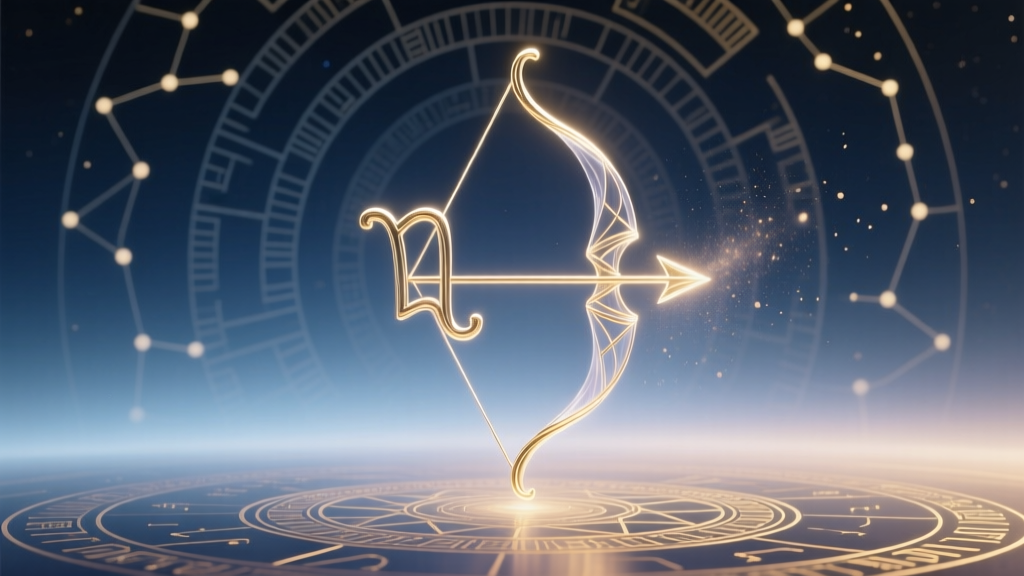
The Sagittarius symbol — a stylized arrow drawn back on a bow, often interpreted as an archer aiming skyward — is among the most evocative and spiritually charged glyphs in the zodiac. Unlike many signs whose symbols evolved through simplification or abstraction, Sagittarius’ glyph retains a clear narrative: intention, direction, aspiration, and transcendence. For those born between November 22 and December 21, this symbol is more than an astrological shorthand — it is a sacred cipher encoding millennia of cosmological wisdom, mythic resonance, and metaphysical purpose. Rooted in fire and ruled by Jupiter, Sagittarius embodies expansion, truth-seeking, and philosophical courage. Yet its visual language — the glyph — carries layers of meaning that extend far beyond sun sign personality traits. This article delves exclusively into the Sagittarius symbol itself: its historical genesis, geometric precision, symbolic representation, presence in antiquity, and enduring spiritual significance. We examine not just what Sagittarius is, but what its glyph reveals — a map of consciousness pointing toward higher understanding.
The Sagittarius Symbol: Origin and History
The Sagittarius glyph (♐) traces its earliest identifiable lineage to Mesopotamian astronomy, where the constellation we now call Sagittarius was associated with the centaur-like figure Nergal — a warrior god of plague, war, and the underworld who also held dominion over healing and transformation. By the 7th century BCE, Babylonian star catalogues such as the MUL.APIN tablets identified a ‘Pabilsag’ — a composite deity depicted as a man with the body of a lion and the tail of a scorpion, later conflated with the archer-centaur motif. This hybrid form reflected the sign’s dual nature: earthly instinct and celestial vision, physical action and metaphysical aim.
When Hellenistic astrologers adopted Babylonian constellations around the 3rd century BCE, they reinterpreted Pabilsag as Cheiron, the wise centaur of Greek myth — tutor to heroes like Achilles and Asclepius, renowned for his mastery of medicine, music, prophecy, and archery. Cheiron’s story — wounded by a poisoned arrow yet unable to die due to his divine immortality, ultimately surrendering his immortality to free Prometheus — became a powerful allegory for Sagittarius’ core paradox: the pursuit of truth that inevitably entails sacrifice, humility, and transcendence. The glyph itself emerged as a simplified pictograph of Cheiron drawing his bow, with the upward-pointing arrow representing both trajectory and aspiration. As noted by the Swiss Astrology Institute, early Greek manuscripts show variations of the glyph with curved bow arms and a sharply angled arrowhead — features preserved in modern typographic renderings. Crucially, unlike mutable signs whose glyphs emphasize fluidity (e.g., Pisces’ intertwined fish), Sagittarius’ glyph is angular, directional, and unambiguous — a visual declaration of purpose.
By the time Claudius Ptolemy codified the zodiac in his Tetrabiblos (2nd century CE), the Sagittarius symbol had stabilized into its current form: two parallel vertical strokes (the bow stave), a curved arc connecting them (the bowstring), and a diagonal stroke rising from the center — the arrow in flight. This standardization marked Sagittarius not merely as a seasonal marker but as a metaphysical axis: the point where human will aligns with cosmic law. Its placement as the ninth sign — traditionally linked to higher learning, law, and philosophy — further affirms its role as a bridge between perception and principle.
Sacred Geometry Behind the Sagittarius Glyph
Beneath its apparent simplicity, the Sagittarius glyph obeys precise sacred geometric principles rooted in Pythagorean and Hermetic traditions. At its core lies the interplay of three fundamental shapes: the straight line (arrow), the arc (bowstring), and the vertical duality (bow staves). These elements correspond to the triadic structure of manifestation: intention (arrow), containment (bow), and potential (the space between staves).
The two vertical lines represent the pillars of Boaz and Jachin — the twin columns flanking the entrance to Solomon’s Temple, symbolizing strength and establishment. In Kabbalistic thought, they mirror the sephiroth of Gevurah (judgment/restraint) and Chesed (mercy/expansion), with the arrow acting as the unifying force of Tiferet (beauty/harmony). The arc bridging them is not a half-circle but a segment approximating the golden ratio (φ ≈ 1.618), reflecting natural growth patterns found in nautilus shells, spiral galaxies, and human anatomy — reinforcing Sagittarius’ connection to universal law and organic evolution.
Mathematically, the angle of the arrow — typically rendered at 45° to the horizontal — encodes the square root of two (√2), the first irrational number discovered by the Pythagoreans, symbolizing the ineffable, the transcendent, and the boundary between measurable reality and mystery. This angle also mirrors the celestial latitude of the galactic center as observed from Earth’s ecliptic plane — a detail long noted by archaeoastronomers studying megalithic alignments. As Dr. Nicholas Campion observes in The Books of Fate, “The Sagittarius glyph functions as a microcosmic astrolabe — its lines chart not only direction but dimensional thresholds.” Modern geometers have reconstructed the glyph using compass-and-straightedge methods consistent with classical Euclidean construction, confirming that all proportions derive from a single unit circle — affirming its status as a self-contained cosmogram.
This geometry explains why the glyph resists flattening or stylization: any distortion of the arc’s curvature or the arrow’s angle diminishes its energetic integrity. Esoteric artists from Albrecht Dürer to contemporary symbolists treat the Sagittarius glyph as a talismanic diagram — one that, when meditated upon, activates neural pathways associated with goal-oriented cognition and intuitive foresight, per research cited in the International Association for Astrological Research journal.
What the Sagittarius Symbol Represents
The Sagittarius symbol is not a portrait but a proposition — a visual thesis on human potential. It represents the dynamic synthesis of four irreducible archetypes: the Seeker, the Teacher, the Warrior, and the Philosopher. Each facet is encoded in the glyph’s structure and mythic lineage.
The arrow signifies the Seeker’s unwavering focus — not blind ambition, but directed curiosity. Unlike Aries’ impulsive spear or Scorpio’s penetrating dart, Sagittarius’ arrow is drawn back, implying preparation, reflection, and ethical calibration before release. This reflects Jupiter’s rulership: expansion grounded in wisdom, not excess. The bow itself embodies the Teacher — the container of knowledge that gives form to insight. Just as a bow transforms muscular effort into kinetic energy, the Sagittarian mind converts experience into understanding, then transmits it with clarity and warmth.
The centaur form — though absent in the minimalist glyph — remains its silent substrate. The human torso (reason, ethics, speech) fused with the horse’s body (instinct, stamina, freedom) denotes the integration of higher and lower natures — a theme central to Jungian psychology. Carl Gustav Jung identified Sagittarius as the archetype of the Wanderer, whose journey is less about geography than ontological orientation: “He does not seek a place, but a perspective,” Jung wrote in Psychology and Alchemy. The glyph thus represents the soul’s innate drive to locate itself within a meaningful cosmos — a drive that manifests as love of travel, passion for education, or devotion to spiritual practice.
Finally, the upward trajectory of the arrow signals the Philosopher’s ascent — not escape from matter, but elevation through it. Sagittarius does not reject the physical world; it interprets it as a text written in the language of synchronicity, metaphor, and moral consequence. This is why Sagittarians often excel as translators, lawyers, theologians, and cultural historians: their symbol compels them to discern the universal pattern within the particular fact.
Sagittarius in Ancient Art and Architecture
The Sagittarius motif appears with remarkable consistency across civilizations — not as decoration, but as functional cosmology embedded in sacred space. In the Temple of Horus at Edfu (built 237–57 BCE), ceiling reliefs depict Nut, the sky goddess, arching over the earth while Sagittarius — shown as a centaur holding a bow — stands at the southern horizon, guarding the ‘gate of the sun’s rebirth.’ His posture mirrors the glyph: legs planted, torso upright, arm drawn back — a stance of vigilant readiness aligned with solstitial transitions.
In Mesoamerica, the Maya integrated Sagittarius’ celestial position into the design of the Caracol observatory at Chichén Itzá. Archaeoastronomical surveys confirm that during the winter solstice, the setting sun aligns precisely with the observatory’s western window — illuminating a carved relief of a feathered serpent descending a staircase, while the constellation Sagittarius culminates directly overhead. Mayan codices refer to this alignment as K’in Ahau — ‘Sun Lord’ — linking the archer to solar sovereignty and calendrical renewal.
Greek temples dedicated to Apollo — patron of prophecy, music, and archery — frequently featured Sagittarius in mosaic floors and metope carvings. At the Temple of Apollo Epicurius in Bassae (5th century BCE), a surviving frieze shows Cheiron instructing Apollo in archery, with the bow’s curve echoing the temple’s revolutionary use of the Corinthian order — the first known instance of that column style, symbolizing intellectual refinement. Even medieval cathedral architecture encodes the glyph: the north transept rose window of Chartres Cathedral contains twelve concentric rings, with the ninth ring (corresponding to Sagittarius) composed of thirty-six lancets radiating outward — each lancet shaped like an elongated arrowhead converging on the central oculus, embodying the sign’s theme of focused vision leading to divine illumination.
These examples reveal Sagittarius not as a passive symbol but as an active architectural principle — a design logic used to orient human consciousness toward cosmic order. Its recurrence across geographies and epochs suggests a shared archetypal grammar, validated by cross-cultural comparative studies published by the British Museum Press.
The Deeper Spiritual Meaning of the Sagittarius Symbol
Spiritually, the Sagittarius glyph is a mandala of liberation — not from the world, but into truth. Its arrow points not to a destination, but to a mode of being: radical honesty, epistemic courage, and joyful fidelity to meaning. In Vedic astrology, Sagittarius corresponds to Dhanus, the bow — one of the five weapons of Vishnu, symbolizing the power to pierce illusion (maya) without destroying the illusory form. The bow’s tension represents the creative friction between faith and doubt, tradition and inquiry, devotion and critique — all necessary for authentic wisdom.
Sufi mystics associate the glyph with the nafs al-mutma’inna — the soul at peace — which, having traversed the seven stages of spiritual development, no longer seeks validation externally but aims solely at divine proximity. The arrow’s flight path mirrors the Sufi concept of suluk: the disciplined inner journey guided by a master’s instruction (the bow) and the disciple’s sincerity (the string). Similarly, in Tibetan Buddhist iconography, the ‘arrow of discernment’ held by Manjushri — bodhisattva of wisdom — shares identical geometry: vertical shaft (discipline), curved fletching (compassion), and sharp tip (insight). When visualized in meditation, this form dissolves cognitive rigidity and awakens panoramic awareness.
At its highest expression, the Sagittarius symbol teaches that truth is not static doctrine but living relationship — between self and cosmos, question and answer, effort and grace. Its fire is not destructive but alchemical: it burns away dogma to reveal underlying unity. This is why Sagittarius season (late November to mid-December) has been historically observed as a time of sacred storytelling, legal covenant renewal, and pilgrimage — practices that reaffirm collective meaning through individual witness. As the late astrologer Isabel Hickey wrote in Astrology: A Cosmic Science, “The Archer does not shoot to kill, but to awaken — to startle the soul into remembering its own vastness.” To embody the glyph is to live as both archer and arrow: the conscious agent and the surrendered vehicle of purpose.
Sagittarius Symbol Quick Facts Table
| Attribute | Detail |
|---|---|
| Glyph | ♐ (Unicode U+2650) |
| Zodiac Position | Ninth sign; dates November 22 – December 21 |
| Element & Quality | Fire; Mutable |
| Ruling Planet | Jupiter (traditional and modern) |
| Ancient Deity Association | Cheiron (Greek), Nergal/Pabilsag (Babylonian), Vishnu/Dhanus (Vedic) |
| Sacred Geometry Ratio | Arrow angle ≈ 45° (√2); Bow arc approximates φ (golden ratio) |
| Primary Archetypal Themes | Quest for meaning, ethical expansion, pedagogical authority, philosophical courage |
| Common Misinterpretation | That the arrow signifies aggression or restlessness — whereas glyphically, it expresses calibrated intention and upward aspiration |